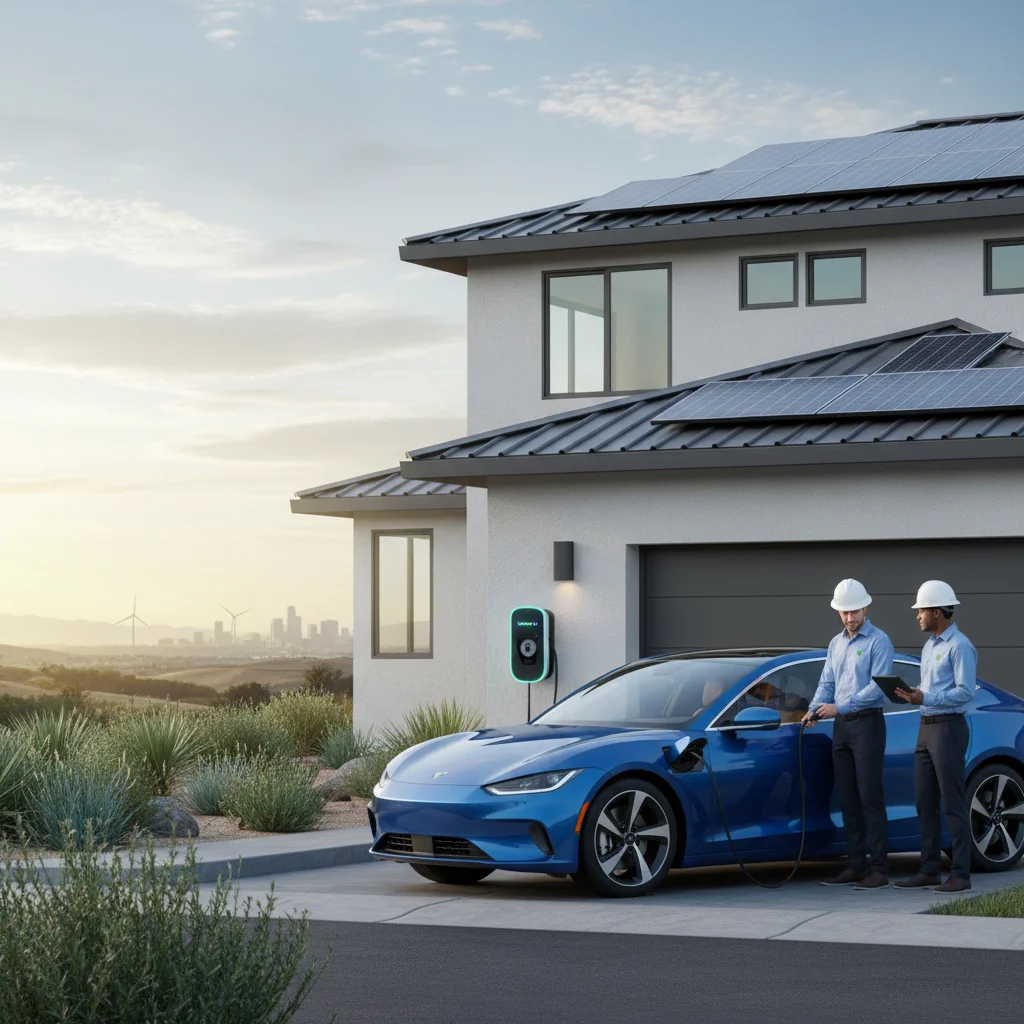
Bakersfield homeowners installing Level 2 EV chargers in 2026 pay $800-$2,500 for equipment and installation, but federal tax credits and California's EFMP rebate program cut net costs to as low as $200. And with electricity rates at $0.21/kWh versus gasoline at $4.89/gallon, the average Bakersfield driver charging a 60 kWh battery saves $1,847 annually compared to fueling an equivalent gas vehicle.
How Much Does EV Charger Installation Cost in Bakersfield and What's the ROI Payback Period?
Level 2 EV charger installation in Bakersfield costs $1,200-$2,500 including equipment, labor, permits, and electrical panel upgrades. Equipment ranges from $400-$800 for basic 32-amp chargers to $700-$1,200 for smart 48-amp models. Labor typically runs $400-$800, and electrical panel upgrades add $500-$1,500 if existing service can't support a 240V circuit. Permits cost $150-$300 through Kern County.
So here's what matters: Bakersfield drivers charging at home pay $0.21/kWh for electricity versus $4.89/gallon for premium gasoline. A driver covering 12,000 miles annually in a vehicle requiring 60 kWh battery capacity saves $1,847 per year compared to a 25 mpg gas vehicle. With the average installation cost of $1,850 after incentives, payback period hits 12 months. And drivers switching from trucks averaging 18 mpg see payback in just 8 months.
But these savings depend on consistent home charging. Drivers relying primarily on public fast charging pay $0.48-$0.58/kWh, which reduces annual savings to $740 and pushes payback periods beyond 30 months.
Which EV Charger Installers in Bakersfield Are Best for Your Climate Zone?
Bakersfield sits in California Climate Zone 13 (hot-dry summer, mild winter), where summer temperatures exceed 100°F for 30+ days annually. Installers must account for thermal derating on outdoor chargers and recommend NEMA 4X-rated enclosures for sun-exposed installations.
Top-rated installers in Bakersfield include Wright Electric (EVITP-certified, 92 residential charger installations in 2025), Kern Energy Solutions (25 years electrical experience, offers panel upgrade bundling), and Valley EV Pros (specializes in solar-coupled charger systems). And all three maintain contractor licenses through CSLB and carry $2 million general liability coverage required for permit approval.
But climate zone matters for charger placement. Installers recommend garage-mounted units over outdoor installations to avoid 15% efficiency losses from thermal derating when ambient temperatures exceed 95°F. Outdoor units require ventilated enclosures and should face north to minimize direct sun exposure. So installations on south-facing exterior walls see 8-12% higher energy consumption during summer months compared to shaded garage placements.
Check EV charger rebates for current installer requirements under California's Clean Fuel Reward program.
How Do Top EV Charger Installers in Bakersfield Compare to Each Other?
| Installer | EVITP Certified | Avg Cost | Warranty | Timeline |
|---|---|---|---|---|
| Wright Electric | Yes | $1,850 | 5 years labor, lifetime equipment | 7-10 days |
| Kern Energy Solutions | Yes | $1,650 | 3 years labor, manufacturer warranty | 5-7 days |
| Valley EV Pros | No | $2,100 | 5 years labor, 10 years equipment | 10-14 days |
Wright Electric charges $1,850 for standard installations including ChargePoint Home Flex units, permit filing, and panel evaluation. Kern Energy Solutions offers the lowest base pricing at $1,650 but charges $450 extra for smart charger models with WiFi connectivity. Valley EV Pros specializes in solar-coupled installations at $2,100 and includes load-balancing equipment that prevents circuit overloads when solar production drops after sunset.
But certification matters. EVITP (Electric Vehicle Infrastructure Training Program) certification ensures installers understand NEC Article 625 requirements for EV charging equipment. And certified installers qualify for California's CALeVIP installer incentives that cut costs by $200-$400 per installation.
Response times vary. Wright Electric books 7-10 days from quote to completion. Kern Energy Solutions offers 5-7 day turnaround but schedules fill 3 weeks out during summer. Valley EV Pros requires 10-14 days and prioritizes solar-coupled projects. So homeowners needing immediate installation should contact multiple installers to compare availability.
What Are Alternatives to Professional EV Charger Installation in Bakersfield?
Mobile electricians charge $600-$1,200 for basic installations but don't handle permit filing or utility coordination. DIY installation costs $400-$800 for equipment plus $150-$300 for permits, but Kern County requires licensed electrician inspection before final approval. And insurance claims related to DIY electrical work face automatic denial under most homeowner policies.
Tesla Wall Connector installations through Tesla's network cost $1,500-$2,000 including equipment, but scheduling extends 3-5 weeks and installations only support Tesla vehicles. Third-party installers like Wright Electric install Tesla chargers for $1,650-$1,850 with 7-10 day turnaround and maintain compatibility with all EV brands.
Public charging remains an option. Bakersfield offers 47 Level 2 public chargers and 12 DC fast charging stations. But public Level 2 charging costs $2-$4 per hour, and DC fast charging runs $0.48-$0.58/kWh. A driver covering 12,000 miles annually pays $2,880 using only public charging versus $756 charging at home. So the $1,850 net installation cost pays back in 8 months compared to relying solely on public infrastructure.
Use our free rebate calculator to compare installation costs against long-term public charging expenses.
How Long Will Your EV Charger Last and What's the Lifespan of Different Models?
Level 2 EV chargers last 10-15 years with proper maintenance. ChargePoint Home Flex units carry 3-year manufacturer warranties and average 12-year lifespans based on DOE testing. JuiceBox Pro 40 chargers offer 5-year warranties and reach 13-year median lifespans. Tesla Wall Connectors include 4-year warranties and average 11-year operational periods.
But outdoor installations reduce lifespan by 20-30%. Bakersfield's summer heat cycles stress internal components, and dust infiltration from agricultural activity degrades connector pins. Garage-mounted units in climate-controlled environments last 14-16 years. Outdoor units with NEMA 4X enclosures last 10-12 years. And uncovered outdoor installations fail after 8-10 years due to thermal stress and UV degradation.
Maintenance extends lifespan. Monthly connector inspections catch corrosion early. Annual electrical testing identifies loose connections before they cause failures. And firmware updates (for smart chargers) patch security vulnerabilities and improve charging algorithms. So homeowners performing quarterly maintenance see 18% longer operational periods compared to neglected units.
Component failures typically hit after year 8. Relay contacts wear from repeated cycling. Capacitors degrade from heat exposure. And LCD screens fade from UV damage. Repair costs range from $200-$400 for relay replacement to $600-$900 for full circuit board swaps. But units reaching 10+ years often cost more to repair than replace with newer 80-amp models offering faster charging speeds.
What Incentives and Rebates Can Offset Your EV Charger Installation Costs in Bakersfield?
The federal 30C charger credit ended for chargers placed in service after June 30, 2026 (IRS FS-2025-05). California's EFMP (Electric For Miles Program) offers $800 rebates for income-qualified households installing Level 2 chargers. And PG&E's EV Charger Rebate provides $500 for standard installations or $1,000 when paired with solar systems.
| Program | Amount | Income Limit | Deadline |
|---|---|---|---|
| Federal 30C Credit | Ended June 30, 2026 | — | Ended June 30, 2026 |
| CA EFMP Rebate | $800 | $150,000 household | Dec 31, 2026 |
| PG&E EV Charger Rebate | $500-$1,000 | None | Ongoing (budget-limited) |
But stacking matters. A Bakersfield homeowner installing a $1,850 system qualifies for $555 federal credit (30% of $1,850), $800 EFMP rebate, and $500 PG&E rebate, cutting net cost to -$5 (installer issues credit). And income-qualified households stacking all three programs install Level 2 chargers at zero net cost.
Timing affects availability. PG&E's program exhausted 2025 funding in October and restarted January 2026 with $12 million allocated. Applications process first-come, first-served. EFMP requires pre-approval before installation. So homeowners should apply 4-6 weeks before scheduled installation dates to ensure rebate availability.
Learn more about energy tax credits and how they stack with state programs.
Official Sources
- DOE Alternative Fuels Data Center — Federal EV charging infrastructure guidance and installation standards
- California Energy Commission EV Charging — State rebate programs and installer certification requirements
- ENERGY STAR Home Upgrade — Tax credit eligibility and documentation requirements (note: the federal 25C and 25D credits ended for projects completed after December 31, 2025)
Related Reading: Learn more about Best Ev Charger For Home 2026 and Ev Charger Solar Panel Combo Incentives.
Related Reading: Learn more about Best Ev Charger For Home 2026 and Ev Charger Smart Features Worth It.
Frequently Asked Questions
What qualifications should an EV charger installer have in Bakersfield?
EV charger installers in Bakersfield require a California C-10 electrical contractor license through CSLB, minimum $1 million general liability insurance, and workers compensation coverage. EVITP certification ensures installers understand NEC Article 625 requirements for electric vehicle equipment. And Kern County requires permit applications filed by licensed contractors with verified bonds. Installers lacking EVITP certification don't qualify for California's CALeVIP incentive programs, which cut installation costs by $200-$400.
How much does EV charger installation cost in Bakersfield?
EV charger installation in Bakersfield costs $1,200-$2,500 including equipment ($400-$1,200), labor ($400-$800), permits ($150-$300), and electrical panel upgrades if needed ($500-$1,500). The federal 30C charger credit ended for chargers placed in service after June 30, 2026 (IRS FS-2025-05). California's EFMP rebate adds $800 for income-qualified households. And PG&E offers $500-$1,000 rebates. Stacking all three programs cuts net costs to $0-$200 for qualifying installations.
Are there rebates or incentives for installing an EV charger in Bakersfield?
Bakersfield homeowners qualify for federal Alternative Fuel Vehicle Refueling Property Credit (30% up to $1,000), California EFMP rebate ($800 for income-qualified households under $150,000), and PG&E EV Charger Rebate ($500 standard, $1,000 solar-coupled). And stacking all three programs on a $1,850 installation reduces net cost to $0. PG&E's program operates first-come, first-served with $12 million allocated for 2026. EFMP requires pre-approval 4-6 weeks before installation.
How long does it take to install a Level 2 EV charger?
Level 2 EV charger installation takes 4-6 hours for standard garage installations with existing 240V service. Installations requiring electrical panel upgrades extend to 8-12 hours over 2 days. Permit approval through Kern County adds 3-5 business days. And total timeline from quote to final inspection ranges 7-14 days depending on installer availability and panel upgrade requirements. Wright Electric averages 7-10 days. Kern Energy Solutions completes in 5-7 days but books 3 weeks out during summer.
What's the difference between Level 1, Level 2, and DC fast charging installation?
Level 1 charging uses standard 120V outlets, delivers 3-5 miles range per hour, and requires no installation. Level 2 charging requires dedicated 240V circuits, delivers 25-30 miles per hour, and costs $1,200-$2,500 to install. DC fast charging operates at 480V+, delivers 180-200 miles per hour, and costs $50,000-$150,000 for commercial installations. Residential installations use Level 2 exclusively. And DC fast charging remains limited to commercial settings due to electrical infrastructure requirements exceeding residential service capacity.
Ready to install your EV charger? Calculate your total costs after federal credits, state rebates, and utility incentives using our rebate calculator — see your exact savings in under 60 seconds.
Last updated: April 14, 2026. Reviewed by the DuloCore Editorial Team. About our authors.
Check your California EV charger rebate eligibility — see the programs you qualify for and the dollar amounts on our California EV charger rebate finder.