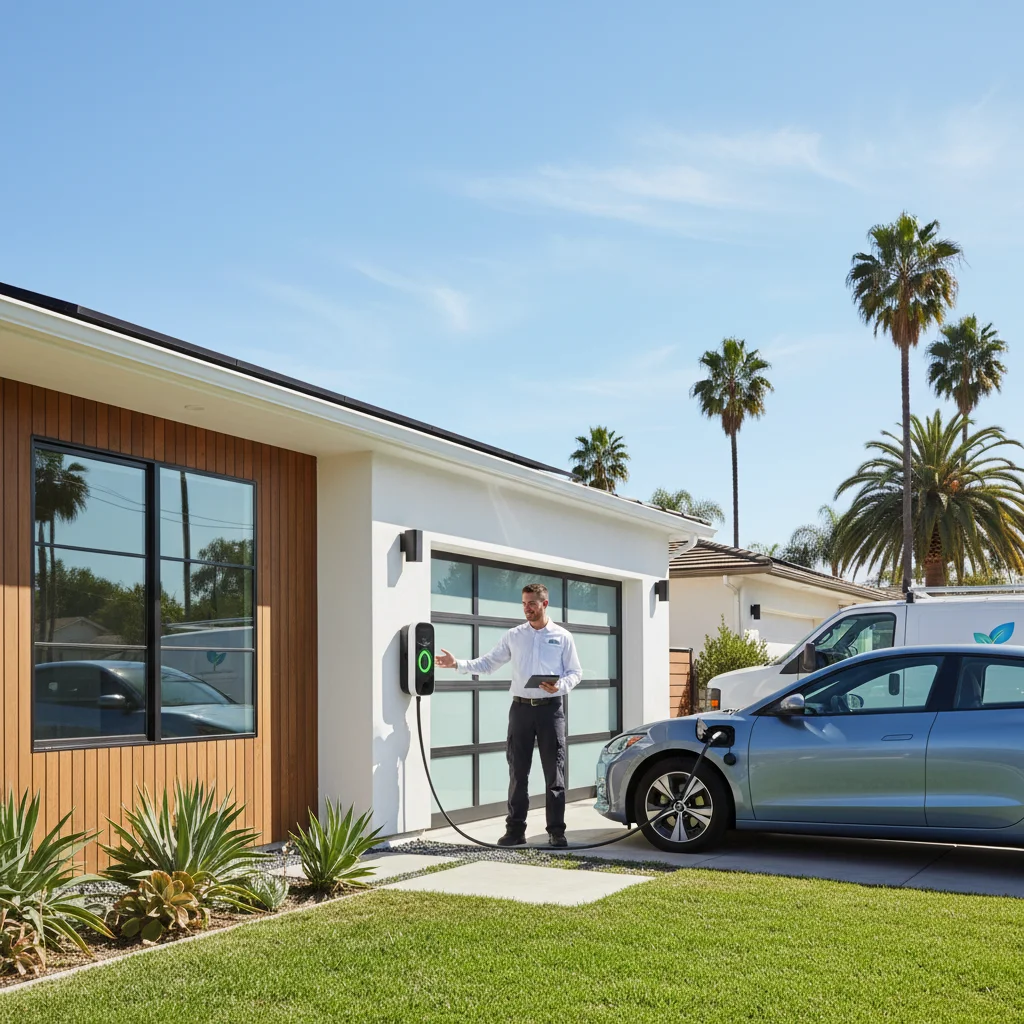
California's electric vehicle market hit 1.9 million registered EVs in early 2026, creating unprecedented demand for home charging infrastructure. The federal 30C EV charger tax credit ended for chargers placed in service after June 30, 2026 (IRS FS-2025-05), so homeowners are racing to secure licensed installers before state and utility rebate funds run out.
What ROI and Payback Period Can You Expect From EV Charger Installation in California?
California homeowners installing Level 2 EV chargers see payback periods of 2-4 years compared to public charging costs. Home charging costs $0.18-0.32 per kWh during off-peak hours versus $0.40-0.60 per kWh at public stations, saving frequent drivers $800-1,200 annually.
The average Level 2 charger installation costs $1,200-2,500 in California; the federal 30C charger credit ended for chargers placed in service after June 30, 2026 (IRS FS-2025-05). And when combined with utility rebates like PG&E's $500 EV charger incentive or SoCal Edison's $1,000 rebate, total out-of-pocket costs drop to $700-1,500. So a two-vehicle household charging 500 miles weekly recoups installation costs within 18-30 months through avoided public charging fees.
"Home EV charging costs about 50% less than public charging stations on average." — U.S. Department of Energy
But ROI calculations must account for California's Time-of-Use electricity rates. Charging during super off-peak hours (midnight-6am) reduces costs by 40-60% compared to peak rates. Installers who optimize charger placement near existing 240V circuits minimize installation costs by $300-800.
Use our free rebate calculator to estimate your specific payback period based on driving patterns and local utility rates.
How Do California's Climate Zones Affect Your EV Charger Installer Selection?
California's 16 climate zones create distinct installation requirements that licensed contractors navigate differently. Coastal installers in Zone 7 prioritize corrosion-resistant hardware for salt air exposure, while inland Zone 14 contractors specify heat-tolerant components rated for 115°F+ ambient temperatures.
And extreme temperature zones require specialized expertise. Desert installers in Palm Springs (Zone 15) use NEMA 3R or 4X-rated enclosures that withstand 120°F temperatures and dust intrusion. Mountain communities in Tahoe (Zone 16) need chargers rated for -20°F operation with weatherproof conduit that prevents ice damage.
Installers familiar with California Building Standards Code Title 24 ensure compliance with climate-specific ventilation requirements. Zone 13 (Sacramento Valley) installations require additional ventilation for enclosed garages due to high summer temperatures. But coastal Zone 3 installations focus on moisture protection and grounding requirements for wet locations.
Climate zone expertise directly impacts installation costs. Coastal installations average $200-400 more for marine-grade components. Desert installations add $150-300 for heat-dissipation features. So selecting an installer with documented experience in your specific climate zone prevents costly retrofits and warranty issues.
Best EV Charger Installers vs. DIY and Alternative Installation Options
Licensed C-10 electrical contractors in California complete EV charger installations in 3-6 hours with permit approval and final inspection included. DIY installations risk permit rejection, insurance claim denial, and potential $5,000-10,000 fines for unpermitted electrical work under California Electrical Code Article 625.
California requires licensed electricians for all EV charger installations exceeding 120V. And homeowner's insurance policies typically exclude coverage for DIY electrical work, creating liability exposure of $50,000-100,000 for fire or property damage. Professional installations include $1-2 million general liability coverage and workmanship warranties of 1-3 years.
Alternative options like portable Level 1 chargers (120V) add 3-5 miles of range per hour versus 25-30 miles per hour for hardwired Level 2 systems. Mobile electrician services charge $150-250 hourly but lack permit processing capabilities that established installers provide bundled into flat-rate pricing of $1,200-2,500.
| Installation Option | Cost Range | Permit Included | Insurance Coverage | Installation Time |
|---|---|---|---|---|
| Licensed C-10 Contractor | $1,200-2,500 | Yes | $1-2M liability | 3-6 hours |
| DIY Installation | $400-800 (materials only) | No (homeowner files) | None | 8-12 hours |
| Mobile Electrician | $600-1,500 | Sometimes | Varies | 4-8 hours |
Tesla-certified installers charge premium rates of $1,800-3,200 but offer integrated smart features and 4-year warranties. But third-party installers using ChargePoint or JuiceBox chargers deliver comparable performance at 20-30% lower costs.
How Long Do EV Chargers Last and What's the Lifespan of Different Charger Types?
Hardwired Level 2 EV chargers installed by licensed contractors last 10-15 years with minimal maintenance. And commercial-grade units like ChargePoint Home Flex carry 3-year warranties but demonstrate operational lifespans exceeding 20 years in California's moderate climate zones.
Component lifespan varies significantly by charger type. Plug-in portable chargers last 5-8 years due to connector wear and cable degradation. Hardwired units eliminate plug wear, extending functional life to 12-18 years. NEMA 14-50 outlet installations require outlet replacement every 7-10 years at $150-300 per service call.
"Level 2 charging equipment has an expected service life of 10-20 years depending on usage patterns and environmental conditions." — National Renewable Energy Laboratory
California's climate zones directly impact charger longevity. Coastal installations (Zones 3-7) experience connector corrosion after 8-12 years without marine-grade components. Inland zones (12-14) see cable insulation degradation from UV exposure after 10-14 years. But garage installations in any zone consistently achieve maximum lifespan by avoiding direct weather exposure.
Smart charger electronics require firmware updates every 2-3 years to maintain connectivity features. Installers offering maintenance packages ($150-300 annually) provide cleaning, connector inspection, and software updates that extend operational life by 30-40%. So total cost of ownership over 15 years averages $1,800-3,200 for professionally installed systems versus $3,500-5,000 for DIY installations requiring multiple repairs.
Learn more about long-term costs in our guide to EV charger rebates.
What Are the Installation Costs and Available Rebates for California EV Charger Installers?
California EV charger installation costs range from $1,200-2,500 for standard residential Level 2 systems in 2026. The federal 30C charger credit ended for chargers placed in service after June 30, 2026 (IRS FS-2025-05). Combined with California Clean Fuel Reward ($750-1,500) and utility rebates ($500-1,000), total incentives reach $1,250-2,500.
Installation costs break down into distinct components. Charger hardware costs $400-800 for quality Level 2 units (ChargePoint, JuiceBox, Grizzl-E). Electrical work runs $600-1,200 for circuit installation, panel upgrades, and trenching. Permit fees add $150-400 depending on municipality. So total pre-rebate costs average $1,150-2,400.
Panel upgrade requirements significantly impact costs. Homes with 100-amp service upgrading to 200-amp panels add $2,000-4,000 to installation costs. But homes with existing 200-amp service and available breaker slots complete installations for $1,000-1,500. Distance from electrical panel to charger location adds $8-15 per linear foot for conduit and wiring.
| Rebate Program | Amount | Eligibility | Application Deadline |
|---|---|---|---|
| Federal Clean Vehicle Charging Credit | Ended June 30, 2026 | — | Ended June 30, 2026 |
| California Clean Fuel Reward | $750-1,500 | Income-qualified | December 31, 2026 |
| PG&E EV Charge Network | $500 | PG&E customers | Ongoing (funds limited) |
| SoCal Edison Charge Ready | $1,000 | SCE customers | December 31, 2026 |
Income-qualified households earning below 80% Area Median Income access enhanced rebates totaling $3,000-4,500. And multi-family properties installing shared chargers qualify for commercial rebates of $2,500-5,000 per charging port through California Electric Vehicle Infrastructure Project (CALeVIP).
Calculate your total savings with our rebate calculator tool.
How to Choose a Licensed EV Charger Installer in California: Process and Timeline
California law requires EV charger installers to hold active C-10 Electrical Contractor licenses verified through the Contractors State License Board (CSLB). And installers must carry minimum insurance of $1 million general liability plus workers' compensation coverage to legally pull permits.
The selection process starts with license verification at cslb.ca.gov where homeowners confirm contractor credentials, bonding status, and complaint history. Qualified installers provide written estimates within 3-5 business days detailing equipment specifications, installation scope, permit fees, and rebate processing services. Request 3-5 competitive bids to identify fair market pricing.
Timeline expectations for professional installations follow this sequence:
- Initial consultation and site assessment (1-2 hours)
- Permit application submission (3-10 business days approval)
- Equipment procurement (5-14 days shipping)
- Installation completion (3-6 hours on-site work)
- Final inspection and approval (3-7 business days)
Total project duration averages 3-5 weeks from contract signing to final inspection approval. But expedited permitting in municipalities like San Francisco and Sacramento reduces timelines to 2-3 weeks.
Installer qualifications beyond licensing include EVITP (Electric Vehicle Infrastructure Training Program) certification demonstrating specialized EV charging knowledge. And installers processing rebate applications on behalf of homeowners eliminate administrative burden that delays incentive payments by 60-90 days. Verify installer references by requesting 3-5 recent customer contacts with similar installation scope.
Red flags include contractors requesting full payment upfront (California law limits deposits to 10% or $1,000, whichever is less), unlicensed "handyman" services, and installers unfamiliar with local utility rebate programs. Compare our analysis of heat pump rebates for similar installer selection criteria.
Official Sources
- U.S. Department of Energy - Save Energy, Save Money — Federal guidance on EV charging costs and home installation best practices
- DSIRE USA — Comprehensive database of California state and utility EV charger incentives and rebates
- California Air Resources Board — Official state EV infrastructure incentive program details
Related Reading: Learn more about Best Ev Charger For Home 2026 and Ev Charger Smart Features Worth It.
Related Reading: Learn more about Best Ev Charger Installers Riverside.
Frequently Asked Questions
How much does it cost to install an EV charger in California?
EV charger installation costs in California range from $1,200-2,500 for standard Level 2 residential systems in 2026. And total costs break down to $400-800 for charger hardware plus $600-1,200 for electrical work and $150-400 for permits. Homes requiring 100-amp to 200-amp panel upgrades add $2,000-4,000. But California utility rebates of $500-1,500 can reduce out-of-pocket expenses; the federal 30C charger credit ended for chargers placed in service after June 30, 2026 (IRS FS-2025-05).
What qualifications should an EV charger installer have in California?
California EV charger installers must hold active C-10 Electrical Contractor licenses verified through CSLB (Contractors State License Board) at cslb.ca.gov. And qualified contractors carry minimum $1 million general liability insurance plus workers' compensation coverage. EVITP (Electric Vehicle Infrastructure Training Program) certification demonstrates specialized EV charging expertise beyond basic electrical licensing. Installers should provide written proof of bonding, insurance certificates, and 3-5 customer references with recent installations completed within the past 12 months.
Are there rebates or incentives for EV charger installation in California?
California homeowners access combined rebates totaling $1,250-2,500 in 2026 through state and utility programs. The federal 30C charger credit ended for chargers placed in service after June 30, 2026 (IRS FS-2025-05). California Clean Fuel Reward provides $750-1,500 for income-qualified households. Utility-specific rebates include PG&E's $500 EV Charge Network incentive and SoCal Edison's $1,000 Charge Ready program. Multi-family properties qualify for CALeVIP commercial rebates of $2,500-5,000 per charging port. Income limits and application deadlines vary by program.
How long does it take to install an EV charger?
Professional EV charger installation takes 3-6 hours of on-site work but total project timelines average 3-5 weeks from contract signing to final inspection. And permit approval requires 3-10 business days in most California municipalities. Equipment procurement adds 5-14 days for shipping. Final inspection scheduling takes 3-7 business days after installation completion. Expedited permitting in San Francisco and Sacramento reduces total timelines to 2-3 weeks. Distance from electrical panel to charger location and panel upgrade requirements extend installation time by 2-4 hours.
Can I install an EV charger myself or do I need a professional?
California law requires licensed C-10 electrical contractors for all EV charger installations exceeding 120V service. And DIY electrical work violates California Electrical Code Article 625, risking $5,000-10,000 fines for unpermitted installations. Homeowner's insurance policies typically exclude coverage for DIY electrical work, creating liability exposure of $50,000-100,000 for fire or property damage. Professional installations include permit processing, $1-2 million liability coverage, and 1-3 year workmanship warranties. Portable 120V Level 1 chargers don't require professional installation but deliver only 3-5 miles of range per hour versus 25-30 miles for hardwired Level 2 systems.
Ready to find your EV charger installation savings? Use our free rebate calculator to estimate your total costs after California state rebates and utility incentives. Get personalized results based on your location, driving patterns, and electrical system requirements in under 60 seconds.
Last reviewed: April 14, 2026. Reviewed by DuloCore Energy Specialists. About the team.
Check your California EV charger rebate eligibility — see the programs you qualify for and the dollar amounts on our California EV charger rebate finder.