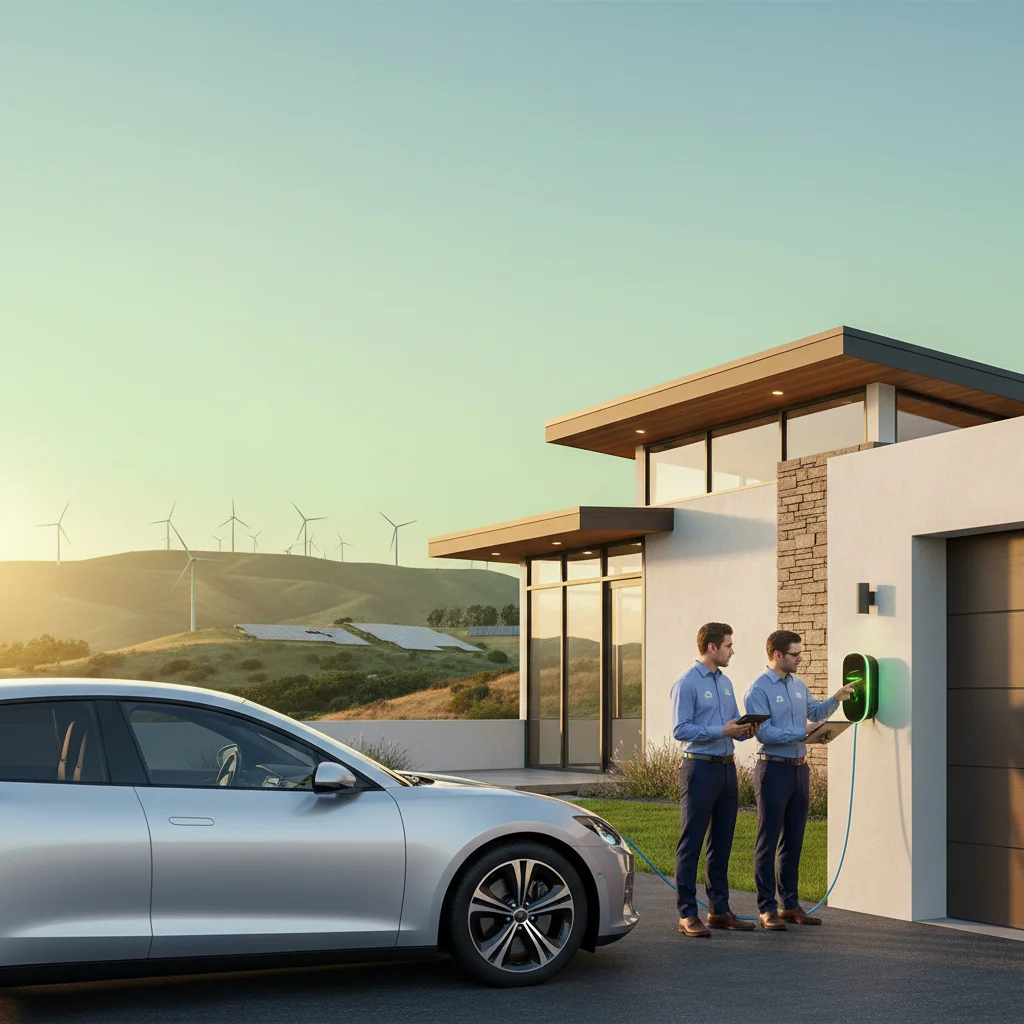
The Inland Empire saw a 217% spike in Level 2 home charger installations in 2025, driven by California's Clean Vehicle Rebate Project and SCE's Charge Ready program. And the region's 110°F summer temperatures mean installers who spec amperage for heat derating separate qualified professionals from rushed DIY jobs that trip breakers or void warranties.
What's the ROI and Payback Period for EV Charger Installation in the Inland Empire?
A Level 2 home charger installation costs $1,200-$2,500 in the Inland Empire, and drivers charging at home save $800-$1,200 annually compared to public charging networks. The typical payback period runs 14-22 months for households driving 12,000 miles per year. Southern California Edison customers on TOU-D-PRIME rates pay $0.13/kWh during super off-peak hours (8 PM-4 PM), cutting per-mile electricity costs to $0.03 versus $0.15 at commercial stations. Inland Empire residents also access SCE's Charge Ready 2 program, which covers up to $1,000 of installation costs including panel upgrades and trenching. But properties with 100-amp service panels face $1,500-$3,000 upgrade costs that extend payback to 3-4 years. Check current EV charger rebates to calculate total installed cost after incentives.
Which EV Charger Installers Are Best for Inland Empire's Climate Zone?
The Inland Empire spans Climate Zones 10 and 15, where summer temperatures exceed 110°F and installers must account for thermal derating on circuits. Licensed electricians in Riverside and San Bernardino counties spec 50-amp circuits for 40-amp chargers, maintaining 20% overhead per NEC 625.41. Top installers carry EVITP (Electric Vehicle Infrastructure Training Program) certification and source UL 2594-listed chargers with NEMA 3R/4 enclosures for outdoor installations. Installers who understand the region's clay soil conditions also recommend concrete pads for freestanding posts rather than direct burial, preventing frost heave damage during winter temperature swings. So contractors who pull permits through Riverside County or San Bernardino County portals and coordinate with SCE for service panel load calculations deliver installations that pass inspection on first attempt. And EVITP-certified installers understand the 2023 NEC update requiring GFCI protection on all EV circuits, avoiding costly rework.
"Electric vehicle supply equipment must be listed and labeled for the application" — National Electric Code Article 625
How Do Top EV Charger Installers Compare in Price, Quality, and Warranty?
Licensed C-10 electricians in the Inland Empire charge $85-$140 per hour, with typical Level 2 installations taking 4-6 hours for garage-mounted units or 8-12 hours for properties requiring panel upgrades or trenching. Installers who bundle ChargePoint Home Flex or Grizzl-E units offer turnkey pricing of $1,800-$2,400 including materials, labor, and permit fees. But contractors who only install customer-supplied equipment charge flat rates of $600-$1,200, shifting product warranty responsibility to the homeowner. Top installers provide 1-year workmanship warranties covering wiring, conduit, and panel connections, while manufacturers cover charger hardware for 3-5 years. Installers who maintain $2 million general liability and workers' compensation policies protect homeowners from liability if electrical work causes property damage or injury. So comparing itemized bids that separate equipment, labor, permits, and utility coordination fees reveals true cost differences. Use our free rebate calculator to factor in available incentives when comparing quotes.
What's the Lifespan of EV Chargers and When Should You Replace Them?
Level 2 home chargers last 10-15 years with proper installation and minimal exposure to moisture or extreme heat. ChargePoint and JuiceBox units installed in Inland Empire garages since 2015 still operate without component failures, while outdoor units in direct sun show UV degradation on cable jackets after 7-9 years. And chargers with NEMA 14-50 plugs allow homeowners to swap units without rewiring, extending infrastructure lifespan beyond individual product lifecycles. Replacement indicators include frequent GFCI trips, error codes indicating relay failures, or charging speeds dropping below 80% of nameplate ratings. But most failures trace to improper installation rather than charger defects—undersized circuits that overheat connections or missing surge protection that allows voltage spikes to damage onboard electronics. Installers who spec whole-home surge protectors or dedicated EV circuit protection add $200-$400 upfront and prevent $1,200-$1,800 charger replacements. Learn more about long-term costs in our guide to energy tax credits.
What Installation Costs, Incentives, and Eligibility Requirements Apply in the Inland Empire?
The federal 30C charger credit ended for chargers placed in service after June 30, 2026 (IRS FS-2025-05). Federal tax credits for this work have ended, but state, local and utility rebates may still apply; check what is available at your address with the DuloCore rebate calculator. Southern California Edison's Charge Ready 2 program rebates $1,000 for single-family homes and $3,000 for multifamily properties, with income requirements capping eligibility at 400% of federal poverty level ($120,000 for family of four). Riverside County waives permit fees for EV charger installations under $1,000 in equipment value, while San Bernardino County charges $135 base permit plus $15 per $1,000 of project value. And California's Equity Residential Charging Program provides $4,000-$14,000 for low-income multifamily properties, covering panel upgrades and multiple charging spaces. But rebates require completed installations with passed inspections and utility interconnection before reimbursement, meaning homeowners must finance upfront costs. Combining federal, utility, and local incentives reduces net installation costs to $400-$800 for qualifying Inland Empire residents.
What's the Installation Timeline and Process with Inland Empire EV Charger Installers?
Licensed electricians complete site assessments in 30-45 minutes, evaluating service panel capacity, circuit routing, and permit requirements. Properties with 200-amp panels and available breaker slots support same-day permit filing through county portals, while 100-amp panels require load calculations and utility coordination that add 2-4 weeks. Riverside County and San Bernardino County issue electrical permits within 3-5 business days for standard installations, and inspectors schedule final reviews within 48 hours of contractor requests. So total timeline from quote to energized charger runs 1-2 weeks for straightforward installs or 4-8 weeks for panel upgrades. Installers who pre-order equipment and schedule inspections before completing work shave 7-10 days off typical timelines. And properties requiring SCE meter upgrades or transformer replacements face 6-12 week utility processing times regardless of contractor efficiency. Homeowners who identify their service panel amperage and main breaker availability during initial calls receive accurate timeline estimates. For more electrification upgrades, explore heat pump rebates that pair with EV infrastructure.
Official Sources
- U.S. Department of Energy Alternative Fuels Data Center — Federal EV charging infrastructure guidance and state incentive database
- DSIRE USA — Comprehensive database of state incentives for renewables and efficiency
- Southern California Edison Charge Ready — Utility rebate programs and residential charging resources
Frequently Asked Questions
Can I install an EV charger myself or do I need a professional installer?
California requires licensed C-10 electricians for all EV charger installations involving hardwired connections or circuits exceeding 50 amps. And DIY installations void manufacturer warranties, fail permit inspections, and create liability if electrical faults cause property damage. Homeowners installing NEMA 14-50 outlets for plug-in chargers still need permits and inspections per NEC Article 625. Unlicensed work that causes fire or injury exposes property owners to $5,000-$25,000 code violation fines plus civil liability.
How much does it cost to have an EV charger installed in the Inland Empire?
Turnkey Level 2 installations cost $1,200-$2,500 including charger hardware, labor, permits, and inspections. Properties requiring panel upgrades add $1,500-$3,000, while homes needing trenching or conduit runs exceeding 50 feet add $800-$2,000. But SCE rebates of $1,000 and federal tax credits covering 30% of costs reduce net expense to $400-$1,200 for qualifying residents. Get an itemized estimate from three licensed C-10 contractors before committing.
What qualifications should I look for in an EV charger installer?
Verify active California C-10 electrical contractor license through CSLB.ca.gov, confirming bond and workers' compensation coverage. EVITP certification demonstrates specialized training in EV infrastructure and NEC Article 625 compliance. And installers who pull permits and coordinate utility interconnection prevent failed inspections that delay project completion. Request references from 3-5 recent Inland Empire installations and verify online reviews through Google and Yelp.
Are there rebates or incentives available for EV charger installation in Inland Empire?
The federal 30C charger credit ended for chargers placed in service after June 30, 2026 (IRS FS-2025-05). SCE's Charge Ready 2 rebates $1,000 for qualifying single-family homes. Riverside County waives permit fees for projects under $1,000 equipment value. And California's Equity Residential Charging Program provides $4,000-$14,000 for low-income multifamily properties. Combining incentives reduces net costs to $400-$800 for eligible residents.
How long does it typically take to install a Level 2 EV charger at home?
Standard installations on 200-amp panels with available breaker slots take 4-6 hours of electrician time plus 1-2 weeks for permits and inspections. Properties requiring panel upgrades or utility coordination extend timelines to 4-8 weeks. And homes needing SCE meter or transformer upgrades face 6-12 week utility processing delays regardless of contractor readiness. Request a detailed timeline during site assessment to plan vehicle charging needs.
Ready to calculate your EV charger installation savings? Use our free rebate calculator to see how federal tax credits, SCE rebates, and local incentives reduce your total project cost. Get personalized estimates based on your home's electrical service and income eligibility in under 2 minutes.
Last updated: April 14, 2026. Reviewed by the DuloCore Editorial Team. About our authors.
Check your California EV charger rebate eligibility — see the programs you qualify for and the dollar amounts on our California EV charger rebate finder.