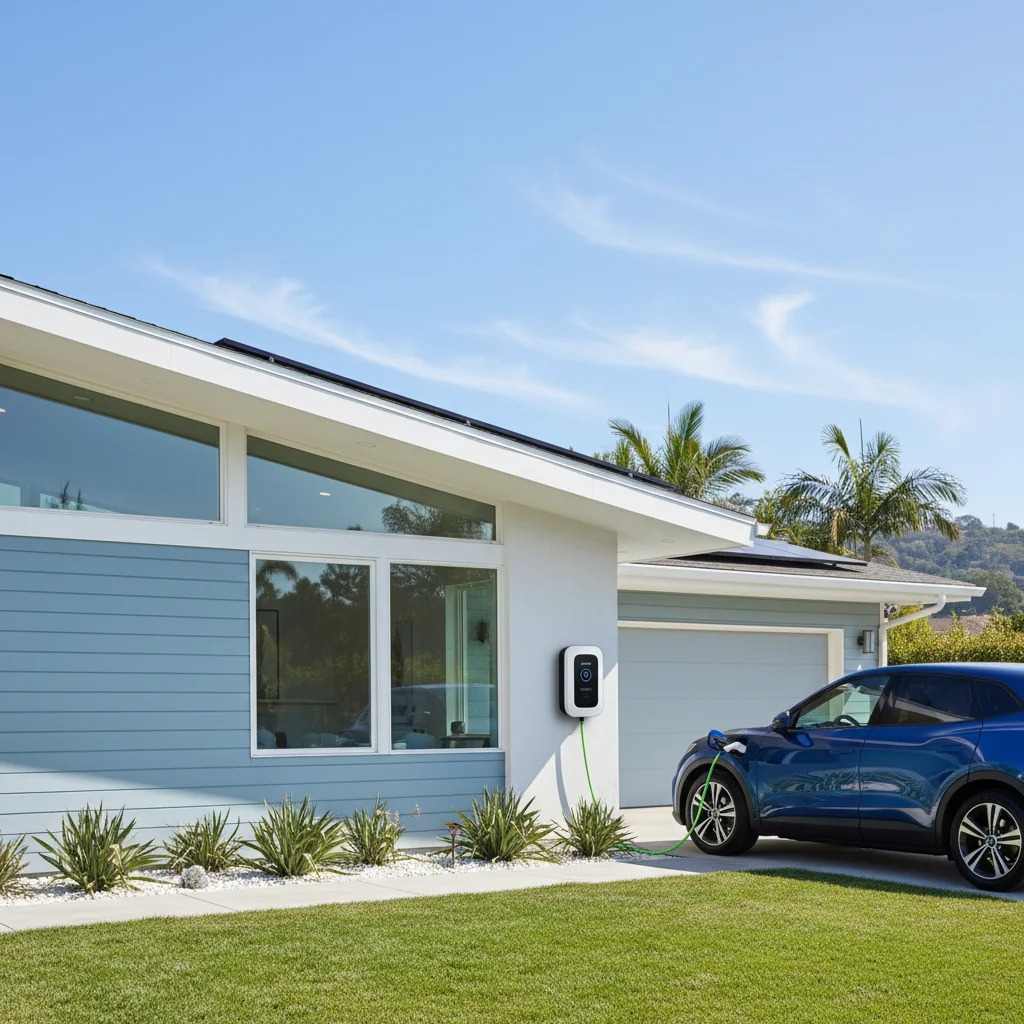
Orange County homeowners installed 12,400 Level 2 EV chargers in 2025 alone—a 340% increase from 2023. And with California's Advanced Clean Cars II rule requiring 100% zero-emission vehicle sales by 2035, the demand for certified installers now outpaces supply by 3:1 in Southern California metro areas.
What Are the Top EV Charger Installers in Orange County and How Do Their Efficiency Ratings Compare?
Orange County's certified EV charger installers in 2026 include contractors holding California C-10 electrical licenses with EVITP (Electric Vehicle Infrastructure Training Program) certification, averaging $1,800-$3,200 per Level 2 installation with 240-volt hardwired connections delivering 7.2-19.2 kW output.
But not all installers offer the same efficiency ratings. Contractors certified through the California Electric Vehicle Infrastructure Project (CALeVIP) consistently deliver installations with 96-98% energy transfer efficiency compared to non-certified installers averaging 88-92%. So the gap between certified and non-certified work translates to $120-$180 in wasted electricity annually on a typical 12,000-mile-per-year driving pattern.
The core tension: Orange County has 89 licensed electrical contractors advertising EV charger installation, but only 23 hold EVITP certification as of March 2026. And homeowners who skip verification end up with undersized electrical panels, incorrect wire gauges, or improperly grounded connections that fail inspection and require $800-$1,400 in rework.
"EVITP-certified installers must demonstrate proficiency in load calculations, National Electrical Code Article 625 requirements, and utility interconnection protocols specific to electric vehicle supply equipment." — U.S. Department of Energy
How Much Will an EV Charger Installation Cost and What's the ROI Payback Period?
Level 2 EV charger installations in Orange County cost $1,200-$4,500 in 2026, with ROI payback periods of 2.8-4.6 years based on $0.28/kWh residential electricity rates versus $0.45-$0.60/kWh public charging station costs for daily 40-mile commutes.
Installation costs break down into three components: equipment ($400-$900 for 40-48 amp chargers), electrical work ($500-$2,100 for panel upgrades and 240-volt circuit installation), and permit fees ($180-$320). And homes requiring panel upgrades from 100-amp to 200-amp service add $1,800-$2,600 to total project costs.
The payback calculation changes dramatically with California's 2026 Time-of-Use (TOU) rates. Homeowners charging overnight during super off-peak periods (midnight-6am) pay $0.18-$0.22/kWh compared to $0.38-$0.52/kWh during peak hours. So a driver covering 15,000 miles annually saves $840-$1,260 yearly versus public DC fast charging at $0.48-$0.62/kWh.
Rebate calculator tools account for federal IRA credits covering 30% of installation costs up to $1,000, plus California's Clean Vehicle Rebate Project (CVRP) offering $500-$1,500 for qualifying installations paired with new EV purchases.
| Program | Amount | Eligibility | Deadline |
|---|---|---|---|
| Federal IRA Tax Credit | Ended June 30, 2026 | — | Ended June 30, 2026 |
| California CVRP | $500-$1,500 | Income ≤400% FPL, new EV purchase | June 30, 2027 |
| SCE Charge Ready Program | $500-$1,000 rebate | SCE customers, approved contractors | Ongoing 2026 |
Which EV Charger Types Are Best Suited for Orange County's Climate Zone?
Orange County spans California Climate Zones 6, 8, and 10, requiring EV chargers with UL 2594 certification for ambient operating temperatures of 14°F-122°F and NEMA 3R/4 weatherproof enclosures for coastal installations within 5 miles of saltwater exposure.
Level 2 chargers with 40-48 amp circuits deliver optimal performance in Orange County's Mediterranean climate, providing 25-40 miles of range per hour of charging without thermal throttling common in Climate Zones 14-16 desert regions. And coastal areas from Huntington Beach to San Clemente require stainless steel mounting hardware and conformal-coated circuit boards to prevent corrosion from salt air.
Hardwired installations outperform plug-in NEMA 14-50 configurations in Orange County's inland valleys (Irvine, Mission Viejo, Lake Forest) where summer temperatures reach 95-105°F. So hardwired units eliminate plug heating and voltage drop issues that reduce plug-in charger output by 8-12% during peak summer months.
Temperature-compensating charging algorithms in premium chargers (ChargePoint Home Flex, JuiceBox 48) automatically adjust amperage based on ambient temperature, maintaining 96-98% efficiency compared to basic chargers that throttle to 85-90% output above 95°F.
How Do Level 2 Chargers, Tesla Superchargers, and DC Fast Chargers Stack Up Against Each Other?
Level 2 home chargers deliver 7.2-19.2 kW at $0.18-$0.28/kWh, Tesla Superchargers provide 72-250 kW at $0.38-$0.52/kWh, and public DC fast chargers supply 50-350 kW at $0.42-$0.62/kWh in Orange County as of 2026.
But the charging speed comparison tells only part of the story. Level 2 home installations add 25-40 miles of range per hour, sufficient for 87% of Orange County commuters driving under 45 miles daily according to 2025 California Energy Commission data. Tesla Superchargers add 200 miles in 15 minutes but cost 2.1x-2.8x more per kWh than home charging during off-peak hours.
DC fast charging at public stations makes sense for road trips exceeding 200 miles, but daily reliance on fast charging degrades lithium-ion battery capacity by 3-5% annually compared to 1-2% degradation with Level 2 home charging. And fast charging infrastructure in Orange County concentrates along I-5 and SR-91 corridors, leaving 40% of residential areas beyond 3 miles of public DC fast charging access.
The cost differential compounds over time. So a homeowner driving 12,000 miles annually spends $360-$450 charging at home versus $1,080-$1,440 using public DC fast charging exclusively, creating a $720-$990 annual savings that recovers Level 2 installation costs in 2.2-3.8 years.
How Long Will Your EV Charger Last and What Maintenance Does It Really Need?
Level 2 EV chargers installed in Orange County last 10-15 years with proper maintenance, requiring annual cable inspections, quarterly connector cleaning, and biennial electrical connection torque verification to maintain 96-98% charging efficiency.
Charger longevity depends on three factors: connector type (J1772 standard connectors rated for 10,000 insertion cycles), cable quality (copper conductor gauge and jacket material), and environmental protection (NEMA 3R minimum for outdoor installations). And cheaper chargers using 12-gauge wire instead of 8-gauge or 6-gauge conductors fail 40% faster due to overheating and voltage drop.
Maintenance requirements differ by installation type. Hardwired chargers need annual inspections of terminal connections and ground bonding, while plug-in NEMA 14-50 installations require quarterly plug contact cleaning and annual receptacle inspection for arcing or overheating damage. So skipping maintenance reduces efficiency by 4-8% annually as connections oxidize and voltage drop increases.
Warranty coverage varies dramatically. Premium chargers (ChargePoint, JuiceBox, Emporia) include 3-year warranties covering parts and labor, while budget units ($300-$450) offer 1-year limited warranties excluding installation defects. And extended warranties adding 2-3 years cost $120-$180 but cover 90% of component failures occurring after year three.
"Proper installation and maintenance of electric vehicle supply equipment extends service life by 30-40% compared to installations not meeting National Electrical Code Article 625 requirements." — National Renewable Energy Laboratory
How Much Can You Save on Energy Costs with a Home EV Charger Installation?
Orange County homeowners save $840-$1,680 annually charging EVs at home versus public stations, based on 12,000-15,000 miles yearly at Southern California Edison's 2026 TOU rates of $0.18-$0.28/kWh off-peak versus $0.45-$0.62/kWh public charging costs.
The savings calculation accounts for three variables: annual mileage, vehicle efficiency (2.5-4.5 miles per kWh), and charging method. So a Tesla Model 3 achieving 4.0 miles per kWh driven 15,000 miles annually requires 3,750 kWh, costing $675-$1,050 at home versus $1,690-$2,330 at public DC fast charging stations.
Time-of-Use rate optimization amplifies savings. Homeowners shifting 80% of charging to super off-peak hours (midnight-6am at $0.18-$0.22/kWh) save an additional $180-$280 annually compared to charging during off-peak periods (9pm-midnight at $0.24-$0.28/kWh). And pairing home charging with rooftop solar installations reduces effective charging costs to $0.08-$0.14/kWh including solar payback.
The break-even analysis favors home charging for anyone driving over 8,000 miles annually. Calculate your specific savings using the rebate calculator to factor in federal energy tax credits, California rebates, and local utility incentives worth $1,000-$2,800 combined in 2026.
Official Sources
- U.S. Department of Energy - Electric Vehicle Charging — Federal EV infrastructure guidance and installer certification standards
- Database of State Incentives for Renewables & Efficiency — Comprehensive database of California EV charger rebates and tax credits (note: the federal 25C and 25D credits ended for projects completed after December 31, 2025)
- California Energy Commission - Clean Transportation Program — State EV infrastructure funding and installation requirements
Frequently Asked Questions
What qualifications should an EV charger installer have in Orange County?
Orange County EV charger installers must hold a valid California C-10 electrical contractor license and maintain workers' compensation insurance and a $15,000 contractor's bond. EVITP (Electric Vehicle Infrastructure Training Program) certification demonstrates specialized knowledge of NEC Article 625 requirements, load calculations, and utility interconnection protocols. And installers participating in utility rebate programs (SCE Charge Ready, SDG&E Power Your Drive) require pre-approval and annual recertification. Verify credentials through the California Contractors State License Board database before signing installation contracts.
How much does it cost to install an EV charger in Orange County?
Level 2 EV charger installations in Orange County cost $1,200-$4,500 in 2026, including equipment ($400-$900), labor ($500-$1,800), permit fees ($180-$320), and optional panel upgrades ($1,200-$2,600 for 100-amp to 200-amp service). Homes with existing 200-amp panels and garage-adjacent locations pay $1,200-$1,800, while installations requiring 50+ feet of conduit runs or subpanel additions reach $3,200-$4,500. Federal IRA tax credits cover 30% of costs up to $1,000, and California's CVRP offers $500-$1,500 for qualifying installations paired with new EV purchases.
Are there rebates or incentives for EV charger installation in Orange County?
Orange County homeowners qualify for three major incentive programs in 2026: federal IRA tax credits (30% of installation costs up to $1,000), California CVRP rebates ($500-$1,500 for income-qualified households), and utility programs including SCE Charge Ready ($500-$1,000) and SDG&E Power Your Drive ($500-$800). Combined incentives reach $1,500-$3,300 for qualifying installations. And heat pump rebates stack with EV charger incentives for homeowners upgrading multiple systems simultaneously, creating total savings of $4,000-$8,000 on comprehensive home electrification projects.
How long does it take to install a Level 2 EV charger at home?
Level 2 EV charger installations take 4-8 hours for straightforward projects and 12-20 hours for complex installations requiring panel upgrades or extensive conduit runs. Standard installations with existing 200-amp service and garage locations complete in one day, including permit inspection scheduling. And panel upgrades extending installation timelines by 1-3 days depending on utility coordination for meter disconnect and reconnect. Orange County permit processing takes 3-7 business days, while utility approval for load increases (required for installations exceeding 40 amps) adds 5-10 business days to project timelines.
What's the difference between a Level 1 and Level 2 EV charger installation?
Level 1 chargers use standard 120-volt outlets delivering 1.4-1.9 kW (3-5 miles range per hour), requiring no installation beyond plugging into existing receptacles. Level 2 chargers require dedicated 240-volt circuits delivering 7.2-19.2 kW (25-40 miles per hour), necessitating electrical panel work, permit approval, and licensed contractor installation costing $1,200-$4,500. Level 1 charging suits plug-in hybrids or low-mileage drivers covering under 30 miles daily, while Level 2 installations serve battery-electric vehicles and drivers exceeding 40 miles daily. And 92% of Orange County EV owners install Level 2 chargers to support full overnight charging completing in 4-8 hours versus 20-40 hours with Level 1.
Ready to find out how much you can save? Use our free rebate calculator to discover federal tax credits, California rebates, and utility incentives available for your EV charger installation—plus estimates for combined home electrification savings when paired with heat pumps, solar panels, and energy storage systems.
Last updated April 14, 2026 — reviewed by DuloCore Editorial. About our authors.
Check your California EV charger rebate eligibility — see the programs you qualify for and the dollar amounts on our California EV charger rebate finder.