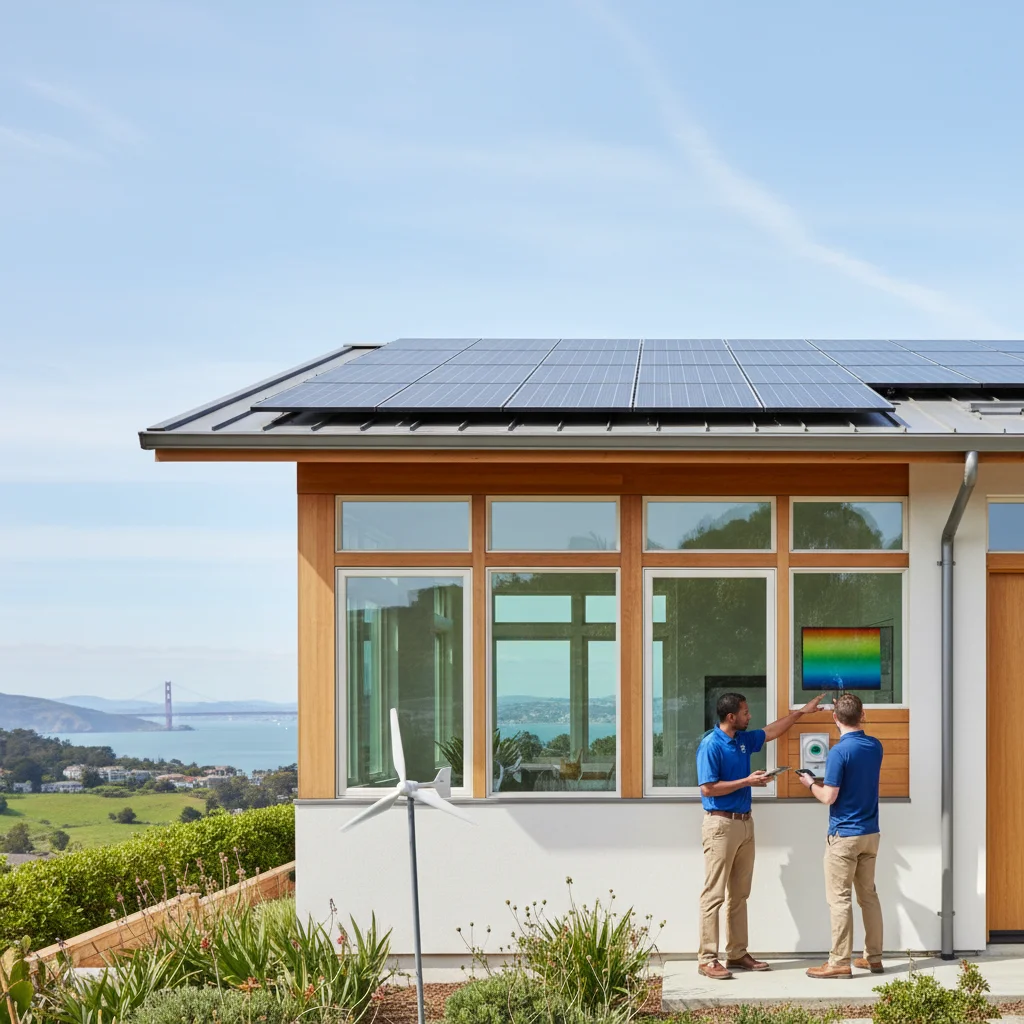
Bay Area homeowners waste an average of $1,400 annually on preventable energy loss, and most don't know it until they schedule a professional energy audit. With PG&E electricity rates hitting $0.52 per kilowatt-hour in 2026 — the highest in the continental United States — identifying air leaks, inefficient HVAC systems, and outdated insulation isn't just smart maintenance. It's financial survival.
What qualifications should a Bay Area home energy auditor have?
Bay Area home energy auditors certified by the Building Performance Institute (BPI) or Residential Energy Services Network (RESNET) complete 40+ hours of field training and pass written exams on building science, combustion safety, and diagnostic equipment operation before earning credentials valid through 2026 programs.
And these certifications matter for rebate eligibility. Most utility and state programs require BPI or RESNET certification to qualify for funding. The California Energy Commission's Energy Upgrade California program mandates certified auditors for all rebate-eligible assessments, blocking DIY or uncertified evaluations from incentive stacks.
But certification alone doesn't guarantee quality work. Top auditors carry blower door equipment (measuring air leakage at 50 pascals of pressure), infrared cameras (detecting thermal bridging invisible to the naked eye), and combustion analyzers (testing furnace efficiency and carbon monoxide levels). So homeowners should verify equipment lists before booking — auditors without thermal imaging miss 30-40% of insulation gaps according to Department of Energy field studies.
Experienced auditors complete 50+ assessments annually, building pattern recognition for Bay Area's mix of Victorian-era homes (pre-1920, minimal insulation, single-pane windows) and mid-century ranch construction (1950-1970, uninsulated crawl spaces, outdated HVAC). And local knowledge matters — auditors familiar with Daly City's fog belt recommend different weatherization priorities than those serving inland Concord's 100°F summer peaks.
How much does a professional energy audit cost in the Bay Area?
Professional energy audits in the Bay Area cost $300-$600 for single-family homes under 2,500 square feet, with prices climbing to $800-$1,200 for properties exceeding 4,000 square feet or requiring specialized testing like duct pressure diagnostics or zonal blower door analysis.
Or homeowners can access subsidized audits through utility programs. PG&E's Home Upgrade program offers audits for $75-$150 to income-qualified households (those earning below 200% of federal poverty guidelines), while the Bay Area Regional Energy Network (BayREN) provides free audits to single-family homeowners in Alameda, Contra Costa, Marin, and San Mateo counties through participating contractors.
But "free" audits often come with strings attached. Some contractors waive audit fees only if homeowners proceed with recommended upgrades exceeding $3,000, creating pressure to commit before comparing bids. So reading the fine print matters — auditors should provide written reports with no-obligation recommendations, not sales pitches disguised as assessments.
And audit costs pale compared to savings potential. The average Bay Area energy audit identifies $4,200 in annual waste from air leaks (40%), inefficient heating/cooling (35%), and outdated appliances (25%). So the $400 audit investment pays back in under 5 weeks at current PG&E rates, even before factoring in available rebates and tax credits.
What funding and rebates are available for energy audits (and what are the deadlines)?
The Inflation Reduction Act's Home Energy Rebate programs allocate $4.28 billion nationally through 2031, with California receiving $467 million for the Home Efficiency Rebates (HER) program launching in late 2026 — but final application deadlines remain unannounced as of April 2026.
And funding stacks across federal, state, and utility layers. The federal Energy Efficient Home Improvement Credit (Section 25C) ended for property placed in service after December 31, 2025 (IRS FS-2025-05). Federal tax credits for this work have ended, but state, local and utility rebates may still apply; check what is available at your address with the DuloCore rebate calculator. California's Tech Clean California program adds up to $8,000 for heat pump installations in income-qualified households, while PG&E rebates contribute $500-$2,000 for ductless mini-splits and heat pump water heaters.
But stacking rules create complexity. Federal tax credits apply to equipment costs only, excluding installation labor, while state and utility rebates cover total project costs including permits and contractor fees. So a $15,000 heat pump installation might receive a $4,500 federal credit (30% of equipment), a $6,000 state rebate (for households under 80% area median income), and a $1,500 utility incentive — totaling $12,000 in combined support, reducing out-of-pocket costs to $3,000.
| Program | Maximum Amount | Income Limit | Application Deadline |
|---|---|---|---|
| IRA Home Energy Rebates (HER) | $8,000 | 80% AMI | TBD (late 2026) |
| Federal Tax Credit (IRA) | Ended Dec 31, 2025 | — | Ended Dec 31, 2025 |
| PG&E Home Upgrade | $6,500 | 200% FPL | Rolling basis |
| BayREN Single Family | $4,000 | None | June 30, 2027 |
So timing matters. Homeowners should schedule audits before state programs launch to secure contractor slots — wait times jumped to 8-12 weeks in 2024 when California's previous TECH program opened applications.
What documents do you need before scheduling an energy audit?
Bay Area homeowners need 12 months of utility bills (showing seasonal consumption patterns), property deed or lease agreement (confirming ownership or landlord authorization), and recent tax returns (verifying income eligibility for subsidized programs) before scheduling rebate-eligible energy audits in 2026.
And utility data matters most. Auditors analyze monthly kilowatt-hour usage and therms of natural gas consumption to establish baseline performance, identifying anomalies like summer spikes (suggesting cooling inefficiency) or winter surges (indicating heating system waste). PG&E customers can download 24 months of interval data through the online portal, providing granular insights unavailable from paper bills.
But income documentation determines rebate tier access. California's Home Efficiency Rebates program offers $8,000 for households below 80% area median income, dropping to $4,000 for those between 80-150% AMI, and phasing out entirely above 150%. So a San Francisco family of four earning $140,000 qualifies for the higher tier (below the $175,200 threshold), while the same household in Santa Rosa exceeds limits at the $129,600 cutoff.
Pre-1978 homes require additional lead paint disclosures under EPA regulations, and properties with known asbestos insulation (common in 1950-1970 construction) need certified abatement before air sealing work begins. So older Bay Area homes face 2-4 weeks of pre-audit preparation compared to newer construction's streamlined process.
Do you need pre-approval before hiring an energy auditor?
Most Bay Area rebate programs require homeowners to complete energy audits and receive written recommendations before submitting pre-approval applications, reversing the typical contractor-first approach and creating a documentation-then-commit workflow that locks in 2026 program terms before upgrades begin.
And pre-approval protects against funding exhaustion. BayREN's Single Family program reserves rebate allocations for 90 days after pre-approval, guaranteeing funds even if the program reaches capacity before installation completes. Without pre-approval, homeowners risk completing $20,000 in upgrades only to discover rebate funding depleted — a scenario that affected 1,200+ California applicants when previous programs closed unexpectedly in 2024.
But pre-approval isn't universal. Form 5695 only covers qualifying work completed by December 31, 2025 and claimed on a 2025 return; the federal 25C and 25D credits ended after that date (IRS FS-2025-05). So the 30% federal credit (this federal credit ended for property placed in service after December 31, 2025) applies retroactively, while state and utility rebates demand upfront commitment.
Application processing times vary by program. PG&E Home Upgrade pre-approvals take 10-15 business days, while California's state-administered programs warn of 30-45 day review periods during peak seasons. So homeowners should submit applications in March-May (off-peak) rather than September-November (high demand) to avoid installation delays.
How long does a typical Bay Area energy audit take (and what's the current wait time)?
A comprehensive Bay Area energy audit takes 3-4 hours for homes under 2,500 square feet, extending to 5-6 hours for properties above 4,000 square feet or requiring specialized tests like duct leakage measurement, infrared scanning of all exterior walls, and zonal pressure diagnostics across multiple HVAC systems.
But scheduling delays exceed audit duration. As of April 2026, certified BPI auditors in San Francisco and Oakland report 6-8 week backlogs, while South Bay contractors (San Jose, Sunnyvale, Palo Alto) schedule appointments within 3-4 weeks. And these wait times balloon when rebate programs launch — California's 2024 TECH program created 12-16 week queues, forcing homeowners to delay upgrades through entire cooling seasons.
The audit itself follows a structured protocol. Auditors spend 45-60 minutes on blower door testing (sealing all windows and doors, then depressurizing the home to measure air leakage), 60-90 minutes on room-by-room infrared scanning (identifying insulation gaps, thermal bridges, and moisture intrusion), and 30-45 minutes on combustion appliance safety testing (verifying furnace efficiency and carbon monoxide levels below 9 parts per million).
Written reports arrive within 5-7 business days, detailing recommended upgrades ranked by payback period, estimated annual savings, and rebate eligibility. Top-tier auditors include thermal images, air leakage measurements in cubic feet per minute at 50 pascals (CFM50), and specific product recommendations meeting federal tax credit requirements.
Official Sources
- Department of Energy Save Energy, Save Money — Federal guidance on home energy efficiency, rebates, and IRA tax credit requirements (note: the federal 25C and 25D credits ended for projects completed after December 31, 2025)
- Database of State Incentives for Renewables & Efficiency — Comprehensive database of California utility programs, state rebates, and eligibility criteria
- ENERGY STAR Home Upgrade — EPA certification standards for equipment qualifying for federal tax credits (note: the federal 25C and 25D credits ended for projects completed after December 31, 2025)
Related Reading: Learn more about Energy Efficient Home Improvement Credit Limit Worksheet and Energy Modeling Software Home.
Related Reading: Learn more about Ev Charger Home Energy Audit and Fall Home Energy Audit Checklist.
Frequently Asked Questions
How much does a home energy audit cost in the Bay Area?
Professional energy audits cost $300-$600 for standard single-family homes, with subsidized options available through PG&E ($75-$150 for income-qualified households) and free assessments through BayREN in Alameda, Contra Costa, Marin, and San Mateo counties. And commercial audits for multi-unit properties run $800-$1,500 depending on building size and system complexity.
What qualifications should a Bay Area energy auditor have?
Certified auditors hold Building Performance Institute (BPI) or Residential Energy Services Network (RESNET) credentials, requiring 40+ hours of training and written exams. And equipment matters — auditors should carry blower doors (measuring air leakage), infrared cameras (detecting insulation gaps), and combustion analyzers (testing HVAC safety). So verify certification and equipment before booking.
How long does a home energy audit typically take?
Comprehensive audits take 3-4 hours for homes under 2,500 square feet, including blower door testing (45-60 minutes), infrared scanning (60-90 minutes), and combustion safety checks (30-45 minutes). But scheduling delays range from 3-8 weeks depending on location, with San Francisco and Oakland contractors reporting the longest backlogs as of April 2026.
Can I get rebates after having an energy audit done?
Most programs require audits before pre-approval applications, but federal tax credits apply retroactively when filing annual returns. And California's Home Efficiency Rebates program (launching late 2026) mandates audit completion within 180 days of pre-approval submission. So auditing first protects rebate eligibility, while waiting risks program capacity limits or changing requirements.
What's the difference between a professional energy audit and a DIY energy assessment?
Professional audits use calibrated blower doors measuring air leakage at 50 pascals, infrared cameras detecting thermal bridges invisible to homeowners, and combustion analyzers testing furnace efficiency to parts-per-million precision. DIY assessments rely on visual inspections and utility bill analysis, missing 30-40% of efficiency opportunities according to Department of Energy studies. And most rebate programs require certified professional audits, blocking DIY evaluations from incentive stacks.
Ready to maximize your energy savings? Use our free rebate calculator to discover exactly how much you can save with Bay Area energy efficiency programs — get your personalized estimate in under 60 seconds and find certified auditors near you.
Last updated April 14, 2026 — reviewed by DuloCore Editorial. About our authors.