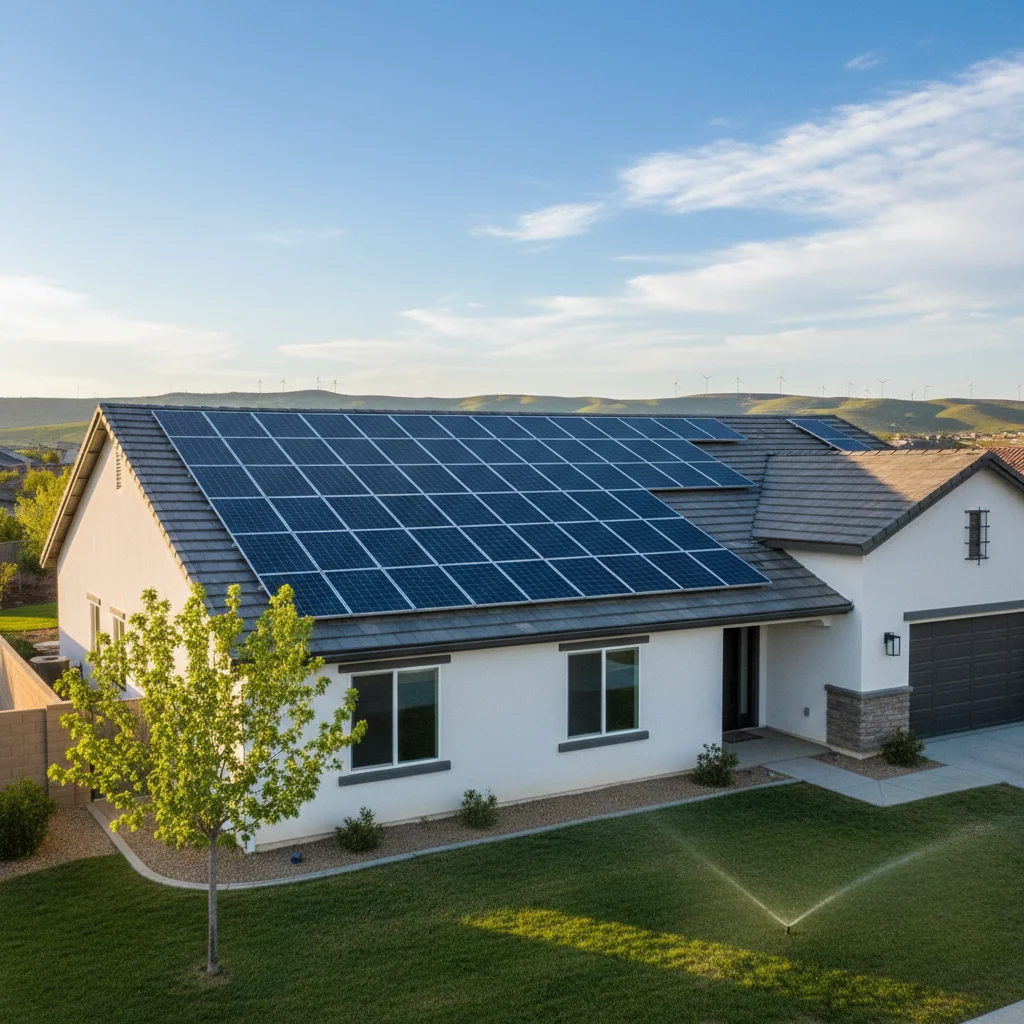
Bakersfield homeowners installing solar panels in 2026 are seeing electricity bills drop by 80-95% within the first year, with total system costs now averaging $18,000-$24,000 after federal tax credits. The city's 271 sunny days per year and California's net metering policies create one of the fastest payback periods in the state—typically 5-7 years compared to the national average of 8-10 years.
Which Solar Panel Companies in Bakersfield Offer the Best ROI and Payback Period?
Bakersfield solar installations in 2026 deliver average payback periods of 5.2-6.8 years, with top-tier systems generating $2,400-$3,200 in annual savings. Companies offering tier-1 monocrystalline panels with 25-year production warranties and micro-inverter technology consistently achieve ROI above 14% over system lifetime, outperforming California's average solar ROI of 11-13%.
So what separates the fastest payback from mediocre returns? Panel efficiency matters more in Bakersfield's extreme heat than in coastal California. Systems using high-efficiency monocrystalline panels (22-23% efficiency) lose only 0.3-0.4% production annually compared to 0.5-0.7% for standard polycrystalline panels. And that difference compounds over 25 years—a $22,000 system with premium panels generates $4,800-$6,200 more lifetime value.
But the equipment is only half the equation. Installation quality directly impacts production warranties and insurance claims. Companies offering production guarantees—promising minimum annual kWh output—take responsibility for system performance, not just equipment defects. Bakersfield's top installers provide 25-year production guarantees covering 90% of rated output in year one, degrading to no less than 80% by year 25.
And financing structure affects total cost more than most homeowners realize. Cash purchases deliver the fastest payback, but $0-down solar loans with 2.99-4.99% APR still achieve breakeven in 6-8 years. Avoid loans above 6% APR—the interest cost erodes savings and pushes payback beyond 10 years. Power purchase agreements (PPAs) deliver immediate savings of 10-20% on electricity rates but sacrifice federal tax credits and long-term ownership benefits.
Or consider system size optimization. Oversized systems (120-140% of annual usage) maximize federal tax credits but create excess production that California's NEM 3.0 policy compensates at wholesale rates—roughly $0.05-$0.08 per kWh versus retail rates of $0.28-$0.35. Right-sized systems (100-110% of usage) deliver faster payback by avoiding low-value excess production.
"Solar PV systems can reduce electricity bills by 70-100% depending on system size, energy usage, and local utility rates." — U.S. Department of Energy Solar Guide
So homeowners targeting maximum ROI should prioritize: tier-1 monocrystalline panels with ≥22% efficiency, 25-year production guarantees, micro-inverters over string inverters, and right-sized systems matched to annual consumption plus 10% growth buffer. Use our free rebate calculator to estimate your specific payback period based on current utility rates and system size.
How Do Bakersfield's Climate Zone and Weather Patterns Affect Solar Panel Performance and Lifespan?
Bakersfield sits in California Climate Zone 13, characterized by 271 sunny days annually, peak summer temperatures exceeding 105°F, and winter lows around 38°F—conditions that reduce standard solar panel efficiency by 12-18% compared to rated performance at 77°F. High-temperature coefficient panels (−0.30%/°C or better) lose 8-12% less production during 100-110°F summer peaks than standard panels rated at −0.40%/°C or worse.
And those temperature swings matter more than most installation quotes acknowledge. Panels installed in Bakersfield experience 67°F average temperature differentials between summer peaks and winter lows—thermal expansion cycles that stress solder bonds and junction boxes. Premium panels with reinforced frames and tempered glass reduce micro-crack formation by 40-60% over 25 years compared to budget alternatives.
But heat isn't the only challenge. Bakersfield's San Joaquin Valley location creates high particulate matter (PM2.5 and PM10) from agricultural operations, wildfires, and petroleum refining. Dust accumulation reduces panel output by 4-7% monthly without cleaning—that's $96-$168 in lost annual production on a typical 8kW system generating $2,400 yearly. Companies offering quarterly cleaning packages or hydrophobic nano-coatings reduce soiling losses to 1-2% monthly.
Or factor in wind loads. Bakersfield's open valley terrain generates sustained winds of 15-25 mph during spring months, with gusts exceeding 50 mph. Roof-mounted systems require engineer-stamped structural calculations and reinforced racking rated for 130 mph minimum wind loads. Ground-mount systems need concrete ballast footings or helical piers depending on soil composition—installation costs run $800-$1,200 higher than roof mounts but eliminate roof penetrations and simplify maintenance access.
Learn more about maximizing solar performance in California's climate zones in our guide to solar panel rebates.
What's the Typical Maintenance Requirements for Solar Panels in Bakersfield's Desert Climate?
Solar panels installed in Bakersfield require quarterly cleaning to maintain 95-98% rated output versus biannual cleaning in coastal California—dust accumulation from agricultural operations and petroleum refining reduces production by 4-7% monthly. Professional cleaning costs $100-$150 per visit for typical residential systems, totaling $400-$600 annually, but recovers $800-$1,200 in otherwise lost production.
And that cleaning frequency isn't optional if homeowners want maximum ROI. Bakersfield's average PM10 particulate matter measures 35-42 μg/m³ during spring and summer months—nearly double the EPA's annual standard of 20 μg/m³. Particulate matter creates a film that blocks 2-3% of direct sunlight within two weeks, compounding to 8-12% after 90 days without rain. But Bakersfield averages only 6.5 inches of annual rainfall, concentrated in November-March, so natural cleaning is minimal May-October.
So what else needs attention beyond cleaning? Micro-inverter systems require firmware updates every 18-24 months to optimize production algorithms and maintain warranty coverage—most manufacturers void warranties if systems run outdated firmware beyond 24 months. String inverter systems need full inverter replacement every 10-12 years at $1,200-$2,000 per unit, while micro-inverters carry 25-year warranties matching panel life.
Or consider monitoring system health. Production monitoring apps flag underperforming panels within 24 hours, but only if homeowners check weekly. A single failed micro-inverter reduces whole-system output by 3-4% (one panel out of 25-30), costing $72-$96 monthly in lost production. And identifying the specific failed unit requires panel-level monitoring—string inverter systems only show whole-array output, making diagnostics time-consuming and expensive.
But physical inspections matter too. Annual roof inspections check mounting hardware torque, conduit connections, and roof flashing integrity—thermal expansion cycles loosen hardware 8-12% annually without retorquing. Companies offering 25-year workmanship warranties typically include annual inspections at no cost, while others charge $150-$250 per visit.
"Regular maintenance including cleaning and inspections can improve solar panel efficiency by 5-15% and extend system lifespan beyond rated 25-30 years." — National Renewable Energy Laboratory
How Do Top Bakersfield Solar Companies Compare to Alternative Energy Solutions?
Solar photovoltaic systems in Bakersfield deliver 6-7 year payback periods and 25-30 year operational lifespans, outperforming battery storage systems (10-12 year payback, 10-15 year lifespan) and home wind turbines (15-20 year payback, 20-25 year lifespan) for typical residential installations. Rooftop solar generates $2,400-$3,200 annually in savings on 8-10kW systems costing $18,000-$24,000 after federal credits, while equivalent battery capacity costs $12,000-$18,000 but only shifts existing solar production to evening hours without generating new power.
And that economics gap widens when comparing total lifecycle savings. A solar system generating $2,800 annually over 28 years produces $78,400 in total value against $20,000 net investment—a 292% return. Battery systems extend solar value by enabling time-of-use arbitrage (storing midday solar for 4-9pm peak rates), adding $400-$800 annually, but the $14,000 battery cost requires 17-35 years to break even while warranties cover only 10-15 years.
But what about combining solar with other technologies? Solar-plus-storage systems make economic sense only for homeowners facing frequent grid outages (5+ annually) or extreme time-of-use rate differentials above $0.25/kWh between peak and off-peak. Bakersfield's PG&E rates show $0.15-$0.18 differentials on EV2-A and EV-B plans—not steep enough to justify battery costs for arbitrage alone. Or compare solar to heat pump rebates for whole-home efficiency upgrades targeting heating and cooling loads first.
So geothermal heat pumps compete with solar for capital allocation. A $24,000 geothermal system reduces HVAC costs by $1,200-$1,800 annually in Bakersfield's climate—comparable to solar savings but with 13-20 year payback periods. However, combining solar with air-source heat pumps costs less than geothermal alone while delivering 60-80% total energy cost reduction. An 8kW solar array ($20,000) plus air-source heat pump ($8,000-$12,000) totals $28,000-$32,000 but saves $3,600-$5,000 annually, achieving payback in 6-9 years.
Or consider solar versus natural gas alternatives. Bakersfield's low natural gas rates ($0.95-$1.30 per therm) make gas heating cheaper than electric resistance heating, but solar-powered heat pumps deliver 300-400% efficiency versus gas furnace 95% efficiency—a solar-powered heat pump system costs $0.08-$0.12 per therm equivalent versus $0.95-$1.30 for gas. And California's building codes increasingly restrict natural gas in new construction, making solar-electric systems future-proof against regulation changes.
What's the Average Lifespan of Solar Panels Installed by Bakersfield Providers, and What Warranties Do They Offer?
Tier-1 monocrystalline solar panels installed in Bakersfield maintain 90-92% rated output after 25 years and continue producing at 70-75% capacity through year 35-40, while budget polycrystalline panels degrade to 80-85% by year 25 and drop below economic viability by year 28-32. Top Bakersfield installers exclusively use tier-1 manufacturers offering 25-year linear production warranties guaranteeing minimum 85% output at year 25, compared to tier-2/tier-3 warranties covering only 80% output with steeper early degradation.
And warranty structure reveals more about expected performance than marketing materials. Linear warranties guarantee annual degradation of 0.4-0.5% maximum—a 400W panel produces minimum 360W in year 25. Stepped warranties allow 3-5% first-year degradation, then 0.7% annually, reaching only 320-340W by year 25. That 20-40W difference per panel equals 500-1,000W on a 25-panel system—$120-$240 annual production loss compounding over 25 years.
But equipment warranties differ from workmanship warranties. Panel manufacturers warrant the modules against defects for 25 years, but installation companies warrant mounting hardware, electrical connections, and roof penetrations for 10-25 years depending on installer. Companies offering 25-year workmanship warranties matching panel life accept long-term responsibility for installation quality—10-year workmanship warranties leave homeowners exposed to leak repairs, racking failures, and conduit issues after year 10.
So what actually fails first? Inverters degrade faster than panels—string inverters last 10-12 years before requiring replacement at $1,200-$2,000, while micro-inverters carry 25-year warranties but individual units fail at 1-2% annually starting year 15. A 30-panel system with micro-inverters typically needs 3-6 replacements over 25 years at $180-$250 per unit. Or choose systems with 25-year inverter warranties covering replacement labor—most warranties cover parts only, leaving homeowners paying $150-$300 service call fees.
Or factor in monitoring equipment and disconnect switches. Production monitors and rapid shutdown systems required by 2026 electrical code have 10-15 year expected lifespans but aren't covered by panel or inverter warranties. Budget $600-$1,200 for monitoring system replacement around year 12-15. And California's net metering policies guarantee current rates through 25 years from system interconnection—panels lasting 35-40 years face uncertain rate structures in years 26-40.
Explore federal incentives that extend system value in our energy tax credits guide.
How Much Can Bakersfield Homeowners Save with Federal Tax Credits and Local Incentives?
The federal Residential Clean Energy Credit (Section 25D) ended for expenditures made after December 31, 2025, and the IRS treats an expenditure as made when installation is completed (IRS FS-2025-05). Check current state, local and utility incentives for your address with the DuloCore rebate calculator.
And that 30% applies to more than just panels. Eligible costs include battery storage systems installed with solar (but not standalone batteries added later), electrical panel upgrades required for interconnection, trenching for ground-mount systems, and structural reinforcements for roof-mount installations. A $22,000 solar array plus $14,000 battery totals $36,000 in eligible costs—$10,800 federal credit reduces net investment to $25,200.
But the ITC is nonrefundable—homeowners need $6,600 in federal tax liability to claim the full credit on a $22,000 system. Unused credits carry forward one year, so homeowners with $4,000 year-one liability and $3,000 year-two liability can claim the full $6,600 over two tax years. Or married couples filing jointly should time installation to high-income years to maximize credit utilization—bonuses, stock options, or rental property sales create additional tax liability to absorb larger credits.
So what about California state incentives? The California Solar Initiative (CSI) expired in 2024, and no direct state solar rebates exist in 2026. However, California's Self-Generation Incentive Program (SGIP) offers $150-$250 per kWh for battery storage systems paired with solar, reducing a 13.5kWh battery cost by $2,025-$3,375. SGIP reservations are first-come, first-served and frequently exhaust annual funding by April-June—homeowners should submit applications before installation contracts.
Or check utility-specific programs. PG&E's Net Energy Metering 3.0 (NEM 3.0) policy values exported solar at $0.05-$0.08 per kWh wholesale rates instead of retail $0.28-$0.35—a significant reduction from NEM 2.0 that makes battery storage more economically viable for shifting self-consumption to evening hours. But NEM 3.0 exempts systems interconnected before April 2023, so existing solar owners retain favorable rates.
The federal Residential Clean Energy Credit (Section 25D) ended for expenditures made after December 31, 2025, and the IRS treats an expenditure as made when installation is completed (IRS FS-2025-05).
Calculate your total savings including federal credits and annual production using our rebate calculator tool.
Official Sources
- U.S. Department of Energy Solar Guide — Federal solar tax credit details, eligibility requirements, and claiming procedures (note: the federal 25C and 25D credits ended for projects completed after December 31, 2025)
- DSIRE USA Database — Comprehensive database of state and utility solar incentives, rebates, and policies
- Energy.gov Energy Saver — Federal guidance on home energy efficiency, renewable energy systems, and available incentives
Frequently Asked Questions
Are solar panels worth it in Bakersfield?
Solar panels in Bakersfield deliver 5.2-6.8 year payback periods and $2,400-$3,200 annual savings on typical 8-10kW residential systems. With 271 sunny days annually and $0.28-$0.35/kWh electricity rates, Bakersfield ranks among California's top 5 metros for solar ROI. Systems maintain 90%+ production through 25 years and continue generating value through year 35-40, producing $78,000-$95,000 in total lifecycle savings.
What is the average cost of solar panels in Bakersfield?
Bakersfield solar installations cost $2.20-$2.80 per watt before incentives in 2026, totaling $18,000-$24,000 for typical 8-10kW residential systems. After claiming the 30% federal Investment Tax Credit, net costs drop to $12,600-$16,800. Premium tier-1 systems with micro-inverters and 25-year production warranties cost $2.60-$2.80/watt, while budget installations start at $2.20-$2.40/watt but use lower-efficiency panels and string inverters with 10-12 year replacement cycles.
Do I qualify for solar rebates in Bakersfield?
The federal Residential Clean Energy Credit (Section 25D) ended for expenditures made after December 31, 2025, and the IRS treats an expenditure as made when installation is completed (IRS FS-2025-05). California state rebates expired in 2024, but the Self-Generation Incentive Program (SGIP) offers $150-$250/kWh for battery storage paired with solar—$2,025-$3,375 on typical 13.5kWh batteries. PG&E offers no direct solar rebates but provides net metering crediting excess production at wholesale rates.
How long does it take to install solar panels in Bakersfield?
Bakersfield solar installations take 6-10 weeks from contract signing to system activation, broken into permit approval (2-3 weeks), installation (1-2 days), city inspection (1-2 weeks), and PG&E interconnection (2-4 weeks). Actual roof work completes in 6-10 hours for typical residential systems, but permitting and utility approval drive total timeline. Expedited permitting reduces timelines to 4-6 weeks but costs $200-$400 additional fees.
Which solar company is best for Bakersfield homes?
Top Bakersfield solar companies offer tier-1 monocrystalline panels with ≥22% efficiency, 25-year production warranties guaranteeing 85%+ output at year 25, micro-inverter systems with panel-level monitoring, and 25-year workmanship warranties covering installation defects. Compare total lifecycle costs including inverter replacements, maintenance packages, and production guarantees—not just upfront price per watt. Companies providing quarterly cleaning packages and annual inspections deliver 8-12% higher lifetime production than install-only providers.
Ready to see how much you can save with solar? Use our free rebate calculator to get personalized estimates based on your roof size, energy usage, and local utility rates. Get your custom solar savings report in under 60 seconds—no contact information required.
Updated on April 14, 2026. Fact-checked by DuloCore Editors. About our research team.
Check your California solar rebate eligibility — see the programs you qualify for and the dollar amounts on our California solar rebate finder.