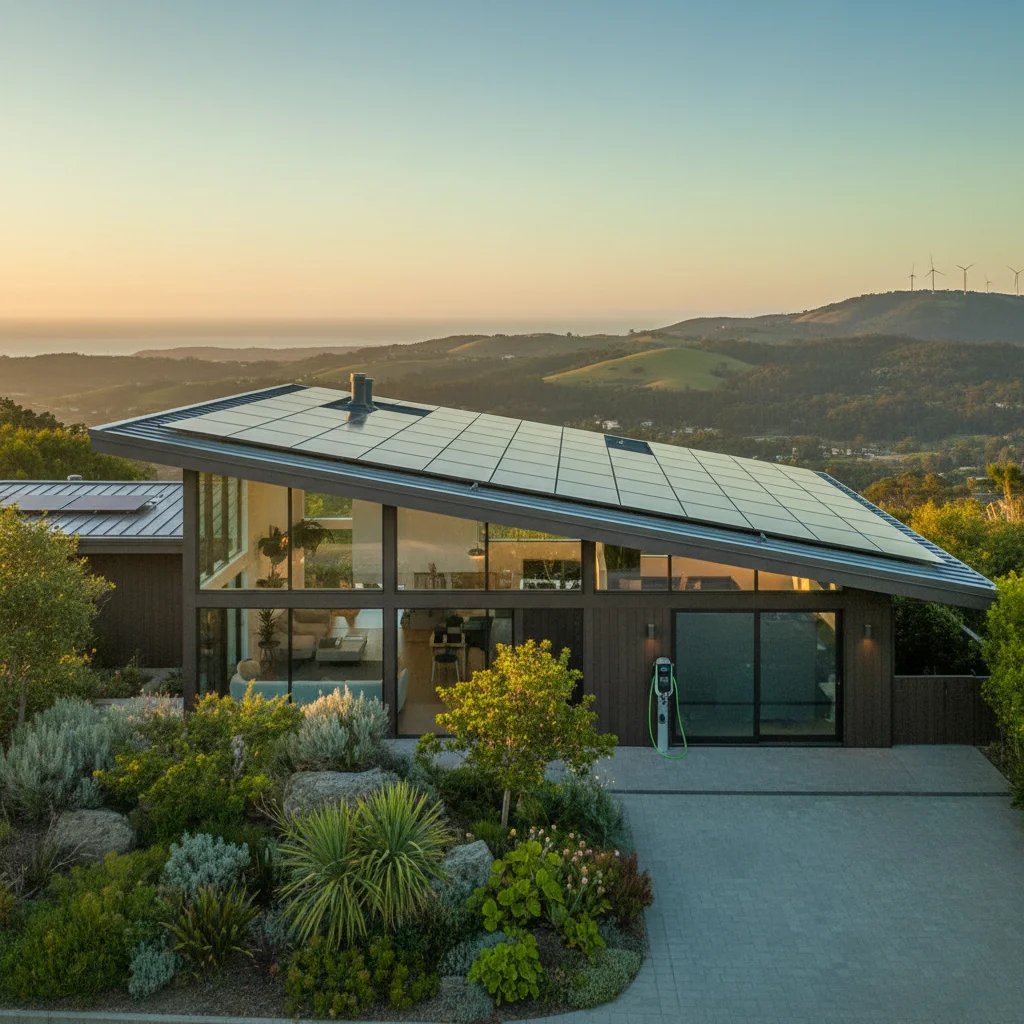
Bay Area homeowners installed 47,000 solar systems in 2025—more than any other California metro region—driving a 62% jump in residential solar adoption and pushing total grid-connected capacity past 1.2 gigawatts. And with California's Net Energy Metering 3.0 slashing export credits by 75%, choosing the right installer now determines whether a system pays for itself in 7 years or 15.
What's the Average ROI and Payback Period for Solar Panels in the Bay Area?
Bay Area solar installations in 2026 deliver 8-12% annual returns with payback periods of 6-9 years, depending on system size, roof orientation, utility rates, and financing structure. PG&E's $0.38 per kWh peak rate accelerates savings compared to inland regions.
A typical 7-kilowatt system costs $18,000-$24,000 before incentives. After applying the 30% federal IRA tax credit—worth $5,400-$7,200—net cost drops to $12,600-$16,800. Monthly savings average $180-$250 for households consuming 900-1,200 kWh. So a homeowner paying $220 monthly recoups the $14,000 net investment in 5.3 years, then banks $2,640 annually for the remaining 20-year warranty period.
But NEM 3.0 changes the math. Export rates fell from $0.30 to $0.08 per kWh, cutting payback speed for systems without battery storage. Installers now pair 10-13 kWh batteries with solar arrays, adding $9,000-$12,000 but boosting self-consumption from 35% to 75%. The combined payback stretches to 8-9 years, yet lifetime savings reach $68,000-$84,000 over 25 years—double the pre-NEM 3.0 figures.
And financing matters. Cash purchases yield the fastest ROI at 6-7 years. Zero-down loans extend payback to 8-10 years due to 5.5-7.9% APR interest. Power purchase agreements eliminate upfront costs but surrender 30-40% of lifetime savings to the financing company, stretching effective payback beyond 12 years. Use our free rebate calculator to model your specific scenario.
How Long Do Solar Panels Last and What's Covered by Warranties?
Tier-1 monocrystalline panels installed by Bay Area companies carry 25-30 year performance warranties guaranteeing 80-85% output at year 25, while inverters last 10-15 years with replacement costs of $1,800-$3,200 for string inverters and $200-$400 per microinverter.
Premium manufacturers like SunPower, REC, and Panasonic warranty 92% output retention at 25 years—7-12 percentage points higher than budget brands. And their all-black monocrystalline cells degrade 0.25-0.35% annually versus 0.5-0.8% for polycrystalline panels. So a SunPower system producing 9,500 kWh in year one still delivers 8,740 kWh in year 25, while a budget panel drops to 7,600 kWh—a 1,140 kWh gap worth $433 annually at 2026 PG&E rates.
But inverters fail first. String inverters from Enphase, SolarEdge, and SMA last 12-15 years with 10-year standard warranties and $300-$500 extensions to 20 years. Microinverters outlast string units, with Enphase IQ8 models warranted for 25 years and failure rates below 0.05% annually. Replacing a failed 7 kW string inverter costs $2,100-$2,800 including labor. Swapping two microinverters runs $600-$900.
Workmanship warranties cover installation defects for 5-25 years depending on the installer. Sunrun and Tesla offer 10-year labor warranties. Momentum Solar and SunPower-certified dealers extend coverage to 25 years. And roofing penetrations—the most common leak source—get separate 10-year waterproofing guarantees from top-tier installers who use flashed mounts instead of lag bolts.
Which Bay Area Solar Companies Offer the Best Pricing and Financing Options?
Bay Area solar pricing ranges from $2.40-$3.60 per watt installed, with local installers like Cosmic Solar and Renewable Energy World undercutting national chains by 12-18% while offering 0.99-5.99% APR financing through Mosaic, GoodLeap, and Dividend Finance.
National installers charge $2.90-$3.40 per watt. Tesla quotes $2.50-$2.80 per watt but schedules installs 4-7 months out and subcontracts to local crews with inconsistent quality. Sunrun's pricing hits $3.20-$3.60 per watt, yet their lease and PPA options require zero down and include 25-year maintenance. So a 7 kW system costs $20,300-$25,200 from Sunrun versus $16,800-$19,600 from a local installer—a $3,500-$5,600 premium.
But local outfits deliver faster timelines and personalized service. Cosmic Solar completes installs in 6-10 weeks with 2.99% APR loans and $500 referral credits. Renewable Energy World matches that pace, offers same-day site assessments, and partners with Bay Area Federal Credit Union for 1.99% APR construction loans. And smaller installers often negotiate better with permitting offices, shaving 2-4 weeks off approval delays in San Francisco and Oakland.
Financing shapes total cost. Cash purchases avoid 6-8% loan interest, saving $6,700-$9,400 over 20 years on an $18,000 system. Home equity lines of credit deliver 4.5-6.5% APR and preserve the 30% federal credit (this federal credit ended for expenditures made after December 31, 2025). But zero-down loans from Mosaic and GoodLeap charge 5.99-7.49% APR, inflating the $18,000 system to $24,300-$26,100 after interest. Check solar panel rebates for Bay Area utility incentives that further cut net cost.
How Do Bay Area Solar Panel Installers Compare in Terms of Efficiency Ratings?
Top Bay Area installers deploy monocrystalline panels with 19.8-22.8% efficiency ratings, while budget contractors use 17.2-19.1% polycrystalline modules that require 15-20% more roof space to match output and degrade faster under coastal fog exposure.
SunPower Maxeon 6 panels hit 22.8% efficiency—the highest residential rating in 2026—converting 228 watts per square meter versus 198 watts for standard 19.8% panels. So a 350-square-foot south-facing roof fits a 7.98 kW SunPower array but only 6.93 kW of conventional panels—a 1.05 kW gap worth $399 annually. And SunPower's Maxeon cells use copper backing instead of aluminum, reducing microcracks from thermal cycling and coastal humidity.
But premium panels cost 18-26% more. SunPower quotes $3.40-$3.80 per watt installed. REC Alpha Pure-R panels deliver 22.3% efficiency at $3.10-$3.50 per watt. Mid-tier options from Panasonic, LG, and Canadian Solar provide 20.3-21.1% efficiency for $2.70-$3.10 per watt. Budget brands like Trina and JinkoSolar offer 17.8-19.4% efficiency at $2.40-$2.70 per watt—sufficient for larger roofs but requiring 220-280 square feet more space for a 7 kW system.
And efficiency matters most in fog-prone zones. Panels lose 8-14% output on overcast days. High-efficiency monocrystalline cells recapture more diffuse light than polycrystalline, boosting annual production by 340-520 kWh in coastal San Francisco and Daly City. Inland areas like San Jose and Walnut Creek see smaller 180-290 kWh gains, making mid-tier panels the better value. Explore energy tax credits to offset premium panel costs.
What Tax Credits and Rebates Can Bay Area Homeowners Claim in 2026?
Bay Area solar buyers claim a 30% federal IRA tax credit worth $5,400-$7,200 on typical systems, plus $2,000-$3,000 from local utility programs and $400-$1,000 in accelerated depreciation for home-based businesses, stacking to cover 42-48% of total project cost.
The federal Residential Clean Energy Credit (Section 25D) ended for expenditures made after December 31, 2025, and the IRS treats an expenditure as made when installation is completed (IRS FS-2025-05). Federal tax credits for this work have ended, but state, local and utility rebates may still apply; check what is available at your address with the DuloCore rebate calculator. A $20,000 system generates a $6,000 credit claimed on Form 5695 when filing 2026 taxes. And battery storage qualifies separately, adding $2,700-$3,600 in credits for a 10-13 kWh unit. So a $30,000 solar-plus-storage project yields $9,000 in federal credits, reducing net cost to $21,000.
But state rebates dried up. California's SGIP (Self-Generation Incentive Program) exhausted residential solar funding in 2024, though $150-$250 per kWh battery incentives remain for low-income households. PG&E retired its solar rebate in 2023. SMUD still offers $400-$600 for installations under 5 kW, but the program closes when the annual budget caps.
Bay Area cities fill the gap. San Francisco's GreenFinanceSF provides zero-interest loans up to $25,000 repaid via property taxes. San Jose's Solar + Storage Rebate grants $1,500 for systems paired with 7+ kWh batteries. And homeowners who operate businesses from their residence claim 30% Section 179 accelerated depreciation on the business-use portion, worth $1,800-$3,000 on a $20,000 system. Verify current heat pump rebates and solar incentives before signing contracts.
How Long Does the Solar Installation Process Take in the Bay Area?
Bay Area solar installations span 8-16 weeks from contract signing to activation, broken into permitting (3-6 weeks), installation (1-3 days), and utility interconnection (4-7 weeks), with San Francisco and Oakland adding 2-4 weeks due to stricter fire codes and historic district reviews.
Permit approval times dominate the timeline. San Jose and Fremont process residential solar permits in 5-10 business days. San Francisco's Planning Department requires 4-6 weeks for standard installs and 8-12 weeks in Landmarks Districts. Oakland averages 3-5 weeks but demands stamped structural engineering reports for roofs older than 30 years, adding $800-$1,400 in costs and 7-14 days. And counties like Contra Costa and Alameda centralize solar permitting, cutting approval to 2-3 weeks.
But physical installation moves fast. Crews mount racking, panels, and inverters in 6-12 hours for systems under 8 kW. Two-day installs handle complex roof layouts or tile replacements. Electrical inspections follow within 2-5 business days, though San Francisco schedules 7-10 days out during peak summer demand.
Utility interconnection drags longest. PG&E requires a signed Permission to Operate (PTO) before the system can feed the grid. Applications submitted through the online portal process in 4-6 weeks. Paper submissions stretch to 6-9 weeks. And PG&E inspects 15-20% of systems in person, adding 10-14 days. So a San Jose homeowner contracts in early March, installs in mid-April, and energizes by late May—a 12-week timeline. San Francisco pushes that to 16 weeks.
"Most solar installations are completed in one to three days, but permitting and utility approval extend the total timeline to two to four months depending on local requirements." — DSIRE USA
Official Sources
- U.S. Department of Energy Solar Tax Credit Guide — Federal IRA credit details and eligibility requirements (note: the federal 25C and 25D credits ended for projects completed after December 31, 2025)
- DSIRE USA California Programs — Comprehensive database of state and utility solar incentives
- Energy.gov Home Energy Resources — Federal guidance on residential clean energy systems
Frequently Asked Questions
What are the top-rated solar panel companies in the Bay Area?
Sunrun, SunPower, Tesla, Momentum Solar, Cosmic Solar, and Renewable Energy World rank highest in 2026 customer reviews, with SunPower and Cosmic Solar leading in efficiency ratings (22.3-22.8%) and Sunrun offering the most flexible financing. Local installers complete projects 3-5 weeks faster than national chains and undercut pricing by $2,800-$4,200 on 7 kW systems.
How much do solar panels cost from Bay Area companies?
Bay Area solar systems cost $18,000-$26,000 before incentives for typical 6-8 kW residential installs, or $2.40-$3.60 per watt. After the 30% federal IRA credit, net cost drops to $12,600-$18,200. Local installers charge $2.40-$2.90 per watt versus $2.90-$3.60 for national brands. Adding 10-13 kWh battery storage increases total cost to $27,000-$38,000 pre-credit.
Are Bay Area solar companies eligible for federal tax credits?
The federal Residential Clean Energy Credit (Section 25D) ended for expenditures made after December 31, 2025, and the IRS treats an expenditure as made when installation is completed (IRS FS-2025-05). A $20,000 system generates a $6,000 credit claimed on IRS Form 5695. Homeowners must have sufficient tax liability to claim the full credit in one year or carry the remainder forward.
What is the average installation time for solar panels in the Bay Area?
Bay Area solar installations take 8-16 weeks total, broken into permitting (3-6 weeks), physical installation (1-3 days), and utility interconnection (4-7 weeks). San Francisco and Oakland add 2-4 weeks due to stricter fire codes and historic district reviews. San Jose and Fremont permit in 5-10 days, while Contra Costa and Alameda counties average 2-3 weeks.
Which Bay Area solar company offers the best warranty and financing options?
SunPower provides the longest combined warranty—25 years on panels, inverters, and workmanship—while Sunrun offers zero-down leases and PPAs with 25-year maintenance included. Cosmic Solar and Renewable Energy World deliver the best financing at 0.99-2.99% APR through local credit unions, saving $4,200-$6,800 in interest versus national chains' 5.99-7.49% loans.
Ready to see how much you'll save with Bay Area solar incentives? Use our free rebate calculator to compare costs, model payback timelines, and find every federal, state, and utility program you qualify for in 2026.
Last reviewed: April 14, 2026. Reviewed by DuloCore Energy Specialists. About the team.
Check your California solar rebate eligibility — see the programs you qualify for and the dollar amounts on our California solar rebate finder.