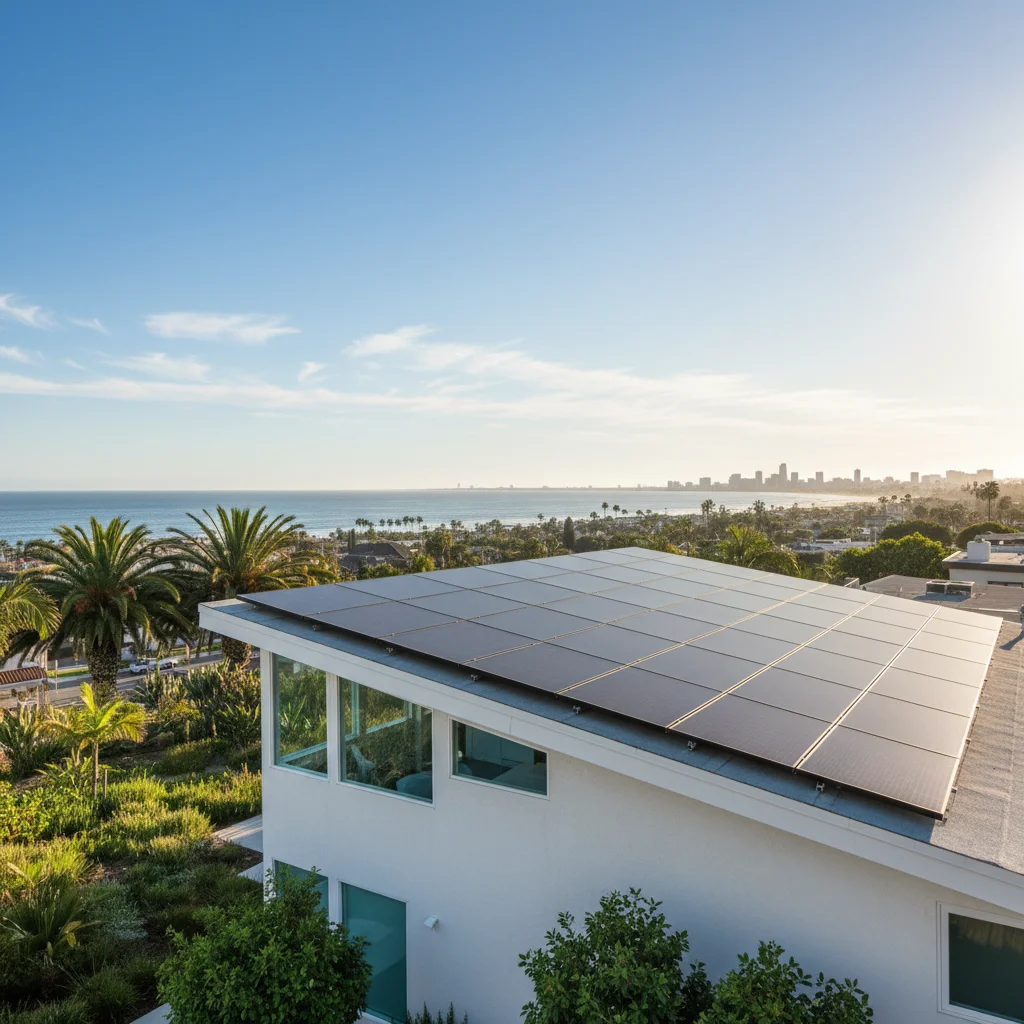
Long Beach homeowners installed 1,247 residential solar systems in 2025, ranking the city third in Los Angeles County for solar adoption. The federal Residential Clean Energy Credit (Section 25D) ended for expenditures made after December 31, 2025, and the IRS treats an expenditure as made when installation is completed (IRS FS-2025-05). Check current state, local and utility incentives for your address with the DuloCore rebate calculator. But the city's coastal climate, average electricity rates of $0.32 per kilowatt-hour, and 287 annual sunny days create conditions where solar panels generate returns faster than inland California markets.
What Solar Panel Companies Operate in Long Beach?
Long Beach's solar market includes 14 licensed C-46 contractors operating within city limits as of March 2026. SunPower, Tesla Energy, and Momentum Solar maintain local offices, while regional installers like Baker Electric and Sullivan Solar Power serve the area from San Diego and Orange County headquarters. Local contractors Complete Solar Solutions and Renewable Energy Concepts hold both state licensing and Long Beach business permits.
The California Contractors State License Board (CSLB) requires C-46 (Solar) or C-10 (Electrical) classification for photovoltaic installation. Long Beach adds municipal permit requirements through the Development Services Department, which processed 1,847 solar permit applications in 2025. And installers must meet Title 24 Building Energy Efficiency Standards that mandate specific mounting hardware for the city's Seismic Design Category D rating.
"All solar installations within Long Beach require both state contractor licensing and city building permits, with inspections at rough-in and final stages." — Long Beach Development Services
Pricing ranges from $2.15 to $3.40 per watt for standard roof-mounted systems, with 6-kilowatt installations averaging $15,900 before incentives. So a typical Long Beach home using 850 kilowatt-hours monthly needs a 7.2-kilowatt system costing $18,720 to $24,480.
How Much Can You Save With Solar in Long Beach? ROI and Payback Period Explained
Long Beach solar installations generate average returns of 12.4% annually, with payback periods ranging from 5.8 to 8.2 years depending on system size and financing method. A 7-kilowatt system costing $21,000 saves $2,940 yearly at current Southern California Edison rates, reaching break-even at year 7.1. And net metering credits under NEM 3.0 add $420 to $780 in annual export compensation.
The federal Residential Clean Energy Credit (Section 25D) ended for expenditures made after December 31, 2025, and the IRS treats an expenditure as made when installation is completed (IRS FS-2025-05). Federal tax credits for this work have ended, but state, local and utility rebates may still apply; check what is available at your address with the DuloCore rebate calculator. So that $21,000 system qualifies for a $6,300 tax credit, reducing net cost to $14,700. But the credit requires sufficient tax liability—homeowners with less than $6,300 in federal taxes owed cannot claim the full amount in one year.
| Cost Component | Amount | Timeline |
|---|---|---|
| Average 7kW system cost | $21,000 | Upfront |
| Federal ITC (30%) | -$6,300 | Year 1 tax filing |
| Annual electricity savings | $2,940 | Years 1-25 |
| Payback period | 7.1 years | — |
| 25-year total savings | $73,500 | Lifetime |
California's Net Energy Metering 3.0 program, which took effect April 2023, reduced export rates by 75% compared to NEM 2.0. So current excess generation earns $0.05 to $0.08 per kilowatt-hour versus the previous $0.30 retail rate match. But self-consumption strategies using battery storage can recapture value by storing midday generation for evening use when time-of-use rates peak at $0.48 per kilowatt-hour.
"The average California solar system pays for itself in 6-9 years and generates $25,000-$30,000 in electricity savings over its lifetime." — U.S. Department of Energy
Long Beach's South Coast climate zone delivers 1,642 peak sun hours annually, 8% above the California average. And the city's coastal location moderates temperature extremes that reduce solar panel efficiency—panels lose 0.5% output for every degree above 77°F, making Long Beach's average highs of 74°F optimal for photovoltaic performance. Calculate your specific savings with our rebate calculator.
Is Your Long Beach Home Suitable for Solar? Climate Zone and System Requirements
Long Beach falls within California Climate Zone 6, characterized by mild coastal conditions with minimal heating demand and moderate cooling loads. Homes in this zone average 850 kilowatt-hours monthly, requiring 6.5 to 7.5 kilowatt systems for 90-100% offset. And south-facing roof slopes between 15 and 40 degrees capture maximum solar radiation, though east-west configurations still achieve 85% of optimal output.
Roof age determines installation feasibility—solar panels last 25-30 years, so roofs older than 15 years need replacement before installation. Composite shingle roofs in Long Beach average 18-22 year lifespans due to mild weather, while concrete tile roofs last 40-50 years. So tile roofs offer better long-term platforms for solar arrays that outlive shingle warranties.
Shading analysis using tools like Aurora Solar or PVWatts identifies obstructions that reduce system output. Trees, adjacent structures, or roof features casting shadows for more than 4 hours daily can decrease production by 20-40%. But microinverters or power optimizers minimize shading losses by allowing each panel to operate independently rather than in series strings.
Long Beach building codes require engineered structural calculations for solar installations exceeding 7 kilowatts or on roofs with slopes above 25 degrees. And the city's Fire Marshal enforces setback requirements of 3 feet from ridgelines and 18 inches from eaves for firefighter roof access. These setbacks reduce usable roof area by 12-18% on typical 1,500-square-foot roof planes.
Solar Panels vs. Other Energy Options: How Do Long Beach Alternatives Compare?
Solar photovoltaic systems cost $2.15-$3.40 per watt compared to heat pump water heaters at $1,200-$3,500 installed and heat pump rebates HVAC systems at $4,000-$12,000. A 7-kilowatt solar array generating $2,940 yearly outperforms heat pump water heater savings of $380-$520 annually. But combined installations maximize total household energy reduction and qualify for multiple IRA tax credits.
Community solar programs let renters and homeowners without suitable roofs subscribe to shared arrays, receiving bill credits for their portion of generation. Southern California Edison's Community Renewables program offers subscriptions starting at 2-kilowatt shares with no upfront cost, though savings average only $8-$14 monthly versus $245 for owned rooftop systems.
Battery storage systems like Tesla Powerwall or Enphase IQ Battery cost $10,000-$15,000 installed for 13.5-kilowatt-hour capacity. And batteries paired with solar capture time-of-use arbitrage by storing midday generation worth $0.05 per kilowatt-hour for evening discharge worth $0.48. So 10-kilowatt-hour daily cycling saves an additional $1,570 yearly beyond solar-only configurations.
Virtual power plant programs pay solar-plus-storage owners $200-$400 annually for letting utilities dispatch batteries during grid emergencies. Southern California Edison's Emergency Load Reduction Program offers $2 per kilowatt-hour discharged during events, adding revenue streams beyond electricity savings.
How Long Do Solar Panels Last and What's Covered by Warranties?
Tier 1 solar panels carry 25-year performance warranties guaranteeing 85-90% output at year 25, with annual degradation rates of 0.3-0.5%. So a panel rated for 400 watts produces 340-360 watts after 25 years of Long Beach operation. But actual lifespan extends to 30-35 years before output drops below economically viable levels.
Inverter warranties range from 10 years for string inverters to 25 years for microinverters, with central inverters requiring replacement at years 10-12 costing $1,200-$2,500. Microinverter systems from Enphase avoid single points of failure, allowing individual unit replacement at $150-$250 versus full inverter swaps.
Installation workmanship warranties cover roof penetrations, mounting hardware, and electrical connections for 5-10 years depending on contractor. And Long Beach's mild climate reduces warranty claims—coastal areas report 40% fewer leak-related issues than inland markets with temperature extremes causing expansion-contraction cycles.
Manufacturer product warranties protect against defects in materials for 10-12 years, separate from performance guarantees. So a panel with manufacturing defects in year 8 receives free replacement, while performance below guaranteed output in year 15 triggers pro-rated compensation based on the performance warranty curve.
What Financial Incentives and Tax Credits Are Available in Long Beach?
The federal Residential Clean Energy Credit (Section 25D) ended for expenditures made after December 31, 2025, and the IRS treats an expenditure as made when installation is completed (IRS FS-2025-05).
California's Disadvantaged Communities - Single-family Solar Homes (DAC-SASH) program offers upfront rebates of $3 per watt for income-qualified homeowners in designated census tracts. Long Beach contains 14 DAC-SASH eligible areas in North Long Beach and West Long Beach, where a 7-kilowatt system receives $21,000 in rebates covering 100% of installation costs.
| Incentive Program | Amount | Eligibility | Expiration |
|---|---|---|---|
| Federal Solar ITC | Ended Dec 31, 2025 | — | Ended Dec 31, 2025 |
| DAC-SASH | $3.00/watt | Income ≤80% AMI in DAC areas | Ongoing (subject to funding) |
| Property Tax Exclusion | 100% assessment exclusion | All CA solar installations | December 31, 2026 |
California's property tax exclusion prevents solar installations from increasing assessed home value through December 31, 2026. So a $21,000 system adds zero to annual property taxes, saving $210-$294 yearly at Long Beach's effective rate of 1.0-1.4%. But this exclusion requires renewal by state legislature for post-2026 installations.
Southern California Edison's Self-Generation Incentive Program (SGIP) provides rebates for battery storage ranging from $200 to $1,000 per kilowatt-hour depending on income qualification. And equity budget allocations in high fire-threat districts offer $1,000 per kilowatt-hour, reducing a 13.5-kilowatt-hour Powerwall cost from $12,000 to $1,500 for qualified applicants. Learn more about available energy tax credits for comprehensive home energy upgrades.
Official Sources
- DOE Homeowner's Guide to Solar Tax Credit — Federal solar photovoltaic tax credit details and requirements (note: the federal 25C and 25D credits ended for projects completed after December 31, 2025)
- DSIRE USA California Programs — Database of state and local renewable energy incentives
- Energy.gov Save Energy, Save Money — Federal guidance on residential energy efficiency and clean energy programs
Frequently Asked Questions
What are the top-rated solar panel companies in Long Beach?
SunPower, Tesla Energy, and Momentum Solar operate local Long Beach offices with C-46 solar contractor licenses. Regional installers Baker Electric and Sullivan Solar Power serve the area with combined 40+ years experience. And local contractors Complete Solar Solutions and Renewable Energy Concepts maintain A+ Better Business Bureau ratings with average installation timelines of 6-8 weeks from permit to interconnection.
How much do solar panels cost in Long Beach?
Long Beach solar installations cost $2.15-$3.40 per watt before incentives, with typical 6-7 kilowatt systems ranging from $15,900 to $24,480. Federal ITC credits reduce net costs by 30%, bringing a $21,000 system to $14,700 after tax filing. And financing options include $0-down loans at 4.99-8.99% APR with 10-25 year terms, or power purchase agreements with no upfront cost but reduced long-term savings.
Are there rebates or incentives for solar panels in Long Beach?
The federal solar credit is no longer available (the federal 25D credit ended for expenditures made after December 31, 2025, IRS FS-2025-05), but Long Beach homeowners can access California's DAC-SASH program offering $3 per watt upfront rebates for income-qualified residents in 14 designated census tracts. Southern California Edison's SGIP provides $200-$1,000 per kilowatt-hour for battery storage, and the state property tax exclusion prevents solar from increasing assessments through December 2026. Check our solar panel rebates guide for complete program details.
How long does it take to install solar panels in Long Beach?
Long Beach solar installations require 6-10 weeks from contract signing to grid interconnection, including 2-3 weeks for Development Services permit approval, 1-2 days for physical installation, and 2-4 weeks for Southern California Edison interconnection approval. And complex projects involving service panel upgrades or structural reinforcement extend timelines to 12-14 weeks. Expedited permitting reduces approval time to 7-10 business days for complete applications with engineered stamped plans.
What is the difference between leasing and buying solar panels?
Purchased solar systems cost $15,900-$24,480 upfront but qualify for $6,300 federal tax credits and generate 25-year savings of $73,500 with 7.1-year payback. Leased systems require $0 down with fixed monthly payments of $80-$150 for 20-25 years, saving $40-$90 monthly versus utility bills but transferring tax credits and SREC revenue to leasing companies. And power purchase agreements charge $0.14-$0.18 per kilowatt-hour for solar generation versus $0.32 utility rates, with no ownership or maintenance responsibility but lower lifetime savings.
Updated: April 14, 2026 — fact-checked by DuloCore Research. About our editorial process.
Check your California solar rebate eligibility — see the programs you qualify for and the dollar amounts on our California solar rebate finder.