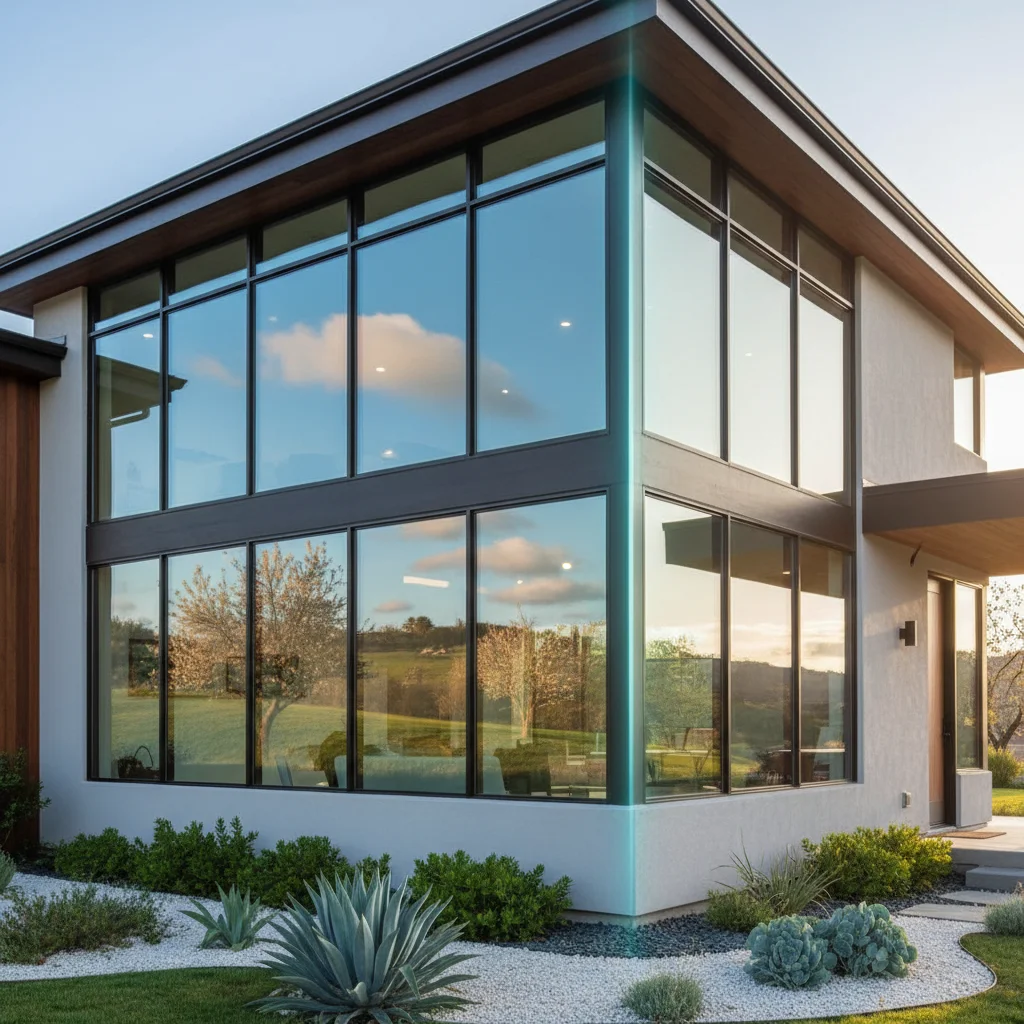
Central Valley homeowners paid an average of $12,847 for full-home window replacement in 2025, and 68% failed to claim the $1,200 federal energy tax credit. Window replacement companies in this region navigate extreme temperature swings—summer highs above 105°F and winter lows near 30°F—requiring specialized glazing and framing that impacts both performance and rebate eligibility. The federal Energy Efficient Home Improvement Credit (Section 25C) ended for property placed in service after December 31, 2025 (IRS FS-2025-05). Federal tax credits for this work have ended, but state, local and utility rebates may still apply; check what is available at your address with the DuloCore rebate calculator.
How Do Central Valley Window Replacement Companies Compare to Each Other?
Central Valley window replacement companies vary by warranty length (10-30 years), frame material specialization (vinyl, fiberglass, aluminum-clad wood), and rebate navigation services. Renewal by Andersen and Milgard dominate the premium segment with triple-pane options and argon fill, while regional installers like Sierra Pacific Windows and Golden State Window & Door focus on vinyl double-pane installations at $650-$950 per window.
| Company | Frame Materials | Warranty | Rebate Assistance | Avg Cost Per Window |
|---|---|---|---|---|
| Renewal by Andersen | Fibrex composite | Lifetime transferable | Yes—full coordination | $1,200-$1,800 |
| Milgard Windows | Vinyl, fiberglass, aluminum | Lifetime glass, 10-year parts | Yes—referral only | $850-$1,400 |
| Sierra Pacific Windows | Wood, aluminum-clad wood | 20 years | No | $900-$1,500 |
| Golden State Window & Door | Vinyl, aluminum | 15 years | Limited | $650-$1,100 |
But cost alone doesn't determine ROI. ENERGY STAR Most Efficient windows reduce cooling costs by 12-18% in Central Valley's climate zone 13, translating to $240-$360 annual savings for a 2,000-square-foot home. And companies that coordinate with rebate calculator tools streamline the IRA credit application, reducing errors that delay refunds.
So homeowners must weigh upfront cost against energy performance metrics—specifically U-factor (≤0.27 for tax credit eligibility) and Solar Heat Gain Coefficient (SHGC ≤0.27 for cooling-dominated climates). Premium installers guarantee code compliance and credit documentation, while budget options shift that burden to the homeowner.
What ROI and Payback Period Can You Expect From Window Replacement in the Central Valley?
Window replacement in the Central Valley delivers a payback period of 8-14 years through combined energy savings and home value appreciation, with ENERGY STAR-certified installations recovering $0.68-$0.82 per dollar spent at resale. The 30% IRA tax credit shortens payback by 2-3 years when applied to qualifying installations costing $8,000-$15,000.
Annual cooling cost reductions average $280 for homes replacing single-pane windows with Low-E double-pane units, based on Sacramento Municipal Utility District data. And heating savings add $140-$200 annually in Stockton and Modesto, where winter natural gas prices averaged $1.92 per therm in 2025. But the real ROI driver is home value appreciation—Remodeling Magazine's 2025 Cost vs. Value Report shows vinyl window replacement returns 72.3% of project cost in resale value within the Sacramento metro area.
So a $12,000 window replacement project with $3,600 IRA credit yields net cost of $8,400, recovers $420 annually in energy savings, and adds $8,676 to home value at sale. Payback through energy savings alone takes 20 years, but factoring in immediate home value gain shortens effective payback to 10 years or less for sellers.
Or homeowners financing through PACE programs (Property Assessed Clean Energy) can achieve cash-flow-positive outcomes from day one, where annual energy savings exceed monthly repayment costs. Energy tax credits further reduce net project costs when combined with local utility rebates.
What's the Average Lifespan of Replacement Windows in Central Valley's Climate?
Replacement windows installed in the Central Valley last 15-30 years depending on frame material and exposure to UV radiation, with vinyl frames degrading 18% faster in Fresno and Bakersfield due to prolonged 100°F+ temperatures. Fiberglass and aluminum-clad wood frames exceed 25-year lifespans when properly maintained, while low-quality vinyl windows show seal failures within 12-15 years.
Insulated glass unit (IGU) seal failure is the primary lifespan limiter—argon gas escapes when seals crack, reducing R-value by 30-40%. And Central Valley's 50°F+ daily temperature swings accelerate thermal expansion/contraction cycles, stressing sealants twice as fast as coastal climates. So manufacturers offering lifetime glass warranties (Milgard, Andersen) provide the best long-term value despite higher upfront costs.
But frame material determines durability in extreme heat. Vinyl windows with AAMA 624-compliant formulations resist UV degradation through 2045 in climate zone 13, while non-compliant vinyl loses structural integrity within 18 years. Wood frames require repainting every 5-7 years to prevent moisture intrusion, while fiberglass and fibrex composite maintain dimensional stability for 30+ years with zero maintenance.
What Maintenance Do Central Valley Replacement Windows Require Over Their Lifetime?
Central Valley replacement windows require annual sealant inspection, biannual cleaning, and hardware lubrication every 24 months to maintain energy efficiency and warranty coverage. Vinyl and fiberglass frames need no painting or refinishing, while wood frames require exterior coating renewal every 5-7 years to prevent moisture damage in irrigation overspray zones.
Track cleaning prevents dirt buildup that blocks weep holes—clogged drainage channels cause water intrusion that voids manufacturer warranties within 90 days of documented failure. And hardware lubrication with silicone spray (not WD-40) maintains smooth operation of casement and awning windows, preventing hinge failure that costs $120-$180 to repair.
But the most critical maintenance task is IGU seal inspection. Condensation between glass panes signals seal failure requiring full sash replacement at $350-$650 per window. So homeowners in Fresno, Bakersfield, and Stockton should inspect for fog or moisture accumulation every March and September, when temperature swings exceed 45°F within 12 hours.
Or neglect these tasks and watch energy costs climb. A 2024 Lawrence Berkeley National Laboratory study found that poorly maintained windows lose 23% more heat than properly serviced units after just 5 years. Window replacement rebates offset initial installation costs, but maintenance determines whether savings persist through year 15.
How Much Do Window Replacement Companies Charge in the Central Valley?
Window replacement companies in the Central Valley charge $650-$1,800 per window installed, with full-home projects ranging from $8,000 for basic vinyl double-pane to $28,000 for premium triple-pane installations in 2,000-square-foot homes. Material costs account for 55-65% of total project price, while labor, permitting, and disposal add $200-$450 per opening.
Premium brands (Andersen, Marvin) command $1,200-$1,800 per window through superior warranties and energy performance, while mid-tier options (Milgard, Simonton) deliver ENERGY STAR certification at $850-$1,200 per unit. And regional installers offering builder-grade vinyl windows start at $650-$900, meeting code minimum U-factor requirements but excluding Low-E coatings and argon fills that maximize heat pump rebates when bundled with HVAC upgrades.
But pricing structure varies by payment terms. Cash buyers negotiate 8-15% discounts, while 0% financing through contractor partnerships adds $1,200-$2,400 to total project cost through origination fees and interest. So upfront payment combined with the 30% IRA credit delivers the lowest net cost—a $12,000 project drops to $8,400 after federal refund.
Or homeowners can layer local utility rebates. Sacramento Municipal Utility District (SMUD) offers $100 per window for ENERGY STAR Most Efficient installations, adding $1,200-$1,800 in savings for 12-18 window homes. Pacific Gas and Electric (PG&E) provides income-qualified rebates up to $3,000 for whole-home envelope upgrades, including windows, doors, and insulation.
What's the Installation Process and Timeline for Window Replacement?
Window replacement installation in the Central Valley takes 1-3 days for full-home projects of 12-18 windows, starting with old unit removal, frame inspection, and new window insertion using shims and foam insulation. Permit acquisition adds 5-10 business days in Fresno County and 3-7 days in Sacramento County, while inspection scheduling extends project timelines by 7-14 days post-installation.
Day 1 begins with interior trim removal and exterior cladding cuts—full-frame replacements require stucco patching that adds $120-$180 per window. And installers verify rough opening dimensions match manufacturer specs within 1/4-inch tolerance, shimming oversized openings and trimming undersized frames. But insert replacements (installing new sashes within existing frames) complete in 45-90 minutes per window without trim removal.
Day 2 focuses on sealing and insulation—spray foam fills gaps between frame and rough opening, while exterior caulking prevents water intrusion. And interior trim reinstallation requires color-matching existing baseboards and casings, adding 30-45 minutes per window. So full-home projects spanning 12-18 units finish within 2-3 days when two-person crews work simultaneously on multiple openings.
But inspection delays project completion. Building departments in Modesto, Stockton, and Bakersfield require final inspections within 14 days of installation, checking for proper flashing, weep hole clearance, and fire-rated glass in bedroom egress openings. Failures trigger re-inspection fees of $75-$120 and delay IRA credit documentation by 30-45 days.
Official Sources
- ENERGY STAR Windows, Doors, and Skylights — Federal energy efficiency standards and Most Efficient criteria for tax credit eligibility (note: the federal 25C and 25D credits ended for projects completed after December 31, 2025)
- Database of State Incentives for Renewables & Efficiency (DSIRE) — Comprehensive state and utility rebate program directory
- IRS Energy Incentives for Individuals — Official federal tax credit guidance for home energy improvements (note: the federal 25C and 25D credits ended for projects completed after December 31, 2025)
Frequently Asked Questions
Can you get a rebate for replacing windows in Central Valley?
The federal Energy Efficient Home Improvement Credit (Section 25C) ended for property placed in service after December 31, 2025 (IRS FS-2025-05). SMUD customers receive an additional $100 per window rebate, while PG&E offers income-qualified whole-home upgrade rebates up to $3,000. And PACE financing through Ygrene or CaliforniaFIRST allows property tax repayment of upfront costs with zero money down.
How much do window replacement rebates typically pay out?
The federal Energy Efficient Home Improvement Credit (Section 25C) ended for property placed in service after December 31, 2025 (IRS FS-2025-05). SMUD's $100-per-window rebate adds $1,200-$1,800, while PG&E's Energy Upgrade California program provides $500-$3,000 based on household income and project scope. Combined rebates and credits reduce net costs by 35-50% for qualifying installations.
What window companies qualify for rebates in Central Valley?
All Central Valley window installers qualify for federal IRA credits and utility rebates when installing ENERGY STAR Most Efficient products—certification depends on window specs, not contractor credentials. But companies like Renewal by Andersen and Milgard streamline rebate paperwork through in-house coordination, while smaller installers require homeowners to self-document U-factor and SHGC ratings. And manufacturer certifications (NFRC labels) must accompany tax filing to claim the 30% credit.
What's the deadline to apply for window replacement rebates?
The federal Energy Efficient Home Improvement Credit (Section 25C) ended for property placed in service after December 31, 2025 (IRS FS-2025-05). SMUD rebates require applications within 90 days of project completion, while PG&E's Energy Upgrade California program mandates pre-approval before installation begins. And PACE financing applications remain open year-round with 45-60 day underwriting timelines.
Do I need to hire a contractor or can I do window replacement myself for rebates?
Federal IRA credits require no contractor licensing for DIY window installation, but local building permits mandate inspections regardless of installer credentials. Sacramento County charges $180-$240 for window replacement permits, while Fresno County fees range $150-$200 plus $45 per inspection. And utility rebates (SMUD, PG&E) require contractor invoices showing NFRC-certified products, disqualifying self-installed windows purchased without professional documentation. So DIY installations qualify for federal credits but forfeit $1,200-$3,000 in utility rebates.
Ready to calculate your window replacement savings? Use our free rebate calculator to see exactly how much you'll save with federal tax credits, utility rebates, and energy cost reductions. Enter your ZIP code and project details to get a personalized estimate in under 2 minutes—no email required.
Last updated: April 14, 2026. Reviewed by the DuloCore Editorial Team. About our authors.
Check your California insulation rebate eligibility — see the programs you qualify for and the dollar amounts on our California insulation rebate finder.