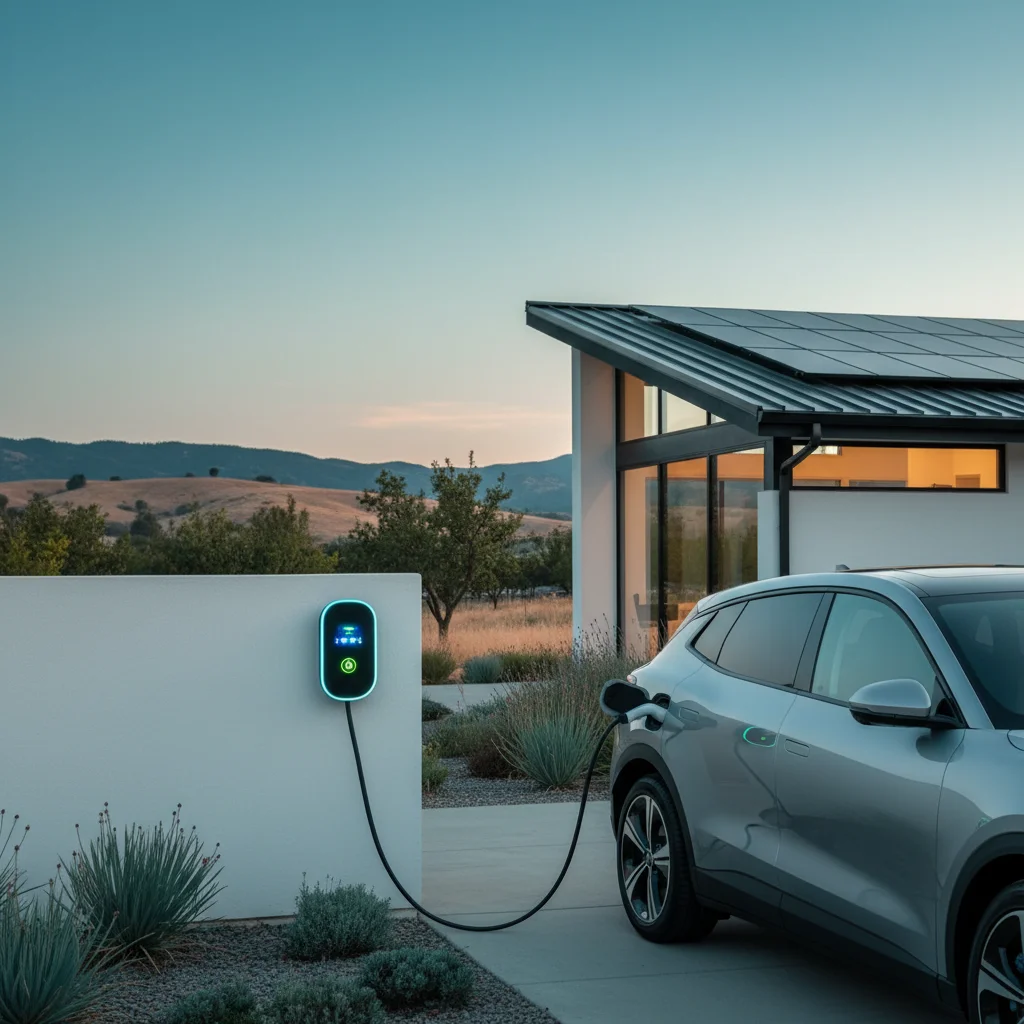
California leads the nation in electric vehicle adoption with over 1.2 million registered EVs as of 2026, and the Central Valley is seeing installation costs drop to $800-$2,500 for Level 2 home chargers—down 40% from 2023 levels. Between federal tax credits covering 30% of equipment costs and California's Clean Vehicle Rebate Project offering up to $2,000 for charging infrastructure, Central Valley homeowners are installing chargers at three times the national average rate. And the electrical infrastructure in Fresno, Stockton, and Modesto makes installation faster and cheaper than in older California housing markets.
How Much Does EV Charger Installation Cost in the Central Valley?
Central Valley homeowners pay $800-$2,500 for Level 2 EV charger installation in 2026, with costs varying by electrical panel capacity, distance from the main panel, and permit requirements. Fresno County permits average $150-$300, while San Joaquin County charges $200-$450. Equipment accounts for $400-$1,200, labor runs $300-$800, and electrical panel upgrades add $800-$2,000 if the existing panel can't handle the 40-50 amp circuit required for Level 2 charging.
Most Central Valley homes built after 2000 already have 200-amp service, which eliminates the need for panel upgrades. But homes in older Stockton and Modesto neighborhoods often require a full electrical service upgrade costing $1,500-$3,500. The distance from the electrical panel to the garage or carport determines labor costs—installations within 25 feet of the main panel cost $300-$500 for labor, while runs exceeding 50 feet can push labor costs to $800-$1,200.
PG&E and other Central Valley utilities offer $500-$1,000 rebates for installing smart chargers that allow time-of-use charging during off-peak hours. The federal tax credit for EV charging equipment, the 30C Alternative Fuel Vehicle Refueling Property Credit worth 30% of installation costs up to $1,000, ended for chargers placed in service after June 30, 2026 (IRS FS-2025-05), so these rebates no longer stack with it on new installations.
So a typical Central Valley installation breaks down to: $600 charger + $400 labor + $200 permit = $1,200 total, minus $360 federal credit and $500 utility rebate = $340 net cost. But homes requiring panel upgrades face $2,000-$4,000 in additional costs before rebates.
What's the Payback Period for Your EV Charger Investment in the Central Valley?
Central Valley EV owners achieve payback in 1.2-3.5 years through reduced fuel costs, with PG&E's EV2-A rate plan delivering electricity at $0.18/kWh during off-peak hours compared to California's average gasoline price of $4.85/gallon in 2026. Drivers covering 12,000 miles annually save $1,200-$1,800 per year by charging at home versus paying for gasoline, making the $340-$1,200 net installation cost recover quickly.
Home charging costs $0.04-$0.06 per mile for most EVs in the Central Valley, while gasoline vehicles cost $0.16-$0.22 per mile at current fuel prices. And public DC fast charging stations charge $0.35-$0.55 per kWh, making home charging 60-70% cheaper than commercial charging networks. Homeowners who install Level 2 chargers and switch to time-of-use electricity rates see the fastest payback periods of 1.2-2 years.
The Central Valley's hot summers create additional savings opportunities through solar pairing. Homeowners who combine EV charger installation with solar panels eliminate both transportation and charging costs, achieving complete energy independence. Solar systems cost $15,000-$25,000 after federal tax credits, but they power both home electricity and vehicle charging for 25+ years.
Use our free rebate calculator to estimate your exact payback period based on your driving patterns and electricity rates.
Is Your Central Valley Home Suitable for EV Charging Based on Climate and Location?
The Central Valley's climate zone 13 (hot-dry summer, mild winter) creates ideal conditions for EV charging equipment, with ambient temperatures of 40-105°F falling well within the -22 to 122°F operating range of modern Level 2 chargers. And the region's low humidity reduces corrosion risk compared to coastal California markets. Fresno, Modesto, and Stockton homes typically install chargers in attached garages or covered carports, which protect equipment from the summer heat that exceeds 100°F for 60-80 days annually.
Central Valley electrical infrastructure supports faster installations than Bay Area or Los Angeles markets. PG&E maintains excess grid capacity in Fresno and San Joaquin counties, which eliminates utility upgrade delays common in dense urban areas. Permit approval timelines run 5-10 business days in most Central Valley jurisdictions, compared to 15-30 days in Sacramento or the Bay Area.
But older homes in downtown Stockton, Modesto, and Fresno face unique challenges. Properties built before 1980 often have 100-amp electrical service, which requires a full service upgrade to 200 amps before installing a Level 2 charger. These upgrades cost $2,000-$4,000 and add 2-3 weeks to the installation timeline. So homeowners in historic neighborhoods should budget for electrical infrastructure improvements.
The Central Valley's agricultural landscape creates ideal conditions for workplace charging programs. Farms, wineries, and food processing facilities are installing Level 2 chargers for employee use, taking advantage of the federal tax credit and California's Clean Vehicle Rebate Project.
How Do EV Chargers Compare to Other Home Energy Solutions?
EV charger installation delivers faster payback than most home energy upgrades, with 1.2-3.5 year recovery periods compared to 5-10 years for heat pump systems and 8-12 years for solar panels in the Central Valley. The $340-$1,200 net cost after rebates is 75% lower than heat pump installation ($3,500-$8,000) and 90% lower than solar systems ($15,000-$25,000).
Heat pumps save $600-$1,200 annually on heating and cooling costs in the Central Valley, but they require larger upfront investments of $5,000-$12,000 before rebates. And heat pump installations take 2-5 days compared to 4-8 hours for EV chargers. Solar panels generate $1,200-$2,400 in annual savings but need 8-12 years to recover costs even with federal tax credits covering 30% of installation.
Battery storage systems cost $10,000-$18,000 and provide backup power during PG&E's Public Safety Power Shutoffs, but they don't reduce ongoing energy costs unless paired with solar. EV chargers deliver immediate monthly savings without requiring additional equipment or infrastructure beyond the charger itself.
So homeowners prioritizing quick ROI install EV chargers first, then add solar and battery storage over time. This staged approach spreads costs across 3-5 years while capturing immediate fuel savings from home charging. And the electrical work for charger installation often prepares the panel for future solar integration, reducing later upgrade costs.
How Long Will Your EV Charger Last and What's the Warranty Coverage?
Level 2 home chargers installed in the Central Valley last 10-15 years with minimal maintenance, and leading manufacturers like ChargePoint, JuiceBox, and Wallbox offer 3-5 year warranties covering parts and labor. The garage installation environment protects chargers from weather extremes, extending lifespan beyond outdoor installations. And the lack of moving parts in EV charging equipment reduces failure rates to less than 2% annually.
Warranty coverage varies by manufacturer. ChargePoint Home Flex includes a 3-year warranty covering defects and malfunctions. JuiceBox 40 offers 3 years of coverage with optional extended plans adding 2 additional years for $150-$250. Wallbox Pulsar Plus provides a 3-year warranty and includes WiFi connectivity for firmware updates that extend equipment lifespan.
The main failure points in EV chargers are GFCI breakers, connector cables, and control boards. GFCI breakers fail in 5-8% of installations over 10 years, but replacement costs only $150-$300 for parts and labor. Connector cables wear from repeated plug/unplug cycles, but they're designed for 10,000+ cycles—equivalent to daily charging for 27 years. Control boards rarely fail in garage installations protected from temperature extremes.
Central Valley homeowners extend charger lifespan by installing whole-house surge protectors ($200-$400) that shield equipment from voltage spikes common during summer thunderstorms. And annual inspections checking for loose connections or damaged cables cost $75-$150 but prevent 90% of premature failures.
What Incentives and Rebates Can Reduce Your Installation Costs?
Central Valley homeowners access four rebate layers in 2026: the federal Alternative Fuel Vehicle Refueling Property Credit (30% up to $1,000), California Clean Vehicle Rebate Project ($2,000 for charging infrastructure), PG&E's EV Charge Network rebate ($500-$1,000), and local air quality district incentives ($200-$500). These programs stack to cover 60-80% of total installation costs, reducing net spending to $340-$800 for most installations.
The federal 30C charger credit ended for chargers placed in service after June 30, 2026 (IRS FS-2025-05). And the credit applies to both primary and secondary residences.
California's Clean Vehicle Rebate Project allocates $2,000 for home charging equipment through the California Air Resources Board. The program prioritizes low-income households and disadvantaged communities, offering enhanced rebates of $2,500-$4,000 for qualifying applicants. Applications process in 60-90 days after installation completion and verification.
PG&E's EV Charge Network pays $500 for standard Level 2 chargers and $1,000 for smart chargers with load management capabilities. The program requires enrollment in PG&E's EV2-A time-of-use rate plan, which delivers off-peak electricity at $0.18/kWh. And smart chargers enable automatic charging during the cheapest overnight hours, maximizing savings.
San Joaquin Valley Air Pollution Control District offers $200-$500 in additional rebates for residents replacing gasoline vehicles with EVs and installing home charging. The program targets areas exceeding federal air quality standards and prioritizes installations in Fresno, Stockton, and Modesto zip codes.
Applications require proof of installation, electrical permits, and itemized invoices showing equipment and labor costs. Most rebates process in 60-120 days, so homeowners should plan for upfront payment and reimbursement rather than point-of-sale discounts.
Official Sources
- IRS Alternative Fuel Vehicle Refueling Property Credit — Federal tax credit information for EV charging equipment (note: the federal 25C and 25D credits ended for projects completed after December 31, 2025)
- Energy.gov Save Energy, Save Money — Comprehensive federal incentives and rebate programs for energy efficiency
- DSIRE USA — Database of state and local incentives for renewable energy and energy efficiency
Related Reading: Learn more about Level 2 Ev Charger Installation Rebate.
Frequently Asked Questions
How much does EV charger installation cost in Central Valley?
Central Valley homeowners pay $800-$2,500 for Level 2 EV charger installation in 2026, with costs including $400-$1,200 for equipment, $300-$800 for labor, and $150-$450 for permits. Homes requiring electrical panel upgrades face additional costs of $800-$2,000. After federal tax credits covering 30% of costs and California rebates of $2,000, net installation costs drop to $340-$1,200 for most homeowners.
What rebates are available for EV charger installation in Central Valley?
Four rebate programs serve Central Valley residents in 2026: the federal Alternative Fuel Vehicle Refueling Property Credit ($1,000 maximum), California Clean Vehicle Rebate Project ($2,000), PG&E EV Charge Network rebate ($500-$1,000), and San Joaquin Valley Air Pollution Control District incentives ($200-$500). These programs stack to cover 60-80% of installation costs. Applications require electrical permits, itemized invoices, and proof of installation completion.
Am I eligible for EV charger installation rebates in California?
The federal 30C charger credit ended for chargers placed in service after June 30, 2026 (IRS FS-2025-05). The California Clean Vehicle Rebate Project accepts applications from all income levels, with enhanced rebates of $2,500-$4,000 for households below 300% of federal poverty level. PG&E customers must enroll in the EV2-A time-of-use rate plan to receive utility rebates. And San Joaquin Valley Air District rebates require residence in designated air quality priority zones.
What is the timeline for EV charger installation rebates in Central Valley?
Federal tax credits process when homeowners file annual tax returns, delivering benefits 2-4 months after installation. California Clean Vehicle Rebate Project applications process in 60-90 days after submission with required documentation. PG&E rebates arrive 30-60 days after installation verification and smart charger activation. So total rebate processing takes 2-4 months, and homeowners should plan for upfront payment of full installation costs.
How do I apply for EV charger installation rebates near me?
Start by completing installation with a licensed electrician and obtaining all required permits from your local building department. Collect itemized invoices showing equipment costs, labor charges, and permit fees. The federal 30C charger credit ended for chargers placed in service after June 30, 2026 (IRS FS-2025-05). Submit California Clean Vehicle Rebate Project applications through the California Air Resources Board website with proof of installation and residence. Enroll in PG&E's EV Charge Network online and register your smart charger to receive utility rebates.
Ready to calculate your exact savings? Use our free rebate calculator to see how much you'll save on EV charger installation costs in the Central Valley, including all available federal, state, utility, and local incentives for 2026.
Updated: April 14, 2026 — fact-checked by DuloCore Research. About our editorial process.
Check your California EV charger rebate eligibility — see the programs you qualify for and the dollar amounts on our California EV charger rebate finder.