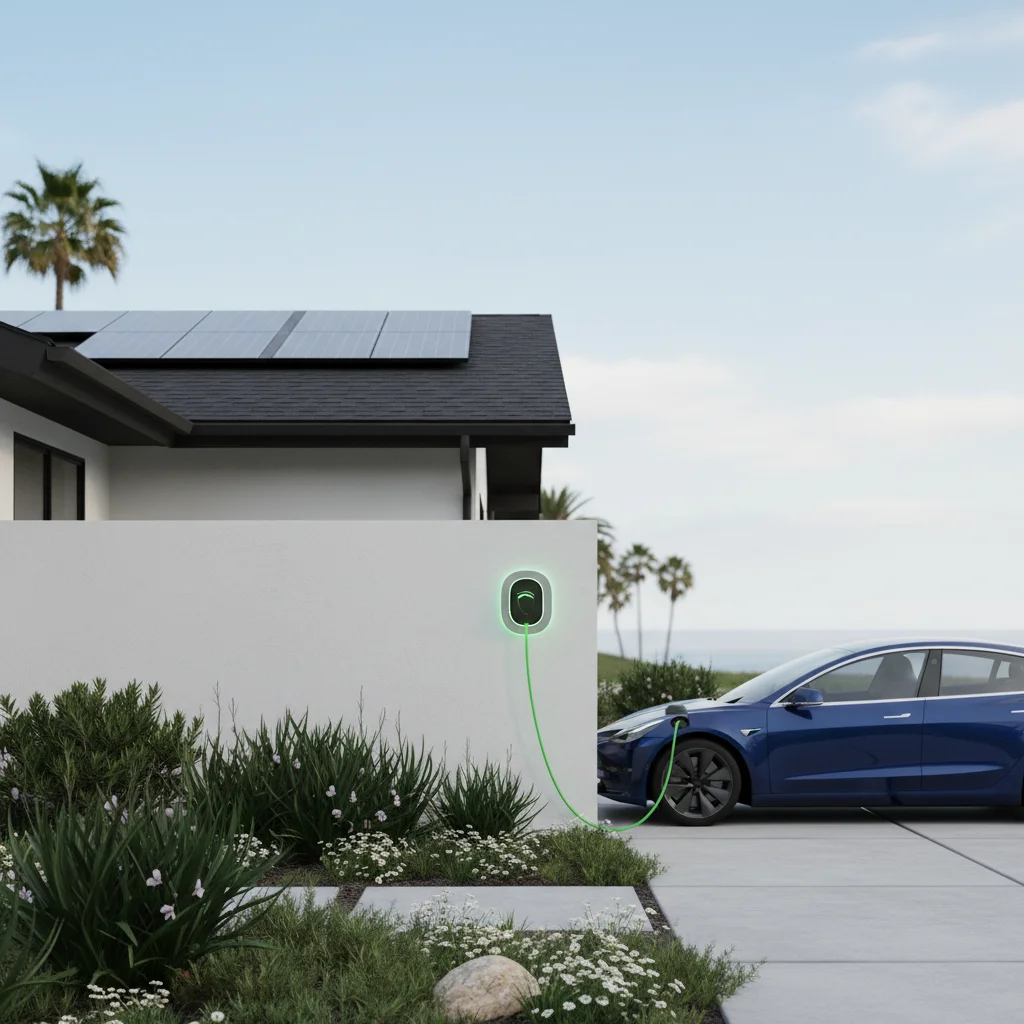
Long Beach homeowners installing a Level 2 EV charger in 2026 pay between $800 and $3,200 after factoring in federal tax credits and local utility rebates—but the final price depends on electrical panel capacity, permit fees, and whether the installer qualifies for prevailing wage requirements. Southern California Edison offers up to $1,500 in rebates, but the federal 30C Alternative Fuel Vehicle Refueling Property Credit ended for chargers placed in service after June 30, 2026 (IRS FS-2025-05), so new installations no longer get a federal credit on top of the utility rebate.
How Much Does EV Charger Installation Cost in Long Beach?
Level 2 EV charger installations in Long Beach range from $1,200 to $4,700 before incentives, with the average project costing $2,400 in 2026. Hardware accounts for $400 to $1,200, while labor and electrical work add $800 to $3,500 depending on panel upgrades and distance from the meter.
The total price depends on five factors: charger model, electrical panel capacity, permit fees, trenching or conduit runs, and prevailing wage compliance for rebate-qualified installers. Homeowners with modern 200-amp panels and garage-adjacent meters pay $1,200 to $1,800. But properties requiring panel upgrades or 50-foot cable runs see costs climb to $3,500 or more. And Long Beach requires permits for all hardwired installations, adding $150 to $300 in city fees.
So what drives the spread? Panel upgrades account for 60% of cost variance. A home with a maxed-out 100-amp panel needs a $1,500 to $2,500 upgrade before the charger goes in. But homes with spare capacity skip this expense entirely.
Southern California Edison (SCE) serves most of Long Beach and offers the Charge Ready 2 rebate—up to $1,500 for income-qualified residents installing Level 2 chargers. The federal 30C charger credit ended for chargers placed in service after June 30, 2026 (IRS FS-2025-05). Check our rebate calculator to see your exact savings.
What's the ROI and Payback Period for Installing an EV Charger at Home?
Home EV charger installations in Long Beach deliver payback periods of 1.2 to 3.5 years based on gasoline price differentials and annual driving mileage. Drivers covering 12,000 miles per year save $900 to $1,400 annually compared to gasoline vehicles at 2026 fuel prices.
The math breaks down like this: charging a Tesla Model 3 at home costs $0.18 per kWh on SCE's residential rate, translating to $0.04 per mile. Gasoline at $4.50 per gallon and 30 mpg costs $0.15 per mile—a $0.11 savings per mile. So a 12,000-mile driver saves $1,320 annually. And after the federal credit and SCE rebate, a $2,400 installation drops to $900 out-of-pocket, delivering payback in 8 months.
But the ROI varies by rate plan. SCE's Time-of-Use (TOU-D-PRIME) plan offers $0.13 per kWh overnight rates, cutting per-mile costs to $0.03 and boosting annual savings to $1,440. Drivers on standard TOU plans pay $0.23 per kWh during peak hours, slashing savings if they charge after 4 PM.
The tension lies in charging behavior: overnight chargers see 3-year payback, while peak-hour users stretch it to 5 years. And drivers logging 20,000 miles annually recoup costs in 6 months versus 2.5 years for 6,000-mile commuters. Public charging at $0.35 to $0.60 per kWh makes home installations a clear winner for anyone driving more than 8,000 miles per year. Learn more about how energy tax credits apply to EV infrastructure.
How Does Home Charging Compare to Public Charging Alternatives in Long Beach?
Home Level 2 charging costs $0.04 per mile in Long Beach versus $0.09 to $0.16 per mile at public stations, with DC fast charging hitting $0.20 per mile during peak hours. A driver covering 12,000 miles annually spends $480 at home versus $1,080 to $2,400 at public chargers.
Public charging networks like Electrify America and EVgo charge $0.35 to $0.60 per kWh across Long Beach, with demand-based pricing spiking to $0.70 during rush hours. DC fast chargers add convenience—80% charge in 25 minutes—but cost 10x more per kWh than overnight home rates. And membership fees ($4 to $7 monthly) add another $50 to $85 annually.
The convenience gap matters: home charging eliminates station hunting, wait times, and availability uncertainty. Long Beach has 147 public charging ports as of 2026, but 62% experience peak-hour queues exceeding 15 minutes. So drivers relying on public infrastructure lose 45 to 90 minutes weekly to charging logistics.
But apartment dwellers without home charging options face a tough trade-off. Installing a charger in a rental property requires landlord approval and often fails ROI tests for tenants planning to move within 3 years. Public charging remains the only option for 38% of Long Beach residents in multi-unit buildings. Explore ev charger rebates to see if shared building installations qualify.
What Incentives and Rebates Can Reduce Your Installation Costs?
Long Beach homeowners in 2026 access three stacked incentives: the federal Alternative Fuel Vehicle Refueling Property Credit (30% up to $1,000), Southern California Edison's Charge Ready 2 rebate (up to $1,500), and California's Clean Vehicle Rebate Project Charge Ahead initiative ($2,000 for income-qualified buyers).
The federal credit applies to hardware and installation costs, capping at $1,000 regardless of project size. SCE's program targets income-qualified households earning below 80% of area median income—$89,600 for a family of four in Los Angeles County in 2026. And the Charge Ahead rebate combines with vehicle purchase rebates, covering chargers installed within 12 months of EV purchase.
So a $2,400 installation for an eligible household drops to zero: $1,000 federal credit, $1,500 SCE rebate, minus $2,400 cost. But higher-income households receive only the federal $1,000 credit, paying $1,400 out-of-pocket on the same project.
The catch: rebates require prevailing wage compliance for installations exceeding $1,500 in total costs. Long Beach contractors certified under SCE's program charge 15% to 25% more than non-certified installers, offsetting some rebate value. And applications take 8 to 12 weeks for approval, delaying project timelines. The Database of State Incentives for Renewables & Efficiency (DSIRE) tracks all California EV incentives at dsireusa.org.
"California's Clean Vehicle Rebate Project offers up to $2,000 for income-qualified residents purchasing or leasing eligible zero-emission vehicles, with additional funding available for charging infrastructure through Charge Ahead." — California Clean Vehicle Rebate Project
How Long Will Your EV Charger Last and What's the Maintenance Cost?
Level 2 EV chargers installed in Long Beach carry 15 to 20-year lifespans with maintenance costs averaging $50 to $150 annually for cable replacements and electrical inspections. Hardware warranties cover 3 to 5 years, while electrical components last 10 to 15 years before requiring service.
The main wear points are charging cables and GFCI breakers. Cables exposed to UV light and temperature swings degrade faster—outdoor installations in coastal Long Beach see 12-year cable life versus 18 years for garage-mounted units. And GFCI breakers trip 2 to 4 times annually on older panels, requiring $75 to $120 electrician visits.
So annual ownership costs break down to $35 for cable replacement reserves, $40 for electrical inspections, and $25 for connectivity or software updates on smart chargers. But basic hardwired units like the ChargePoint Home Flex eliminate connectivity fees entirely, dropping annual costs to $60.
The hidden cost: electrical panel maintenance. Chargers drawing 40 to 50 amps stress aging panels, accelerating breaker wear. Homes with panels older than 20 years face $200 to $400 in preventive replacements every 5 to 7 years. And insurance riders for EV charging equipment add $15 to $30 annually to homeowner policies in fire-prone areas. Similar long-term planning applies to heat pump rebates and whole-home efficiency upgrades.
What's the Installation Process and Timeline in Long Beach?
EV charger installations in Long Beach follow a four-phase process spanning 2 to 6 weeks: site assessment (1-3 days), permit approval (7-14 days), installation (4-8 hours), and utility inspection (3-7 days). Projects requiring panel upgrades or trenching extend timelines to 8 weeks.
Phase one involves an electrician evaluating panel capacity, meter distance, and code compliance. Long Beach requires GFCI protection, dedicated 40- to 50-amp circuits, and conduit for outdoor runs—adding $150 to $400 beyond basic installations. And coastal properties within 3 miles of the Pacific need corrosion-resistant enclosures, raising material costs 12% to 18%.
Permit approval through the Long Beach Development Services Department takes 10 business days for standard installations and 21 days for projects involving panel upgrades or structural modifications. The city charges $183 for electrical permits plus $47 for plan review on installations exceeding $2,500 in value.
Installation day involves mounting the charger, running conduit, connecting the circuit, and testing voltage. But the final inspection can't occur until SCE activates the meter upgrade if load requirements exceed existing capacity—adding 5 to 10 days. So total elapsed time from quote to first charge averages 24 days for simple installs and 52 days for complex projects. Use our rebate calculator to estimate your timeline with incentive processing.
Official Sources
- IRS Alternative Fuel Refueling Property Credit — Federal tax credit details and eligibility requirements for EV charging infrastructure (note: the federal 25C and 25D credits ended for projects completed after December 31, 2025)
- Database of State Incentives for Renewables & Efficiency — Comprehensive database of California EV charging rebates and incentive programs
- U.S. Department of Energy Alternative Fuels Data Center — Federal guidance on EV infrastructure costs, savings calculations, and charging station locators
Frequently Asked Questions
How much does it cost to install an EV charger in Long Beach?
EV charger installation in Long Beach costs $1,200 to $4,700 before incentives in 2026, with the average project running $2,400. Hardware accounts for $400 to $1,200, while labor and electrical work add $800 to $3,500 depending on panel capacity and permit requirements. Homes needing panel upgrades pay $1,500 to $2,500 extra, but federal and utility rebates reduce out-of-pocket costs to $900 to $1,400 for eligible households.
What rebates are available for EV charger installation in Long Beach?
Long Beach residents access three rebates in 2026: the federal Alternative Fuel Vehicle Refueling Property Credit (30% up to $1,000), Southern California Edison's Charge Ready 2 program (up to $1,500 for income-qualified households), and California's Clean Vehicle Rebate Project Charge Ahead ($2,000 for low-income EV buyers). These stack to cover $2,500 to $4,500 in total installation costs, often eliminating out-of-pocket expenses for eligible families.
Am I eligible for EV charger installation rebates in Long Beach?
Southern California Edison's Charge Ready 2 rebate requires household income below 80% of area median income—$89,600 for a family of four in Los Angeles County in 2026. The federal credit applies to all taxpayers with tax liability, while California's Charge Ahead targets households below 300% of federal poverty level ($93,600 for four people). And all rebates require using certified installers and approved charger models from the California Energy Commission's equipment list.
How long does it take to get an EV charger installed in Long Beach?
EV charger installations in Long Beach take 2 to 6 weeks from quote to activation, including site assessment (1-3 days), permit approval (7-14 days), installation (4-8 hours), and utility inspection (3-7 days). Projects requiring electrical panel upgrades extend timelines to 8 weeks, while rebate applications add 8 to 12 weeks for processing. And coastal properties need corrosion-resistant materials, delaying procurement 5 to 10 days.
What is the difference between Level 2 and DC fast charging installation costs?
Level 2 chargers cost $1,200 to $4,700 to install in Long Beach homes, delivering 25 to 30 miles of range per hour at 240 volts. DC fast chargers require commercial-grade electrical service (480 volts, 100+ amps) and cost $40,000 to $150,000 to install, making them impractical for residential use. And home DC fast charging draws enough power to trigger utility demand charges of $500+ monthly, eliminating any cost advantage over public stations.
Ready to see your exact savings? Use our free rebate calculator to find every federal, state, and utility incentive available for your Long Beach home—plus get matched with certified installers who maximize your rebates.
Updated on April 14, 2026. Fact-checked by DuloCore Editors. About our research team.
Check your California EV charger rebate eligibility — see the programs you qualify for and the dollar amounts on our California EV charger rebate finder.