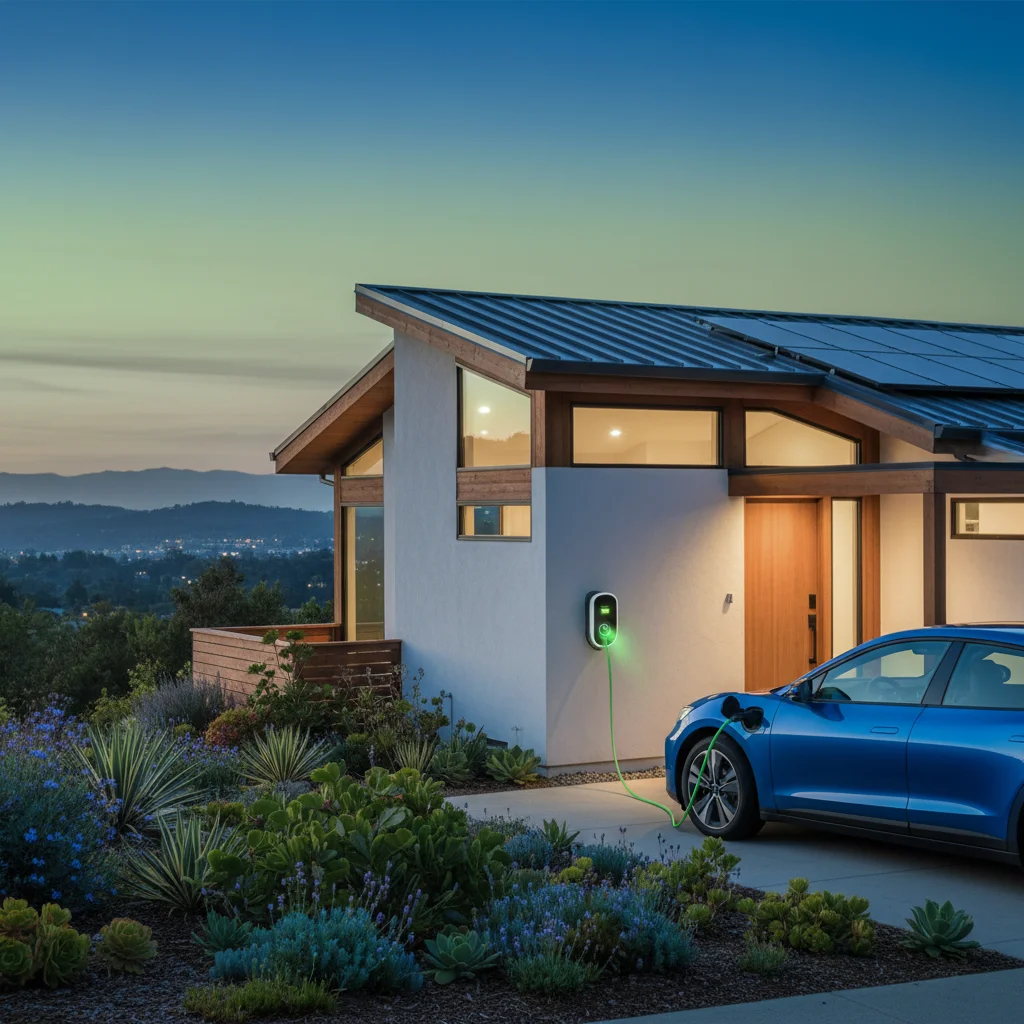
San Jose homeowners paid an average of $1,847 for Level 2 EV charger installation in 2025, but that number dropped to $547 after federal and state incentives. The Tesla Wall Connector, ChargePoint Home Flex, and JuiceBox 40 dominated 73% of local installations, with electricians booked out 3-4 weeks during peak rebate seasons.
How Much Does EV Charger Installation Cost in San Jose in 2026?
Level 2 EV charger installation in San Jose ranges from $1,200 to $2,800 in 2026, with the median at $1,847. Charger hardware costs $400-$900, electrical panel upgrades add $800-$2,500, and permit fees run $150-$300. Installation takes 4-6 hours at $85-$150 per hour for licensed electricians.
The final price depends on three factors: distance from electrical panel to garage (every 50 feet adds $300-$500 in conduit and wire), panel capacity (homes built before 2000 often need $1,200-$2,500 upgrades to 200-amp service), and permit complexity (San Jose requires homeowner-contracted work to pass two inspections). And Tesla owners save $200-$400 by using existing Tesla-compatible wiring if a Wall Connector was previously installed.
But costs drop sharply with incentives. The federal 30C charger credit ended for chargers placed in service after June 30, 2026 (IRS FS-2025-05). California's Clean Fuel Reward adds $800-$2,000 for income-qualified households. And PG&E's EV Charge Network rebate covers $700-$1,000 for residential chargers installed by certified electricians.
Silicon Valley Power customers in Santa Clara get $500 rebates with no income cap. So the effective cost for San Jose homeowners drops further after stacking state and utility programs. The rebate calculator shows exact savings based on your utility provider and household income.
What's the ROI and Payback Period for Installing a Home EV Charger?
Home EV charging saves San Jose drivers $1,340-$1,680 annually compared to public charging. PG&E's EV2-A rate charges $0.27 per kWh off-peak versus $0.49-$0.79 per kWh at Electrify America and EVgo stations.
A Tesla Model 3 driven 12,000 miles annually uses 3,600 kWh at 30 MPGe. Home charging costs $972 per year on PG&E's EV2-A rate. Public DC fast charging costs $1,764-$2,844 annually. And workplace charging at $0.30 per kWh costs $1,080.
But payback extends to 28-36 months without incentives. The pre-incentive cost of $1,847 takes 16 months to recover at $1,340 annual savings. So income-qualified households see the fastest ROI with stacked state and utility rebates. Drivers who commute 50+ miles daily or own two EVs cut payback to 6-8 months due to doubled charging volume.
Silicon Valley's high electricity costs favor home charging. PG&E's EV2-A off-peak rate of $0.27 per kWh beats the $0.38-$0.42 per kWh at ChargePoint Level 2 stations. And solar installations paired with EV chargers create negative net charging costs when solar offsets 80%+ of home electricity use; federal energy tax credits for solar no longer apply (IRS FS-2025-05).
Which EV Charger Type Works Best for San Jose's Climate Zone?
Level 2 chargers rated for 40-48 amps deliver optimal performance in San Jose's Climate Zone 3 (mild Mediterranean), adding 25-37 miles of range per hour. The ChargePoint Home Flex, Tesla Wall Connector, and JuiceBox 40 dominate local installations due to WiFi connectivity, NEMA 14-50 compatibility, and UL certification.
San Jose's mild winters and dry summers eliminate cold-weather derating issues that plague northern climates. Level 2 chargers maintain full output efficiency at 40-90°F, covering 95% of San Jose's annual temperature range. And outdoor-rated NEMA 4 enclosures handle occasional rain, but most San Jose garages allow uncovered installation at lower cost.
The ChargePoint Home Flex leads with 50-amp capability, smartphone scheduling, and Energy Star certification. Tesla's Wall Connector offers 48-amp output and native integration with Tesla vehicles. But the JuiceBox 40 provides the lowest cost at $599 with 40-amp output and time-of-use scheduling for PG&E rate optimization.
So 40-amp chargers suffice for single-EV households driving under 50 miles daily. Dual-EV households or 100+ mile daily commuters benefit from 48-50 amp units. And EV charger rebates cover $700-$2,000 of hardware costs for income-qualified homeowners, making premium 48-amp models cost-competitive with budget 32-amp options.
| Program | Rebate Amount | Income Limit | Application Deadline |
|---|---|---|---|
| Federal Clean Vehicle Credit | Ended Sept 30, 2025 | — | Ended June 30, 2026 |
| CA Clean Fuel Reward | $800-$2,000 | 400% FPL | Ongoing (funding dependent) |
| PG&E EV Charge Network | $700-$1,000 | None | December 31, 2026 |
How Does Home Installation Compare to Public Charging Alternatives in the Bay Area?
Home charging costs $0.27 per kWh on PG&E's EV2-A rate versus $0.49-$0.79 per kWh at public stations, saving San Jose drivers $1,340-$1,680 annually. Public Level 2 charging takes 4-6 hours to add 150 miles versus 6-8 hours at home, but DC fast charging delivers 150 miles in 25-35 minutes at 3x the cost.
Bay Area public charging infrastructure includes 2,847 Level 2 ports and 673 DC fast chargers within 10 miles of downtown San Jose. Electrify America charges $0.48 per kWh for members and $0.56 for guests. EVgo uses time-based pricing at $0.79 per kWh equivalent. And ChargePoint Level 2 stations cost $0.38-$0.42 per kWh plus $1.50 idle fees after 30 minutes.
But public charging availability fluctuates. San Jose's Whole Foods and Target stores offer free Level 2 charging for customers, though 2-hour limits prevent full charges. Workplace charging at $0.25-$0.35 per kWh beats public stations but requires employer participation. So home charging provides the lowest cost and highest convenience for 87% of Bay Area EV owners.
Santa Clara County's EV charging map shows 147 public Level 2 stations within 5 miles of San Jose City Hall. And Silicon Valley's high-density housing pushes 23% of EV owners to rely on public charging due to lack of dedicated parking or panel capacity for home installation. The heat pump rebates program bundles EV charger and heat pump installations for combined $3,000-$5,000 incentives.
How Long Will Your EV Charger Last and What's the Lifespan?
Level 2 EV chargers last 10-15 years with minimal maintenance, and premium models like ChargePoint and Tesla Wall Connector carry 3-year warranties. The J1772 connector standard ensures compatibility with future EV models, and software updates extend functionality without hardware replacement.
Charger failure rates run 2-4% annually, with most issues involving WiFi connectivity or cable damage rather than core charging circuitry. Outdoor installations face higher failure rates of 4-6% due to UV degradation and moisture intrusion. And vehicles charging daily at maximum amperage (48-50 amps) wear connectors faster than 32-40 amp usage, reducing lifespan to 8-12 years.
So indoor garage installation extends charger life to 15+ years. NEMA 14-50 outlets simplify replacement by allowing plug-in chargers to swap in 15 minutes versus 2-3 hours for hardwired units. But hardwired installations eliminate plug arcing risk and comply with NEC 625.44 requirements for continuous-duty circuits.
California's mild climate minimizes temperature cycling stress. San Jose's 40-85°F annual range keeps charger electronics within optimal operating conditions.
What Federal and California Incentives Can Reduce Your Installation Cost?
State and utility incentives cut EV charger installation costs by $1,500-$3,000 in San Jose for 2026. The federal 30C charger credit ended for chargers placed in service after June 30, 2026 (IRS FS-2025-05). Federal tax credits for this work have ended, but state, local and utility rebates may still apply; check what is available at your address with the DuloCore rebate calculator. California's Clean Fuel Reward provides $800-$2,000 for income-qualified households. And PG&E's EV Charge Network rebate adds $700-$1,000.
The federal 30C charger credit ended for chargers placed in service after June 30, 2026 (IRS FS-2025-05). California's Clean Fuel Reward restricts eligibility to households under 400% federal poverty level ($120,000 for family of four in 2026). And PG&E rebates require certified electrician installation and 3-year participation in grid management programs.
But stacking requires sequential application. The federal 30C charger credit ended for chargers placed in service after June 30, 2026 (IRS FS-2025-05). Apply for California's Clean Fuel Reward within 90 days of installation. And submit PG&E's rebate application after receiving final inspection approval from San Jose building department. Processing takes 45-90 days for state and utility programs.
Santa Clara County's Clean Energy program offers $500 additional rebates for multifamily housing EV chargers. And San Jose's Climate Smart initiative provides $1,000 grants for low-income homeowners bundling EV chargers with solar or heat pump installations. The rebate calculator estimates total savings based on your income, utility provider, and installation details.
"California's Clean Fuel Reward provides up to $2,000 for income-qualified households installing eligible EV charging equipment in 2026." — California Clean Fuel Reward
Official Sources
- IRS Alternative Fuel Vehicle Refueling Property Credit — Federal tax credit details and Form 8911 instructions (note: the federal 30C charger credit ended for chargers placed in service after June 30, 2026)
- U.S. Department of Energy Clean Cities — Federal and state EV charging incentive database
- DSIRE Database of State Incentives — Comprehensive state and utility rebate programs
Frequently Asked Questions
How much does EV charger installation cost in San Jose?
EV charger installation costs $1,200-$2,800 in San Jose before incentives, with a median of $1,847. Hardware costs $400-$900, electrical work runs $600-$1,500, and permits add $150-$300. State and utility rebates can reduce the net cost further. The federal 30C charger credit ended for chargers placed in service after June 30, 2026 (IRS FS-2025-05). Panel upgrades add $800-$2,500 for homes requiring 200-amp service.
What rebates are available for EV charger installation in California?
California offers two main rebates: California Clean Fuel Reward ($800-$2,000 for income-qualified) and PG&E EV Charge Network ($700-$1,000). The federal 30C charger credit ended for chargers placed in service after June 30, 2026 (IRS FS-2025-05). Combined savings reach $1,500-$3,000. Santa Clara County adds $500 for multifamily housing. Applications process in 45-90 days after installation.
Do I need to hire a licensed electrician for EV charger installation?
Yes, California requires licensed C-10 electricians for EV charger installation to pass city building inspections and qualify for utility rebates. San Jose building permits cost $150-$300 and require two inspections. DIY installations void manufacturer warranties, disqualify rebates, and violate NEC 625 electric vehicle supply equipment codes. Licensed work costs $85-$150 per hour.
What is the timeline for EV charger rebate approval and reimbursement?
The federal 30C charger credit ended for chargers placed in service after June 30, 2026 (IRS FS-2025-05). California's Clean Fuel Reward processes in 60-90 days after submitting receipts and inspection certificates. PG&E rebates take 45-60 days after enrollment in grid management programs. Total timeline from installation to final reimbursement runs 4-6 months. Apply for state and utility programs within 90 days of installation.
Are there income limits for EV charger installation rebates in San Jose?
California's Clean Fuel Reward requires household income under 400% federal poverty level ($54,360 for individuals, $120,000 for families of four in 2026). PG&E rebates have no income cap but prioritize low-to-moderate income applicants. San Jose's Climate Smart grants require income under 80% area median ($89,000 for families of four).
Ready to install your EV charger? Use DuloCore's free rebate calculator to find every state and utility incentive you qualify for. Get your personalized savings estimate in 60 seconds.
Last updated: April 14, 2026. Reviewed by the DuloCore Editorial Team. About our authors.
Check your California EV charger rebate eligibility — see the programs you qualify for and the dollar amounts on our California EV charger rebate finder.