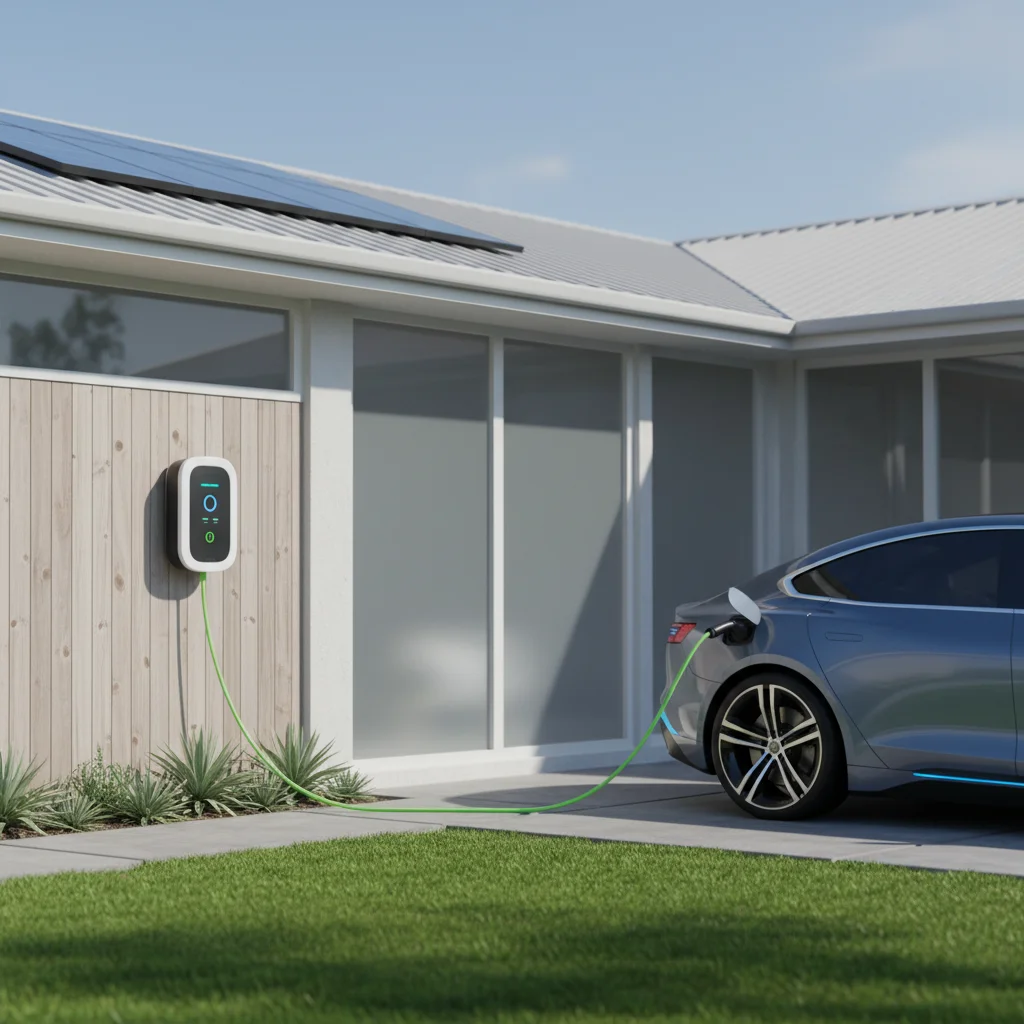
The average home EV charger installation now costs $1,200 to $2,800 in 2026, and federal rebates through the IRA's Alternative Fuel Infrastructure Credit cover up to 30% of that total. But most homeowners don't realize their utility company offers an additional $500 to $1,000 in stackable incentives that can drop the net cost to under $800.
How much does EV charger installation cost in 2026?
Level 2 home EV chargers cost $400-$800 for the unit itself, with installation labor adding $800-$2,000 depending on electrical panel upgrades and circuit distance. And homes requiring a panel upgrade to 200-amp service pay an additional $1,500-$3,000, while installations within 25 feet of the existing panel typically fall at the lower end.
The total project cost ranges from $1,200 to $4,800, with the median installation landing at $1,850 for a standard 240-volt Level 2 charger. Electrical permits add $50-$200, and conduit runs exceeding 50 feet increase labor costs by $200-$600. So homeowners with modern electrical infrastructure save 40% compared to those needing panel upgrades.
The federal 30C charger credit ended for chargers placed in service after June 30, 2026 (IRS FS-2025-05). But utility rebates from PG&E, ConEd, and Duke Energy add another $500-$1,000, effectively reducing net costs to $400-$1,800 for most qualifying households.
Which EV chargers qualify for federal rebates and tax credits?
IRA Alternative Fuel Infrastructure Credits apply to Level 2 chargers (240-volt, 40-80 amp) installed at primary residences in census tracts meeting low-income or non-urban criteria. And the IRS defines qualified property as charging equipment located where the taxpayer parks the vehicle, not public or commercial locations.
Hardwired chargers and plug-in models both qualify, but the charger must meet UL 2594 or UL 2202 safety standards and deliver at least 208 volts. So portable Level 1 chargers using standard 120-volt outlets don't qualify because they fall below the voltage threshold. The credit covers hardware, labor, permit fees, and materials like conduit and wire.
State and utility programs layer additional incentives. California's Clean Fuel Reward offers $750 through participating utilities, while Massachusetts MOR-EV adds $1,500 for income-qualified applicants. Check the rebate calculator to stack federal and local programs and identify your total savings.
What's the efficiency rating system for home EV chargers?
Home EV chargers don't use EPA efficiency ratings like appliances, but charging speed and power conversion efficiency determine real-world performance. Level 2 chargers operate at 85-95% efficiency, meaning 5-15% of electricity is lost as heat during AC-to-DC conversion in the vehicle.
A 7.2 kW charger delivers 25-30 miles of range per hour, while 11.5 kW models provide 40-45 miles per hour for vehicles with larger onboard chargers. And ChargePoint Home Flex and Wallbox Pulsar Plus both hit 94% efficiency at full load, outperforming budget models that drop to 87% efficiency.
Smart chargers with Wi-Fi connectivity and scheduling features cost $100-$200 more but enable time-of-use rate optimization, saving $200-$400 annually in electricity costs. So homeowners on tiered utility rates recoup the smart charger premium in 6-12 months through off-peak charging automation.
Which EV charger brands offer the best value for installation?
ChargePoint Home Flex ($699) leads in utility rebate compatibility and supports 16-50 amp breakers, while Tesla Wall Connector ($450) delivers the lowest upfront cost for Tesla owners but limits universal compatibility. And Wallbox Pulsar Plus ($649) offers the best balance of smart features and installation flexibility across vehicle brands.
Grizzl-E Classic ($419) provides the lowest total cost of ownership for basic installations without smart features, saving $280 compared to ChargePoint while maintaining 92% efficiency and NEMA 3R weatherproofing. But JuiceBox 48 ($579) includes Wi-Fi scheduling and utility program integration that unlocks $300-$600 in annual electricity savings through managed charging.
Installation-ready models with plug-in NEMA 14-50 connectors reduce labor costs by $200-$400 compared to hardwired units requiring direct panel connection. So budget-conscious homeowners choosing plug-in Grizzl-E or Mustart models save $500-$800 on total project costs. Review EV charger rebates to identify brand-specific incentive programs.
How long does it take to recoup your EV charger investment?
Payback periods range from 2.5 to 5 years based on gasoline displacement, federal credits, utility rebates, and time-of-use rate optimization. And homeowners driving 12,000 miles annually save $1,200-$1,800 per year compared to a 30 MPG gas vehicle at $3.50 per gallon, assuming $0.13 per kWh electricity costs.
A $1,850 installation with $1,000 federal credit and $600 utility rebate nets $250 out-of-pocket. So annual fuel savings of $1,500 deliver full payback in 2 months, not including avoided oil changes ($150/year) and reduced brake wear ($200/year) from regenerative braking systems.
Cold-climate states see 15-20% higher electricity consumption due to battery heating in winter, extending payback to 3-4 years. But southern homeowners with solar panels achieve 18-month payback by charging exclusively on self-generated electricity, eliminating grid costs entirely.
| Scenario | Net Cost | Annual Savings | Payback Period |
|---|---|---|---|
| Federal credit only | Ended June 30, 2026 | Ended June 30, 2026 | — |
| Federal + utility rebate | $250 | $1,500 | 2 months |
| With solar charging | $250 | $1,800 | 2 months |
Is your home's climate zone affecting charger performance and lifespan?
Cold-climate installations in IECC zones 6-7 require NEMA 4X or UL 50E rated enclosures to withstand -40°F temperatures and prevent moisture intrusion that degrades circuit boards. And extreme heat in zones 1-2 reduces electronics lifespan by 20-30% compared to temperate climates, requiring garage installations instead of exterior wall mounting.
Chargers mounted in direct sunlight experience 15-25°F internal temperature increases, accelerating capacitor aging and cable insulation breakdown. So south-facing exterior installations in Arizona and Texas reduce expected lifespan from 12 years to 8-9 years without proper shading or ventilation.
Coastal installations within 1 mile of saltwater require stainless steel enclosures and conformal-coated circuit boards to prevent corrosion. And homeowners in hurricane-prone regions should mount chargers below flood zone elevations or choose portable models that can be disconnected and stored during evacuations.
EV chargers vs. alternative charging solutions: cost and ROI comparison
Level 2 home chargers deliver the best ROI for daily commuters, while public DC fast charging costs $0.35-$0.60 per kWh (3-5x home rates) and adds $840-$1,440 annually for 12,000 miles. And workplace charging programs eliminate home installation costs but limit weekend access and vacation charging availability.
Portable Level 1 chargers included with EVs cost $0 upfront but deliver only 4-5 miles of range per hour, requiring 40-50 hour charging cycles for full battery replenishment. So commuters driving 50+ miles daily need Level 2 home infrastructure to avoid range anxiety and public charging premiums.
Community solar programs paired with home Level 2 charging reduce electricity costs by 20-30% through subscription credits, while Supercharger memberships ($12.99/month) make sense only for Tesla owners driving under 5,000 miles annually. Compare options using the energy tax credits guide to identify the lowest total cost of ownership.
Official Sources
- IRS Alternative Fuel Vehicle Refueling Property Credit — Federal tax credit details and eligibility requirements for EV charging infrastructure (note: the federal 25C and 25D credits ended for projects completed after December 31, 2025)
- U.S. Department of Energy Alternative Fuels Data Center — State and federal incentive database for EV charging equipment and installation
- DSIRE USA — Comprehensive state-by-state database of renewable energy and energy efficiency incentives including EV charging rebates
Related Reading: Learn more about Ev Charger Installation Cost Bay Area.
Related Reading: Learn more about How Much Does EV Charger Installation Cost in 2026?.
Related Reading: Learn more about Ev Charger Installation Cost Riverside.
Related Reading: Learn more about Ev Charger Installation Cost Inland Empire.
Frequently Asked Questions
How much does it cost to install an EV charger at home?
Home EV charger installation costs $1,200-$2,800 including equipment and labor, with the median project at $1,850. Electrical panel upgrades add $1,500-$3,000 for homes with 100-amp service. Federal IRA credits reduce net costs by 30% (up to $1,000), and utility rebates provide an additional $500-$1,000 in stackable incentives.
What rebates are available for EV charger installation in 2026?
The federal 30C charger credit ended for chargers placed in service after June 30, 2026 (IRS FS-2025-05). Utility programs like California's Clean Fuel Reward ($750), Massachusetts MOR-EV ($1,500), and New York's Charge Ready ($500) offer additional rebates. And income-qualified households in designated census tracts can access enhanced utility rebates of $1,000-$2,500 through equity-focused programs.
Are EV charger installation costs tax deductible?
The federal 30C charger credit ended for chargers placed in service after June 30, 2026 (IRS FS-2025-05). So a $2,000 installation generates a $600 credit that reduces tax liability dollar-for-dollar, while deductions only reduce taxable income. The federal 30C charger credit ended for chargers placed in service after June 30, 2026 (IRS FS-2025-05).
How long does EV charger installation take?
Standard Level 2 charger installations take 2-4 hours when the electrical panel is within 25 feet and has available capacity. But installations requiring panel upgrades or conduit runs exceeding 50 feet extend to 6-8 hours. And permit approval adds 1-3 weeks in most jurisdictions before installation can begin, though some utilities offer expedited 48-hour permitting for rebate participants.
Can I get a rebate if I already installed an EV charger?
Federal IRA credits apply only to installations completed after the equipment purchase date and claimed in the tax year of installation. So homeowners who installed chargers in 2025 can claim the credit on their 2025 tax return filed in 2026, but retroactive claims for 2024 installations aren't allowed. Some utility rebates require pre-approval before installation, while others accept post-installation applications within 90-180 days of completion.
Ready to calculate your total savings? Use our free rebate calculator to stack federal credits, state incentives, and utility rebates for your EV charger installation. Enter your zip code and project details to get personalized estimates in under 60 seconds.
Last updated April 14, 2026 — reviewed by DuloCore Editorial. About our authors.
Check your California EV charger rebate eligibility — see the programs you qualify for and the dollar amounts on our California EV charger rebate finder.