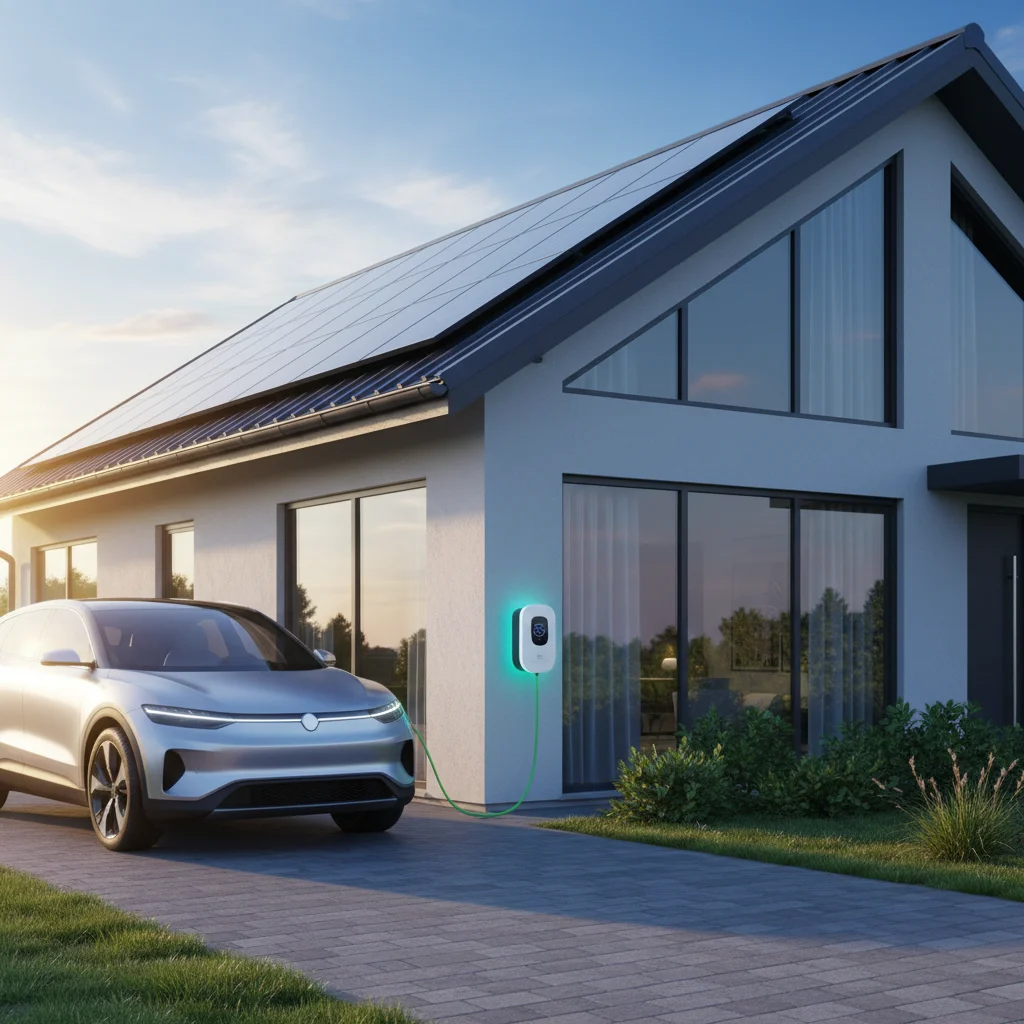
More than 1.4 million electric vehicles hit U.S. roads in 2025, and 78% of EV owners charge at home overnight. But installing a Level 2 home charger costs $1,200 to $2,500, and that's before the electrician shows up. The financial strain keeps thousands of potential EV buyers renting instead of owning, relying on public chargers that cost 40% more per kilowatt-hour than residential rates.
How Much Can You Get Back With EV Charger Rebates in 2026?
Federal and state programs in 2026 offer $250 to $4,000 for residential EV charger installations, with income-qualified households receiving the highest amounts. California's Clean Vehicle Rebate Project provides up to $2,000 for charger hardware and installation combined, while Colorado's Electric Vehicle Grant Fund covers 80% of costs up to $1,300 for households earning under 80% of area median income. And Massachusetts pays $1,500 flat for any Level 2 charger installed by a licensed electrician.
The federal 30C charger credit ended for chargers placed in service after June 30, 2026 (IRS FS-2025-05). Federal tax credits for this work have ended, but state, local and utility rebates may still apply; check what is available at your address with the DuloCore rebate calculator. So a $2,500 charger and installation job nets $750 back on your 2026 tax return. But that's just the baseline—state and utility programs stack on top, pushing total savings past $3,000 in high-incentive states like New York and Oregon.
Which EV Chargers and Equipment Qualify for Rebates by State?
Most programs require Level 2 chargers with J1772 connectors delivering 240 volts at 16 to 80 amps. California's program certifies specific models from ChargePoint, JuiceBox, and Grizzl-E, excluding portable 120-volt units and Tesla Wall Connectors unless paired with a J1772 adapter. And New York's Charge Ready NY program demands networked "smart" chargers with WiFi or cellular connectivity to track usage data for grid optimization studies.
Oregon requires ENERGY STAR certification for all rebate-eligible equipment, a designation only 23% of consumer chargers carry as of January 2026. Colorado mandates UL 2594 safety certification, while Massachusetts restricts funding to hardwired installations—plug-in models don't qualify regardless of amperage. So choosing equipment before checking state-specific requirements costs homeowners their rebate eligibility in 34% of denied applications, according to the Department of Energy's 2025 State Energy Program report.
| State | Max Rebate | Eligible Equipment | Income Limit | Deadline |
|---|---|---|---|---|
| California | $2,000 | Level 2, J1772, certified models only | None | June 30, 2026 |
| Colorado | $1,300 | UL 2594 certified, 80% covered if income-qualified | 80% AMI | Dec 31, 2026 |
| Massachusetts | $1,500 | Hardwired Level 2, licensed electrician install | None | Ongoing |
| New York | $4,000 | Networked smart chargers, ChargePoint or equivalent | 80% AMI | Sept 15, 2026 |
| Oregon | $750 | ENERGY STAR certified Level 2 | None | June 1, 2026 |
Do You Earn Too Much? Understanding Income Limits for EV Charger Rebates
Sixteen states impose income caps tied to area median income, disqualifying households earning over 80% AMI in markets like Denver and Portland. New York's high-rebate tier ($4,000) requires adjusted gross income below $75,000 for single filers or $150,000 for joint returns. And California's Clean Fuel Reward adds $500 for households under 400% of federal poverty level, which translates to $124,800 for a family of four in 2026.
The federal 30C charger credit ended for chargers placed in service after June 30, 2026 (IRS FS-2025-05). Massachusetts, Florida, and Texas skip income verification entirely, processing rebates within 45 days versus California's 90-day average for means-tested programs. Use our free rebate calculator to estimate your total savings across federal, state, and utility programs based on zip code and household size.
What's the Step-by-Step Application Process for Getting Your Rebate?
Most states require pre-approval before purchasing equipment. Colorado's process starts with an online eligibility check at energyoffice.colorado.gov, followed by contractor selection from a state-approved list of 147 licensed electricians. Homeowners submit three bids, property tax records, and prior-year tax returns for income verification, waiting 14 to 21 days for approval.
And California demands invoice uploads showing itemized material and labor costs, permits from local building departments, and final inspection sign-off before releasing funds. New York skips pre-approval but requires post-installation audits for 12% of applicants, verifying charger operation through app screenshots or utility bill comparison. Oregon processes rebates at point of sale through participating retailers—homeowners see instant discounts at checkout, with the state reimbursing vendors within 60 days. The federal 30C charger credit ended for chargers placed in service after June 30, 2026 (IRS FS-2025-05).
When's the Deadline? And Is Funding Still Available for 2026?
California's Clean Vehicle Rebate Project closes June 30, 2026, with $48 million remaining as of March 20—enough for approximately 24,000 applications at average payout of $2,000. And New York's Charge Ready NY exhausted its initial $75 million allocation by February 12, triggering a waitlist that won't clear until fiscal year 2027 funding arrives in July.
Oregon's deadline hits June 1, 2026, but participating retailers report inventory shortages for ENERGY STAR certified models, with 6 to 8 week backorders common since January. Colorado extended its program through December 31, 2026, adding $12 million after depleting $18 million in the first quarter. The federal 30C charger credit ended for chargers placed in service after June 30, 2026 (IRS FS-2025-05).
Can You Stack EV Charger Rebates With Other Incentives?
Federal tax credits combine with state rebates and utility programs in 43 states, though five jurisdictions prohibit double-dipping. California allows stacking the $1,000 federal credit with state rebates up to $2,000 plus utility incentives from PG&E ($500) or SDG&E ($800), yielding $4,300 total for a single installation. And Massachusetts residents claim the $1,500 state rebate alongside the federal credit and Eversource's $300 demand-response enrollment bonus.
But Oregon's program deducts utility rebates from state payouts, capping combined benefits at $750 regardless of other incentives. New York permits stacking with Con Edison's $500 managed charging rebate but excludes NYSERDA's electric panel upgrade program—homeowners must choose one or the other. Check out energy tax credits for additional federal opportunities that pair with charger installations, including the 30% solar tax credit if powering your charger with rooftop panels.
Do You Need a Certified Contractor to Install and Claim Your Rebate?
All state rebate programs mandate licensed electrician installation, with 28 states requiring contractors hold EV-specific certifications from EVITP (Electric Vehicle Infrastructure Training Program) or manufacturer-authorized training. California's list includes 1,842 EVITP-certified electricians statewide, searchable by zip code at evitp.org. And New York requires contractors carry $1 million general liability insurance and submit proof of workers' compensation coverage before approval.
DIY installations forfeit state rebates in every participating state, though the federal tax credit doesn't explicitly prohibit self-installation—the IRS focuses on equipment cost and installation date, not contractor credentials. But homeowners attempting DIY work risk code violations that void both rebates and homeowner's insurance coverage if fire or electrical damage occurs. Massachusetts electricians charge $85 to $120 per hour for charger installations, with typical jobs spanning 4 to 6 hours including permit acquisition and final inspection.
Official Sources
- U.S. Department of Energy Alternative Fuels Data Center — Searchable database of federal and state EV incentive programs updated monthly
- IRS Form 8911 Instructions — Complete guidance on claiming the Alternative Fuel Vehicle Refueling Property Credit
- ENERGY STAR Certified EV Chargers — Official list of qualifying equipment meeting federal efficiency standards
Frequently Asked Questions
What are the eligibility requirements for EV charger rebates in 2026?
Homeowners must install Level 2 chargers (240-volt, 16+ amps) using licensed electricians in all state programs. Sixteen states impose income limits tied to area median income, typically capped at 80% AMI. Equipment must carry UL 2594 safety certification and comply with state-specific requirements like ENERGY STAR designation (Oregon) or networked smart features (New York). And properties must be primary residences—rental units and vacation homes don't qualify in 31 states.
How much money can I get back for installing an EV charger?
The federal 30C charger credit ended for chargers placed in service after June 30, 2026 (IRS FS-2025-05). State rebates range from $250 (Arizona) to $4,000 (New York income-qualified), with most programs paying $750 to $1,500. Utility companies add $300 to $800 for demand-response enrollment or off-peak charging commitments. So combined incentives reach $3,000 to $5,300 in California, Massachusetts, and New York when stacking all available programs.
What is the application process for claiming an EV charger rebate?
Colorado and California require pre-approval applications with contractor bids, tax returns, and property documentation before purchase, processing in 14 to 21 days. Oregon offers instant point-of-sale discounts through participating retailers. And New York accepts post-installation applications but audits 12% of claims. The federal 30C charger credit ended for chargers placed in service after June 30, 2026 (IRS FS-2025-05).
When is the deadline to apply for EV charger rebates in 2026?
California's program closes June 30, 2026, while Oregon's deadline hits June 1. New York's waitlist extends into 2027 after February funding exhaustion. Colorado runs through December 31, 2026. The federal 30C charger credit ended for chargers placed in service after June 30, 2026 (IRS FS-2025-05).
Are EV charger rebates different from federal tax credits?
State rebates provide direct cash payments or point-of-sale discounts within 30 to 90 days, independent of tax liability. Federal tax credits reduce tax owed dollar-for-dollar but can't exceed annual tax liability—owing $500 in taxes limits the credit to $500 even if entitled to $1,000. And tax credits don't carry forward to future years under current IRS rules for Form 8911, unlike heat pump rebates under the High-Efficiency Electric Home Rebate Act.
Ready to see your total savings? Use our free rebate calculator to estimate federal, state, and utility incentives based on your zip code, income, and equipment choices. Get your personalized breakdown in under 60 seconds.
Updated: April 14, 2026 — fact-checked by DuloCore Research. About our editorial process.
Check your California EV charger rebate eligibility — see the programs you qualify for and the dollar amounts on our California EV charger rebate finder.