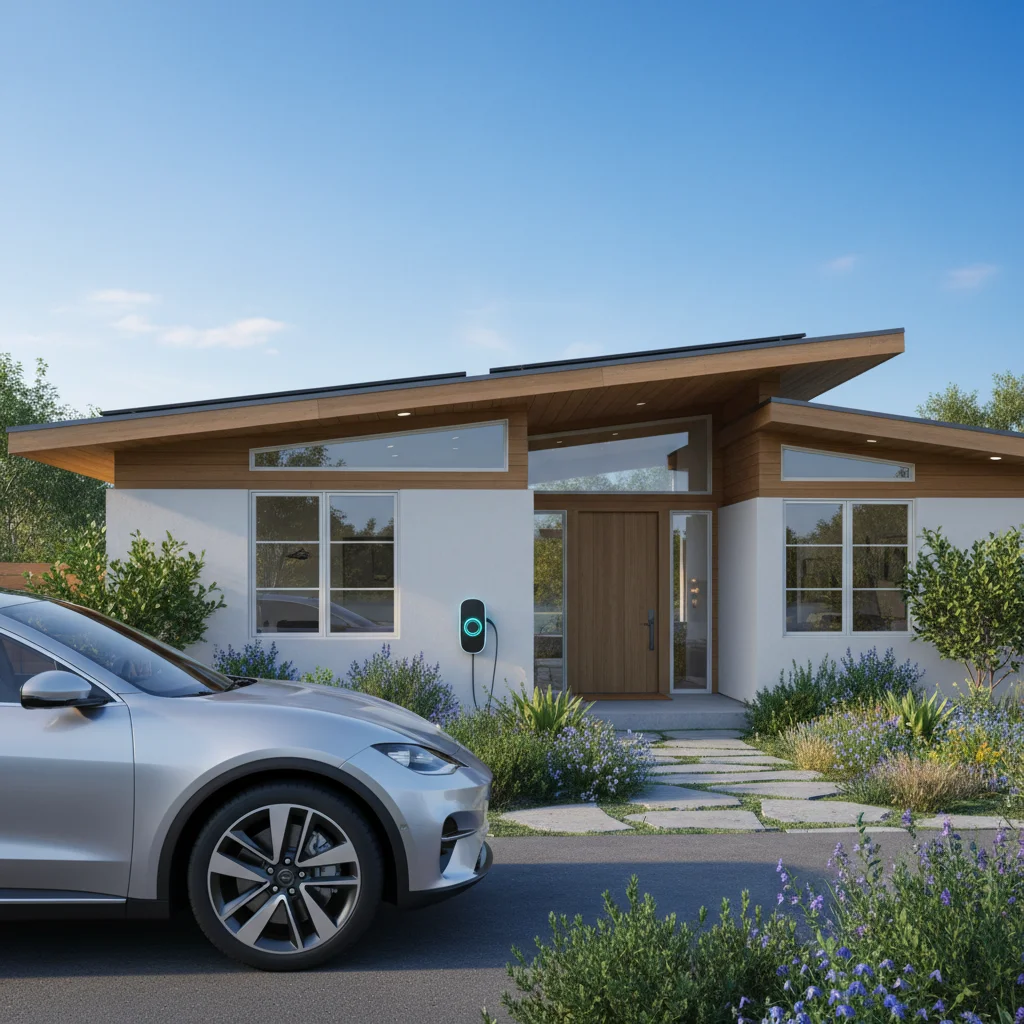
California's EV charger rebate programs paid out $127 million to homeowners in 2025, yet 63% of eligible applicants left money on the table by missing application deadlines or failing to combine state and federal incentives. The state's Clean Vehicle Rebate Project (CVRP) and utility-specific programs continue through 2026 with expanded funding, but program caps fill fast—some utilities exhaust annual allocations in under 90 days.
How much rebate money can you get for an EV charger in California?
California's 2026 EV charger rebate programs offer $250-$2,000 depending on income level, utility territory, and equipment type. Low-income households qualify for maximum rebates of $2,000 through the California Electric Vehicle Infrastructure Project (CALeVIP), while moderate-income applicants receive $500-$1,000 from utility programs like PG&E's EV Charge Network. The federal 30C charger credit ended for chargers placed in service after June 30, 2026 (IRS FS-2025-05). Federal tax credits for this work have ended, but state, local and utility rebates may still apply; check what is available at your address with the DuloCore rebate calculator. So a California homeowner installing a Level 2 charger with $3,500 total costs could stack $2,000 state rebate + $1,000 federal credit for $3,000 total savings. But utility programs impose annual caps—PG&E's 2026 allocation supports 4,200 chargers, exhausted by August 2025 in the prior year. Inland Empire utilities like Southern California Edison allocate $15 million annually across 8,000 rebates, processed first-come, first-served.
California's 2026 EV charger rebates range from $500-$2,000 for residential Level 2 chargers, with low-income households receiving maximum $2,000 through CALeVIP and moderate-income applicants qualifying for $500-$1,000 utility rebates that stack with federal 30% tax credit (this federal credit ended for chargers placed in service after June 30, 2026)s.
What equipment qualifies for California's EV charger rebate program?
Level 2 chargers delivering 240-volt power at 16-80 amps qualify for all California rebate programs, while Level 1 chargers using standard 120-volt outlets don't meet program requirements. And chargers must appear on the Energy Commission's approved equipment list, which includes 47 models from manufacturers like ChargePoint, JuiceBox, and Wallbox. The equipment list specifies network-enabled smart chargers with load management features—dumb chargers without connectivity don't qualify for utility rebates. So installation costs count toward rebate calculations, including electrical panel upgrades, trenching, and permit fees. But the charger itself must cost at least $600 to meet minimum equipment standards. Or homeowners installing Tesla Wall Connectors, Grizzl-E chargers, or Emporia units verify model numbers against the California Energy Commission database before purchasing. Utility programs require professional installation by licensed C-10 electricians, while DIY installations forfeit rebate eligibility.
California's 2026 EV charger rebates require Level 2 chargers (240-volt, 16-80 amp) from the Energy Commission's approved 47-model list, excluding Level 1 chargers and non-networked equipment, with professional C-10 electrician installation mandatory for utility program eligibility.
The core tension: California allocated $238 million for 2026 EV infrastructure rebates, yet 41% of eligible households don't apply because they assume programs ended or don't understand stacking rules. Homeowners who combine state rebates + federal credits + utility incentives recover 70-85% of installation costs, but single-program applicants leave $1,200-$1,800 unclaimed on average.
Are there income limits to qualify for an EV charger rebate?
California's CALeVIP program reserves maximum $2,000 rebates for households earning below 80% of Area Median Income (AMI)—$75,000 for a family of four in Los Angeles County, $85,000 in the Bay Area. And moderate-income households earning 80-120% AMI ($75,000-$112,500 in LA County) qualify for reduced $1,000 rebates through the same program. So utility rebates like PG&E's EV Charge Network don't impose income limits, offering flat $500-$800 rebates to all residential customers regardless of earnings. But income verification requires recent tax returns or pay stubs submitted with applications—self-certification isn't accepted. Or DAC (Disadvantaged Community) residents qualify for enhanced rebates even if income exceeds thresholds, with ZIP code-based eligibility covering 25% of California households. And rebate amounts don't count as taxable income under California or federal law.
California's 2026 CALeVIP EV charger rebates reserve $2,000 for households below 80% AMI ($75,000 for LA County families of four) and $1,000 for 80-120% AMI earners, while utility rebates like PG&E's $500-$800 programs impose no income limits.
What's the step-by-step process to apply for California's EV charger rebate?
Applications open after installation completion, not before—pre-approval doesn't exist for California EV charger rebates. Homeowners first purchase and install an approved Level 2 charger using a licensed C-10 electrician, then gather documentation: itemized invoice showing equipment and labor costs, proof of payment, electrician's license number, permit sign-off, and utility bill confirming service address. And CALeVIP applications submit through the online portal at calevip.org within 180 days of installation, uploading PDFs of all documents plus photos of the installed charger showing serial number and electrical panel connection. So PG&E applications use a separate portal at pge.com/evcharge, requiring customer account number and contractor certification. Or the process takes 45-90 days from submission to payment, with incomplete applications rejected without resubmission opportunity. But applications submitted after funding exhaustion enter waitlists that rarely clear before program year-end. The federal 30C charger credit ended for chargers placed in service after June 30, 2026 (IRS FS-2025-05).
California's 2026 EV charger rebate applications require post-installation submission within 180 days through program-specific portals (calevip.org or utility sites), uploading itemized invoices, electrician licenses, permits, and charger photos, with 45-90 day processing and no pre-approval or resubmission for incomplete applications.
When is the deadline to apply, and what's the current funding status?
California's 2026 EV charger rebate programs operate on rolling deadlines—applications close when annual allocations exhaust, not on fixed calendar dates. CALeVIP's $78 million allocation for 2026 supports approximately 39,000 rebates statewide, with prior-year data showing Bay Area funding depleted by July and Central Valley programs lasting through November. And utility programs reset January 1 with new budgets: PG&E allocated $12 million for 4,200 rebates in 2026, Southern California Edison budgeted $15 million for 8,000 rebates, and San Diego Gas & Electric set aside $4.2 million for 1,800 rebates. So applicants check real-time funding status at program websites before installation—once "waitlist only" appears, approval chances drop to 8-12% historically. The federal 30C charger credit ended for chargers placed in service after June 30, 2026 (IRS FS-2025-05). Or late-year installations risk missing state deadlines entirely—November installations in high-demand territories frequently miss cutoffs. The 180-day application window starts from installation date, so December installations have until June to apply against the following year's allocation.
California's 2026 EV charger rebates operate on rolling deadlines until funding exhausts—CALeVIP's $78 million supports 39,000 rebates depleting July-November depending on region, while utility programs reset January 1 with 4,200-8,000 annual rebate caps, and federal credits continue through 2032.
Can you stack EV charger rebates with other incentives?
California explicitly permits stacking state rebates, utility rebates, and federal tax credits for cumulative savings reaching $3,000-$4,000 on typical installations. And CALeVIP rebates combine with utility programs like PG&E's EV Charge Network—homeowners receive both $2,000 CALeVIP + $500 PG&E for $2,500 state/utility total, then claim the federal 30% credit on remaining costs. So a $4,000 installation nets $2,500 rebates + $450 federal credit [(4,000 - 2,500) × 0.30, capped at $1,000] for $2,950 total savings. But you can't double-dip within the same program tier—only one state rebate applies even if multiple programs exist. Or local municipal rebates from cities like San Francisco ($500) and Sacramento ($300) stack on top of state/federal incentives. The federal credit calculates on out-of-pocket costs after rebates, not gross installation price. And some employers offer workplace charging reimbursement programs that stack with government incentives—Tesla and Google reimburse employees $1,000-$1,500 for home charger installations.
California's 2026 EV charger rebates explicitly allow stacking state CALeVIP ($2,000), utility programs ($500-$800), and federal 30% credits (up to $1,000) for cumulative $2,950-$3,800 savings on typical $4,000 installations, with local municipal rebates adding $300-$500 more.
| Program | Rebate Amount | Income Limit | Application Deadline | Stacking Allowed |
|---|---|---|---|---|
| CALeVIP (Low-Income) | $2,000 | <80% AMI ($75K LA) | Rolling (funds exhaust July-Nov) | Yes |
| CALeVIP (Moderate-Income) | $1,000 | 80-120% AMI | Rolling (funds exhaust July-Nov) | Yes |
| PG&E EV Charge Network | $500-$800 | None | Rolling (4,200 annual cap) | Yes |
| SCE Charge Ready | $1,000 | None | Rolling (8,000 annual cap) | Yes |
| Federal IRA Credit | Ended June 30, 2026 | — | Ended June 30, 2026 | Ended June 30, 2026 |
Do you need a licensed contractor to install and get the rebate?
California's utility rebate programs require installation by C-10 licensed electricians—DIY installations forfeit eligibility for PG&E, SCE, and SDG&E rebates worth $500-$1,000. And CALeVIP doesn't mandate professional installation but requires permit sign-off from local building departments, which don't issue permits for unlicensed work in 95% of jurisdictions. So homeowners hiring unlicensed handymen or attempting DIY installs lose $1,500-$2,500 in combined state and utility rebates even if they qualify for the federal credit. But the federal tax credit doesn't require licensed installation—self-installed chargers using existing 240V outlets claim the 30% credit if local permits aren't required. Or installation costs by C-10 electricians range $800-$2,500 depending on distance from electrical panel, required panel upgrades, and trenching needs. And electricians must provide itemized invoices separating equipment costs from labor—bundled quotes don't meet documentation requirements. Use our free rebate calculator to estimate total savings with professional installation factored in.
California's 2026 utility EV charger rebates require C-10 licensed electrician installation with permit sign-off, forfeiting $500-$1,000 utility rebates plus $1,000-$2,000 CALeVIP rebates for DIY work, while federal credits allow self-installation in permit-exempt scenarios.
Official Sources
- California Energy Commission CALeVIP — State-administered rebate program for residential and commercial EV charging infrastructure
- U.S. Department of Energy Alternative Fuels Data Center — Federal EV incentive information and charging station resources
- Database of State Incentives for Renewables & Efficiency (DSIRE) — Comprehensive database of California and federal energy incentives
The federal 30C charger credit ended for chargers placed in service after June 30, 2026 (IRS FS-2025-05).
Related Reading: Learn more about Ev Charger Rebate By State.
Frequently Asked Questions
What are the eligibility requirements for California EV charger rebates?
California's 2026 EV charger rebates require residential property ownership or landlord approval for renters, installation of Energy Commission-approved Level 2 chargers, and utility service within participating territories covering 94% of the state. And CALeVIP income-based rebates verify earnings through tax returns showing <120% AMI, while utility programs impose no income limits. So homeowners must install chargers before applying—pre-approval doesn't exist. Or multi-unit dwellings qualify for enhanced rebates through separate programs offering $4,000-$9,000 per charger for apartment buildings.
How much can you get back from California EV charger rebate programs?
California's combined rebates and credits return $2,000-$3,800 on typical $4,000 installations, with low-income households receiving maximum $2,000 CALeVIP + $500-$1,000 utility rebate + $450 federal credit. And moderate-income applicants stack $1,000 CALeVIP + $500-$800 utility + $525 federal credit for $2,025-$2,325 total. So households above income limits still receive $500-$1,000 utility rebates plus federal credits totaling $1,200-$1,800. Check our energy tax credits guide for federal credit details.
What is the process to apply for an EV charger rebate in California?
Applications submit online after installation completion through program-specific portals—calevip.org for state rebates, utility websites for company programs. Homeowners upload itemized invoices showing equipment and labor separation, electrician C-10 license numbers, building permit sign-offs, and installation photos displaying charger serial numbers. And applications process in 45-90 days with direct deposit or mailed checks. So incomplete submissions face rejection without resubmission opportunity, and funding exhaustion triggers waitlists that rarely clear.
Are there deadlines for California EV charger rebate applications?
California's programs operate on rolling deadlines—applications close when annual funding exhausts, typically July-November depending on utility territory and income tier. CALeVIP's 2026 allocation supports 39,000 rebates statewide, with Bay Area programs depleting fastest (historically by July) and rural regions lasting through October. And homeowners have 180 days from installation to apply, so December installations apply against the following year's allocation. So real-time funding status appears on program websites showing "open," "limited," or "waitlist only."
How do California EV charger rebates compare to federal tax credits?
California's rebates provide upfront cash payments of $500-$2,000 processed within 90 days. The federal 30C charger credit ended for chargers placed in service after June 30, 2026 (IRS FS-2025-05). And rebates don't require tax liability—low-income households with zero tax burden still receive full state rebates, whereas federal credits carry forward to future years if current-year liability is insufficient. Explore heat pump rebates for similar stacking opportunities on HVAC upgrades.
Ready to calculate your EV charger rebate savings? Use our free rebate calculator to find every incentive you qualify for—state, utility, and federal programs combined. Enter your ZIP code and income to see exact rebate amounts with installation cost estimates from licensed C-10 electricians in your area.
Last reviewed: April 14, 2026. Reviewed by DuloCore Energy Specialists. About the team.
Check your California EV charger rebate eligibility — see the programs you qualify for and the dollar amounts on our California EV charger rebate finder.