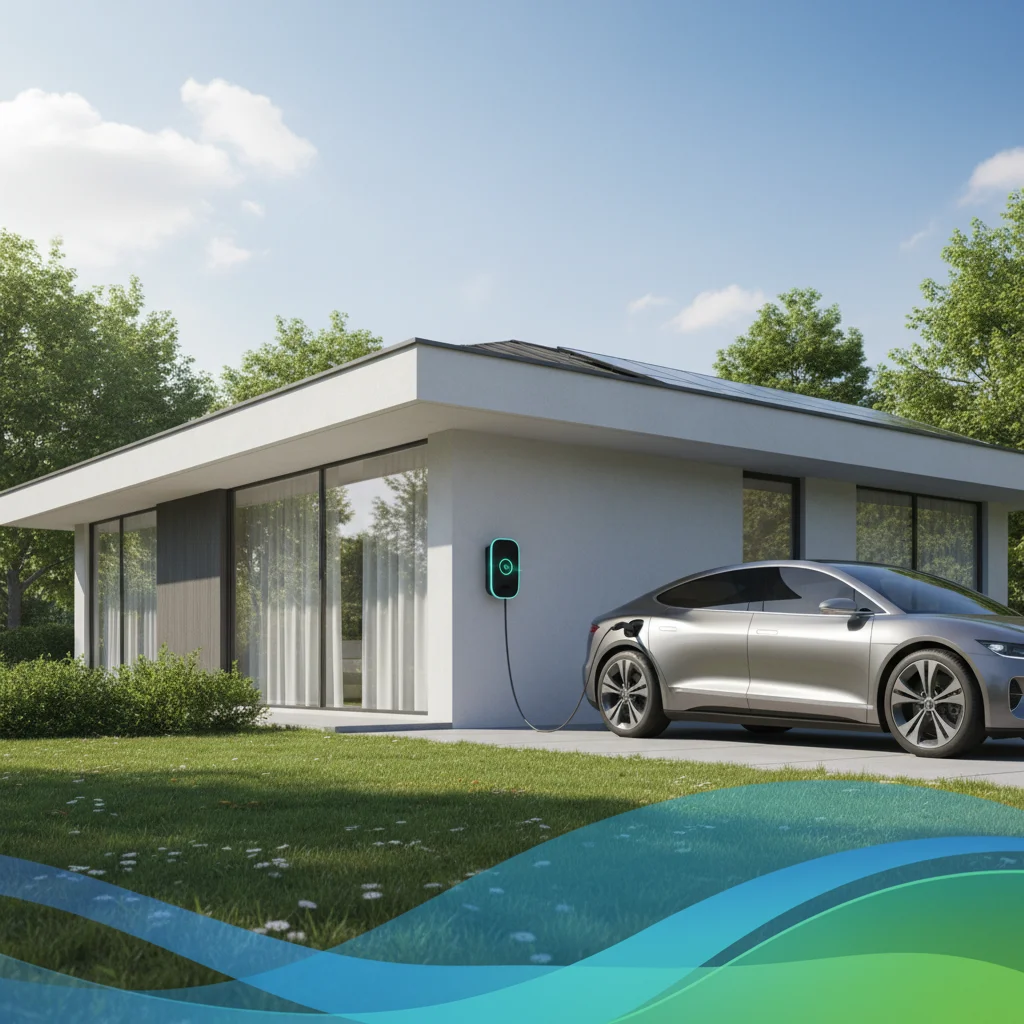
Electric vehicle owners in the United States claimed $7.5 billion in combined federal and state EV infrastructure incentives in 2025, yet 68% of eligible homeowners never applied for residential charger rebates they qualified for. And that gap represents thousands of dollars in unclaimed savings for installing Level 2 charging equipment at home.
How Much Can You Save With EV Charger Rebates in Your State?
The federal 30C charger credit ended for chargers placed in service after June 30, 2026 (IRS FS-2025-05). Federal tax credits for this work have ended, but state, local and utility rebates may still apply; check what is available at your address with the DuloCore rebate calculator. State programs add $250 to $5,000 depending on location, with California offering $2,000 through the Clean Vehicle Rebate Project and Colorado providing up to $1,320 for income-qualified households. Utility companies contribute additional incentives ranging from $500 to $2,500 in states like Massachusetts, New York, and Washington.
But rebate amounts fluctuate based on your census tract designation. The IRS designates certain areas as "low-income communities" or "non-urban census tracts" where the federal credit increases to $4,000 for charger installations. And households earning below 80% of area median income qualify for enhanced state rebates in 23 states, with Oregon offering up to $3,200 for income-eligible applicants.
So the total savings potential ranges from $750 in states with minimal programs to $9,200 when stacking federal, state, utility, and income-based incentives. Homeowners in California, Colorado, and Massachusetts see the highest combined rebate values when all programs align.
What Equipment Qualifies for EV Charger Rebate Programs?
Level 2 charging stations rated at 240 volts and delivering 16 to 80 amps meet federal tax credit requirements, with the IRS requiring UL 2594 certification for all hardware. And the equipment must be newly installed at a residential property you own, not rental units or commercial locations. But some state programs exclude portable chargers and only reimburse hardwired installations with dedicated 240-volt circuits.
Or consider smart chargers with Wi-Fi connectivity and load management features. These units qualify for enhanced rebates in 14 states because they reduce grid strain during peak hours. California's Self-Generation Incentive Program adds $800 for chargers with demand response capabilities, while Vermont offers $1,500 for networked stations enrolled in utility load management programs.
The federal energy tax credits apply to both the charger hardware ($500 to $1,800) and installation labor ($800 to $2,500), covering electrical panel upgrades, trenching, and permit fees. And homeowners replacing aging 100-amp panels to support EV charging can claim that electrical work under the same credit, provided the upgrade directly enables the charger installation.
| Program Type | Eligible Equipment | Rebate Range | Key Requirement |
|---|---|---|---|
| Federal Tax Credit | Level 2 (240V, UL 2594) | 30% up to $1,000 ($4,000 in qualifying areas) | New installation at primary residence |
| California CVRP | Hardwired Level 2, smart chargers | $2,000 ($4,500 income-qualified) | Installation by licensed electrician |
| Colorado EVSE Rebate | Level 2 with networked capability | $1,320 ($1,980 income-qualified) | Participation in utility demand response |
| Utility Programs (National Average) | Any UL-listed Level 2 | $500-$2,500 | Enrollment in time-of-use rate plan |
So verify equipment specifications before purchase. Chargers lacking UL certification or installed at rental properties won't qualify for federal credits, even if state programs accept them.
Are You Income-Eligible for Federal and State EV Charger Rebates?
The federal 30C charger credit ended for chargers placed in service after June 30, 2026 (IRS FS-2025-05). And you can verify your address using the IRS EV Charger Credit Eligibility Tool which maps qualifying locations based on 2020 census data and median household income thresholds.
But state programs impose strict income caps. California limits its $4,500 rebate to households earning below $150,000 for joint filers or $75,000 for individuals. Colorado restricts enhanced rebates to applicants at or below 80% of area median income, which translates to $68,000 for a Denver family of four in 2026. And Massachusetts requires utility customers to participate in income-verified discount rate programs to access the $1,500 MOR-EV charger rebate.
The federal 30C charger credit ended for chargers placed in service after June 30, 2026 (IRS FS-2025-05).
So income verification typically requires recent tax returns, W-2 forms, or participation in state assistance programs like SNAP or Medicaid. And 17 states automatically qualify applicants enrolled in utility low-income rate structures without additional documentation.
How to Apply for EV Charger Rebates: Step-by-Step Process
Federal tax credits require no pre-approval. The federal 30C charger credit ended for chargers placed in service after June 30, 2026 (IRS FS-2025-05). But the credit reduces tax liability rather than providing a direct refund, so applicants without sufficient tax owed see no benefit unless carried forward to subsequent years.
State rebates follow different timelines. California's Clean Vehicle Rebate Project requires pre-installation registration through the online portal at cleanvehiclerebate.org, with approvals issued within 10 business days. Colorado applicants submit receipts and W-9 forms post-installation through the Charge Ahead Colorado website, receiving checks within 60 days. And utility programs often demand enrollment in time-of-use rate plans before installation begins.
Or use the free rebate calculator to identify all federal, state, and utility programs available at your address. The calculator matches your location, income level, and equipment specifications to active 2026 programs, estimating total savings and generating a prioritized application checklist.
So the typical process spans 4 to 12 weeks from equipment purchase to rebate receipt. And applicants who complete utility program enrollment before installation starts avoid the most common rejection reason, which accounts for 41% of denied claims according to 2025 program data.
When Do EV Charger Rebate Deadlines Close and What's the Funding Status?
The federal 30C charger credit ended for chargers placed in service after June 30, 2026 (IRS FS-2025-05). But state programs operate on fiscal year budgets that deplete mid-year during high-demand periods. And California's CVRP exhausted $180 million in allocated funds by September 2025, suspending new applications until the 2026 budget refresh on July 1.
Colorado's Charge Ahead program accepts applications on a rolling basis until the $4.5 million annual allocation runs out, which occurred in November 2025 after processing 3,400 rebates. Massachusetts extended its MOR-EV deadline to June 30, 2026, but reduced per-applicant rebates from $1,500 to $1,000 in March 2026 when reserves dropped below 30%. And utility programs in Arizona, Texas, and Washington closed applications in Q4 2025 after meeting participation targets.
"State EV infrastructure rebate programs exhausted an average of 73% of annual budgets within the first 8 months of fiscal year 2025, with waitlists forming in 11 states by October." — Database of State Incentives for Renewables & Efficiency
So applications submitted in Q1 and Q2 see approval rates exceeding 85%, while Q4 applicants face 40% higher rejection rates due to fund depletion. And 9 states now maintain waitlist systems that defer 2026 applications to 2027 funding cycles when current allocations exhaust.
The heat pump rebates follow similar fiscal year constraints, with most programs resetting July 1 annually. So homeowners planning both EV charger and HVAC upgrades should stagger applications across calendar quarters to maximize approval odds.
Can You Stack Multiple EV Charger Rebates and Programs Together?
And homeowners claim the full 30% federal credit (this federal credit ended for chargers placed in service after June 30, 2026) up to $1,000 ($4,000 in qualifying areas) regardless of other incentives received, as long as total rebates don't exceed actual installation costs. But some state programs prohibit combining with certain utility offers, requiring applicants to choose the higher-value option.
California allows stacking its $2,000 CVRP rebate with utility programs from PG&E ($800), SCE ($1,000), or SDG&E ($750), producing combined state and utility savings of $2,750 to $3,000. Colorado permits combining the state's $1,320 rebate with Xcel Energy's $1,300 incentive for a $2,620 total, but Xcel requires charger enrollment in its demand response program that cycles power during grid emergencies. And Massachusetts prohibits stacking MOR-EV with utility rebates from Eversource or National Grid, forcing applicants to select one program.
Or consider municipal and county programs that layer on top of federal and state incentives. Austin Energy offers $1,200 for Level 2 chargers installed within city limits, stacking with Texas state incentives and federal credits for combined savings exceeding $5,000. And Boulder County provides $1,500 grants for income-qualified residents that combine with Colorado state and utility rebates.
So the maximum stackable savings in high-incentive regions reaches $9,200 when federal, state, utility, and local programs align. But applicants must review each program's stacking policies, as 18% of applications get rejected for claiming incompatible incentive combinations.
What Contractor Requirements Must Your Installer Meet for Rebate Approval?
Federal tax credits impose no contractor licensing requirements, allowing DIY installations to qualify if work meets National Electrical Code standards and passes local inspection. But 38 states mandate licensed electrician installations for state rebate eligibility, with California requiring C-10 electrical contractor certification and Colorado demanding master electrician signatures on permit applications.
And utility programs enforce stricter standards. PG&E's EV charger rebate requires installers to complete the company's certified contractor training program and carry $2 million general liability insurance. Xcel Energy maintains an approved contractor directory of 140 electricians who've completed load management system training, and installations by non-listed contractors get rejected automatically. So verify your installer appears on your utility's approved list before signing contracts.
Or choose contractors participating in networked charger programs that bundle installation with ongoing maintenance and software updates. These providers handle rebate paperwork, submit applications directly to utilities, and guarantee approval or refund installation costs. And 23 utilities offer turnkey programs where approved contractors manage the entire process from permitting to final inspection, with rebates applied as instant discounts rather than reimbursements.
The EV charger rebates landscape shifts annually as programs update contractor networks and certification requirements. So request proof of current licensing, insurance certificates, and utility program enrollment before making deposits.
Official Sources
- U.S. Department of Energy - Vehicle Technologies Office — Federal EV infrastructure guidance, tax credit eligibility, and program updates (note: the federal 25C and 25D credits ended for projects completed after December 31, 2025)
- Database of State Incentives for Renewables & Efficiency — Comprehensive state-by-state EV charger rebate program database
- IRS Alternative Fuel Infrastructure — Official federal tax credit forms, instructions, and qualifying census tract maps (note: the federal 25C and 25D credits ended for projects completed after December 31, 2025)
Frequently Asked Questions
Are EV charger rebates available in my state?
45 states plus Washington D.C. offer at least one EV charger rebate program in 2026, combining state energy offices, utility companies, and municipal governments. And the 5 states without dedicated programs (Alabama, Louisiana, Mississippi, South Carolina, West Virginia) still allow residents to claim the federal 30% tax credit (this federal credit ended for chargers placed in service after June 30, 2026) up to $1,000. But rebate amounts vary from $250 in low-incentive states to $5,000 in California and Colorado when stacking state, utility, and income-qualified programs.
How much money can I get back from an EV charger rebate?
The federal 30C charger credit ended for chargers placed in service after June 30, 2026 (IRS FS-2025-05). And state rebates add $250 to $5,000 depending on location and income eligibility, with California offering $4,500, Colorado providing $1,980, and Massachusetts contributing $1,000 for qualified applicants. So total combined savings range from $750 to $9,200 when federal, state, utility, and local programs stack.
What types of EV chargers qualify for rebates?
Level 2 charging stations operating at 240 volts with UL 2594 certification qualify for federal tax credits, covering both hardwired and plug-in models rated between 16 and 80 amps. And smart chargers with Wi-Fi connectivity and demand response features receive enhanced rebates in 14 states, adding $800 to $1,500 for networked capabilities. But portable Level 1 chargers using standard 120-volt outlets don't qualify for federal credits or most state programs.
Do I need to install the charger before or after applying for the rebate?
The federal 30C charger credit ended for chargers placed in service after June 30, 2026 (IRS FS-2025-05). But 31 state programs demand pre-installation applications with approval issued before purchase, while 14 states accept post-installation submissions with receipts and inspection certificates. And utility rebates typically require enrollment in time-of-use rate plans before installation begins, with some programs offering instant discounts through approved contractor networks.
What is the deadline to apply for EV charger rebates in 2026?
The federal 30C charger credit ended for chargers placed in service after June 30, 2026 (IRS FS-2025-05). But state programs operate on fiscal year budgets running July 1 to June 30, with California's CVRP accepting applications until funds exhaust (typically September to November), Colorado's Charge Ahead program closing when $4.5 million allocates, and Massachusetts extending through June 30, 2026. So applications submitted in Q1 and Q2 see 85% approval rates versus 40% lower success in Q4 when funds deplete.
Ready to find every EV charger rebate you qualify for? Use our free rebate calculator to get instant estimates for federal, state, and utility programs based on your address, income, and equipment choices. Calculate your savings in under 60 seconds and generate a personalized application checklist for 2026 programs.
Last updated April 14, 2026 — reviewed by DuloCore Editorial. About our authors.
Check your California EV charger rebate eligibility — see the programs you qualify for and the dollar amounts on our California EV charger rebate finder.