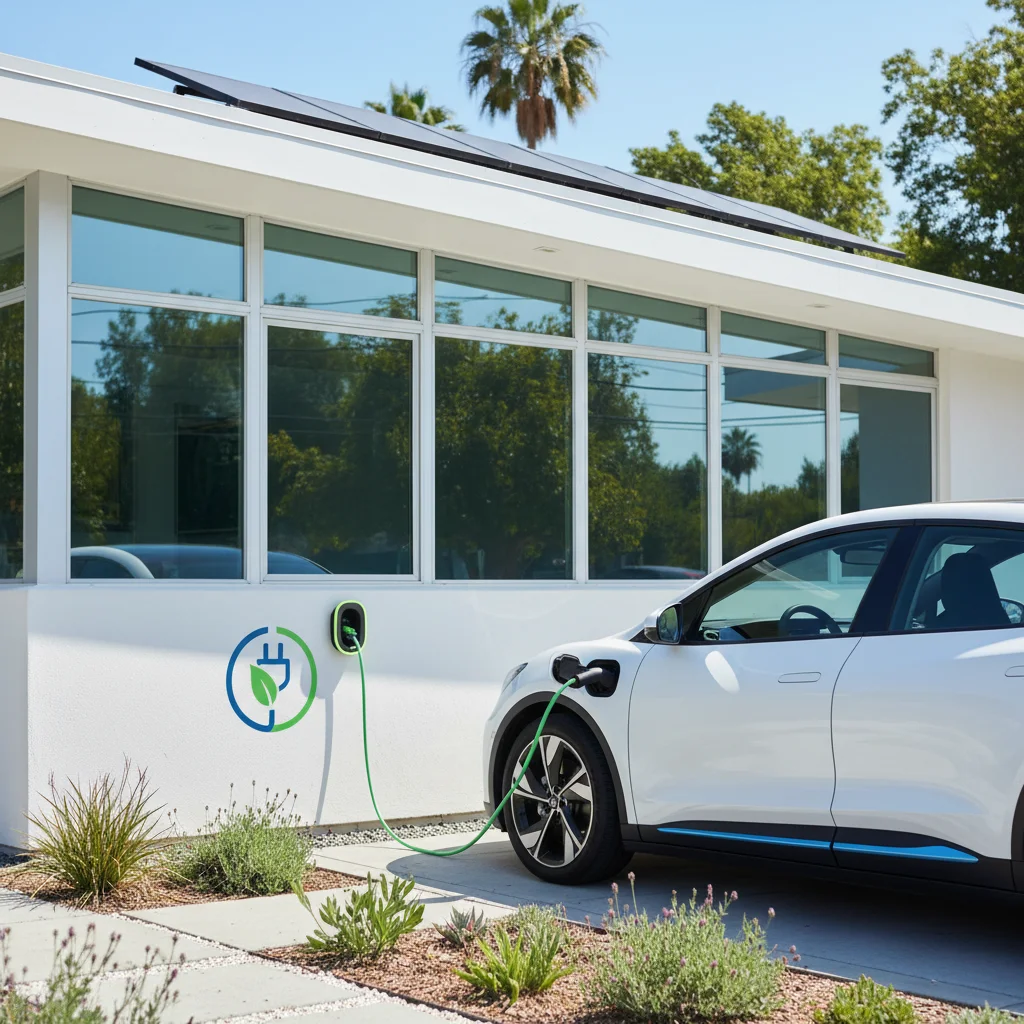
Riverside homeowners installed 2,847 Level 2 EV chargers in 2025, but only 34% claimed available rebates worth an average of $1,200 per installation. That's $2.2 million in unclaimed incentives left on the table in a single year. And the 2026 rebate pool is already 18% depleted just three months into the fiscal year.
What EV Charger Rebates Are Available in Riverside Right Now?
Riverside residents in 2026 access three rebate tiers: federal IRA tax credits covering 30% of installation costs up to $1,000, Southern California Edison's Charge Ready Home Rebate offering $500-$1,500 for residential Level 2 chargers, and Riverside Public Utilities' EV Infrastructure Program providing $750 for qualified installations within RPU service territory.
The federal 30C charger credit ended for chargers placed in service after June 30, 2026 (IRS FS-2025-05). Federal tax credits for this work have ended, but state, local and utility rebates may still apply; check what is available at your address with the DuloCore rebate calculator. So a $3,500 charger installation generates a $1,000 federal tax credit. But the credit caps at $1,000 regardless of installation costs exceeding $3,333.
Southern California Edison operates two distinct programs depending on your address. Charge Ready Home Rebate delivers $1,500 for income-qualified customers earning below 80% of area median income (AMI) and $500 for standard applicants. And SCE's service territory covers 83% of Riverside County households outside RPU boundaries.
Riverside Public Utilities customers access a separate $750 rebate through the municipal utility's EV Infrastructure Program. But this program operates on a first-come, first-served basis with annual funding limits of $187,500—enough for approximately 250 installations. The 2026 allocation reached 43% capacity by March 15.
California's Clean Vehicle Rebate Project discontinued Level 2 charger incentives in December 2025. Or homeowners seeking state-level support now rely exclusively on utility programs and federal tax credits.
How Much Money Can You Get Back on EV Charger Installation in Riverside?
Combined rebates total $2,250-$3,250 for income-qualified Riverside residents installing a Level 2 charger in SCE territory with typical installation costs of $1,800-$4,200. Standard applicants receive $1,500-$2,250 through federal and utility incentives, reducing net installation costs to $1,950-$2,700 for a complete home charging system.
Installation costs break down into equipment ($600-$1,400 for the charging unit), electrical work ($800-$2,100 for panel upgrades and circuit installation), and permitting ($150-$400 through Riverside County Building & Safety). And homes requiring panel upgrades from 100-amp to 200-amp service face additional costs of $1,500-$2,800.
A typical 40-amp Level 2 charger installation costing $3,200 generates these incentives: $1,000 federal IRA tax credit (30% of costs), $500-$1,500 SCE Charge Ready rebate (income-dependent), and $750 RPU rebate (if applicable). So total rebates reach $2,250 for standard applicants or $3,250 for income-qualified households.
The federal 30C charger credit ended for chargers placed in service after June 30, 2026 (IRS FS-2025-05).
But rebate amounts vary by installation complexity. A simple charger installation in a garage with existing 240V service and adequate panel capacity costs $1,800-$2,400 and qualifies for $1,500-$2,250 in combined incentives. Or installations requiring panel upgrades and extensive electrical work cost $3,500-$6,000 and still cap federal credits at $1,000.
The fastest payback occurs when installation costs stay below $3,333—the threshold where the 30% federal credit (this federal credit ended for chargers placed in service after June 30, 2026) reaches its $1,000 maximum. So homeowners installing a $2,800 system receive $840 federal credit plus $500-$1,500 utility rebate, reducing net costs to $950-$1,460 for a complete charging solution.
What Are the Eligibility Requirements for Riverside EV Charger Rebates?
The federal 30C charger credit ended for chargers placed in service after June 30, 2026 (IRS FS-2025-05). And the charging equipment must meet UL certification standards and connect to a qualified plug-in electric vehicle or plug-in hybrid registered in California.
Southern California Edison's Charge Ready Home Rebate requires customers to maintain active SCE residential electric service, install a networked Level 2 charger from the approved equipment list (23 models qualify in 2026), and complete installation within 180 days of reservation approval. But income-qualified applicants must provide documentation proving household income below 80% AMI—$79,200 for a family of four in Riverside County.
Riverside Public Utilities applicants must maintain active RPU electric service, own the property or provide landlord authorization, and install chargers meeting California Energy Commission requirements. Or the program excludes commercial properties, multi-family buildings with more than four units, and installations using unapproved equipment.
All programs require licensed C-10 electrical contractor installation—DIY installations don't qualify. And properties must pass electrical inspection by Riverside County Building & Safety before rebate disbursement. So unpermitted work automatically disqualifies applicants from all three rebate programs.
Renters face additional barriers. Federal tax credits exclude rental properties unless the renter owns the charging equipment and receives landlord permission for installation. But utility rebates typically require property ownership or explicit landlord participation in the rebate application.
What Documentation Do You Need to Claim Your EV Charger Rebate?
The federal 30C charger credit ended for chargers placed in service after June 30, 2026 (IRS FS-2025-05).
Southern California Edison's application portal demands pre-installation reservation approval, W-2s or tax returns for income verification (income-qualified tier only), utility account number, property ownership verification through deed or mortgage statement, and contractor license verification for the C-10 electrician. And post-installation submissions require photographic evidence of the installed charger, final electrical inspection approval, and networked charger activation confirmation.
Riverside Public Utilities requires a one-page application form, proof of RPU electric service through recent utility bill, contractor quote or invoice showing equipment specifications and installation costs, electrical permit number from Building & Safety, and final inspection signoff. But RPU processes applications on a first-come, first-served basis—incomplete applications lose queue position and face delayed processing.
"Residential EV charging equipment must be installed at the taxpayer's principal residence in the United States and meet applicable fire and electrical code requirements" — Department of Energy Alternative Fuels Data Center
Contractor invoices must itemize equipment costs separately from labor charges. So a single $3,200 line item gets rejected—invoices must break down the charger unit ($1,100), electrical materials ($650), labor ($1,200), and permit fees ($250). And the federal credit applies only to equipment and installation labor, excluding permitting and inspection fees.
Financial documentation for income-qualified tiers requires complete tax returns showing all household income sources. Or applicants providing only W-2s from primary employment without documenting spouse income, rental income, or investment returns face automatic application rejection.
What's the Deadline for Applying for Riverside EV Charger Rebates?
The federal IRA tax credit operates on a tax year basis—homeowners claim credits on returns filed for the year installation occurred. So installations completed between January 1, 2026 and December 31, 2026 appear on 2026 tax returns filed by April 15, 2027. The federal 30C charger credit ended for chargers placed in service after June 30, 2026 (IRS FS-2025-05).
Southern California Edison's Charge Ready Home Rebate requires pre-approval reservation before installation begins. And reservations expire 180 days after approval—chargers installed after the deadline forfeit rebates entirely. The program operates on fiscal year budgets refreshing July 1 annually, with no guarantee of continued funding beyond the current allocation.
Riverside Public Utilities sets a 90-day post-installation application deadline. Or homeowners completing installation in January must submit applications by early April to maintain eligibility. And the program's $187,500 annual budget typically depletes by June or July—applications submitted after funding exhaustion join a waitlist for the next fiscal year starting October 1.
The 2026 RPU program launched October 1, 2025 with funding for 250 installations. But the allocation reached 43% depletion by March 15, suggesting full depletion by late May based on historical application rates. So Riverside homeowners planning summer or fall installations risk missing the current funding cycle.
Tax credit timing matters for cash flow. The federal credit reduces tax liability but doesn't generate refunds exceeding tax owed. So a homeowner with $800 in tax liability claiming a $1,000 credit receives $800 in benefit for 2026—the remaining $200 doesn't carry forward or generate a refund. But utility rebates arrive as direct payments 6-10 weeks after application approval.
Can You Stack Multiple Rebates on a Single EV Charger Installation?
Federal IRA credits, Southern California Edison rebates, and Riverside Public Utilities incentives stack without restriction—homeowners claim all three on a single installation. So income-qualified RPU customers installing a $3,200 charger receive $1,000 federal credit plus $1,500 SCE rebate plus $750 RPU rebate, totaling $3,250 in combined incentives against $3,200 in costs.
But SCE and RPU programs don't overlap geographically. Or Riverside addresses fall within either SCE or RPU service territory—never both. So the maximum stack equals federal credit plus one utility rebate, not federal plus both utilities.
State-level Clean Vehicle Rebate Project incentives ended for charging equipment in December 2025. And no local Riverside city or county programs currently offer additional charger rebates beyond utility-sponsored initiatives. So the 2026 maximum remains $3,250 for income-qualified households or $2,250 for standard applicants.
Workplace charging programs operate separately. The federal 30C charger credit ended for chargers placed in service after June 30, 2026 (IRS FS-2025-05). But residential programs don't stack with commercial incentives—homeowners can't claim workplace program benefits for home installations.
Our free rebate calculator shows exact stacking scenarios based on your Riverside address, household income, and installation costs. And the calculator updates automatically when utility programs adjust rebate amounts or eligibility thresholds mid-year.
California's Self-Generation Incentive Program (SGIP) offers separate battery storage rebates of $150-$1,000 per kWh of capacity. So homeowners pairing EV chargers with home battery systems access additional incentives outside the charger rebate stack. But SGIP operates independently through a different application process and timeline.
Official Sources
- IRS Alternative Fuel Vehicle Refueling Property Credit — Federal tax credit details for residential EV charging equipment (note: the federal 30C charger credit ended for chargers placed in service after June 30, 2026)
- U.S. Department of Energy Alternative Fuels Data Center — Comprehensive database of federal and state EV infrastructure incentives and requirements
- Database of State Incentives for Renewables & Efficiency — Searchable archive of California utility rebate programs and eligibility criteria
Related Reading: Learn more about Ev Charger Federal Tax Credit Expired and Ev Charger Incentives.
Related Reading: Learn more about Ev Charger Rebates and Ev Charger Smart Features Worth It.
Frequently Asked Questions
Are electric vehicle charger rebates available in Riverside California?
Riverside residents access three rebate sources in 2026: federal IRA tax credits of up to $1,000 covering 30% of installation costs, Southern California Edison's Charge Ready Home Rebate offering $500-$1,500 depending on income qualification, and Riverside Public Utilities' $750 EV Infrastructure Program for customers in RPU service territory. But SCE and RPU programs don't overlap—addresses fall within one utility boundary or the other. Combined incentives total $1,500-$3,250 depending on utility service provider and household income.
How much can you get back from an EV charger rebate in Riverside?
Standard applicants receive $1,500-$2,250 through combined federal and utility incentives, while income-qualified households earning below 80% AMI access $2,250-$3,250 in total rebates. The federal IRA credit provides $1,000 maximum (30% of costs up to $3,333), SCE offers $500 standard or $1,500 income-qualified, and RPU provides $750 for municipal utility customers. So a typical $3,200 installation costs $950-$1,700 after rebates depending on income qualification and utility service territory.
What are the eligibility requirements for Riverside EV charger rebates?
Federal credits require property ownership, primary residential use, UL-certified equipment, and licensed C-10 contractor installation. SCE's program demands active residential electric service, networked charger from the approved equipment list (23 models qualify), and income documentation for the $1,500 tier ($79,200 limit for four-person households). RPU requires municipal utility service, property ownership or landlord authorization, and completion within program timeline. All three programs exclude DIY installations and require electrical inspection approval from Riverside County Building & Safety.
How long does it take to receive an EV charger rebate in Riverside?
Utility rebates arrive 6-10 weeks after application approval and installation verification. SCE processes Charge Ready Home applications in 3-4 weeks for standard tier or 6-8 weeks for income-qualified applicants requiring income verification. RPU processes applications in 4-6 weeks on a first-come, first-served basis. But federal IRA tax credits appear as reduced tax liability on annual returns filed 4-16 months after installation depending on installation date and filing timeline—December installations claimed on returns filed the following April.
What's the difference between federal and state EV charger rebates in Riverside?
The federal 30C charger credit ended for chargers placed in service after June 30, 2026 (IRS FS-2025-05). State programs ended in December 2025 when California's Clean Vehicle Rebate Project discontinued charger incentives. Or Riverside homeowners now rely on utility programs (SCE and RPU) offering $500-$1,500 direct rebates with income tiers, annual budget limits, and first-come, first-served allocation. Federal credits appear on tax returns while utility rebates arrive as direct payments within 6-10 weeks.
Ready to see your exact rebate amount? Use our rebate calculator to get a personalized breakdown of federal, SCE, and RPU incentives based on your Riverside address, installation costs, and household income. The calculator shows your total available rebates and net installation costs in under 60 seconds.
Last reviewed: April 14, 2026. Reviewed by DuloCore Energy Specialists. About the team.
Check your California EV charger rebate eligibility — see the programs you qualify for and the dollar amounts on our California EV charger rebate finder.