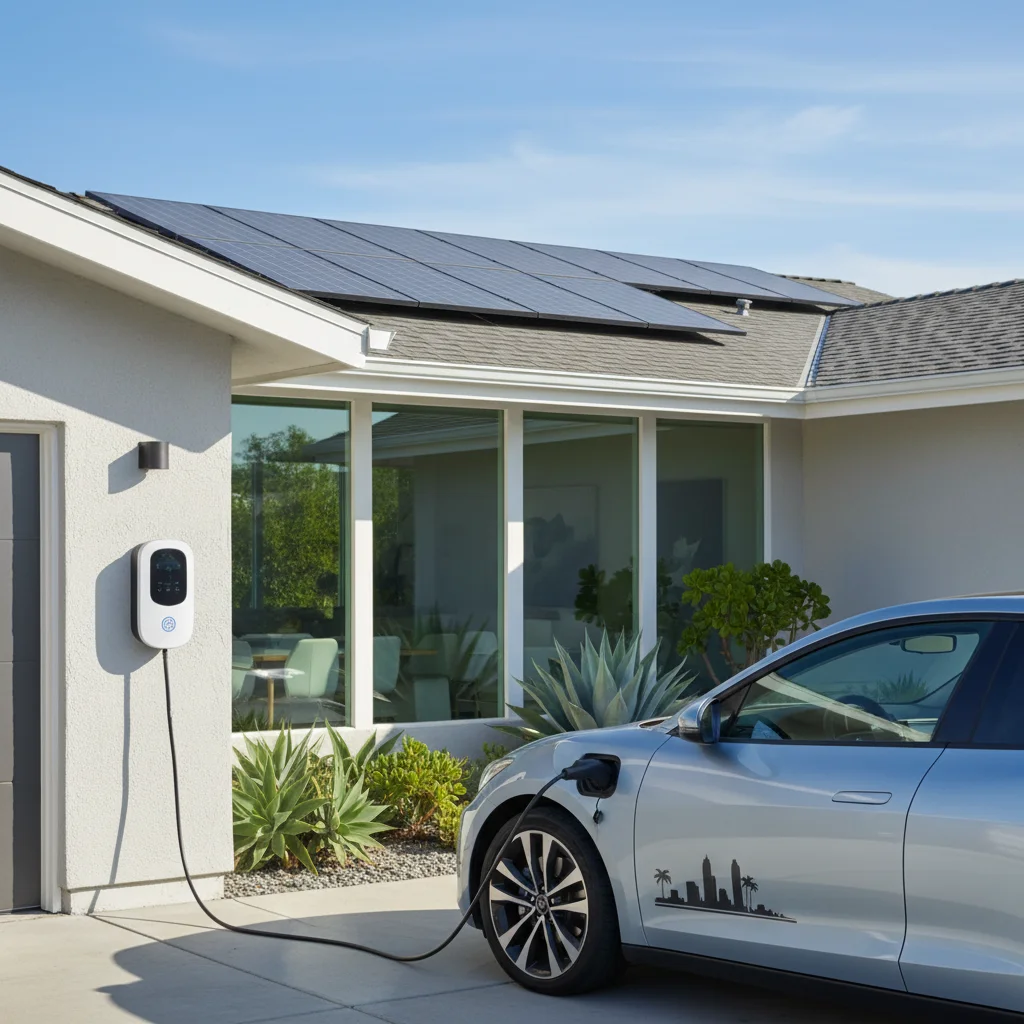
San Diego drivers who installed Level 2 EV chargers in 2025 left over $12,000 in combined rebates unclaimed because they missed application deadlines or didn't know multiple programs could stack. In 2026, San Diego Gas & Electric (SDG&E), California's Clean Vehicle Rebate Project (CVRP), and federal Inflation Reduction Act credits offer a three-layer funding structure that covers 60-85% of total installation costs—but only if homeowners submit complete documentation packages before quarterly funding caps close.
What EV Charger Rebates Are Available in San Diego Right Now?
San Diego homeowners in 2026 access three primary rebate programs: SDG&E's Power Your Drive at Home rebate provides $1,000 for Level 2 charger purchases, California's CVRP offers an additional $2,000 for low-to-moderate income households, and the federal Inflation Reduction Act Alternative Fuel Vehicle Refueling Property Credit delivers a 30% tax credit (this federal credit ended for chargers placed in service after June 30, 2026) capped at $1,000 for residential installations. These programs operate independently with separate eligibility criteria, application portals, and disbursement timelines.
SDG&E's program launched January 15, 2026 with $8.4 million in allocated funds distributed on a first-come, first-served basis. And the utility reports 34% of 2026 funds were claimed in the first six weeks, creating urgency for applicants. California's CVRP maintains rolling applications through December 31, 2026 with income verification requirements: households earning below 300% of the federal poverty level ($93,600 for a family of four in 2026) qualify for the full $2,000, while those earning 300-400% of FPL receive $1,000.
The federal 30C charger credit ended for chargers placed in service after June 30, 2026 (IRS FS-2025-05). Federal tax credits for this work have ended, but state, local and utility rebates may still apply; check what is available at your address with the DuloCore rebate calculator.
How Much Can You Save With San Diego EV Charger Rebates?
A standard Level 2 EV charger installation in San Diego costs $1,800-$3,200 depending on electrical panel upgrades, permit fees, and licensed electrician labor rates averaging $125-$175 per hour. Homeowners who stack all three rebate programs reduce out-of-pocket expenses to $300-$1,200—a 62-83% savings from total project costs.
For a typical $2,400 installation (charger unit $700, electrical work $1,200, permits $500), the combined savings break down as: SDG&E rebate $1,000 + federal tax credit $720 (30% of $2,400) + CVRP $2,000 for qualifying households = $3,720 total incentives. This exceeds the project cost, effectively making the installation free with $1,320 in surplus that offsets future electricity costs.
So income-qualified households achieve the highest savings rates. A family of four earning $82,000 annually (285% of federal poverty level) receives the full CVRP $2,000 plus SDG&E and federal credits, totaling $3,720 in combined incentives. But households above 400% FPL still access $1,720 in combined SDG&E and federal support—a 72% reduction on a $2,400 installation.
The savings timeline varies by program. SDG&E disburses rebate checks 6-8 weeks after application approval. And CVRP processes payments within 90 days of complete submission. Federal credits reduce 2026 tax liability when filing returns in Q1 2027.
Am I Eligible for EV Charger Rebates in San Diego?
SDG&E's Power Your Drive at Home requires applicants to own or lease battery-electric or plug-in hybrid vehicles registered in ZIP codes 91901-92199 (San Diego County service territory), install chargers at primary residences, and purchase equipment from SDG&E's pre-approved vendor list of 14 manufacturers including ChargePoint, JuiceBox, and ClipperCreek. Renters qualify if they submit landlord permission forms notarized within 30 days of application.
California's CVRP adds income thresholds verified through 2025 tax returns or three consecutive pay stubs dated within 45 days of application. And the program excludes households who previously received CVRP funding for EV chargers at the same address—but homeowners who moved to new properties or replaced older non-networked chargers with smart models meeting current utility demand-response standards remain eligible.
But homeowners who owe less than $1,000 in federal taxes after other deductions won't capture the full credit value. The federal 30C charger credit ended for chargers placed in service after June 30, 2026 (IRS FS-2025-05).
"To qualify for the rebate, customers must be an SDG&E residential electric customer, own or lease an eligible electric vehicle, and install a Level 2 charging station at their primary residence." — SDG&E Power Your Drive
What Documentation Do You Need to Claim Your Rebate?
SDG&E requires five mandatory documents uploaded as PDF files under 5MB each: itemized purchase receipt showing charger model number and transaction date, final electrical inspection certificate issued by San Diego County or municipal building departments, proof of vehicle ownership (registration or lease agreement dated within 12 months), utility account number matching the installation address, and W-9 form for tax reporting on rebate payments exceeding $600.
CVRP applications demand additional income verification: complete 2025 Form 1040 with all schedules, or for recent employment changes, three consecutive pay stubs plus a signed employer verification letter on company letterhead confirming annual salary. And applicants claiming low-income enhanced rebates ($2,000 tier) must submit proof of enrollment in California Alternate Rates for Energy (CARE) or Family Electric Rate Assistance (FERA) programs through SDG&E.
Federal tax credit claims need manufacturer certification statements confirming equipment meets qualified fuel infrastructure standards—most vendors provide these as one-page PDFs with UL listing numbers and SAE J1772 compliance declarations. But the IRS audits 8% of Alternative Fuel credits annually, so homeowners should retain installation contracts, canceled checks, credit card statements, and electrician license verification for seven years after filing.
Permit documentation presents the most common rejection point. San Diego County building departments issue inspection certificates within 48 hours of final sign-off, but delays occur when electricians skip required rough-in inspections before drywall closure. So scheduling inspections at rough-in and final stages prevents the 3-6 week resubmission delays that push applications past quarterly funding deadlines.
Use our free rebate calculator to estimate your total savings across all three programs based on installation costs and household income.
When Is the Deadline to Apply for San Diego EV Charger Rebates?
SDG&E's Power Your Drive at Home accepts applications until December 20, 2026 at 11:59 PM Pacific Time, but the program operates on a first-come, first-served basis with quarterly budget reviews. And the utility pauses new applications when 80% of allocated funds are committed—this occurred on March 31, 2025 after just 10 weeks, leaving late applicants waitlisted until Q2 funding authorization.
CVRP maintains rolling deadlines through December 31, 2026 with a critical caveat: applications must be submitted within 18 months of vehicle purchase date and within 12 months of charger installation date. So homeowners who installed chargers in Q1 2025 face a Q3 2026 cutoff regardless of overall program extension.
Federal tax credits follow calendar year rules. But chargers installed between January 1-December 31, 2026 qualify for credits claimed on 2026 returns filed by April 15, 2027 (or October 15, 2027 with extension). The IRS doesn't accept amended returns to add previously unclaimed Alternative Fuel credits beyond three years from the original filing deadline.
Documentation deadlines create tighter constraints than program close dates. SDG&E requires final inspection certificates uploaded within 90 days of rebate reservation approval. And incomplete applications sitting in "pending documentation" status for 120 days automatically cancel, forfeiting reserved rebate amounts that return to the general funding pool.
Can You Stack Multiple Rebates for Greater Savings?
Federal law explicitly permits combining the 30% Alternative Fuel Vehicle Refueling Property Credit with state and utility rebates without reduction. And California Public Utilities Commission Decision 19-08-001 authorizes SDG&E customers to layer utility incentives with CVRP payments, creating a three-program stack worth $3,000-$4,720 depending on income qualification and project costs.
But the stacking calculation order matters for tax purposes. The federal credit calculates from gross installation costs before subtracting rebates—so a $2,400 project generates a $720 federal credit (30% of $2,400) even though SDG&E and CVRP rebates reduce net homeowner costs to near zero. This differs from solar investment tax credit rules where rebates reduce the eligible cost basis.
Local municipal programs add a fourth layer. The City of San Diego's Climate Equity Fund offers an additional $500 for Level 2 charger installations in environmental justice communities (census tracts with CalEnviroScreen 4.0 scores above 75th percentile). And these payments stack with all three primary programs but require separate applications submitted to the city's Sustainability Department within 60 days of final inspection.
So a low-income household in National City (CalEnviroScreen score 89.3) installing a $2,400 Level 2 charger accesses: SDG&E $1,000 + CVRP $2,000 + federal credit $720 + Climate Equity Fund $500 = $4,220 total incentives. This creates a net positive cash flow of $1,820 after installation costs—effectively paying homeowners to install chargers.
How Does the San Diego Rebate Process Work From Start to Finish?
The optimal application sequence starts with SDG&E pre-qualification 2-3 weeks before scheduling installation. Homeowners create accounts at sdge.com/ev-rebates, enter vehicle VIN numbers for eligibility verification, and receive conditional approval emails within 3-5 business days. And this locks in rebate reservations before funding caps close, protecting against mid-installation program suspensions.
Step two involves selecting licensed electricians from SDG&E's contractor network—required for rebate eligibility but also ensuring installers understand utility demand-response requirements. The utility mandates chargers support OpenADR 2.0b communication protocols allowing load management during grid stress events. So purchasing non-networked "dumb" chargers creates instant disqualification even if installation quality meets code.
Permit applications to San Diego County or municipal building departments occur next, requiring site plans showing charger locations, electrical panel load calculations, and circuit specifications. And permit fees range from $185-$425 depending on jurisdiction and scope of electrical work. Inspection scheduling should coordinate with electrician availability—the average timeline from permit submission to final inspection spans 18-22 days.
CVRP applications open after final inspection, requiring photograph uploads showing installed chargers with visible serial numbers and electrical panels with new breaker installations labeled. And the program's income verification portal cross-references submitted tax returns with California Franchise Tax Board databases, flagging discrepancies that trigger manual review adding 4-6 weeks to processing.
Federal credit claims occur last, when filing 2026 tax returns. The federal 30C charger credit ended for chargers placed in service after June 30, 2026 (IRS FS-2025-05).
For more information on related incentives, see our guide to heat pump rebates and comprehensive overview of energy tax credits.
Official Sources
- U.S. Department of Energy: SAVE — Federal guidance on energy efficiency rebates and tax incentives for home improvements
- DSIRE USA — Comprehensive database of state and federal incentives for renewable energy and energy efficiency
Frequently Asked Questions
What EV charger rebates are available in San Diego California?
San Diego homeowners in 2026 access three primary incentives: SDG&E's Power Your Drive at Home provides $1,000 for Level 2 charger installations, California's Clean Vehicle Rebate Project offers $1,000-$2,000 based on household income (below 400% federal poverty level), and the federal Alternative Fuel Vehicle Refueling Property Credit delivers 30% of installation costs up to $1,000. These programs stack without reduction, creating combined incentive packages of $2,720-$4,000 depending on income qualification and total project expenses.
How much money can you get for installing an EV charger in San Diego?
Total available incentives range from $2,720 to $4,220 when stacking all qualifying programs. Low-income households (below 300% federal poverty level, or $93,600 for a family of four) receive SDG&E's $1,000 rebate, CVRP's full $2,000 rebate, and the federal 30% tax credit (this federal credit ended for chargers placed in service after June 30, 2026) up to $1,000—totaling $4,000 on a typical $2,400 installation. Households in environmental justice communities add another $500 from the City of San Diego's Climate Equity Fund, reaching $4,500 in total support.
Are you eligible for EV charger rebates in San Diego California?
Eligibility requires SDG&E residential electric service in ZIP codes 91901-92199, ownership or lease of a battery-electric or plug-in hybrid vehicle, and installation at a primary residence. CVRP adds income thresholds: households below 400% federal poverty level qualify for enhanced rebates. And renters qualify for SDG&E and federal programs with notarized landlord permission but face restrictions on CVRP depending on lease terms.
What is the application process for EV charger rebates in San Diego?
The process starts with SDG&E pre-qualification at sdge.com/ev-rebates to reserve funding, followed by permit applications to local building departments showing electrical plans and load calculations. After installation and final inspection (required within 90 days of SDG&E approval), homeowners submit inspection certificates, purchase receipts, and vehicle registration to SDG&E's portal. CVRP applications follow with income documentation and installation photographs. The federal 30C charger credit ended for chargers placed in service after June 30, 2026 (IRS FS-2025-05).
When is the deadline for EV charger rebate applications in San Diego California?
SDG&E accepts applications until December 20, 2026 but operates first-come, first-served with quarterly funding reviews—the program paused in Q1 2025 after 80% fund depletion. CVRP requires submission within 18 months of vehicle purchase and 12 months of charger installation, with a hard December 31, 2026 program close. Federal credits claim on 2026 tax returns filed by April 15, 2027 (October 15, 2027 with extension), covering installations completed January 1-December 31, 2026.
Ready to maximize your EV charger savings? Use our free rebate calculator to see exactly how much you'll save with SDG&E, CVRP, and federal incentives based on your household income and installation costs. Get your personalized rebate estimate in under 60 seconds.
Last updated April 14, 2026 — reviewed by DuloCore Editorial. About our authors.
Check your California EV charger rebate eligibility — see the programs you qualify for and the dollar amounts on our California EV charger rebate finder.