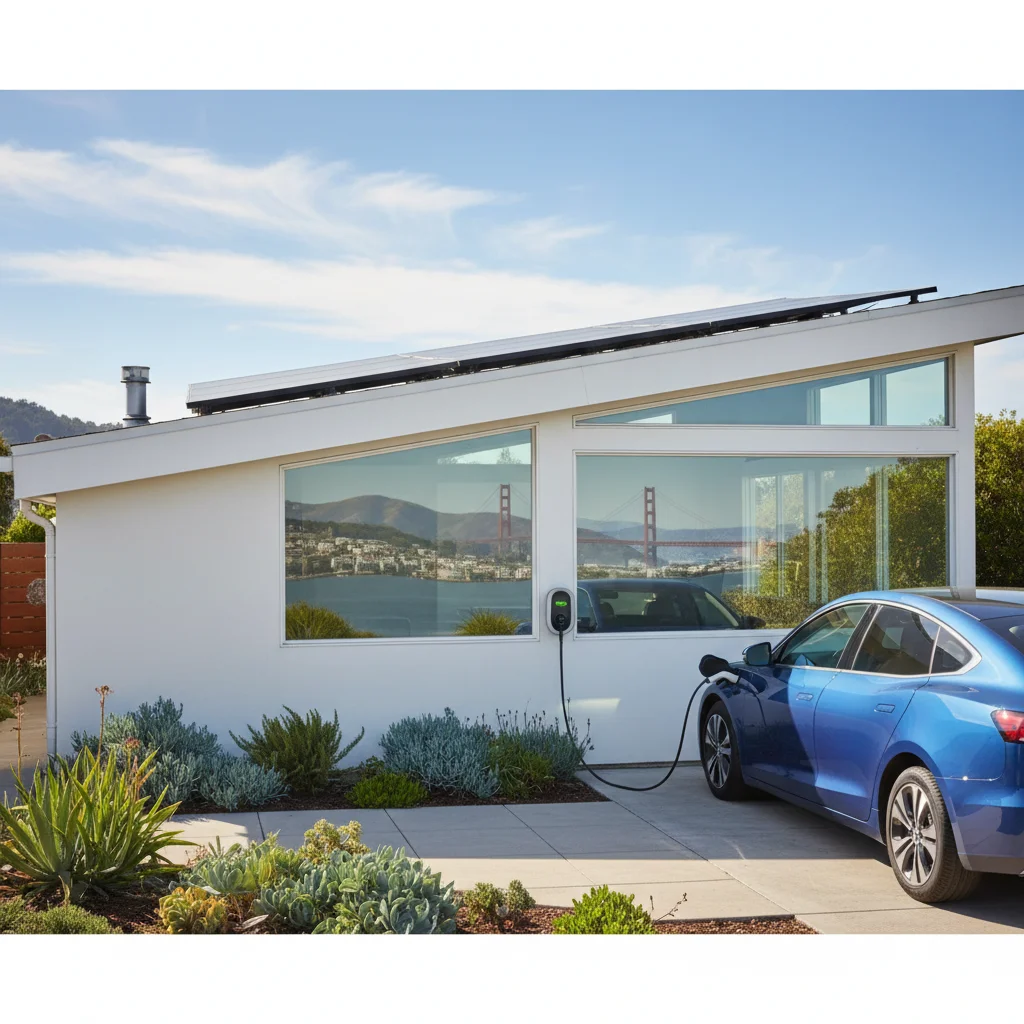
San Francisco drivers who install a Level 2 EV charger in 2026 can stack $2,000 in city rebates with $1,000 in state incentives and a 30% federal tax credit—cutting installation costs from $3,500 to under $800 for eligible households. And the city's Clean Vehicle Rebate Project prioritizes low-income residents with expedited processing and higher rebate caps. But program funds deplete quarterly, and the current allocation runs through June 30, 2026.
What EV Charger Rebates Are Available in San Francisco Right Now?
San Francisco's 2026 EV charger rebate landscape includes three stacked funding sources: the city's GoElectric program, California's Clean Vehicle Rebate Project (CVRP), and the federal Alternative Fuel Infrastructure Tax Credit. The GoElectric program offers $2,000 for income-qualified households installing Level 2 chargers in single-family homes or $1,500 for shared chargers in multi-unit dwellings. CVRP provides an additional $1,000 for residents in disadvantaged communities as defined by CalEnviroScreen 4.0 scores. The federal 30C charger credit ended for chargers placed in service after June 30, 2026 (IRS FS-2025-05). Federal tax credits for this work have ended, but state, local and utility rebates may still apply; check what is available at your address with the DuloCore rebate calculator.
GoElectric prioritizes applications from environmental justice neighborhoods—census tracts with air quality scores in the top 25% statewide. CVRP uses a first-come, first-served model with quarterly funding releases. So timing applications to coincide with funding cycle openings in January, April, July, and October maximizes approval odds.
How Much Money Can You Save With San Francisco EV Charger Rebates?
A typical Level 2 charger installation in San Francisco costs $3,200 to $4,800 depending on electrical panel upgrades and permitting fees. For a household earning 80% of Area Median Income (AMI)—$74,150 for a family of four in 2026—stacking all three rebates reduces out-of-pocket costs to $650 to $1,300. And residents in Bayview-Hunters Point or Visitacion Valley qualify for the maximum $2,000 GoElectric rebate plus $1,000 CVRP incentive, eliminating 60% of total installation costs before the federal credit applies.
But the federal credit functions as a tax liability reduction, not a direct rebate. Homeowners with $1,000 in federal tax liability receive the full $1,000 credit. The federal 30C charger credit ended for chargers placed in service after June 30, 2026 (IRS FS-2025-05). The average San Francisco household saves $2,800 to $3,400 when combining all three programs.
Who Is Eligible for San Francisco EV Charger Rebates in 2026?
GoElectric requires applicants to own or rent property within San Francisco city limits and have household income at or below 80% AMI—$59,300 for individuals, $84,750 for families of four. And renters must submit landlord consent forms with applications. CVRP eligibility extends to all California residents installing chargers at their primary residence, with enhanced rebates for households earning below 300% of federal poverty level ($93,600 for a family of four in 2026).
The federal tax credit applies to property owners who install chargers at their primary or secondary residence. But renters cannot claim the credit even if they pay for installation, and the charger must be placed in service during the tax year claimed. So installations completed in December 2026 qualify for 2026 tax returns filed in April 2027.
San Francisco prioritizes applications from residents in the Bayview, Visitacion Valley, Excelsior, and Outer Mission neighborhoods—census tracts with CalEnviroScreen 4.0 pollution burden scores exceeding 75th percentile statewide. And multi-unit dwelling owners installing shared chargers receive preference in GoElectric processing queues.
What Documentation Do You Need to Apply for EV Charger Rebates?
GoElectric requires itemized installation invoices showing equipment costs, labor charges, and permit fees separately. And applicants submit proof of income through 2024 or 2025 tax returns, recent pay stubs covering 90 days, or benefit award letters for Social Security, disability, or CalFresh programs. Renters include notarized landlord consent forms confirming installation approval and property access.
CVRP demands vehicle registration documents proving ownership of a battery-electric or plug-in hybrid vehicle purchased or leased after January 1, 2023. And applications include photographs of the installed charger showing manufacturer labels, electrical panel connections, and mounting locations. Utility bill copies from the past 60 days verify service address and account holder name matching application details.
The federal 30C charger credit ended for chargers placed in service after June 30, 2026 (IRS FS-2025-05). And taxpayers retain copies of manufacturer certifications confirming equipment meets UL 2594 or UL 2202 safety standards. So homeowners hiring licensed contractors receive stamped permits and final electrical inspection approvals—documents the IRS requests during audits of energy credit claims.
"Qualified alternative fuel vehicle refueling property includes any property for the recharging of motor vehicles propelled by electricity, but only if the original use begins with the taxpayer." — IRS Form 8911 Instructions
When Are the Deadlines for San Francisco EV Charger Rebate Programs?
GoElectric operates on a fiscal year calendar with funding allocated quarterly. The current 2026 cycle runs through June 30, 2026, with $4.8 million in total rebate funds. And applications submitted after April 15, 2026 enter a waitlist for Q3 funding starting July 1. So installing chargers before mid-April maximizes same-quarter approval odds.
CVRP releases funding in quarterly tranches, with the next allocation opening April 1, 2026 at 8:00 AM Pacific. Applications submitted within the first 48 hours of funding windows receive priority processing. But the program pauses when quarterly allocations deplete—typically 6 to 8 weeks after each cycle opens based on 2025 utilization rates.
The federal 30C charger credit ended for chargers placed in service after June 30, 2026 (IRS FS-2025-05). And amended returns claiming overlooked credits extend back three years, so 2023 installations remain eligible if claimed by April 15, 2027.
| Program | Rebate Amount | Income Limit | Application Deadline |
|---|---|---|---|
| GoElectric | $2,000 | 80% AMI ($84,750 family of 4) | June 30, 2026 (Q2 funding) |
| CVRP | $1,000 | 300% FPL ($93,600 family of 4) | Quarterly until funds depleted |
| Federal Tax Credit | Ended June 30, 2026 | — | Ended June 30, 2026 |
How Does the San Francisco Rebate Process Compare to Other California Cities?
San Francisco's $2,000 maximum GoElectric rebate exceeds Los Angeles Clean Energy Incentive Program ($1,000) and San Diego's Power Your Drive ($500) for residential chargers. And processing timelines average 45 to 60 days in San Francisco versus 90 to 120 days in Sacramento and Oakland. But San Jose's SCALE program offers $3,000 for income-qualified multi-unit dwelling installations—the highest single rebate in the Bay Area.
San Francisco's 80% AMI income threshold captures broader household ranges than Berkeley's 60% AMI limit or Palo Alto's means-tested programs requiring CalFresh enrollment. So middle-income families earning $70,000 to $85,000 qualify in San Francisco but face rejection in neighboring cities. And the city's streamlined application portal integrates GoElectric, CVRP, and utility net metering applications in a single submission—reducing administrative burden compared to Los Angeles's four separate portals for overlapping programs.
Verify current program availability through the free rebate calculator tool showing real-time funding balances and estimated savings for your address.
"California allocated $180 million for zero-emission vehicle infrastructure in fiscal year 2025-26, with $42 million earmarked for residential charging incentives in low-income and disadvantaged communities." — California Energy Commission
Official Sources
- U.S. Department of Energy Alternative Fuels Data Center — Federal and state EV infrastructure incentive database
- IRS Alternative Fuel Vehicle Refueling Property Credit — Tax credit eligibility and filing requirements (note: the federal 25C and 25D credits ended for projects completed after December 31, 2025)
- California Clean Vehicle Rebate Project — State rebate program details and application portal
Frequently Asked Questions
What EV charger rebates are available in San Francisco?
San Francisco residents access three rebate sources in 2026: GoElectric ($2,000 for income-qualified households), California CVRP ($1,000 for disadvantaged communities), and the federal Alternative Fuel Infrastructure Tax Credit (30% of costs, max $1,000). And stacking all three programs reduces typical $3,500 installations to under $1,000 out-of-pocket for eligible families. Applications open quarterly through the city's online portal.
How much money can you get for installing an EV charger in San Francisco?
Combining GoElectric, CVRP, and federal credits delivers $3,000 to $4,000 in total incentives for installations costing $3,200 to $4,800. Income-qualified households in environmental justice neighborhoods receive the maximum $2,000 GoElectric rebate plus $1,000 CVRP incentive. And the 30% federal credit (this federal credit ended for chargers placed in service after June 30, 2026) applies to remaining costs after rebates, capped at $1,000. So net installation costs drop to $650 to $1,300 for stacked incentives.
Are you eligible for EV charger rebates in San Francisco?
GoElectric requires San Francisco residency and household income at or below 80% AMI—$84,750 for a family of four in 2026. CVRP extends to all California residents with no income cap, but enhanced rebates apply to households earning below 300% federal poverty level ($93,600 for a family of four).
What is the application process for San Francisco EV charger rebates?
Submit GoElectric applications through the city's online portal with proof of income, installation invoices, and property ownership or landlord consent forms. CVRP requires vehicle registration, charger photos, and utility bills uploaded to the state portal. The federal 30C charger credit ended for chargers placed in service after June 30, 2026 (IRS FS-2025-05). Processing takes 45 to 60 days for city rebates, 30 to 45 days for CVRP, and occurs at tax filing for federal credits.
When is the deadline to apply for EV charger rebates in San Francisco?
GoElectric's Q2 2026 funding cycle closes June 30, 2026, with applications after April 15 entering a Q3 waitlist. CVRP opens quarterly funding windows, with the next allocation starting April 1, 2026 at 8:00 AM Pacific. The federal 30C charger credit ended for chargers placed in service after June 30, 2026 (IRS FS-2025-05). So scheduling installations before April maximizes same-quarter approval odds.
Ready to calculate your total savings? Use our free rebate calculator to estimate combined GoElectric, CVRP, and federal tax credit amounts for your San Francisco address and household income. Get your personalized savings breakdown in under 60 seconds.
Last reviewed: April 14, 2026. Reviewed by DuloCore Energy Specialists. About the team.
Check your California EV charger rebate eligibility — see the programs you qualify for and the dollar amounts on our California EV charger rebate finder.