Update (2026): The federal Energy Efficient Home Improvement Credit (Section 25C) expired December 31, 2025, following the passage of the OBBBA. Check state and local programs for current incentives.
Up to 30% of a home's heating and cooling energy is lost through air leaks in walls, floors, and ceilings alone. This invisible waste silently inflates utility bills month after month, turning your home into an inefficient energy sieve. And every dollar spent on wasted energy is a dollar that can't be used for other home improvements or savings.
But identifying these hidden energy drains is the first step toward a more comfortable and affordable home. A professional home energy audit acts as a diagnostic tool, pinpointing the exact sources of energy loss. So homeowners can make targeted upgrades that deliver immediate and lasting savings on their energy costs. The U.S. Department of Energy estimates that sealing air leaks and adding insulation, two common recommendations from an audit, can save homeowners up to 20% on heating and cooling costs.
What Rebates and Financial Incentives Are Available for Home Energy Audits?
Home energy audit rebates are financial incentives offered by utilities, states, and the federal government that reduce the upfront cost of an assessment. These programs for 2026 provide discounts up to $500 or cover 100% of the cost for income-qualified households.
Financial incentives for 2026 make getting a professional audit more accessible than ever. The federal Energy Efficient Home Improvement Credit (Section 25C) ended for property placed in service after December 31, 2025 (IRS FS-2025-05). Federal tax credits for this work have ended, but state, local and utility rebates may still apply; check what is available at your address with the DuloCore rebate calculator. And many state energy offices and local utility companies offer direct rebates that further reduce or even eliminate the out-of-pocket expense. For example, a utility program offers a $300 instant rebate, while a state program offers a mail-in rebate of $250. So homeowners can often get a comprehensive $450 audit for just $150 after applying the federal credit. These programs are designed to encourage homeowners to take the first step in understanding and improving their home’s energy performance, leading to future savings on larger projects like new heat pump rebates.
Am I Eligible for State and Utility Home Energy Audit Programs and Rebates?
Eligibility for 2026 home energy audit programs is determined by location, utility provider, and often household income. State programs frequently have income caps, while utility rebates require customers to be in their service area, with some programs open to all residential homeowners.
Qualifying for these valuable programs depends on a few key factors. First, your home must be located within the service territory of the sponsoring utility or state agency. And many programs are restricted to owner-occupied, single-family homes or small multi-family buildings. But some of the most generous rebates are income-qualified. For instance, programs modeled after the federal Home Energy Rebates often provide free audits for households earning less than 80% of the Area Median Income (AMI). So a family of four with an income below $75,000 in certain areas receives a no-cost audit. Homeowners should always check the specific requirements on their utility or state energy office website before scheduling an assessment to ensure they qualify for the maximum available financial assistance.
"Many state and local governments and utilities offer incentives for home energy audits and for making energy efficiency improvements to your home." — U.S. Department of Energy
How Do I Apply for Home Energy Audit Rebates and Choose a Qualified Contractor?
The application process for 2026 home energy audit rebates involves finding a certified auditor, scheduling the assessment, and submitting paperwork to the utility or state agency. Homeowners must use contractors with BPI or RESNET certifications to qualify for most financial incentives.
Securing your rebate is a straightforward, multi-step process. First, identify available programs in your area using your utility’s website or a state energy database. And you can use our free rebate calculator to find local programs and savings. Next, you must select a certified professional; most programs require the auditor to hold a certification from the Building Performance Institute (BPI) or the Residential Energy Services Network (RESNET). After the audit is complete, the contractor provides a detailed report and an invoice. So you will submit this documentation along with the program’s rebate application form online or via mail. But some utilities offer instant rebates where the discount is applied directly by the contractor, simplifying the process for the homeowner.
Home Energy Audit Rebate Comparison (2026)
| Program Type | Rebate/Credit Amount | Key Eligibility Requirements |
|---|---|---|
| Federal IRA Tax Credit | Ended Dec 31, 2025 | — |
| State Energy Program | $200 - $500 rebate | Varies by state; often income-qualified. |
| Local Utility Rebate | $100 - $300 instant discount | Must be a customer of the specific utility. |
What Are the Deadlines and Funding Status for Home Energy Audit Programs?
Deadlines for 2026 home energy audit programs are typically set for December 31, 2026, but funding is limited and often allocated on a first-come, first-served basis. Homeowners should verify program funding status online as popular incentives can be exhausted before the year ends.
Timing is critical when applying for home energy audit rebates. While the federal energy tax credits are available through December 31, 2025, state and utility programs operate on annual budgets. And these funds are often depleted before the official end-of-year deadline. For example, a popular state program with a $2 million budget may run out of funds by October. So it is essential for homeowners to check the program's website for real-time funding status updates. Acting early in the calendar year, typically between January and March, ensures a better chance of securing a rebate before the allocation is exhausted. Don't wait until the fall to schedule your audit, as you risk finding the program has already closed for the year.
"DSIRE is the most comprehensive source of information on incentives and policies that support renewables and energy efficiency in the United States." — DSIRE
Can I Combine (Stack) Home Energy Audit Rebates and Maximize My Savings?
Stacking home energy audit rebates in 2026 is often possible by combining a federal tax credit with a state or utility incentive. But some programs prohibit combining two local rebates, requiring homeowners to choose the one offering the greatest financial benefit for the audit.
Maximizing your savings involves strategically combining multiple incentives, a practice known as stacking. The most common and widely allowed combination is pairing the $150 federal tax credit with a single state or utility rebate. For instance, you can claim the $150 federal credit and also receive a $200 instant rebate from your electric company for the same audit. So a $400 audit costs you only $50 out-of-pocket. But you generally cannot stack a state rebate with a utility rebate from the same jurisdiction. Program rules will explicitly state if stacking is prohibited. Therefore, you must compare the offers and choose the more valuable one. Always review the terms and conditions of each program to confirm their policy on combining incentives before you proceed.
Official Sources
- ENERGY STAR — Federal guidance on what to expect from a home energy audit and how to find qualified professionals.
- Database of State Incentives for Renewables & Efficiency (DSIRE) — A comprehensive database of state, local, and utility incentives for energy efficiency.
Related Reading: Learn more about Ashrae Energy Audit Levels Explained and Blower Door Test Home Energy.
Related Reading: Learn more about Infrared Thermography Home Audit.
Related Reading: Learn more about Air Sealing Home Energy Audit and Thermal Camera Home Energy Audit.
Frequently Asked Questions About Home Energy Audits
How much does a home energy audit cost, and can I get one for free?
A professional home energy audit typically costs between $300 and $600. And the final price depends on your home's size and the complexity of the assessment. But many income-qualified programs, such as those for households earning below 80% of the Area Median Income, offer audits for free. So combining a $150 federal tax credit with a $200 utility rebate also reduces the cost to a minimal amount.
What exactly happens during a professional home energy audit?
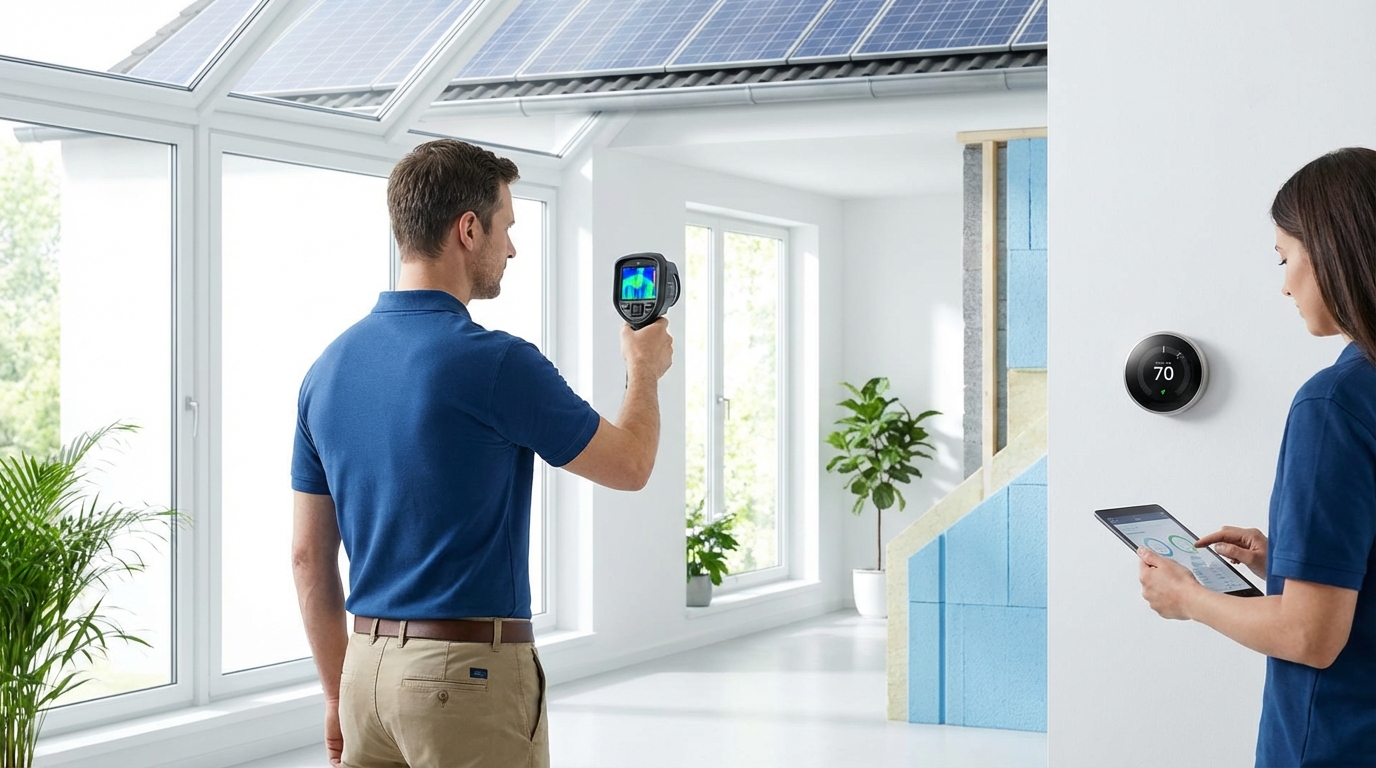
During a 2-4 hour audit, a certified technician inspects your home from attic to basement. They perform a blower door test to measure air leakage and use an infrared camera to detect insulation gaps. And the auditor also checks HVAC systems, appliances, and lighting. So you receive a detailed report with prioritized recommendations, such as adding 12 inches of attic insulation or sealing air leaks around windows.
What are the main benefits of getting a home energy audit?
The primary benefit is a reduction in energy bills, typically saving homeowners 5% to 30
Updated: April 14, 2026 — fact-checked by DuloCore Research. About our editorial process.