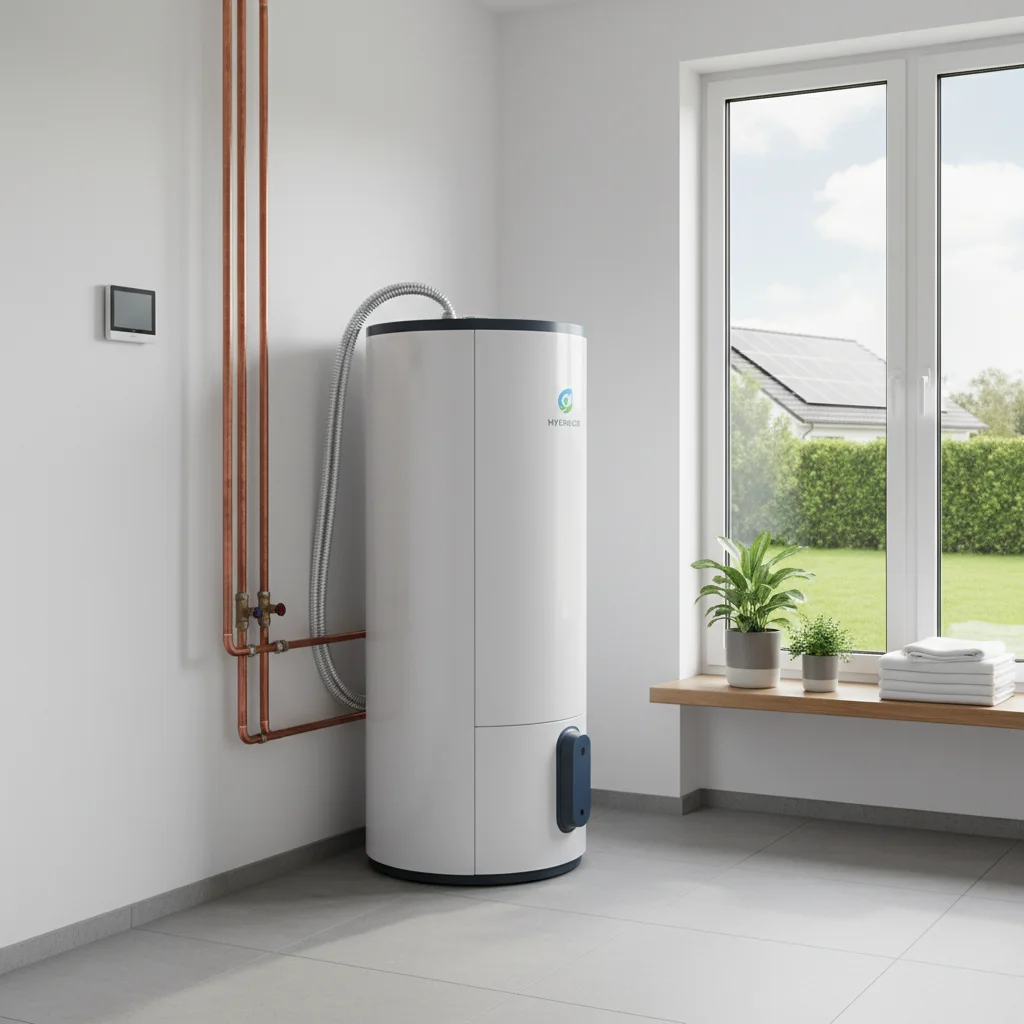
Homeowners switching to hybrid water heaters in 2026 can claim up to $2,000 in federal tax credits and an additional $1,750 from state rebate programs—a combined $3,750 return on a technology that cuts water heating costs by 50-63% compared to conventional electric models. And these numbers come from a grid of overlapping incentives that reward early adopters before funding runs dry.
What is a hybrid water heater rebate and how much money can you save?
A hybrid water heater rebate in 2026 is a post-purchase financial incentive offered by federal, state, and utility programs that returns $300 to $2,000 per installation, with total savings reaching $3,750 when stacking multiple programs. Federal IRA tax credits cover 30% of equipment and installation costs up to $2,000, California's TECH Clean California initiative offers $300-$1,000, and utilities like PG&E and SoCal Edison provide $500-$1,000 depending on capacity and efficiency tier. Rebates apply specifically to ENERGY STAR-certified heat pump water heaters with Uniform Energy Factor (UEF) ratings of 2.0 or higher—the technical designation for what manufacturers market as "hybrid" models.
So what separates a rebate from a tax credit? Rebates arrive as direct payments or point-of-sale discounts within 6-12 weeks. Form 5695 only covers qualifying work completed by December 31, 2025 and claimed on a 2025 return; the federal 25C and 25D credits ended after that date (IRS FS-2025-05). And the combination delivers immediate cash flow relief plus year-end savings that exceed $3,000 for qualifying households.
"Heat pump water heaters use up to 63% less energy than conventional electric water heaters." — ENERGY STAR
But utility rebates carry strict participation windows—PG&E's 2026 allocation funded only 4,200 units before closing applications in March. So households targeting maximum rebates need to cross-reference water heater rebates across all available programs before installation.
What are the eligibility requirements and do I need pre-approval before buying?
California hybrid water heater rebates in 2026 require ENERGY STAR certification, professional installation by a licensed contractor, and income verification for enhanced state incentives, with pre-approval mandatory for TECH Clean California programs but not required for federal tax credits. Households earning below 80% Area Median Income (AMI) qualify for TECH's $1,750 maximum rebate, while those earning 80-150% AMI receive $1,000. Form 5695 only covers qualifying work completed by December 31, 2025 and claimed on a 2025 return; the federal 25C and 25D credits ended after that date (IRS FS-2025-05). Federal tax credits for this work have ended, but state, local and utility rebates may still apply; check what is available at your address with the DuloCore rebate calculator.
Pre-approval requirements split along program lines. TECH Clean California demands application submission before purchase, with a 2-3 week review period to confirm household income and contractor participation.
Installation must meet specific technical standards. Eligible units carry UEF ratings of 2.0 or higher, tank capacities of 50-80 gallons, and first-hour ratings exceeding 67 gallons for 80-gallon models. And contractors must hold C-36 (plumbing) or C-20 (HVAC) licenses in California, with proof of proper electrical and plumbing permits submitted alongside rebate applications.
"California's TECH Clean California program provides up to $3,000 for low-income households installing heat pump water heaters." — California Energy Commission
Utility programs add occupancy requirements—PG&E restricts rebates to single-family homes and multifamily units with individual water heaters, excluding properties with centralized systems. So renters need landlord approval and must verify lease terms allow equipment upgrades before applying.
When is the deadline for hybrid water heater rebates in 2025?
The federal Energy Efficient Home Improvement Credit (Section 25C) ended for property placed in service after December 31, 2025 (IRS FS-2025-05). California state programs operate on fiscal year cycles with TECH Clean California funding periods closing when allocations deplete, typically within 3-6 months of each July 1 funding release. But state and utility rebates enforce stricter timelines—TECH Clean California's current round covers installations through June 30, 2026, with applications due within 180 days of installation.
Utility programs impose tighter windows. PG&E's 2026 allocation opened January 15 and closed March 22 after funding 4,200 units in 66 days. SoCal Edison's program remains open through September 30, 2026, but historical data shows funding exhaustion by mid-August in prior years. And SDG&E operates rolling 90-day application windows with monthly funding resets—installations in April must apply by June 30 to claim the $500 base rebate.
Post-installation documentation deadlines matter as much as purchase timing. TECH requires invoice submission within 180 days of project completion. So a 2026 installation can claim the credit on amended returns filed through April 2030.
Use our free rebate calculator to estimate your total savings across federal, state, and utility programs based on your installation date and household income.
Are hybrid water heater rebates still being funded or have they run out?
Federal hybrid water heater rebates remain fully funded through 2032 with no exhaustion risk, but California state programs face chronic depletion—TECH Clean California's 2026 allocation ran dry on March 22 after funding 4,200 units in 66 days, while utility programs from PG&E, SoCal Edison, and SDG&E maintain active funding as of April 2026 with $18.3 million in uncommitted reserves. The federal Energy Efficient Home Improvement Credit (Section 25C) ended for property placed in service after December 31, 2025 (IRS FS-2025-05). But state programs rely on annual legislative appropriations that fluctuate with budget cycles.
TECH Clean California received $120 million in the 2026-2027 fiscal year budget, a 40% reduction from 2025 levels. And the program prioritizes low-income households earning below 80% AMI—these applicants receive $1,750 per unit versus $1,000 for moderate-income tiers. So funding depletes faster in metro areas with high concentrations of qualifying households. Sacramento County exhausted its allocation in 38 days, while rural counties like Modoc and Lassen maintain open applications through June 2026.
Utility rebates show uneven availability. PG&E closed its 2026 program after allocating $4.2 million across 4,200 installations. But SoCal Edison maintains $8.1 million in active funding through September 30, 2026, and SDG&E operates monthly resets with $500-$750 rebates available on a rolling basis. And municipal utilities like SMUD and LADWP run independent programs—SMUD offers $800 rebates with no current waitlist, while LADWP provides $400 rebates through December 2026.
So homeowners targeting maximum savings need to stack federal credits with utility rebates, bypassing depleted state programs. Federal credits alone deliver $1,400-$2,000 for typical $7,000-$10,000 installations.
Can I stack hybrid water heater rebates with other energy efficiency incentives?
California homeowners can stack federal IRA tax credits with state TECH Clean California rebates and utility incentives in 2026, claiming up to $3,750 in combined benefits for a single hybrid water heater installation—$2,000 federal credit, $1,000 state rebate, and $750 utility rebate. Federal law explicitly allows credit stacking under IRA provisions, and California's TECH program permits simultaneous claims with utility rebates as long as homeowners report all incentives on final applications. But stacking rules impose specific sequencing requirements—utility rebates reduce the purchase price before calculating the 30% federal credit (this federal credit ended for property placed in service after December 31, 2025), lowering the maximum credit from $2,000 to approximately $1,700 on a $7,000 installation after applying a $1,000 utility rebate.
And bundling water heater upgrades with other home improvements unlocks additional credits. Homeowners installing hybrid water heaters alongside heat pump HVAC systems or insulation upgrades can claim separate federal credits for each improvement—$2,000 for the water heater, $2,000 for the heat pump, and $1,200 for insulation, totaling $5,200 in federal credits alone. But these stack only when projects involve distinct systems. Replacing a furnace and water heater qualifies for two credits; replacing two water heaters claims only one credit regardless of quantity.
Utility programs enforce anti-double-dipping rules. PG&E prohibits claiming rebates for equipment already subsidized through TECH Clean California income-qualified tiers, but allows stacking with federal credits. So households must declare all incentives on utility applications to avoid recapture provisions that require repayment of improperly claimed rebates.
How do hybrid water heaters compare to traditional and heat pump models for rebate value?
Hybrid water heaters deliver 140-180% higher rebate value than traditional electric models and match standalone heat pump water heaters in incentive eligibility, with 2026 federal credits offering $2,000 for hybrids versus $0 for conventional resistance units. Traditional electric water heaters with UEF ratings below 0.95 qualify for no federal tax credits and only minimal $50-$150 utility rebates from programs like PG&E's standard efficiency tier. But hybrid models—technically heat pump water heaters—earn the full 30% IRA credit plus $500-$1,750 in state and utility rebates because they exceed the 2.0 UEF threshold.
So what's the operational difference? Traditional electric water heaters use resistance coils to heat water directly, consuming 4,500-5,500 kWh annually for a typical household. Hybrid models extract heat from surrounding air using refrigerant cycles, cutting consumption to 1,200-2,000 kWh annually—a 63% reduction that saves $350-$450 per year at California's average $0.28/kWh electricity rate. And this efficiency gap explains the rebate disparity—programs incentivize technologies that reduce grid load during peak demand periods.
But hybrid water heaters face installation constraints that traditional units avoid. They require 1,000 cubic feet of surrounding air space for heat extraction, making them incompatible with small closets or cramped utility rooms. And they discharge 250-350 BTU/hour of cool air during operation, which benefits cooling costs in summer but increases heating loads in winter. So households in cold climates see 15-20% lower annual savings than those in temperate zones.
"Heat pump water heaters are the most efficient type of electric water heater, using 60% less energy than standard electric water heaters." — U.S. Department of Energy
For rebate ROI, hybrids dominate. A $7,000 hybrid installation claims $2,000 federal credit plus $1,000 utility rebate, yielding a net cost of $4,000 and 6.2-year payback period based on $450 annual savings. Traditional electric models cost $1,200-$1,800 installed, claim no federal credits, and deliver no operational savings—a permanent $350/year cost disadvantage.
Official Sources
- ENERGY STAR Heat Pump Water Heaters — Federal efficiency standards and rebate qualification criteria
- U.S. Department of Energy - Energy Saver — Technical specifications and energy savings data for heat pump water heaters
- Database of State Incentives for Renewables & Efficiency (DSIRE) — Comprehensive state and utility rebate program database
Related Reading: Learn more about Sce Rebate Programs and Solar Water Heater Energy Audit.
Related Reading: Learn more about Tankless Water Heater Rebate.
Frequently Asked Questions
Are hybrid water heaters eligible for federal tax credits?
The federal Energy Efficient Home Improvement Credit (Section 25C) ended for property placed in service after December 31, 2025 (IRS FS-2025-05). The credit covers equipment and installation costs, with no income limits or pre-approval requirements. But homeowners must retain manufacturer certification statements and contractor invoices to substantiate claims during IRS audits.
How much can you save with a hybrid water heater rebate?
Homeowners save $300-$3,750 in direct rebates and credits, plus $350-$450 annually in reduced electricity costs when replacing traditional electric water heaters with hybrid models. Federal credits deliver $1,400-$2,000 depending on installation costs, state programs provide $300-$1,750 based on income tiers, and utilities add $500-$1,000. And operational savings compound over the unit's 12-15 year lifespan, totaling $5,250-$6,750 in lifetime energy cost reductions.
What is the difference between a hybrid water heater and a traditional water heater for rebates?
Hybrid water heaters use heat pump technology to achieve UEF ratings above 2.0 and qualify for $2,000 federal credits plus $500-$1,750 in state and utility rebates, while traditional electric resistance models rate below 0.95 UEF and receive no federal credits and only $50-$150 utility incentives. The efficiency gap—63% lower energy consumption for hybrids—drives the rebate disparity. And hybrids require 1,000 cubic feet of air space for operation, while traditional units install in tight closets without clearance requirements.
Do you need to install a hybrid water heater before applying for a rebate?
California's TECH Clean California program mandates pre-approval before purchase, with applications reviewed within 2-3 weeks and reservations valid for 180 days. And utility programs split—PG&E allows post-installation applications within 90 days, while SoCal Edison requires pre-approval for rebates exceeding $500. So homeowners targeting state rebates must apply first; those claiming only federal credits can install immediately.
What is the deadline to claim a hybrid water heater rebate?
The federal Energy Efficient Home Improvement Credit (Section 25C) ended for property placed in service after December 31, 2025 (IRS FS-2025-05). But California TECH Clean California requires applications within 180 days of installation, and utility programs impose 60-180 day windows depending on provider. And state programs close when annual allocations deplete—TECH's 2026 round funded only 4,200 units before closing March 22. So federal credits offer permanent availability, while state and utility rebates operate on first-come funding exhaustion cycles.
Ready to claim your hybrid water heater rebate? Use our rebate calculator to estimate your total savings across federal, state, and utility programs. Enter your ZIP code, household income, and installation details to see personalized rebate amounts and application deadlines—it takes 60 seconds and shows you exactly which programs deliver maximum value for your upgrade.
Last updated: April 14, 2026. Reviewed by the DuloCore Editorial Team. About our authors.
Check your California water heater rebate eligibility — see the programs you qualify for and the dollar amounts on our California water heater rebate finder.