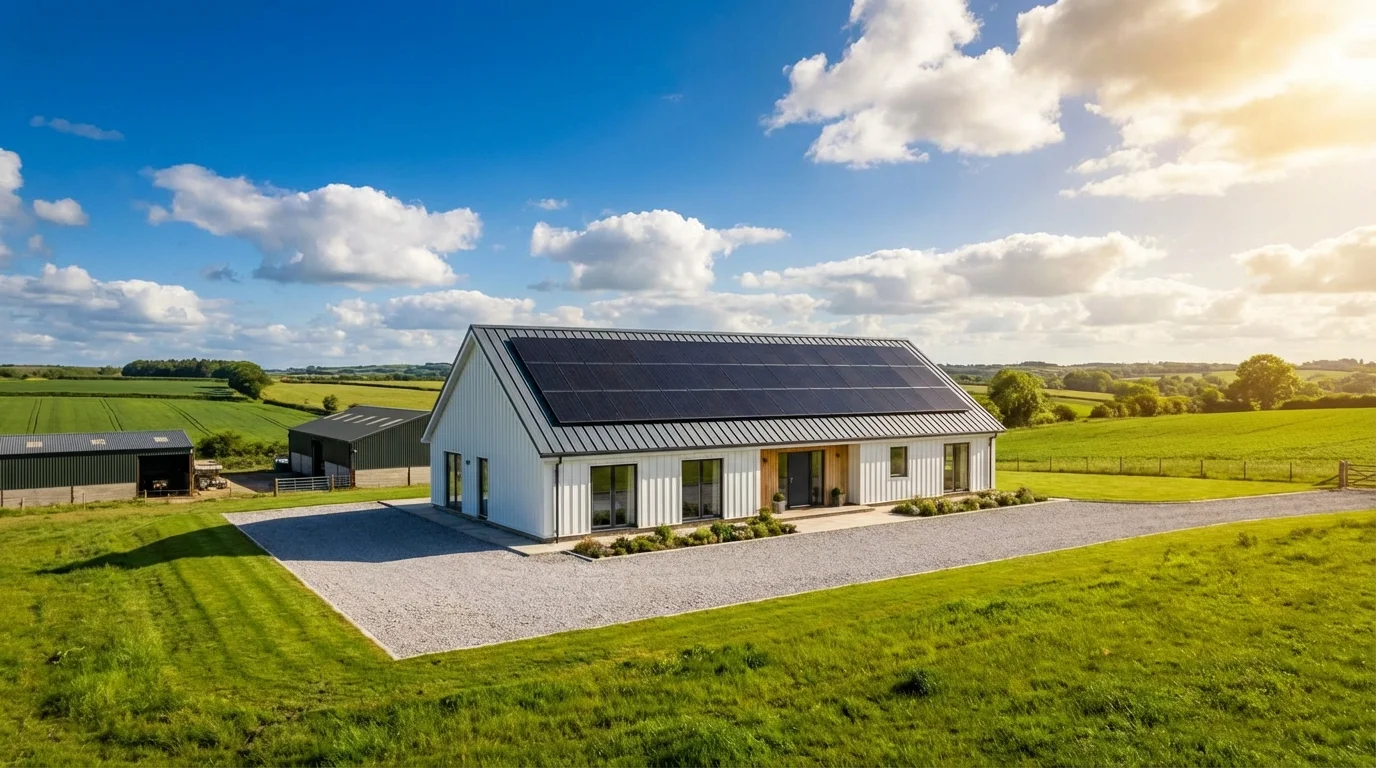
Rural agricultural producers are facing energy costs that have increased by over 15% in the last two years, directly impacting their operational viability. These escalating expenses make the transition to renewable energy less of a choice and more of a critical business strategy. So federal programs designed to offset solar installation costs are a direct lifeline for farms and small businesses seeking to control their financial future.
What USDA Rural Solar Rebate Programs Offer the Best Financial Incentives?
The USDA's Rural Energy for America Program (REAP) offers grants covering up to 50% of total eligible project costs for renewable energy systems in 2026. This program provides direct financial reimbursement, not a tax credit, for installing solar panels and other clean energy technologies.
The USDA's REAP program is the primary vehicle for rural solar incentives, providing grants that directly reduce the upfront cost of a solar installation. For 2026, these grants cover up to 50% of a project's cost, with a maximum grant amount of $1 million for renewable energy systems. And REAP also offers loan guarantees for up to 75% of the project cost, which can be combined with the grant. So this structure makes financing a 2.5 MW solar array or a smaller 50 kW system much more accessible for a farm or rural business. But the program is highly competitive, with funding awarded based on project viability, energy generation, and environmental benefits. Applicants must demonstrate a clear need and a well-defined plan to secure these valuable solar panel rebates. The funding reduces the payback period for a solar investment to as little as 3-5 years.
Who Qualifies for USDA Rural Solar Rebates: Are You Eligible Based on Income, State, and Utility?
Eligibility for USDA rural solar rebates in 2026 is restricted to agricultural producers and rural small businesses. Agricultural producers must derive at least 50% of their gross income from farming operations, while small businesses must meet SBA size standards and be located in designated rural areas.
To qualify for USDA REAP funding, an applicant must be either an agricultural producer or a rural small business. So agricultural producers must generate 50% or more of their gross income from their agricultural operations. And rural small businesses must be located in areas with a population of 50,000 or less. The location of the project, not the business headquarters, determines eligibility. There aren't specific personal income limits; qualification is based on business type and location. Utility provider doesn't directly impact eligibility, but interconnectivity agreements are a necessary part of the project plan.
"REAP has two types of applicants: 1. Agricultural producers with at least 50 percent of their gross income coming from agricultural operations. 2. Rural small businesses." — USDA Rural Development
This focus ensures the program's benefits, including access to powerful energy tax credits, are directed toward strengthening the rural American economy.
How Do I Apply for USDA Rural Solar Rebates, and What Are the Key Application Deadlines?
The application process for USDA rural solar rebates involves submitting a detailed application package to the state's USDA Rural Development office by the specified 2026 deadlines. Key deadlines are typically quarterly, with common dates including March 31, June 30, September 30, and December 31.
Applying for a REAP grant is a multi-step process that demands careful preparation. So applicants must complete and submit Form SF-424, "Application for Federal Assistance," along with a comprehensive technical report, a detailed business plan, and financial statements. The technical report must include a site plan, system design, and an estimate of the energy to be generated. And the business plan must demonstrate the project's financial viability. Applications are submitted to the State Energy Coordinator at the local USDA Rural Development office. But competition is fierce, so incomplete or poorly prepared applications are often rejected. Deadlines are strict, with quarterly submission windows closing on March 31 and June 30 for the first half of 2026. Use our free rebate calculator to estimate your potential project savings before you apply.
How Can I Maximize My USDA Rural Solar Rebates: Understanding Stacking Rules, Funding Status, and Contractor Requirements?
Maximizing USDA rural solar rebates requires combining REAP grants with other incentives and adhering to strict federal guidelines. For 2026, REAP grants can be stacked with federal tax credits and state rebates, but total federal assistance, including the grant, cannot exceed 75% of the project cost.
To get the most value, applicants must strategically stack incentives. So the 50% REAP grant can be combined with the 30% federal IRA solar tax credit. And many states offer their own heat pump (these federal credits ended for projects completed after December 31, 2025) rebates and solar incentives that can be added on top. But the total amount of any other federal grants combined with the REAP grant cannot exceed 75% of the total project cost. (Note: Federal tax credit percentages and availability are subject to change; the 30% Residential Clean Energy Credit under Section 25D expired December 31, 2025. Verify current incentives at energy.gov.)
"The combined amount of a REAP grant and any other Federal grant cannot exceed 75 percent of the total project cost." — USDA Rural Development
It’s critical to check the program's funding status, as it can be oversubscribed. Or applicants can work with experienced grant writers and qualified solar contractors who understand the USDA's technical and environmental review requirements, ensuring the application is robust and compliant. This approach increases the probability of securing a grant for a geothermal tax credit eligible system or solar array.
USDA Solar Incentive Comparison (2026)
| Incentive/Program | Max Financial Value | Eligible Applicants | Key Deadline (Typical) |
|---|---|---|---|
| REAP Grant | 50% of project cost (up to $1M) | Ag Producers, Rural Small Businesses | March 31, June 30 |
| REAP Loan Guarantee | 75% of project cost (up to $25M) | Ag Producers, Rural Small Businesses | Ongoing |
| Federal IRA Tax Credit | Ended Dec 31, 2025 | — | Ended Dec 31, 2025 |
Official Sources
- Database of State Incentives for Renewables & Efficiency (DSIRE) — The most comprehensive source for federal, state, and local renewable energy incentives.
- ENERGY.GOV Homeowner’s Guide to the Federal Tax Credit for Solar — Official guidance from the Department of Energy on qualifying for solar tax credits. (note: the federal 25C and 25D credits ended for projects completed after December 31, 2025)
Frequently Asked Questions
What are the eligibility requirements for USDA rural solar rebate programs?
For 2026, eligibility is limited to two groups. The first is agricultural producers who earn at least 50% of their gross income from agricultural operations. The second group is small businesses that meet SBA size standards and are located in a rural area, defined as having a population of 50,000 or fewer.
How much funding can I receive from a USDA rural solar grant or rebate?
The USDA's REAP grant program can fund up to 50% of the total eligible project costs for a renewable energy system in 2026. The maximum grant award for a solar project is $1 million. The program also offers loan guarantees for up to 75% of project costs, up to a maximum of $25 million.
What is the application process for USDA solar programs in rural areas?
The process involves submitting a detailed application package, including Form SF-424, a technical report, and a business plan, to your state's USDA Rural Development office. The application must outline the project's scope, cost, energy output, and economic feasibility. The process is competitive and requires thorough documentation to be successful.
When are the application deadlines for USDA rural energy for America program (REAP) solar grants?
Application deadlines for REAP grants are typically held quarterly. For 2026, the key deadlines for grant requests under $20,000 and over $20,000 are March 31st and June 30th. It is critical to check with your state's USDA office for specific dates, as they can vary slightly by location and funding cycle.
Can USDA rural solar rebates be combined with other federal or state solar incentives?
Yes, USDA REAP grants can be combined with other incentives. They are commonly stacked with the 30% federal Investment Tax Credit (ITC) and various state-level solar (this federal credit ended for expenditures made after December 31, 2025) rebates. However, there is a cap: the total value of the REAP grant plus any other federal grants cannot exceed 75% of the total project cost.
Unlock Your Solar Savings
Don't leave money on the table. See how much you can save on a rural solar project with USDA grants and other local incentives.
Calculate Your Savings NowLast reviewed: April 14, 2026. Reviewed by DuloCore Energy Specialists. About the team.
Check your California solar rebate eligibility — see the programs you qualify for and the dollar amounts on our California solar rebate finder.