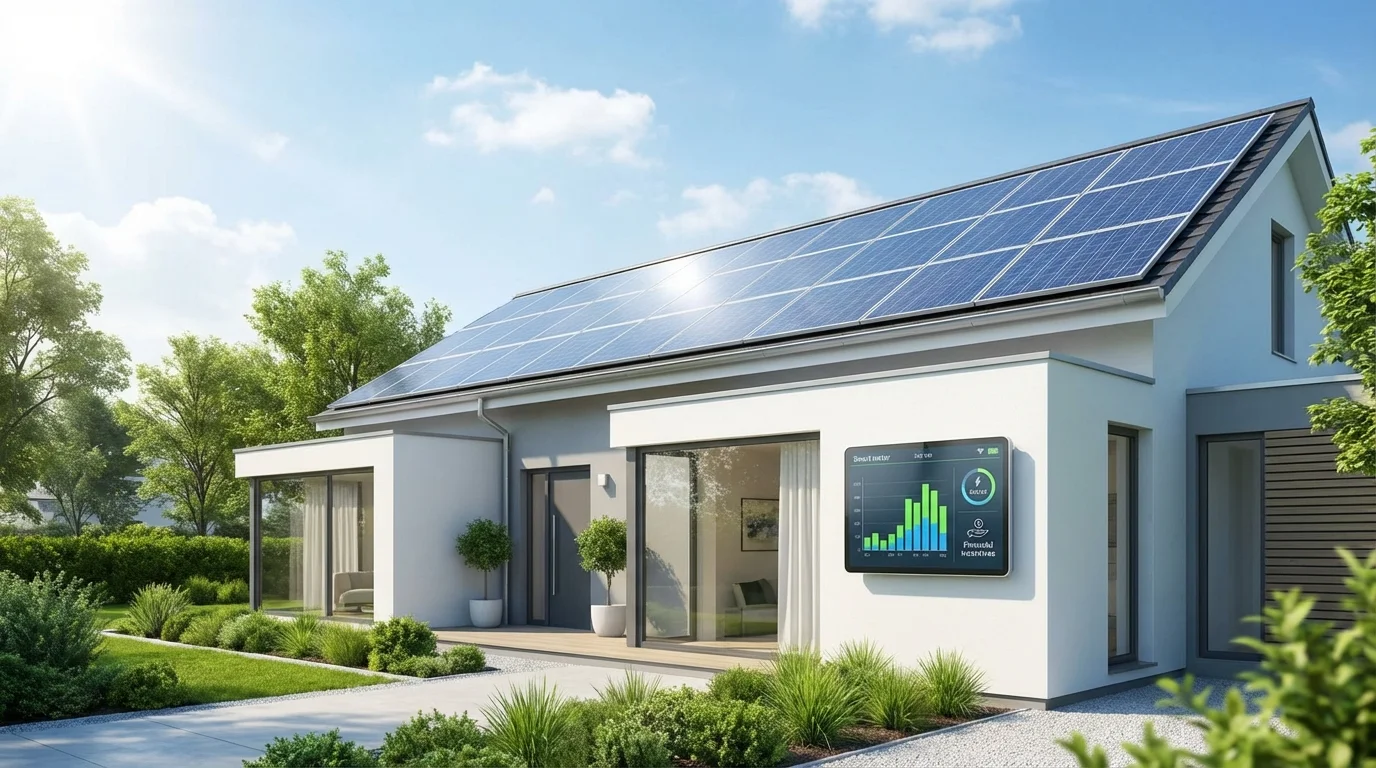
The most efficient commercially available solar panels are now surpassing 23% efficiency, a 5% increase over the common panels installed just five years ago. This leap forward directly translates into more power from a smaller roof space, accelerating payback periods and maximizing the value of federal and state incentives. So understanding these new ratings is critical for any homeowner considering a solar investment in 2026.
What are the top solar panel efficiency ratings for 2026, and how are they measured?
Top-tier solar panels for 2026 feature efficiency ratings between 22.8% and 24.1%, with brands like SunPower, Qcells, and REC leading the market. These ratings are measured under Standard Test Conditions (STC), which simulate a perfect lab environment of 1,000 watts of sunlight per square meter at 25°C.
In 2026, the leading residential solar panels achieve efficiency ratings between 22.8% and 24.1%. So these ratings, determined under Standard Test Conditions (STC), quantify how much sunlight hitting a panel's surface is converted into usable DC electricity. But real-world performance is often 10-15% lower due to factors like heat, shading, and panel orientation, which is why a higher initial rating provides a better performance buffer. The National Renewable Energy Laboratory (NREL) validates these efficiency benchmarks, confirming that monocrystalline PERC and heterojunction (HJT) technologies are driving these gains. And understanding these metrics is the first step in assessing a system's potential output and long-term value, as detailed in comprehensive guides on solar panel rebates. A 1% increase in efficiency can generate an additional 150-200 kWh of electricity over a panel's lifespan.
What's the typical cost of high-efficiency solar panels and installation in 2026?
A high-efficiency solar panel system in 2026 costs between $18,000 and $25,000 for a typical 7kW installation before any incentives. This price includes premium panels (22%+ efficiency), inverters, mounting hardware, and labor, with panels themselves accounting for approximately 25-30% of the total project expense.
The national average cost for a professionally installed high-efficiency solar system in 2026 is approximately $2.95 per watt. And for a standard 7-kilowatt system, this translates to a total pre-incentive cost of $20,650. But premium panels with efficiencies over 23% from brands like SunPower can push the cost closer to $3.50 per watt. So while the upfront cost is higher than standard panels (19-21% efficiency), the increased energy production over 25 years often justifies the initial $3,000 to $5,000 price difference. Homeowners can use a rebate calculator to see how federal and local incentives reduce this initial investment. The final cost depends on roof complexity, local labor rates, and the specific brand of components selected for the project.
Which high-efficiency solar panels and brands qualify for rebates and incentives in 2026?
The federal Residential Clean Energy Credit (Section 25D) ended for expenditures made after December 31, 2025, and the IRS treats an expenditure as made when installation is completed (IRS FS-2025-05). Federal tax credits for this work have ended, but state, local and utility rebates may still apply; check what is available at your address with the DuloCore rebate calculator. For state and utility rebates, eligibility in 2026 often requires panels to have a minimum efficiency rating, commonly set between 20% and 21.5%.
To qualify for the 30% federal tax credit under the IRA framework, any new, purchased (not leased) grid-tied solar (this federal credit ended for expenditures made after December 31, 2025) PV system is eligible, regardless of its specific efficiency rating. But many state and utility rebate programs in 2026 impose stricter requirements. For instance, a utility program may offer an additional $500 rebate for systems using panels with at least 21.5% efficiency. So brands like Qcells (Q.PEAK DUO series), REC (Alpha series), and SunPower (M-Series) consistently exceed these thresholds, making them eligible for stacked incentives. Verifying specific program requirements on a database like DSIRE is essential before purchase. (Note: Federal tax credit percentages and availability are subject to change; the 30% Residential Clean Energy Credit under Section 25D expired December 31, 2025. Verify current incentives at energy.gov.)
"The credit is allowable for the tax year that the property is placed in service." — IRS.gov
And these combined incentives can reduce the net cost of a high-efficiency system by 40% or more, making premium technology accessible.
Solar Rebate Program Comparison for 2026
| Incentive Program | Type | 2026 Amount/Rate | Key Eligibility Requirement |
|---|---|---|---|
| Residential Clean Energy Credit | Federal Tax Credit | 30% of total system cost | System purchased (not leased) and placed in service in 2026 |
| State Solar Rebate (Varies) | State Rebate | $500 - $2,000 (example) | Often requires minimum 21% panel efficiency; varies by state |
| Utility Performance-Based Incentive | Utility Rebate | $0.02 - $0.05 per kWh produced | Varies; may require specific installers or equipment |
What's the long-term ROI, lifespan, and maintenance for 2026's high-efficiency solar panels?
High-efficiency solar panels in 2026 deliver a return on investment (ROI) with a typical payback period of 8 to 12 years. These premium panels feature a 25- to 30-year performance warranty, a lifespan exceeding 30 years, and require minimal maintenance beyond annual cleaning.
The primary financial benefit of high-efficiency panels is generating more electricity from a limited roof area, which is critical for homes with smaller roofs or higher energy needs. And this accelerated energy production shortens the payback period by 1-2 years compared to standard-efficiency panels. The industry-standard performance warranty guarantees panels will produce at least 85-92% of their rated output after 25 years. So maintenance is simple: an annual inspection and cleaning to remove debris can cost $150-$300, ensuring optimal performance. The long-term savings on electricity bills, combined with various energy tax credits, result in a total ROI often exceeding 200% over the system's 30+ year lifespan.
How do high-efficiency solar panels perform across different climate zones, and what are the alternatives?
High-efficiency solar panels excel in sunny climates but also offer a distinct advantage in cloudy or space-constrained regions by maximizing output from limited sunlight. Their superior temperature coefficient means they lose less efficiency (around -0.25% per °C) in extreme heat compared to standard panels.
While ideal for sun-rich areas like the Southwest, high-efficiency panels are particularly valuable in the Northeast and Pacific Northwest. So in these regions, where sunlight is less intense or roof space is limited, generating 20% more power per panel is a decisive advantage. But in areas with ample land and less aesthetic concern, a larger array of standard-efficiency panels can sometimes provide a lower cost-per-watt. For homes with heavy shade or complex rooflines, installing power optimizers or microinverters with any panel type is a critical alternative. For a whole-home energy solution, homeowners often pair solar with other technologies like those qualifying for heat pump rebates.
"A solar PV system's performance depends on the climate and weather at the site." — Department of Energy
## Official Sources
- Database of State Incentives for Renewables & Efficiency (DSIRE) — The most comprehensive source for up-to-date information on state and utility renewable energy rebates.
- ENERGY STAR Rebate Finder — A federal tool for finding rebates on ENERGY STAR certified products, including some solar-related equipment.
- IRS.gov Residential Clean Energy Credit Guidance — Official tax guidance from the IRS on eligibility and rules for the 30% federal solar tax credit. (note: the federal 25C and 25D credits ended for projects completed after December 31, 2025)
Related Reading: Learn more about Solar Panel Rebate 2026.
Frequently Asked Questions
What are the projected average solar panel efficiency ratings for 2026?
The projected average efficiency for standard residential solar panels in 2026 is between 20% and 22%. And high-efficiency premium models will consistently range from 22.5% to over 24%. This reflects a steady annual improvement of approximately 0.5% driven by advancements in PERC and HJT cell technology.
How do I compare solar panel efficiency ratings when buying in 2026?
When comparing panels in 2026, look beyond the primary efficiency rating. Also examine the temperature coefficient (lower is better, ideally below -0.30%/°C) and the power tolerance rating (a positive tolerance like +5W/0W is best). And check the 25-year performance warranty, as premium panels guarantee 90-92% of original output.
Will higher efficiency solar panels offer greater energy savings by 2026?
Yes, higher efficiency panels directly translate to greater energy savings. A system with 23% efficient panels will generate approximately 15% more electricity than a same-sized system with 20% efficient panels. So over 25 years, this results in thousands of dollars in additional savings on utility bills.
What new technologies are expected to improve solar panel efficiency by 2026?
By 2026, tandem perovskite-on-silicon solar cells are the most promising technology set to push commercial efficiency ratings toward 30%. While still emerging, this technology layers a perovskite cell on top of a traditional silicon cell to capture more of the solar spectrum, breaking through the theoretical limits of silicon alone.
Do specific efficiency ratings qualify for better solar rebates in 2026?
While the 30% federal tax credit has no efficiency minimum, many state and utility rebates in 2026 do. It is common for these programs to require a minimum panel efficiency of 20% or 21% to qualify for an extra rebate, often between $250 and $1,000, rewarding investment in higher-performance technology.
Maximize Your Solar Savings in 2026
High-efficiency solar panels are more affordable than ever with available rebates and tax credits. Use our free tool to see how much you can save on your project.
Calculate Your Savings NowUpdated: April 14, 2026 — fact-checked by DuloCore Research. About our editorial process.
Check your California solar rebate eligibility — see the programs you qualify for and the dollar amounts on our California solar rebate finder.