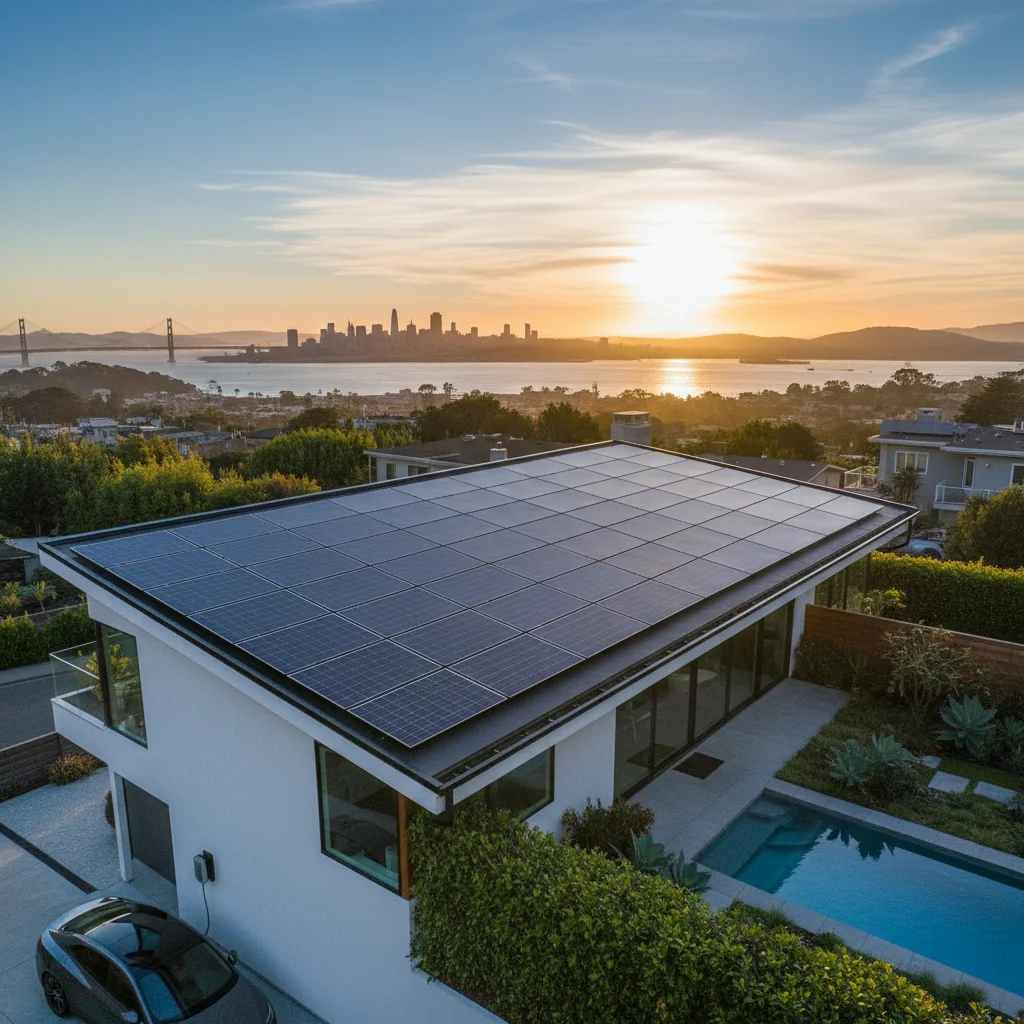
Bay Area homeowners paid between $15,000 and $35,000 for residential solar installations in 2026, and federal tax credits no longer apply (IRS FS-2025-05). And with electricity rates hitting $0.42 per kilowatt-hour during peak hours, solar payback periods have dropped to 6-8 years across most Bay Area counties.
What Are Current Solar Panel Installation Costs in the Bay Area?
Residential solar panel installation in the Bay Area costs $2.75 to $3.50 per watt in 2026, with typical 6kW to 10kW systems ranging from $16,500 to $35,000 before incentives. Installation costs vary by county due to permitting fees, labor rates, and roof complexity.
San Francisco and Marin County installations run 15% to 20% higher than Alameda or Contra Costa County due to higher labor costs and stricter building codes. But a 7kW system—enough to offset 80% to 90% of average household consumption—costs $19,250 to $24,500. The federal Residential Clean Energy Credit (Section 25D) ended for expenditures made after December 31, 2025, and the IRS treats an expenditure as made when installation is completed (IRS FS-2025-05).
Equipment accounts for 40% to 50% of total costs. Premium tier-one panels from manufacturers like SunPower or REC cost $0.80 to $1.20 per watt, while standard panels run $0.50 to $0.75 per watt. Inverters add $1,500 to $3,500 depending on system size—string inverters cost less upfront but microinverters provide panel-level optimization worth 5% to 15% more energy production in foggy coastal areas.
Labor and permitting fees make up the remaining 50% to 60%. Bay Area installers charge $75 to $125 per hour, and permitting fees range from $250 in smaller counties to $1,200 in San Francisco. So total soft costs add $8,000 to $15,000 to material expenses for standard residential installations.
"The average cost of solar photovoltaic (PV) systems in the U.S. has declined by more than 70% since 2010, making solar energy more affordable for American households." — U.S. Department of Energy
How Does Your Bay Area Climate Zone Affect Solar Panel Suitability and Costs?
Bay Area climate zones span from coastal fog-heavy Zone 3 to inland heat-dominant Zone 12, with solar production varying by 20% to 35% between zones. Climate zone determines panel orientation, tilt angle, and expected annual kilowatt-hour output—all factors that affect system sizing and cost-effectiveness.
Coastal zones like San Francisco (Zone 3) and Half Moon Bay (Zone 5) experience marine layer fog 120 to 180 days per year, reducing peak sun hours to 4.5 to 5.5 daily hours compared to 6.5 to 7.5 hours in inland Concord or Livermore (Zone 12). So coastal installations need 15% to 25% more panel capacity to match inland energy production—adding $2,500 to $6,000 to system costs.
Panel orientation matters more in fog-prone zones. South-facing arrays produce 25% to 30% more energy than west-facing installations in coastal areas, but west-facing panels capture afternoon sun when electricity rates peak at $0.42 to $0.54 per kilowatt-hour under PG&E's time-of-use rates. And that timing advantage increases monthly bill savings by $30 to $65 despite lower total production.
Roof slope and shading analysis costs $150 to $400 across all zones—but tree shading reduces system output by 10% to 40% depending on canopy density. Installers model annual sun exposure using tools like Aurora Solar or Helioscope, producing hour-by-hour production forecasts that guide system design. So pre-installation assessments prevent oversizing or undersizing systems based on actual site conditions.
Temperature coefficients matter inland. Panels lose 0.3% to 0.5% efficiency per degree Celsius above 25°C—and Zone 12 summer temperatures hit 38°C to 43°C. Premium panels with lower temperature coefficients maintain 92% to 95% rated output in extreme heat, while standard panels drop to 85% to 88% efficiency. That 7% to 10% production difference adds up to 800 to 1,200 kilowatt-hours annually for a 7kW system—worth $336 to $504 in avoided electricity costs.
What Financial Incentives and Rebates Are Available for Bay Area Solar Installation?
The federal Residential Clean Energy Credit (Section 25D) ended for expenditures made after December 31, 2025, and the IRS treats an expenditure as made when installation is completed (IRS FS-2025-05). Federal tax credits for this work have ended, but state, local and utility rebates may still apply; check what is available at your address with the DuloCore rebate calculator. Bay Area homeowners can still use California's Self-Generation Incentive Program (SGIP) battery rebates and net metering to reduce net costs.
SGIP offers $200 to $350 per kilowatt-hour for residential battery storage paired with solar installations—enough to offset 25% to 40% of battery costs. A 13.5kWh Tesla Powerwall 3 costs $11,000 to $14,000 installed, and SGIP rebates reduce net costs to $6,300 to $9,300. But program funding varies by utility territory, with PG&E allocations typically exhausted 4 to 6 months into each program year.
Net energy metering (NEM 3.0) compensates excess solar production at $0.05 to $0.08 per kilowatt-hour—75% to 85% lower than retail rates. So battery storage becomes essential for maximizing solar value by storing midday production for evening use when rates peak. And pairing a 7kW solar system with a 10kWh battery increases monthly savings by $45 to $80 compared to solar-only installations.
Property tax exclusions add hidden value. California's solar property tax exclusion prevents solar installations from increasing property tax assessments through 2026, saving homeowners $180 to $420 annually on a $20,000 system. Use the free rebate calculator to estimate combined state and utility incentives for your specific address and system size.
The federal Residential Clean Energy Credit (Section 25D) ended for expenditures made after December 31, 2025, and the IRS treats an expenditure as made when installation is completed (IRS FS-2025-05).
What Is the Step-by-Step Process for Installing Solar Panels in the Bay Area?
Bay Area solar installation takes 60 to 120 days from contract signing to system activation, with permitting and utility interconnection accounting for 70% to 80% of that timeline. The process involves site assessment, permit approval, physical installation, inspection, and permission to operate from your utility.
Site assessments take 1 to 3 hours and include roof measurements, electrical panel inspection, and shading analysis. Installers use drone photography or manual measurements to calculate roof area, slope, and azimuth—then model annual production using weather data and utility rate schedules. And this assessment produces a customized system design with expected kilowatt-hour output and monthly bill savings projections.
Permitting timelines vary by jurisdiction. San Francisco requires 4 to 8 weeks for plan review and permit issuance, while smaller cities like San Mateo or Fremont approve permits in 2 to 4 weeks. Installers submit structural calculations, electrical one-line diagrams, and equipment specifications to building departments. So choosing an installer familiar with local permitting processes cuts 2 to 4 weeks from total timelines.
Physical installation takes 1 to 3 days for standard residential systems. Crews mount racking systems to roof rafters, install panels, run conduit to the electrical panel, and connect inverters and monitoring equipment. Roof penetrations get flashed and sealed to prevent leaks—and installers maintain $2 million to $5 million liability insurance covering workmanship for 10 to 25 years.
Inspection and interconnection add 3 to 6 weeks. Building departments inspect electrical connections and structural attachments within 5 to 15 business days. Then utilities review interconnection applications and install net metering equipment within 15 to 30 days. And PG&E's NEM 3.0 interconnection queue currently runs 3 to 5 weeks for standard residential applications.
Final system activation happens after utility approval. Installers configure inverter settings, activate monitoring systems, and verify net metering operation. So homeowners start generating solar credits the day utilities grant permission to operate—not when physical installation completes.
How Do Bay Area Solar Costs Compare to Other California Regions?
Bay Area solar installation costs run 15% to 25% higher than Southern California and Central Valley regions due to labor rates, permitting complexity, and cost of living. But higher electricity rates and net metering compensation make Bay Area solar more financially attractive despite higher upfront costs.
Average Bay Area installation costs of $2.75 to $3.50 per watt compare to $2.25 to $2.75 per watt in San Diego and $2.00 to $2.50 per watt in Fresno or Bakersfield. A 7kW system costs $19,250 to $24,500 in the Bay Area versus $15,750 to $19,250 in San Diego and $14,000 to $17,500 in the Central Valley. So Bay Area homeowners pay $4,250 to $7,000 more for identical equipment and system sizes.
But electricity rate differences offset higher installation costs. PG&E charges $0.38 to $0.54 per kilowatt-hour under time-of-use rates in 2026, while SDG&E rates range from $0.32 to $0.46 and Central Valley rates run $0.24 to $0.36. A 7kW Bay Area system saves $1,800 to $2,400 annually compared to $1,400 to $1,900 in San Diego and $1,000 to $1,500 in Fresno.
Payback periods favor the Bay Area despite higher costs. Bay Area installations pay back in 6 to 8 years versus 7 to 10 years in San Diego and 9 to 12 years in the Central Valley. And 25-year net savings reach $45,000 to $60,000 in the Bay Area compared to $35,000 to $48,000 in Southern California and $25,000 to $38,000 inland.
Permitting complexity adds hidden costs. Bay Area jurisdictions require structural calculations, fire setback compliance, and electrical plan reviews that add 15 to 40 hours of engineering time compared to streamlined permitting in Riverside or Sacramento. So soft costs consume 55% to 65% of Bay Area installation budgets versus 45% to 50% in less regulated regions.
Check solar panel rebates for regional incentive differences that affect net costs and payback timelines across California climate zones.
What Are the Eligibility Requirements and Permitting Deadlines for Bay Area Solar?
Bay Area solar installations require building permits, electrical permits, and utility interconnection agreements—with no homeowner income limits or property value restrictions for state incentives. Permitting deadlines don't expire, but SGIP battery rebate funding depletes annually and NEM 3.0 tariff structures change every 12 to 18 months.
The federal Residential Clean Energy Credit (Section 25D) ended for expenditures made after December 31, 2025, and the IRS treats an expenditure as made when installation is completed (IRS FS-2025-05).
SGIP eligibility requires pairing battery storage with new or existing solar installations within PG&E, SCE, or SoCalGas service territories. General market residential rebates offer $200 per kilowatt-hour, while equity resilience rebates provide $850 to $1,000 per kilowatt-hour for low-income households or those in high fire threat districts. But general market funding typically depletes by May to July each program year—so applications submitted after depletion wait for next year's allocation.
Building permits require licensed contractors (C-46 Solar or C-10 Electrical) and structural engineering stamps for systems exceeding 7.5kW or installations on older homes built before 1980. Bay Area jurisdictions enforce 2022 or 2025 California Building Code with local amendments covering fire setbacks (18 to 36 inches from roof edges), wind uplift calculations, and rapid shutdown requirements. And permits expire 180 days after issuance if installation doesn't commence.
NEM 3.0 interconnection requires completed installations and passed inspections before utilities grant permission to operate. PG&E processes standard residential applications within 30 days under California Rule 21, but systems exceeding 10kW or requiring distribution upgrades face extended review periods of 60 to 120 days. And missed inspection appointments or incomplete permit documentation adds 2 to 6 weeks to activation timelines.
Property requirements include adequate roof space (60 to 80 square feet per kilowatt), southern exposure, and electrical panels with 100-amp minimum service. Homes with wood shake roofs, asbestos siding, or inadequate structural capacity need remediation before solar installation—adding $2,500 to $12,000 to project costs. So pre-installation assessments identify deal-breaker issues before contract signing.
Official Sources
- U.S. Department of Energy Solar Tax Credit Guide — Federal solar tax credit details and eligibility requirements (note: the federal 25C and 25D credits ended for projects completed after December 31, 2025)
- Database of State Incentives for Renewables & Efficiency — Comprehensive database of federal, state, and utility solar incentives
- U.S. Department of Energy Save Energy — Energy efficiency and renewable energy guidance for homeowners
Frequently Asked Questions
How much does solar panel installation cost in the Bay Area?
Bay Area solar panel installation costs $15,000 to $35,000 for residential systems, with typical 7kW installations ranging from $19,250 to $24,500. Installation costs vary by county—San Francisco and Marin run 15% to 20% higher than Alameda or Contra Costa due to labor rates and permitting complexity. The federal Residential Clean Energy Credit (Section 25D) ended for expenditures made after December 31, 2025, and the IRS treats an expenditure as made when installation is completed (IRS FS-2025-05).
What rebates and tax credits are available for solar panels in California?
The federal Residential Clean Energy Credit (Section 25D) ended for expenditures made after December 31, 2025, and the IRS treats an expenditure as made when installation is completed (IRS FS-2025-05). SGIP battery rebates provide $200 to $350 per kilowatt-hour for storage systems paired with solar. Property tax exclusions prevent solar systems from increasing assessed values through 2026, saving $180 to $420 annually.
How long does it take to install solar panels in the Bay Area?
Bay Area solar installation takes 60 to 120 days from contract signing to system activation. Physical installation requires 1 to 3 days, but permitting and utility interconnection consume 70% to 80% of total timelines. San Francisco permits take 4 to 8 weeks versus 2 to 4 weeks in smaller cities. PG&E interconnection approval adds 3 to 5 weeks after building inspection completion.
Are there financing options for solar panel installation in the Bay Area?
Bay Area solar installers offer $0-down loans with 10 to 25-year terms at 4.99% to 8.99% APR based on credit scores. Home equity lines of credit provide lower rates of 3.5% to 6.5% but require existing home equity. Property Assessed Clean Energy (PACE) financing allows repayment through property tax bills over 20 to 30 years. Cash purchases maximize savings by avoiding interest costs of $6,000 to $18,000 over loan terms.
What is the average payback period for solar panels in California?
Bay Area solar installations pay back in 6 to 8 years due to electricity rates of $0.38 to $0.54 per kilowatt-hour. Southern California payback periods run 7 to 10 years, while Central Valley systems take 9 to 12 years due to lower electricity costs. A 7kW Bay Area system saves $1,800 to $2,400 annually and generates $45,000 to $60,000 in net savings over 25 years after accounting for installation costs and incentives.
Ready to calculate your solar savings? Use our free rebate calculator to estimate SGIP battery rebates and monthly electricity savings based on your specific address, roof characteristics, and current utility rates. Get a personalized report in 60 seconds with no email required.
Updated: April 14, 2026 — fact-checked by DuloCore Research. About our editorial process.
Check your California solar rebate eligibility — see the programs you qualify for and the dollar amounts on our California solar rebate finder.