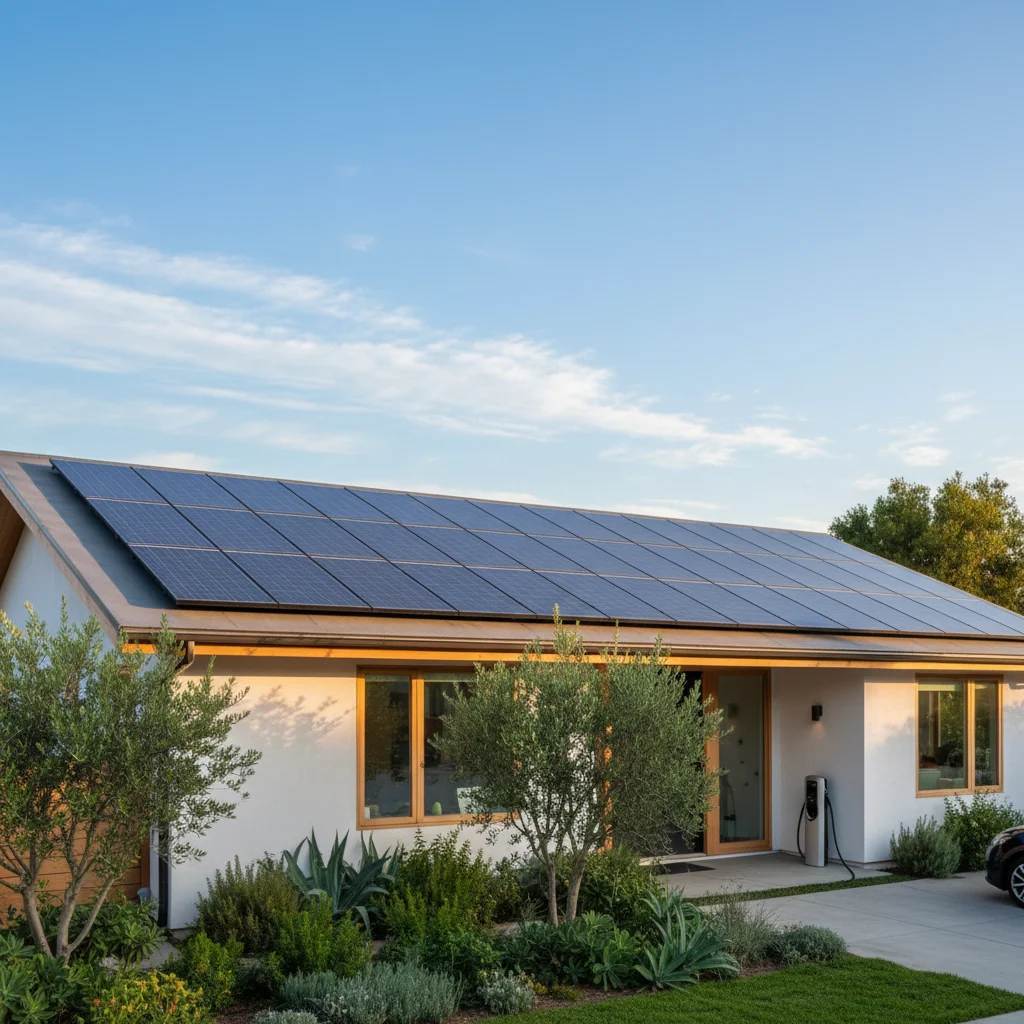
California's solar installations dropped 83% in Q1 2026 after net metering policy changes slashed homeowner credits from $0.30 per kilowatt-hour to $0.08. And the federal 30% solar tax credit is gone too: the Residential Clean Energy Credit (Section 25D) ended for expenditures made after December 31, 2025, and the IRS treats an expenditure as made when installation is completed (IRS FS-2025-05), so a 2026 installation is priced without it.
How Much Does Solar Panel Installation Cost in California?
Solar panel installation in California costs $15,000 to $30,000 for a typical 6-kilowatt residential system before incentives in 2026. No federal tax credit reduces that price for a 2026 installation, so the $15,000 to $30,000 range is what homeowners pay before any state, local or utility incentives. And regional installers in Southern California charge 12-18% more than Central Valley contractors due to permit complexity and labor shortages.
Cost breaks down into three buckets: equipment ($8,000-$12,000), installation labor ($4,000-$8,000), and permits plus interconnection fees ($3,000-$10,000). But San Diego homeowners face the highest permit costs at $2,500-$4,000, while Sacramento averages $800-$1,200. Equipment pricing dropped 22% since 2024 as Chinese manufacturers flooded the market with overstock inventory.
So the total installed cost per watt ranges from $2.50 in inland counties to $5.00 in coastal metros. Premium panels from SunPower or LG cost $0.40-$0.80 more per watt than economy brands. The federal Residential Clean Energy Credit (Section 25D) ended for expenditures made after December 31, 2025, and the IRS treats an expenditure as made when installation is completed (IRS FS-2025-05). Federal tax credits for this work have ended, but state, local and utility rebates may still apply; check what is available at your address with the DuloCore rebate calculator. Use our free rebate calculator to estimate your specific savings based on roof size and local utility rates.
The federal Residential Clean Energy Credit (Section 25D) ended for expenditures made after December 31, 2025, and the IRS treats an expenditure as made when installation is completed (IRS FS-2025-05).
Which Climate Zones in California Are Most Suitable for Solar Panels?
Climate zones 10 through 16 in Southern California and the Central Valley produce optimal solar output with 280-310 sunny days annually and peak sun hours averaging 5.5-6.5 hours daily. Coastal zones 3-7 generate 15-25% less electricity due to marine layer coverage reducing direct sunlight exposure from May through September.
Bakersfield (Zone 13) leads the state with 6.8 peak sun hours daily, followed by Fresno at 6.5 and Palm Springs at 6.3. But San Francisco (Zone 3) averages only 4.2 peak sun hours, requiring 30-40% larger systems to match inland production. And Northern California zones 1-2 see winter snow accumulation that blocks panels for 15-45 days per year in mountain communities above 4,000 feet elevation.
Temperature matters too—panels lose 0.5% efficiency for every degree above 77°F. So Imperial County's 110°F summers reduce output by 16% compared to coastal San Luis Obispo's mild 75°F averages. Desert installations require dust mitigation systems adding $800-$1,500 to maintenance costs over 25 years.
How Long Do Solar Panels Last and What's the Long-Term Cost Benefit?
Solar panels last 25-30 years with manufacturers guaranteeing 80-85% of original output at year 25, degrading at approximately 0.5-0.8% annually. California homeowners recoup installation costs in 6-9 years through electricity savings averaging $1,400-$2,800 annually, generating $35,000-$84,000 in total lifetime savings after payback.
Premium monocrystalline panels degrade slower at 0.3-0.5% per year versus polycrystalline at 0.8-1.0%. And inverters require replacement after 10-15 years at $1,200-$3,000, representing the only major component failure. Microinverters last 20-25 years but cost $150-$300 more per panel upfront.
California's NEM 3.0 policy reduced savings timelines by 2-4 years for systems installed after April 2023, pushing break-even from 5-6 years to 7-10 years for most homeowners. But battery storage systems paired with solar achieve payback in 8-12 years by storing excess daytime generation for evening peak rate periods when utilities charge $0.45-$0.65 per kilowatt-hour.
So a $20,000 system saving $2,200 annually breaks even in 9 years, then generates $46,200 in free electricity over the remaining 16 years of warranty coverage.
Are You Eligible for California Solar Incentives and Tax Credits?
The federal Residential Clean Energy Credit (Section 25D) ended for expenditures made after December 31, 2025, and the IRS treats an expenditure as made when installation is completed (IRS FS-2025-05). State-level rebates ended in 2024, but SGIP battery storage incentives provide $150-$250 per kilowatt-hour for low-income households and $200-$1,000 per kilowatt-hour in disadvantaged communities.
The federal Residential Clean Energy Credit (Section 25D) ended for expenditures made after December 31, 2025, and the IRS treats an expenditure as made when installation is completed (IRS FS-2025-05).
SGIP eligibility requires enrollment through participating utilities (PG&E, SCE, SoCalGas, SDG&E) with applications processed first-come, first-served until program budgets deplete. Equity Budget customers in disadvantaged communities receive $1,000 per kilowatt-hour versus $150 for general market applicants. But SGIP only covers battery storage, not solar panels themselves.
"DSIRE tracks information on state, local, utility and federal incentives and policies that support renewable energy and energy efficiency." — DSIRE USA
What's the Step-by-Step Process for Installing Solar Panels in California?
Solar installation in California follows a six-stage process taking 60-120 days from contract signing to system activation, with permitting and utility interconnection consuming 70-80% of total timeline. Homeowners first obtain quotes from 3-5 licensed contractors, compare financing options, then sign a purchase agreement triggering the design and engineering phase.
Step one: Site assessment and engineering (5-10 days) where contractors measure roof dimensions, analyze shading patterns, and design electrical layouts meeting California Building Code Title 24 requirements. Step two: Permit application submission to local building departments (15-45 days) with coastal cities averaging 35-40 day approvals versus 12-18 days in inland counties.
Step three: Utility interconnection application filed with PG&E, SCE, or SDG&E (10-30 days) requesting permission to connect to the grid under NEM 3.0 tariffs. And step four: Physical installation (1-3 days) once permits issue, including panel mounting, inverter wiring, and electrical system integration by licensed C-10 or C-46 contractors.
Step five: Municipal inspection (3-7 days after installation) verifying code compliance before utilities authorize operation. So step six: Utility permission to operate (PTO) granted (5-15 days post-inspection) allowing homeowners to activate systems and begin generating credits. But Los Angeles and San Francisco add 10-20 days due to inspection backlogs.
Financing options include cash purchase, solar loans at 4.5-8.5% APR over 10-25 years, or leases/PPAs with $0 down but 20-25 year contracts. The federal Residential Clean Energy Credit (Section 25D) ended for expenditures made after December 31, 2025, and the IRS treats an expenditure as made when installation is completed (IRS FS-2025-05). Learn more about available solar panel rebates for additional savings.
What Are the Deadlines for California Solar Rebates and Federal Tax Credits?
The federal solar tax credit was not extended and has no step-down schedule: the Residential Clean Energy Credit (Section 25D) ended for expenditures made after December 31, 2025, and the IRS treats an expenditure as made when installation is completed (IRS FS-2025-05). Check current state, local and utility incentives for your address with the DuloCore rebate calculator. California's SGIP battery storage incentives operate on a first-come basis with $28 million remaining in 2026 equity budgets and $12 million in general market budgets expected to deplete by Q3 2026.
Form 5695 only covers qualifying work completed by December 31, 2025 and claimed on a 2025 return; the federal 25C and 25D credits ended after that date (IRS FS-2025-05).
SGIP applications must be submitted within 18 months of battery installation with PG&E processing 85-95% of applications within 60 days while SCE averages 45-75 days. But equity budget customers face longer wait times of 90-120 days due to additional income verification requirements. Program budgets refresh annually but deplete faster each year as battery adoption accelerates.
Local utility rebates vary by provider—SMUD offers $500-$1,000 for solar-plus-storage systems through June 2026, while LADWP ended residential incentives in December 2025. So homeowners should verify current program availability through the Database of State Incentives for Renewables & Efficiency before finalizing installation contracts.
How Do Solar Installation Costs Compare Across California Regions?
Northern California installations average $2.80-$3.50 per watt compared to Southern California's $3.20-$4.20 per watt, with the Bay Area commanding premium pricing at $3.80-$5.00 per watt due to labor costs and permitting complexity. And the Central Valley offers the lowest rates at $2.50-$3.00 per watt with simpler permit requirements and higher contractor competition.
San Francisco's average $25,000 system cost (before incentives) exceeds Fresno's $16,500 for identical 6-kilowatt installations—a 51% price premium driven by $8,000-$12,000 higher labor and permitting fees. Los Angeles falls mid-range at $21,000-$23,000, while San Diego matches Bay Area pricing at $24,000-$26,000 for coastal installations.
But Central Valley homeowners face higher electrical panel upgrade costs, with 40-50% of installations requiring $2,000-$4,000 in 200-amp service upgrades compared to 15-20% in newer coastal developments. And desert regions add $1,200-$2,400 for critter guards protecting wiring from rodents, plus $800 annually for dust cleaning reducing output by 15-25% when neglected.
So total installed cost varies $8,000-$12,000 between cheapest and most expensive regions for identical systems. Homeowners comparing quotes should verify line-item pricing for equipment, labor, permits, and upgrades rather than focusing solely on per-watt rates. Calculate your regional savings using our rebate calculator with location-specific utility rates.
Official Sources
- Energy Saver - Solar — Federal guidance on solar energy systems, tax credits, and efficiency programs (note: the federal 25C and 25D credits ended for projects completed after December 31, 2025)
- Homeowner's Guide to the Federal Tax Credit for Solar Photovoltaics — Detailed IRS credit rules and eligibility requirements
- DSIRE - Database of State Incentives for Renewables & Efficiency — Comprehensive tracking of federal, state, and local solar incentives
Related Reading: Learn more about Solar Panel Installation Cost Breakdown and Solar Rebates.
Related Reading: Learn more about Solar Panel Installation Cost In Bay Area.
Related Reading: Learn more about Solar Panel Installation Cost In Central Valley.
Frequently Asked Questions
How much does solar panel installation cost in California?
Solar panel installation costs $15,000-$30,000 for a typical 6-kilowatt residential system; the federal 30% credit ended for systems installed after December 31, 2025 (IRS FS-2025-05), so that is the out-of-pocket cost before any state, local or utility incentives. And regional pricing varies by $2.50-$5.00 per watt depending on location, with Bay Area installations commanding premium rates of $3.80-$5.00 per watt versus Central Valley's $2.50-$3.00 per watt. Total cost includes equipment ($8,000-$12,000), labor ($4,000-$8,000), and permits ($3,000-$10,000).
What rebates and incentives are available for solar panels in California?
The federal Residential Clean Energy Credit (Section 25D) ended for expenditures made after December 31, 2025, and the IRS treats an expenditure as made when installation is completed (IRS FS-2025-05). California's SGIP program offers $150-$1,000 per kilowatt-hour for battery storage paired with solar, with higher rates for low-income and disadvantaged community residents. But state-level solar panel rebates ended in 2024, and federal tax credits no longer apply (IRS FS-2025-05).
Are you eligible for California solar rebates if you rent your home?
Renters cannot claim SGIP battery storage incentives unless they own the solar equipment through a portable ground-mount system, which remains uncommon in California residential settings. And tenants receive no direct rebate benefits unless lease agreements explicitly pass through electricity savings. The federal Residential Clean Energy Credit (Section 25D) ended for expenditures made after December 31, 2025, and the IRS treats an expenditure as made when installation is completed (IRS FS-2025-05).
How long does it take to get a solar rebate in California?
Form 5695 only covers qualifying work completed by December 31, 2025 and claimed on a 2025 return; the federal 25C and 25D credits ended after that date (IRS FS-2025-05). SGIP battery storage rebates take 45-120 days after application submission, with PG&E averaging 60 days and SCE processing in 45-75 days for general market customers. And equity budget applicants face 90-120 day timelines due to additional income verification requirements before receiving $200-$1,000 per kilowatt-hour payments.
What's the difference between federal and California state solar incentives?
The federal Residential Clean Energy Credit (Section 25D) ended for expenditures made after December 31, 2025, and the IRS treats an expenditure as made when installation is completed (IRS FS-2025-05). California's SGIP program offers rebates only for battery storage systems at $150-$1,000 per kilowatt-hour depending on income and location, paid directly by utilities after installation. So no federal credit covers panels or batteries for 2026 installations, while state programs in 2026 exclusively target energy storage to support grid stability during peak demand periods.
Ready to go solar? Calculate your exact savings and payback timeline with our free solar rebate calculator. Get personalized estimates based on your roof size, location, and current utility rates in under 2 minutes.
Last updated April 14, 2026 — reviewed by DuloCore Editorial. About our authors.
Check your California solar rebate eligibility — see the programs you qualify for and the dollar amounts on our California solar rebate finder.