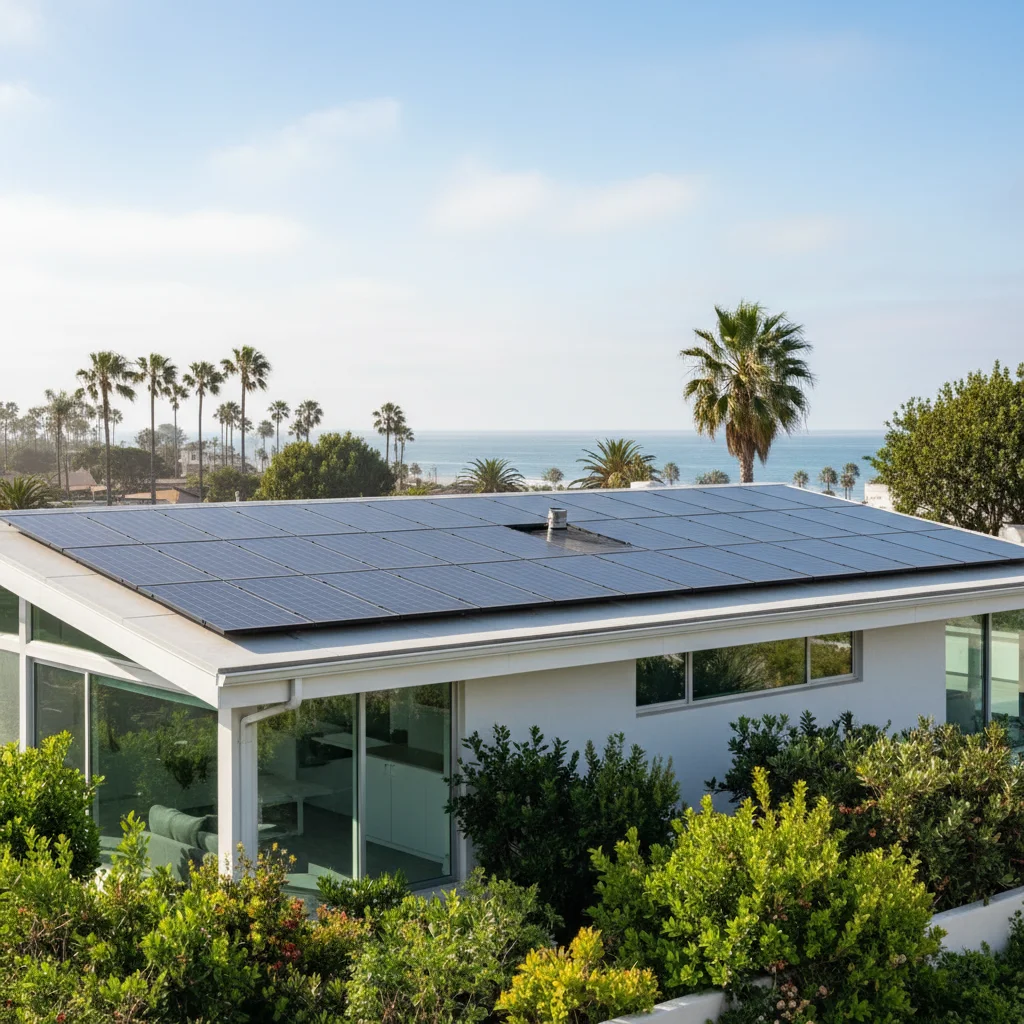
Long Beach homeowners who installed solar in 2025 paid an average of $18,400 for a 6-kilowatt system—but the actual out-of-pocket cost dropped to $12,880 after the 30% federal tax credit. And that's before counting California's property tax exemption, which prevents solar installations from increasing home assessments despite adding $20,000-$30,000 in property value.
How much does solar panel installation cost in Long Beach?
Residential solar panel systems in Long Beach cost $2.85-$3.45 per watt installed in 2026, translating to $17,100-$20,700 for a typical 6-kilowatt system. The federal Residential Clean Energy Credit (Section 25D) ended for expenditures made after December 31, 2025, and the IRS treats an expenditure as made when installation is completed (IRS FS-2025-05). Check current state, local and utility incentives for your address with the DuloCore rebate calculator. And Southern California Edison offers additional incentives through its Self-Generation Incentive Program for battery storage paired with solar.
The price varies based on roof complexity, panel efficiency, and whether the homeowner adds battery backup. Flat roofs with southern exposure require less labor than multi-story installations with multiple roof planes. But Long Beach's coastal climate minimizes snow load requirements and simplifies permitting compared to inland regions.
Equipment costs represent 40-50% of total installation expenses. Labor, permitting, and interconnection fees comprise the remaining 50-60%. So a $18,000 system typically includes $7,200-$9,000 in panels and inverters, with $9,000-$10,800 covering installation and approvals.
Installation timelines run 6-12 weeks from contract signing to system activation. Permitting with Long Beach Building & Safety takes 2-4 weeks, physical installation requires 1-3 days, and Southern California Edison interconnection adds another 2-6 weeks. And homeowners who install in Q1-Q2 often face shorter wait times than summer peak season.
What are the main alternatives to solar panels for Long Beach homeowners?
Geothermal heat pumps deliver heating and cooling for $20,000-$35,000 installed but don't generate electricity like solar systems. The federal Residential Clean Energy Credit (Section 25D) ended for expenditures made after December 31, 2025, and the IRS treats an expenditure as made when installation is completed (IRS FS-2025-05). Federal tax credits for this work have ended, but state, local and utility rebates may still apply; check what is available at your address with the DuloCore rebate calculator. But Long Beach's mild climate provides smaller heating and cooling savings than locations with temperature extremes.
Air-source heat pump rebates through California's Tech Clean California program offer $3,000-$8,000 for qualifying systems replacing natural gas heating. These systems cost $8,000-$15,000 installed and reduce both electricity and gas consumption. And homeowners can combine heat pumps with solar panels to maximize energy savings and incentive stacking.
Community solar programs allow renters and homeowners without suitable roofs to subscribe to off-site solar farms. Participants receive 5-15% discounts on electricity from solar generation without upfront installation costs. So residents in multi-family housing or homes with excessive shading access solar benefits through subscription models.
Battery storage systems without solar panels cost $10,000-$15,000 for 10-13.5 kWh capacity. California's Self-Generation Incentive Program provides $200-$250 per kWh for battery-only installations in disadvantaged communities. But batteries alone don't reduce electricity bills—they shift consumption to off-peak hours when rates are lower.
How long do solar panels last and what's the warranty coverage?
Modern solar panels carry 25-30 year performance warranties guaranteeing 80-85% of original output after 25 years. Tier 1 manufacturers like LG, Panasonic, and REC provide 25-year product warranties covering defects and failures. And third-party testing shows panels typically retain 90-95% efficiency after 20 years in Southern California's climate.
Inverters require replacement every 10-15 years at $1,500-$3,000 for string inverters or $200-$400 per microinverter. String inverter warranties run 10-12 years with optional extensions to 20-25 years. So homeowners should budget $0.10-$0.15 per watt annually for maintenance and eventual inverter replacement.
Roof penetrations require inspection every 5-10 years to verify waterproof integrity. Long Beach's minimal precipitation reduces leak risk compared to Northern California installations. But coastal salt air accelerates corrosion on mounting hardware and junction boxes without marine-grade materials.
Installation workmanship warranties cover 5-10 years depending on contractor. The California Solar & Storage Association maintains a certified contractor database for installers meeting industry standards. And homeowners who choose installers with 10+ year track records reduce risk of warranty claims on defunct companies.
What financing options and rebates are available for solar installation in Long Beach?
Form 5695 only covers qualifying work completed by December 31, 2025 and claimed on a 2025 return; the federal 25C and 25D credits ended after that date (IRS FS-2025-05).
The federal Residential Clean Energy Credit (Section 25D) ended for expenditures made after December 31, 2025, and the IRS treats an expenditure as made when installation is completed (IRS FS-2025-05).
California's property tax exemption prevents solar installations from increasing assessed value for property tax calculations. This saves $200-$400 annually on a $20,000 system based on Long Beach's 1.1% effective property tax rate. So homeowners capture added property value without increased tax burden.
PACE financing through California FIRST allows homeowners to finance solar installations through property tax assessments over 20-30 years. Interest rates run 6-9% with no upfront costs or credit checks. But PACE liens take priority over mortgages, complicating refinancing or home sales.
Southern California Edison offers net metering under NEM 3.0, crediting excess solar generation at wholesale rates plus grid access charges. Export rates average $0.05-$0.08 per kWh compared to $0.25-$0.35 retail electricity costs. And battery storage maximizes value by storing solar production for use during evening peak rate periods.
Calculate your potential savings with our free rebate calculator to see how federal credits and California incentives affect your installation costs.
What's the process for getting solar panels installed in Long Beach?
Site assessment comes first, evaluating roof condition, shading, electrical panel capacity, and optimal system size. Installers use satellite imagery and utility bills to model production and payback timelines. And homeowners with roofs over 15 years old should consider replacement before solar installation to avoid removal and reinstallation costs of $3,000-$5,000.
Permitting through Long Beach Building & Safety requires electrical and structural plan sets stamped by California-licensed engineers. The city charges $450-$850 in permit fees based on system size. So a 6-kilowatt system typically pays $650 in building permits plus $180 for electrical permits.
Installation takes 1-3 days depending on system complexity and crew size. Installers mount racking, attach panels, run conduit to the inverter and electrical panel, and install monitoring equipment. But homeowners can't use the system until passing city inspection and receiving Southern California Edison permission to operate.
Interconnection with Southern California Edison requires submitting technical specifications and waiting 30-60 days for approval. The utility installs a bidirectional meter measuring both consumption and excess generation sent to the grid. And NEM 3.0 requires separate import and export metering to calculate credits at different rate structures.
Learn more about the federal energy tax credits that apply to solar installations and other renewable energy improvements.
How do solar panel costs in Long Beach compare to other energy solutions?
Heat pump water heaters cost $1,500-$3,500 installed and reduce water heating costs by 50-60%, saving $300-$500 annually for a family of four. The federal Residential Clean Energy Credit (Section 25D) ended for expenditures made after December 31, 2025, and the IRS treats an expenditure as made when installation is completed (IRS FS-2025-05). So payback periods run 2-5 years compared to 8-12 years for solar panels.
Whole-home battery backup systems cost $18,000-$25,000 for 20-40 kWh capacity providing 1-2 days of backup power during outages. California's SGIP provides $200-$1,000 per kWh based on income and location in high fire-threat districts. But batteries without solar panels don't reduce electricity bills—they only provide resilience and time-of-use optimization.
LED lighting retrofits cost $500-$1,500 for whole-home conversion and reduce lighting energy consumption by 75-85%. The California Energy Commission estimates $150-$250 annual savings for typical homes. And the 6-month to 2-year payback makes LED conversion the fastest-return efficiency upgrade before investing in solar.
Attic insulation upgrades cost $1,500-$3,500 and reduce cooling loads by 15-30% in Long Beach's climate. The federal tax credit doesn't cover insulation in 2026 after Section 25C expired. So homeowners prioritize insulation only when combined with HVAC upgrades that qualify for heat pump rebates and tax credits.
Check current incentive availability with our rebate calculator before finalizing equipment choices and installation timelines.
Official Sources
- DOE Homeowners Guide to Solar Tax Credit — Federal tax credit details and eligibility requirements for residential solar installations (note: the federal 25C and 25D credits ended for projects completed after December 31, 2025)
- IRS Residential Clean Energy Credit — Official tax credit percentages, qualifying equipment, and filing instructions (note: the federal 25C and 25D credits ended for projects completed after December 31, 2025)
- DSIRE California Solar Programs — Comprehensive database of state and utility solar incentives and rebates
Frequently Asked Questions
How much does solar panel installation cost in Long Beach?
Solar panel systems in Long Beach cost $17,100-$20,700 for a 6-kilowatt residential installation before incentives. The federal tax credit reduces this by 30%, bringing net cost to $11,970-$14,490. And Southern California Edison's Self-Generation Incentive Program provides $200-$350 per kWh for battery storage paired with solar arrays.
What rebates and incentives are available for solar installation in Long Beach?
The federal Residential Clean Energy Credit (Section 25D) ended for expenditures made after December 31, 2025, and the IRS treats an expenditure as made when installation is completed (IRS FS-2025-05). California's property tax exemption prevents solar from increasing assessed value, saving $200-$400 annually. So a $18,000 system receives $5,400 in federal credits plus ongoing property tax savings averaging $300 per year.
How long does it take to get solar panels installed in Long Beach?
Complete installation timelines run 6-12 weeks from contract signing to system activation. Long Beach permitting requires 2-4 weeks, physical installation takes 1-3 days, and Southern California Edison interconnection adds 2-6 weeks. But homeowners who apply during off-peak seasons in Q1-Q2 face shorter approval timelines than summer installations.
What are the eligibility requirements for solar rebates in Long Beach?
The federal Residential Clean Energy Credit (Section 25D) ended for expenditures made after December 31, 2025, and the IRS treats an expenditure as made when installation is completed (IRS FS-2025-05). Homeowners must own the solar system—leased systems don't qualify. And the installation must occur on a primary or secondary residence, not rental properties or investment real estate.
Can you get solar panels installed for free in Long Beach with rebates?
No programs provide completely free solar installations in Long Beach in 2026. The federal Residential Clean Energy Credit (Section 25D) ended for expenditures made after December 31, 2025, and the IRS treats an expenditure as made when installation is completed (IRS FS-2025-05). And third-party ownership through solar leases or power purchase agreements eliminates upfront costs but transfers all incentives to the system owner, not the homeowner.
Ready to see how much you can save? Use our free rebate calculator to get personalized estimates for solar installation costs, federal tax credits, and California incentives based on your home's energy usage and location. Enter your zip code and current electricity bills to see your projected savings and payback timeline in under 60 seconds.
Last updated: April 14, 2026. Reviewed by the DuloCore Editorial Team. About our authors.
Check your California solar rebate eligibility — see the programs you qualify for and the dollar amounts on our California solar rebate finder.