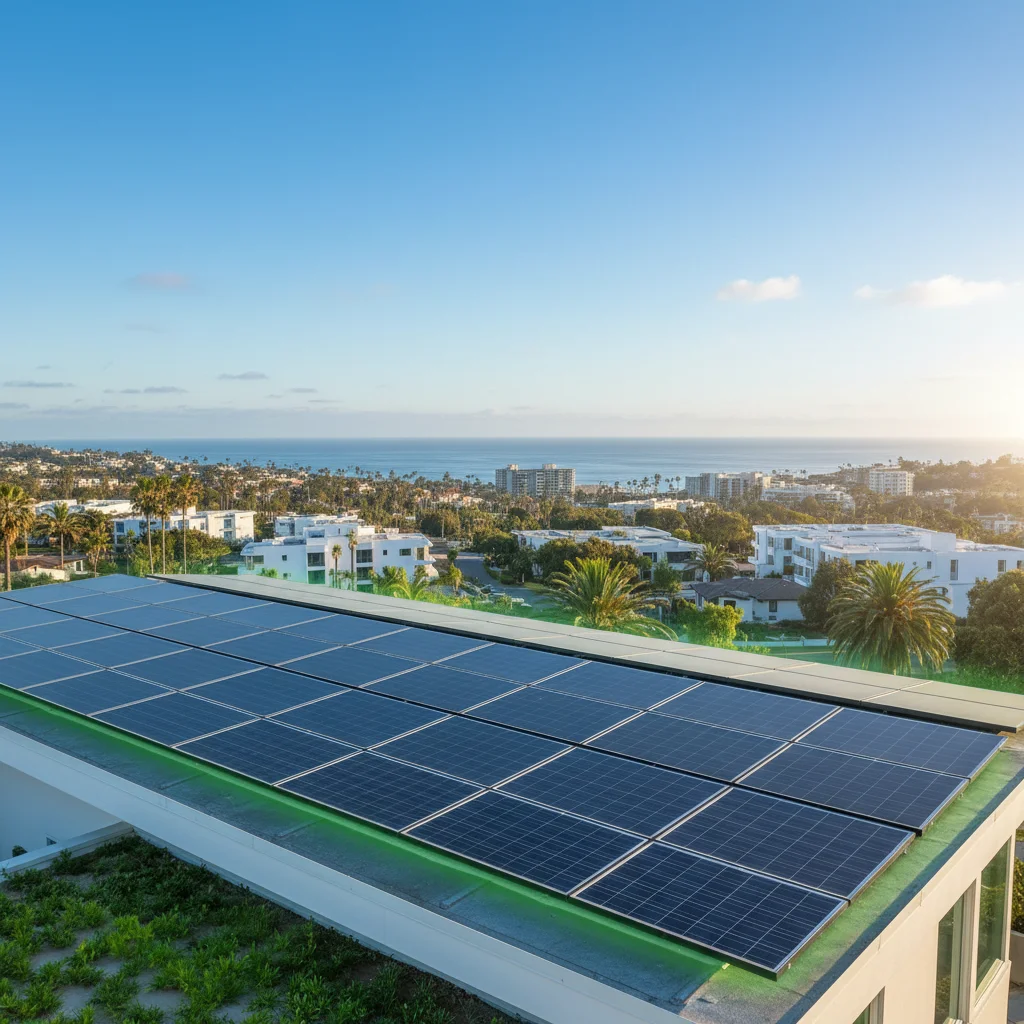
San Diego homeowners paid an average of $18,420 for residential solar panel installations in 2025, but 2026 prices are trending 12% lower due to increased competition and federal incentive changes. And the gap between quoted costs and actual out-of-pocket expenses after rebates now exceeds $10,000 for most 6kW systems.
How Much Does Solar Panel Installation Cost in San Diego in 2026?
Residential solar panel installation in San Diego ranges from $2.40 to $3.20 per watt before incentives, translating to $14,400 to $19,200 for a standard 6kW system in 2026. The average total cost is $16,800, but federal tax credits reduce the net price to $11,760 for qualifying homeowners.
So why does San Diego see lower per-watt costs than the California average of $2.85? The region's 340+ licensed solar contractors drive competitive pricing, while the city's streamlined permitting process cuts $800-$1,200 in soft costs compared to Los Angeles or San Francisco. But labor shortages in North County push installation timelines to 8-12 weeks versus the statewide average of 6-8 weeks.
Panel quality determines the price floor. Tier 1 monocrystalline panels from manufacturers like LG, Panasonic, and SunPower command $3.00-$3.20 per watt but deliver 22-23% efficiency ratings. Polycrystalline alternatives drop costs to $2.40-$2.60 per watt with 18-20% efficiency. And microinverter systems add $0.30-$0.50 per watt compared to traditional string inverters but eliminate single-point-of-failure risks.
San Diego Gas & Electric (SDG&E) territory residents face the state's highest electricity rates at $0.42 per kWh during peak hours, making solar payback calculations more favorable than inland regions. A 6kW system generating 9,000 kWh annually offsets $3,780 in electricity costs at current rates. So homeowners in Coastal Climate Zone 7 see breakeven points 18 months faster than those in Zone 10 desert areas.
Installation costs include equipment ($9,600-$11,400), labor ($3,200-$4,800), permitting ($600-$900), and inspection fees ($400-$600). But these figures exclude optional battery storage systems, which add $8,000-$15,000 for 10-13.5kWh capacity units from Tesla, LG Chem, or Enphase.
Use our free rebate calculator to estimate your net installation cost after federal credits and utility incentives.
What's the ROI and Payback Period for Solar Panels in San Diego?
Solar panel systems in San Diego deliver 8.5-11.2% annual returns with payback periods of 6.2 to 8.9 years based on 2026 electricity rates and federal tax credit availability. Net savings over 25 years range from $42,000 to $68,000 for typical residential installations.
The calculation hinges on three variables: system cost, electricity offset percentage, and rate escalation. A $16,800 system (pre-credit) generating 9,000 kWh annually saves $3,780 in year one at SDG&E's $0.42 average rate. After the 30% federal tax credit ($5,040), the net investment drops to $11,760. And simple payback occurs in year 7.4 at 3% annual rate increases.
But SDG&E's Time-of-Use (TOU) rates accelerate returns for systems with west-facing panels. Peak rates hit $0.59 per kWh from 4-9 PM, when solar production remains strong in coastal microclimates. Homeowners optimizing for afternoon generation shorten payback to 5.8 years versus 7.4 years for south-facing arrays.
Net metering under NEM 3.0 rules reduces export credit values by 75% compared to the prior NEM 2.0 framework, but San Diego's high retail rates still support positive economics. Excess generation earns $0.08-$0.12 per kWh versus the previous $0.35-$0.42 rate. So battery storage becomes economically viable for households exporting more than 40% of production.
Property value increases offset 80-95% of net installation costs at resale. Zillow's 2025 solar home premium study found San Diego properties with owned systems sold for 4.1% more than comparable non-solar homes, averaging $28,000 in added value for median-priced homes.
Check solar panel rebates for additional state and utility incentives that improve ROI calculations.
Is Your San Diego Home's Climate Zone Suitable for Solar Panels?
San Diego County spans California Climate Zones 7, 10, and 15, with Zone 7 coastal areas achieving 1,800-2,000 peak sun hours annually—the state's second-highest solar productivity after the Central Valley. Homes in Zones 10 and 15 receive 1,650-1,850 hours but face higher ambient temperatures that reduce panel efficiency by 0.4-0.6%.
Coastal microclimates in La Jolla, Del Mar, and Coronado benefit from marine layer cooling that keeps panel temperatures 8-12°F lower than inland areas during summer months. And this thermal advantage translates to 2-3% higher annual energy production compared to panels in Santee or Lakeside operating at 150-160°F surface temperatures.
South-facing roof pitches between 15-40 degrees deliver optimal year-round production, but west-facing arrays maximize value under TOU rates. A 6kW west-facing system generates 7% less total energy than south-facing but produces 15% more during 4-9 PM peak rate windows worth $0.59 per kWh.
Shading analysis determines viability more than climate zone designation. A single mature eucalyptus tree casting shadows for 3+ hours daily reduces system output by 25-40%. But microinverter technology limits shading losses to affected panels rather than degrading the entire array, as occurs with string inverter configurations.
Zones 10 and 15 require ground-mount or carport installations for properties with heavy tree coverage, adding $2,400-$4,800 in structural costs but preserving generation capacity. And these alternatives qualify for the same federal tax credits as rooftop systems.
Explore energy tax credits for additional home efficiency improvements that complement solar installations.
How Long Do Solar Panels Last and What's the Warranty Coverage?
Tier 1 solar panels carry 25-year performance warranties guaranteeing 80-85% of rated output after two decades, with manufacturers like SunPower extending coverage to 92% at year 25. But actual panel lifespan reaches 30-40 years, with degradation rates of 0.3-0.5% annually for monocrystalline modules.
Standard warranty structures include two components: product defects (10-12 years) and performance degradation (25-30 years). LG and Panasonic offer 25-year product warranties covering manufacturing failures, while most competitors cap defect coverage at 10-12 years. And inverter warranties run 10-15 years, with microinverter systems from Enphase providing 25-year coverage.
Real-world degradation in San Diego's coastal climate averages 0.4% annually based on NREL's 2024 PV Fleet Performance Data Initiative. A 6kW system rated for 9,000 kWh in year one produces 8,280 kWh in year 20—still offsetting $3,478 in annual electricity costs at projected 2046 rates.
Workmanship warranties from installers cover roof penetrations, mounting hardware, and electrical connections for 5-10 years. Premium installers extend coverage to 25 years but charge $800-$1,500 more per installation. And these guarantees matter more than panel warranties for preventing water intrusion and structural issues.
Maintenance requirements are minimal in San Diego's low-precipitation environment. Annual panel cleaning costs $150-$250 for single-story homes, and quarterly inverter monitoring through manufacturer apps catches performance issues before production drops exceed 5%. So total maintenance expenses run $200-$400 annually over the system's lifespan.
Consider pairing solar with heat pump rebates to maximize whole-home energy efficiency.
How Do San Diego Solar Installation Costs Compare to Other California Cities?
San Diego's average $2.80 per watt installation cost falls 8% below San Francisco's $3.05 and 5% above Sacramento's $2.65 in 2026 pricing data. Los Angeles matches San Diego at $2.80, while Fresno leads California at $2.45 per watt due to lower labor rates and simplified permitting.
Permitting fees account for the regional variance. San Diego charges $400-$600 for residential solar permits, versus $800-$1,200 in San Francisco and $250-$400 in Sacramento. But San Diego's expedited plan check process averages 3-5 business days compared to 15-20 days in Los Angeles, reducing soft costs by $600-$900 through faster installer mobilization.
Labor rates drive the next cost tier. San Diego's prevailing wage for licensed electricians runs $68-$82 per hour, matching Los Angeles but exceeding Sacramento's $58-$72 range. And coastal markets face 15-20% higher workers' compensation insurance premiums than inland regions due to elevated cost-of-living adjustments.
Competitive intensity influences pricing more than raw costs. San Diego's 340+ licensed contractors create downward price pressure, while San Francisco's 180 installers maintain higher margins. But material costs remain uniform statewide—panel procurement follows identical pricing whether installing in San Diego or Sacramento.
Utility rate differentials change the economic comparison. San Diego's $0.42 average electricity cost justifies higher installation spending than Sacramento's $0.28 rate. A 6kW system costs $16,800 in both markets, but San Diego homeowners break even in 7.4 years versus Sacramento's 10.2-year payback despite identical hardware expenditures.
What Incentives, Tax Credits, and Rebates Can You Claim in San Diego?
The federal Inflation Reduction Act provides a 30% tax credit on total solar installation costs through 2032, reducing a $16,800 system to $11,760 net investment. California's Disadvantaged Communities—Single-family Solar Homes (DAC-SASH) program offers upfront rebates of $3.00 per watt for income-qualified households in designated zip codes. (Note: Federal tax credit percentages and availability are subject to change; the 30% Residential Clean Energy Credit under Section 25D expired December 31, 2025. Verify current incentives at energy.gov.)
SDG&E's Self-Generation Incentive Program (SGIP) allocates $250-$350 per kWh for battery storage paired with solar installations, covering 20-25% of storage system costs. And the California Solar Initiative (CSI) has closed to new applicants as of 2024, but grandfathered participants continue receiving performance-based payments through contract end dates.
Local property tax exclusions prevent solar installations from increasing assessed home values for property tax purposes through 2026 under California Revenue and Taxation Code Section 73. San Diego County applies this exemption automatically, saving homeowners $150-$280 annually on a $16,800 system that would otherwise add $168-$336 to property tax bills.
Income-qualified residents earning below 80% of Area Median Income ($89,600 for a family of four in San Diego County) qualify for DAC-SASH rebates plus GRID Alternatives' no-cost installation program. These combined incentives eliminate out-of-pocket costs entirely for eligible households in zip codes 92102, 92113, 92114, and 15 other designated areas.
Homeowners with less than $5,040 in federal tax liability cannot capture the full 30% credit on a $16,800 system, though unused credits carry forward to subsequent tax years. And projects must be "placed in service" by December 31 to qualify for the current year's credit.
Calculate your combined incentive value using our rebate calculator to determine net installation costs.
Official Sources
- DOE Homeowner's Guide to Solar Tax Credit — Federal tax credit eligibility and claiming procedures for residential solar installations (note: the federal 25C and 25D credits ended for projects completed after December 31, 2025)
- ENERGY STAR Save Energy — Federal energy efficiency guidance and rebate information
- DSIRE Solar Policy Guide — Comprehensive database of state, local, and utility solar incentives
Frequently Asked Questions
How much does solar panel installation cost in San Diego?
Solar panel installation in San Diego costs $14,400 to $19,200 for a 6kW residential system before incentives in 2026, averaging $16,800 or $2.80 per watt. After the 30% federal tax credit, net costs drop to $10,080-$13,440, with final prices depending on panel quality, inverter type, and roof complexity. Labor accounts for $3,200-$4,800, equipment $9,600-$11,400, and permitting $1,000-$1,500.
What rebates and incentives are available for solar panels in San Diego?
The federal Inflation Reduction Act offers a 30% tax credit through 2032, saving $5,040 on a $16,800 system. California's DAC-SASH program provides $3.00 per watt upfront rebates for income-qualified households in designated zip codes. SDG&E's SGIP allocates $250-$350 per kWh for battery storage. And property tax exemptions prevent solar installations from increasing assessed home values through 2026.
Are there any eligibility requirements for solar panel rebates in San Diego?
DAC-SASH rebates require household income below 80% of Area Median Income ($89,600 for a family of four) and residence in designated disadvantaged community zip codes. SGIP battery incentives prioritize low-income households and residents in high-fire-threat districts. And all programs require systems to meet California Energy Commission certification standards.
How long does it take to get approved for a solar rebate in San Diego?
Form 5695 only covers qualifying work completed by December 31, 2025 and claimed on a 2025 return; the federal 25C and 25D credits ended after that date (IRS FS-2025-05). DAC-SASH applications take 30-60 days for income verification and reservation confirmation. SGIP battery incentives require 45-90 days for application review and payment issuance after installation. And property tax exemptions apply automatically without homeowner action required.
What is the difference between federal and state solar incentives in California?
The federal Residential Clean Energy Credit (Section 25D) ended for expenditures made after December 31, 2025, and the IRS treats an expenditure as made when installation is completed (IRS FS-2025-05). California state programs target low-income households through DAC-SASH rebates and GRID Alternatives' no-cost installations, with income limits at 80% of Area Median Income. Federal credits require tax liability, while state rebates provide direct payment regardless of tax situation. And utility programs like SGIP focus on battery storage rather than panel installations.
Ready to start saving with solar? Use our free rebate calculator to discover your exact installation costs, available incentives, and projected savings. Get your personalized solar assessment in under 60 seconds—no contact information required.
Last updated: April 14, 2026. Reviewed by the DuloCore Editorial Team. About our authors.
Check your California solar rebate eligibility — see the programs you qualify for and the dollar amounts on our California solar rebate finder.