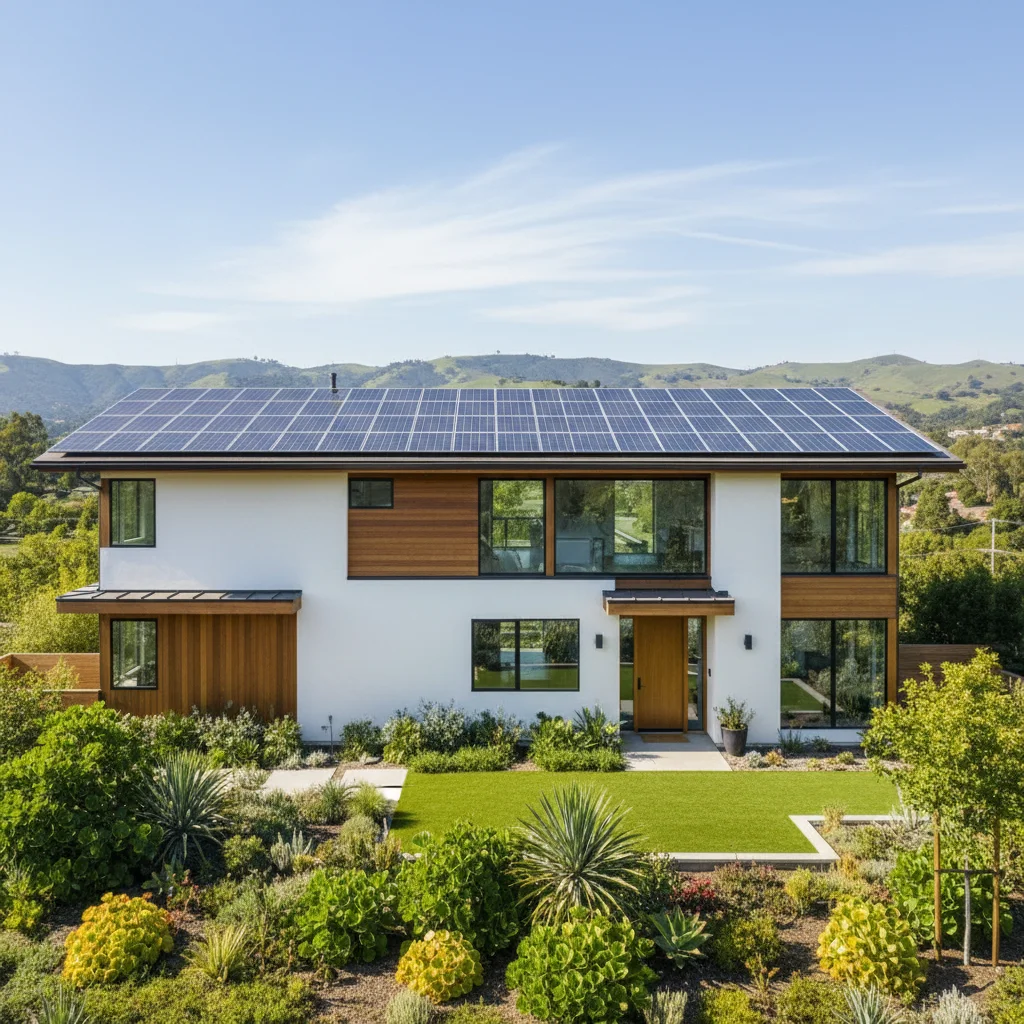
San Jose homeowners paid an average of $18,240 for residential solar panel installations in 2025, but after federal tax credits and local incentives, the net cost dropped to $10,920—a 40% reduction that makes solar one of the fastest-growing home improvements in Silicon Valley. And with California's rising electricity rates averaging $0.32 per kilowatt-hour in 2026, the payback period for solar systems shrank to just 6-8 years.
How Much Does Solar Panel Installation Cost in San Jose?
Residential solar panel installation in San Jose costs $2.53 to $3.16 per watt in 2026, translating to $15,180 to $18,960 for a typical 6-kilowatt system before incentives. After the San Jose Clean Energy rebate ($500 for systems 5 kilowatts or larger), net costs range from $14,680 to $18,460; federal tax credits no longer apply (IRS FS-2025-05).
San Jose's solar installation costs reflect multiple variables tied to the region's unique energy landscape. The city's position in Santa Clara County—where electricity rates rank among California's highest at $0.32 per kilowatt-hour—drives strong demand for solar adoption. And system size directly correlates with household energy consumption: a 1,500-square-foot home typically needs a 5-6 kilowatt system, while a 2,500-square-foot residence requires 8-10 kilowatts.
But equipment quality creates significant price variations. Tier-1 monocrystalline panels from manufacturers like SunPower or LG cost $0.90 to $1.10 per watt, compared to $0.70 to $0.85 per watt for polycrystalline alternatives. Inverter selection adds another layer: string inverters run $1,000 to $2,500 for most residential systems, while microinverters cost $2,000 to $3,500 but deliver 5-12% higher energy production through panel-level optimization.
San Jose's permitting fees add $450 to $800 per installation, and the city requires compliance with 2023 California Building Code Title 24 Part 6 standards. Local labor rates for licensed C-46 solar contractors range from $85 to $125 per hour, with complete installations taking 1-3 days for standard roof-mounted arrays.
The federal Residential Clean Energy Credit (Section 25D) ended for expenditures made after December 31, 2025, and the IRS treats an expenditure as made when installation is completed (IRS FS-2025-05).
What Factors Affect Solar Installation Costs in Your Area?
Roof characteristics, shading patterns, electrical panel capacity, and permitting requirements determine final solar installation costs in San Jose, with variations reaching $4,000 to $7,000 between straightforward installations and complex projects requiring structural reinforcement or electrical upgrades.
Roof pitch and material create the first cost differential. Composite shingle roofs with 4/12 to 6/12 pitch allow standard racking systems costing $0.25 to $0.35 per watt, while Spanish tile or flat roofs require specialized mounting hardware adding $0.40 to $0.60 per watt. And roofs older than 15 years often need replacement before solar installation, adding $8,000 to $15,000 to total project costs.
Shading analysis reveals hidden expenses that surface during site assessment. Trees, chimneys, or adjacent structures casting shadows for more than 2 hours daily reduce system efficiency by 10-25%, requiring additional panels to meet energy targets. So a home with significant shading might need an 8-kilowatt system to generate the same output as an unshaded 6-kilowatt installation, increasing costs by $6,000 to $9,000.
Electrical panel upgrades represent another common expense in San Jose's older housing stock. Homes built before 1990 often have 100-amp or 125-amp service panels insufficient for solar integration, requiring upgrades to 200-amp panels at $1,800 to $3,500. The city's interconnection requirements mandate rapid shutdown systems complying with NEC 2020 690.12 standards, adding $400 to $800 for equipment and installation.
San Jose's Tree Preservation Ordinance affects properties with protected trees near optimal solar exposure areas. Homeowners face choices between pruning permits ($200 to $500) or panel repositioning that reduces system efficiency by 8-15%. Battery storage integration adds $8,000 to $15,000 for systems ranging from 10 to 20 kilowatt-hours, though California's SGIP incentive offsets $1,000 to $2,000 of battery costs for income-qualified homeowners.
How Does Solar Compare to Other Energy Alternatives in San Jose?
Solar panels deliver lower lifetime costs than grid electricity, heat pump systems, or community solar subscriptions in San Jose, with 25-year total ownership costs of $22,000 to $28,000 versus $45,000 to $65,000 for equivalent grid-supplied electricity at projected 2026-2050 rate increases of 3.5% annually.
Grid electricity in San Jose costs $0.32 per kilowatt-hour in 2026 under PG&E's E-TOU-C rate plan, translating to $2,304 annually for a household consuming 600 kilowatt-hours monthly. Over 25 years with projected annual rate increases, cumulative electricity costs reach $58,000 to $72,000 without solar. And San Jose Clean Energy's TotalGreen 100% renewable option adds $0.01 per kilowatt-hour, increasing annual costs to $2,376.
Heat pump systems paired with rooftop solar create comprehensive electrification strategies. A cold-climate heat pump costs $5,500 to $12,000 installed, consuming 2,500 to 4,000 kilowatt-hours annually for heating and cooling a 1,800-square-foot home. When powered by grid electricity, annual operating costs reach $800 to $1,280, but solar-powered heat pumps reduce operating costs to $0 after the solar payback period. Learn more about heat pump rebates for additional savings opportunities.
Community solar programs offer subscription-based alternatives without rooftop installation. San Jose residents qualify for 5-10% discounts on electricity through community solar, saving $115 to $230 annually on a typical $2,304 bill. But savings remain capped at subscription percentages regardless of energy consumption changes.
Battery storage paired with solar delivers resilience benefits during California's planned safety power shutoffs. A 13.5-kilowatt-hour battery like Tesla Powerwall 3 costs $11,500 to $14,000 installed, providing 12-18 hours of backup power for essential loads. And time-of-use rate optimization through battery storage saves an additional $300 to $600 annually by storing midday solar production for evening peak-rate periods.
"Solar photovoltaic systems in California generate an average of 1,450 to 1,650 kilowatt-hours per installed kilowatt annually." — National Renewable Energy Laboratory
What's the Lifespan of Solar Panels and How Does It Impact Your Investment?
Solar panels maintain 85-92% of original output after 25 years of operation, with tier-1 manufacturers guaranteeing 25-year performance warranties and expected operational lifespans of 30-35 years before requiring replacement or system decommissioning.
Module degradation rates determine long-term energy production and financial returns. Monocrystalline panels from manufacturers like SunPower or REC degrade at 0.25-0.40% annually, retaining 90-92% capacity after 25 years. Polycrystalline panels degrade faster at 0.50-0.80% per year, maintaining 80-88% of original output by year 25. So a 6-kilowatt system producing 9,000 kilowatt-hours in year one generates 7,650 to 8,280 kilowatt-hours in year 25, depending on panel quality.
Inverter replacement represents the primary maintenance expense during a solar system's lifespan. String inverters last 10-15 years, requiring replacement at $1,500 to $3,000 during a 25-year ownership period. Microinverters carry 25-year warranties matching panel lifespans, eliminating mid-life replacement costs but commanding higher upfront premiums of $1,000 to $1,500.
San Jose's Mediterranean climate extends equipment lifespan compared to extreme-weather regions. Annual temperature ranges of 40°F to 85°F minimize thermal cycling stress that accelerates degradation in desert or arctic installations. And the region's low humidity reduces corrosion risks affecting electrical connections and junction boxes.
Production monitoring reveals performance trends requiring attention. Annual output declining more than 0.8% signals potential issues: soiling from dust or bird droppings reduces output by 2-5% until cleaned, while micro-cracks from hail or debris impact individual cells. Panel cleaning costs $150 to $300 for typical residential systems and restores 3-7% of lost production.
Extended warranties from manufacturers and installers protect long-term investments. Tier-1 manufacturers offer 25-year performance warranties guaranteeing 85-90% output, while 10-15 year product warranties cover manufacturing defects. Installer workmanship warranties run 5-10 years, covering roof penetrations, electrical connections, and racking systems.
Federal Tax Credit Status and Local Incentives You Can Claim
San Jose Clean Energy offers rebates of $300 to $500 per installation; federal tax credits no longer apply (IRS FS-2025-05).
The federal Residential Clean Energy Credit (Section 25D) ended for expenditures made after December 31, 2025, and the IRS treats an expenditure as made when installation is completed (IRS FS-2025-05). Federal tax credits for this work have ended, but state, local and utility rebates may still apply; check what is available at your address with the DuloCore rebate calculator. Explore energy tax credits for comprehensive federal incentive details.
San Jose Clean Energy's Solar Rebate Program provides $300 for systems under 5 kilowatts and $500 for systems 5 kilowatts or larger, available to San Jose Clean Energy customers at time of interconnection. The rebate processes within 60-90 days of system activation. And income-qualified customers earning below 80% of area median income ($106,000 for a family of four in Santa Clara County) receive enhanced rebates of $1,000 to $1,500.
California's Self-Generation Incentive Program (SGIP) offers battery storage rebates of $150 to $1,000 per kilowatt-hour for systems paired with solar installations. A 13.5-kilowatt-hour battery qualifies for $2,025 to $13,500 depending on income and wildfire risk zone. But SGIP funds deplete annually, requiring early application to secure reservations.
Property tax exclusions protect solar investments from increased assessments in California. AB 1451 extends the active solar energy system property tax exclusion through 2026, preventing solar installations from raising property tax bills. And solar systems don't trigger reassessment under Proposition 13, maintaining base-year valuations.
The federal Residential Clean Energy Credit (Section 25D) ended for expenditures made after December 31, 2025, and the IRS treats an expenditure as made when installation is completed (IRS FS-2025-05).
Use our free rebate calculator to estimate your total savings from local solar incentives.
What's the Solar Installation Process and Timeline in San Jose?
Solar panel installation in San Jose takes 45 to 90 days from contract signing to system activation, encompassing site assessment, permitting, installation, inspection, and utility interconnection phases required by city and California Public Utilities Commission regulations.
Initial site assessment occurs 3-7 days after contract execution. Installers evaluate roof conditions, shading patterns, electrical panel capacity, and optimal panel placement using tools like drone imaging and shade analysis software. The assessment produces system designs showing panel layouts, expected annual production, and equipment specifications. And engineering drawings prepared during this phase form the foundation for permit applications.
San Jose's building permit process takes 10-20 business days for residential solar installations under 10 kilowatts. Applications submitted through the city's online portal require structural calculations stamped by a California-licensed engineer, electrical diagrams showing interconnection points, and equipment specification sheets demonstrating California Energy Commission approval. Plan check fees range from $450 to $800 depending on system size.
Physical installation occupies 1-3 days for standard residential systems. Licensed C-46 contractors install roof attachments, mount racking systems, secure panels, run conduit, install inverters, and connect to the electrical panel. But tile roofs, two-story installations, or complex electrical upgrades extend installation to 4-6 days.
City inspection occurs 2-5 days after installation completion. San Jose building inspectors verify compliance with 2023 California Building Code, NEC 2020 electrical standards, and manufacturer installation specifications. Common inspection failures include improper grounding, insufficient clearances around roof penetrations, or missing rapid shutdown labels—issues corrected within 1-2 days for re-inspection.
Utility interconnection represents the final phase before system activation. PG&E's Permission to Operate (PTO) process takes 15-30 days after passing city inspection, though delays reaching 60 days occur during peak solar installation seasons. The utility installs a net energy metering (NEM 3.0) agreement, configures billing systems, and authorizes system activation. And homeowners receive monthly credits at avoided-cost compensation rates ranging from $0.08 to $0.10 per kilowatt-hour for excess production exported to the grid.
Official Sources
- U.S. Department of Energy Solar Guide — Federal solar tax credit eligibility and claiming procedures (note: the federal 25C and 25D credits ended for projects completed after December 31, 2025)
- DSIRE USA Solar Programs — Comprehensive database of state and local solar incentives, rebates, and policies
- National Renewable Energy Laboratory — Solar resource data and performance metrics for California regions
Frequently Asked Questions
How much does solar panel installation cost in San Jose?
Solar panel installation in San Jose costs $15,180 to $18,960 for a typical 6-kilowatt system before incentives in 2026. After the San Jose Clean Energy rebate ($500 for systems 5 kilowatts or larger), net costs range from $14,680 to $18,460; federal tax credits no longer apply (IRS FS-2025-05). Final prices vary based on roof characteristics, equipment quality, and electrical upgrades.
What rebates and incentives are available for solar panels in San Jose?
San Jose homeowners qualify for San Jose Clean Energy rebates of $300 to $500 and California's SGIP battery storage incentives of $150 to $1,000 per kilowatt-hour; federal tax credits no longer apply (IRS FS-2025-05). Income-qualified customers earning below 80% area median income receive enhanced rebates reaching $1,500 for solar installations.
Are there financing options to reduce upfront solar installation costs?
Solar loans, home equity lines of credit, Property Assessed Clean Energy (PACE) financing, and solar leases provide alternatives to cash purchases in San Jose. Solar loans offer terms of 10-25 years with interest rates of 3.5-8.5%, while PACE programs attach repayment to property tax bills.
How long does it take to install solar panels in San Jose?
Physical installation takes 1-3 days for standard residential systems, but the complete process from contract signing to system activation spans 45-90 days. This timeline includes 10-20 days for city permitting, 1-3 days for installation, 2-5 days for inspection, and 15-30 days for utility interconnection through PG&E's Permission to Operate process.
Do I qualify for solar rebates in San Jose?
San Jose Clean Energy customers qualify for solar rebates regardless of income, receiving $300 for systems under 5 kilowatts or $500 for larger installations. Income-qualified customers earning below 80% area median income ($106,000 for a family of four in Santa Clara County in 2026) receive enhanced rebates of $1,000 to $1,500. Check eligibility at San Jose Clean Energy's website.
Ready to calculate your solar savings? Use our free rebate calculator to estimate local incentives and lifetime energy savings for your San Jose home. Get personalized results in under 2 minutes with no obligation.
Last updated: April 14, 2026. Reviewed by the DuloCore Editorial Team. About our authors.
Check your California solar rebate eligibility — see the programs you qualify for and the dollar amounts on our California solar rebate finder.