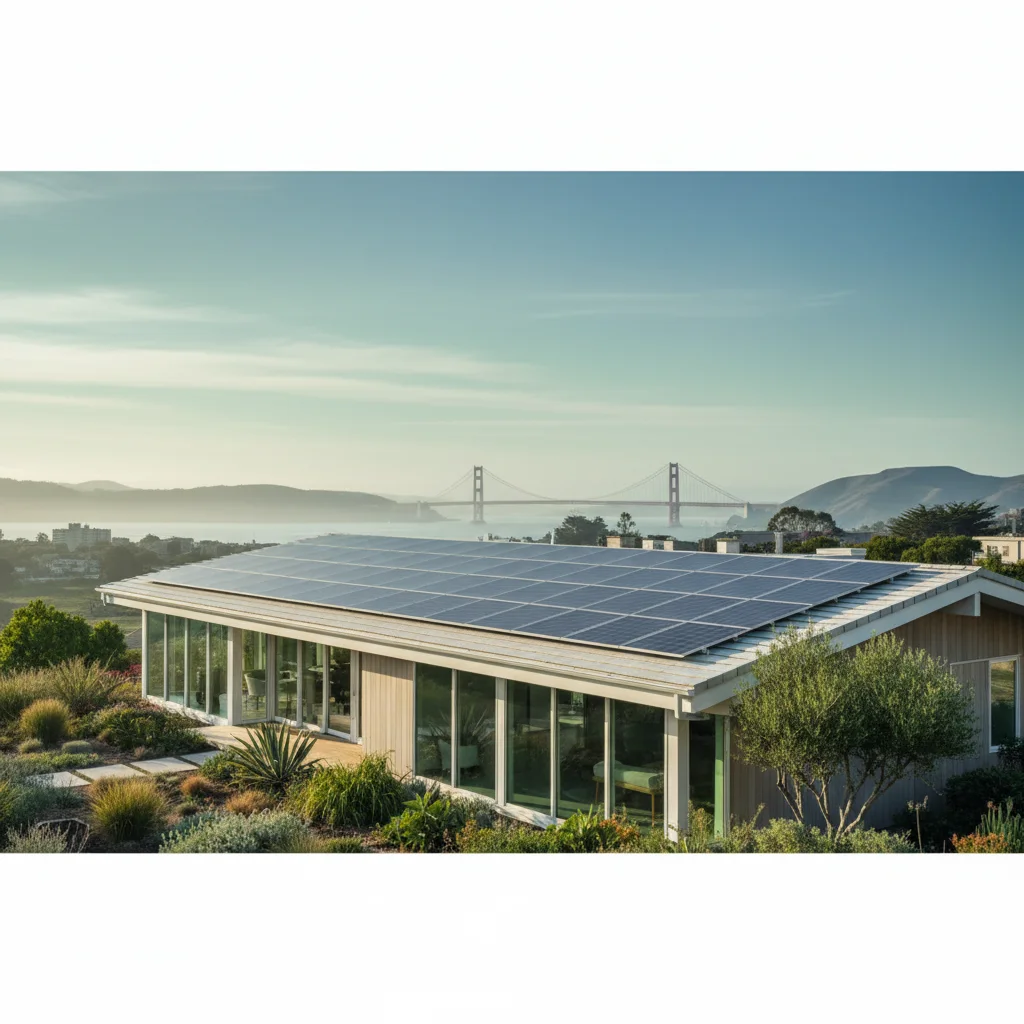
Bay Area homeowners who install solar panels in 2026 can access $9,000 to $14,000 in combined federal tax credits and state rebates—but many miss out because they don't know which programs stack or when funding expires. And three major utility rebate programs serving San Francisco, Oakland, and San Jose counties run out of money before the calendar year ends.
What Solar Rebates and Incentives Are Available in the Bay Area Right Now?
Bay Area solar panel rebates in 2026 include the federal IRA tax credit (30% of installation costs), California's SGIP battery storage rebate ($200-$850 per kWh), and utility-specific programs from PG&E, East Bay Community Energy, and Silicon Valley Clean Energy. These programs provide $9,000 to $14,000 for typical residential installations. The federal Residential Clean Energy Credit (Section 25D) ended for expenditures made after December 31, 2025, and the IRS treats an expenditure as made when installation is completed (IRS FS-2025-05). Federal tax credits for this work have ended, but state, local and utility rebates may still apply; check what is available at your address with the DuloCore rebate calculator. State and utility rebates operate on first-come, first-served funding.
The federal tax credit alone saves homeowners $7,500 on a $25,000 solar installation. But the real savings come from stacking multiple programs. PG&E customers can layer the federal credit with SGIP battery incentives and municipal solar loan programs. And East Bay Community Energy offers a $500 solar PV rebate on top of federal benefits.
So understanding which combinations maximize savings requires checking three program types: federal tax credits, state battery storage rebates, and local utility incentives. Most Bay Area solar companies handle the paperwork—but only if homeowners ask about all available programs before signing contracts.
How Much Money Can You Actually Get From Solar Rebates in Bay Area?
Bay Area solar rebate amounts in 2026 range from $9,000 to $14,000 for residential installations when combining federal IRA tax credits (30% of costs), SGIP battery rebates ($200-$850/kWh), and utility incentives ($300-$1,000). A typical 6 kW system costing $25,000 receives $7,500 federal credit plus $2,400 SGIP rebate for a 10 kWh battery. Actual amounts depend on system size, equipment type, income level, and utility service territory.
Income-qualified homeowners receive higher SGIP rates. California residents earning below 80% of area median income get $850 per kWh for battery storage—more than four times the standard $200/kWh rate. For a 10 kWh battery, that's $8,500 instead of $2,000. And residents in high-fire-threat districts or those relying on electric medical equipment receive priority funding plus equity budget allocations.
Calculate your specific savings using a rebate calculator that accounts for your utility, income bracket, and system specifications.
Who Qualifies for Bay Area Solar Rebates Based on Income and Property Type?
Bay Area solar rebate eligibility in 2026 requires homeowners who own residential property served by participating utilities (PG&E, EBCE, SVCE), file federal taxes with sufficient liability for credits, and meet income limits for enhanced programs ($106,300 for a family of four in San Francisco County). Standard federal IRA credits have no income caps. California SGIP equity budgets prioritize households below 80% area median income, residents in high-fire-threat districts, and properties with medically vulnerable occupants.
Renters don't qualify for homeowner tax credits. But multi-family property owners can claim commercial solar incentives. And community solar programs offer an alternative for residents who can't install rooftop systems due to shading, roof condition, or rental agreements.
Property requirements include adequate roof space (250-400 square feet for typical systems), south or west-facing exposure, and structural capacity to support 3-4 pounds per square foot. Homes built before 1990 often need roof reinforcement before installation, adding $2,000 to $5,000 to project costs.
What Equipment and Solar Installations Are Eligible for Bay Area Rebates?
Eligible solar equipment for Bay Area rebates in 2026 includes photovoltaic panels rated at 300-400 watts, UL 1741-certified inverters, battery storage systems 10 kWh or larger, and complete grid-connected installations. Federal IRA credits cover solar panels, inverters, mounting hardware, wiring, and installation labor. California SGIP rebates apply only to battery storage, not panels. Equipment must be new (not used), meet California Energy Commission specifications, and be installed by C-46 licensed contractors.
The federal Residential Clean Energy Credit (Section 25D) ended for expenditures made after December 31, 2025, and the IRS treats an expenditure as made when installation is completed (IRS FS-2025-05). So a $25,000 turnkey installation generates a $7,500 credit. But standalone components like portable solar generators or RV panels don't qualify unless they're permanently wired to home electrical systems.
SGIP battery requirements specify lithium-ion chemistry, 10-year warranties, and 85% round-trip efficiency. Tesla Powerwall, LG Chem RESU, and Enphase IQ Battery systems meet these standards. And batteries must be sized for at least 4 hours of discharge duration.
| Program | Equipment Covered | Amount | Requirements |
|---|---|---|---|
| Federal IRA Tax Credit | Panels, inverters, batteries, labor | 30% of costs ($7,500 avg) | New equipment, grid-connected |
| CA SGIP | Battery storage only | $200-$850/kWh | 10 kWh minimum, 10-year warranty |
| PG&E Solar PV Program | Panels and inverters | $500-$1,000 | PG&E customers, income-qualified |
What's the Step-by-Step Process to Apply for Bay Area Solar Rebates?
The Bay Area solar rebate application process in 2026 requires homeowners to obtain quotes from licensed contractors, reserve SGIP funds before installation, complete installations within 18 months, pass municipal inspections, and file IRS Form 5695 for federal credits. SGIP applications require upfront reservation through the administrator portal. Utility rebates require post-installation verification and meter data submission within 90 days.
Step 1: Get three quotes from C-46 licensed California solar contractors. Compare equipment specs, warranties, and total installed costs. Don't sign contracts until confirming current rebate availability.
Step 2: Reserve SGIP battery storage funds at energycenter.org/sgip before installation begins. Reservations expire after 18 months. And equity budget applicants must submit income documentation and proof of residence in qualifying zones.
Step 3: Complete installation and pass building department inspection. Contractors submit interconnection paperwork to your utility. Systems must be operational before claiming rebates.
Form 5695 only covers qualifying work completed by December 31, 2025 and claimed on a 2025 return; the federal 25C and 25D credits ended after that date (IRS FS-2025-05). The credit reduces federal tax liability dollar-for-dollar. Unused credits can't be carried forward—so taxpayers with low liability forfeit the difference.
Step 5: Submit utility rebate claims with proof of installation, equipment specifications, and meter data. Processing takes 60-120 days. Payments arrive as checks or bill credits.
When Are the Deadlines and How Do You Check Funding Status for Bay Area Rebates?
Bay Area solar rebate deadlines in 2026 include ongoing federal IRA credits through 2032, SGIP budget exhaustion (typically September-October each year), and utility program cycles (quarterly or until funds deplete). SGIP general market budget closed in September 2025 and January 2026 due to high demand. Equity budgets remain open longer but still exhaust annually. Real-time SGIP funding status appears at California Center for Sustainable Energy's dashboard. Federal credits have no annual cap.
SGIP operates first-come, first-served. Once budgets exhaust, applications enter waitlists that rarely clear before the next fiscal year. So homeowners who delay reservations risk losing $2,000 to $8,500 in battery incentives. Check current funding at energycenter.org/sgip-funding before starting projects.
Utility rebate programs reset annually—but funding depletes within months in high-demand territories like San Francisco and Alameda counties. PG&E's income-qualified solar program exhausted 2025 funds by April. And 2026 allocations opened January 1 with $4.8 million available.
"California's SGIP program has distributed over $1.6 billion in incentives since 2001, with current focus on energy equity and resilience for vulnerable communities." — California Public Utilities Commission
Can You Stack Multiple Bay Area Solar Rebates and Tax Credits Together?
Bay Area homeowners can stack federal IRA tax credits (30% of costs), California SGIP battery rebates ($200-$850/kWh), and utility solar incentives ($300-$1,000) in 2026 without disqualification. SGIP permits layering with federal credits and utility programs. Total stacked savings reach $14,000 for typical installations. The only restriction: homeowners can't claim the same equipment costs for multiple federal tax credits simultaneously.
Stacking maximizes returns. A $30,000 solar-plus-storage installation receives $9,000 federal credit (30% of $30,000), $2,000 SGIP rebate (10 kWh battery × $200/kWh), and $500 PG&E incentive—totaling $11,500. And income-qualified residents in equity budgets receive $8,500 SGIP instead of $2,000, increasing total savings to $18,000.
State rebates don't reduce the federal tax credit basis. So homeowners calculate the 30% IRA credit on gross installed costs—before subtracting state or utility rebates. But SGIP requires homeowners to subtract utility incentives before calculating battery rebate amounts for equity budgets.
What Contractor Requirements Must Your Solar Company Meet for Bay Area Rebates?
Bay Area solar contractors installing rebate-eligible systems in 2026 must hold California C-46 (Solar) contractor licenses, carry $1 million general liability insurance, provide 10-year workmanship warranties, use certified equipment, and be SGIP-approved installers for battery projects. Federal IRA credits allow any licensed contractor. SGIP maintains a registry of approved installers at energycenter.org. Unlicensed installations forfeit all rebate eligibility and violate California law.
California requires C-46 licenses for any solar work exceeding $500. Homeowners who hire unlicensed contractors void insurance coverage, can't claim rebates, and face liability for code violations. Check license status at cslb.ca.gov.
SGIP-approved installers complete program training and agree to standardized application procedures. The registry includes 450+ California contractors. And installations by non-approved contractors require homeowners to self-manage SGIP paperwork—a complex process that delays payments by months.
Contractor agreements should specify who files rebate applications. Most installers handle SGIP reservations and utility paperwork as part of turnkey service. But federal tax credits remain the homeowner's responsibility—contractors can't file IRS forms on behalf of clients.
For related savings opportunities, review heat pump rebates and energy tax credits available in 2026.
Official Sources
- DOE Solar Tax Credit Guide — Federal solar photovoltaic tax credit eligibility and claiming procedures (note: the federal 25C and 25D credits ended for projects completed after December 31, 2025)
- DSIRE California Programs — Database of state incentives for renewables and efficiency, including SGIP details
- IRS Residential Energy Credits — Form 5695 instructions for claiming federal clean energy tax credits (note: the federal 25C and 25D credits ended for projects completed after December 31, 2025)
Related Reading: Learn more about Solar Panel Installation Rebates and Solar Panel Payback Period With Rebates.
Frequently Asked Questions
What solar panel rebates are available in the Bay Area?
Bay Area solar rebates in 2026 include the 30% federal IRA tax credit (saving $7,500 on a $25,000 system), California SGIP battery (this federal credit ended for expenditures made after December 31, 2025) storage rebates ($200-$850 per kWh), and utility-specific incentives from PG&E ($500-$1,000), East Bay Community Energy ($500), and Silicon Valley Clean Energy ($300-$800). Combined savings reach $9,000 to $14,000 for typical residential installations when programs are stacked.
How much money can I get from a solar rebate in Bay Area?
Bay Area homeowners receive $9,000 to $14,000 in combined rebates for residential solar installations in 2026. The federal Residential Clean Energy Credit (Section 25D) ended for expenditures made after December 31, 2025, and the IRS treats an expenditure as made when installation is completed (IRS FS-2025-05). SGIP battery rebates add $2,000 to $8,500 depending on income and battery size. And utility incentives contribute $300 to $1,000. Income-qualified residents in SGIP equity budgets receive the highest amounts—up to $18,000 total.
Am I eligible for solar panel rebates in the Bay Area?
Bay Area homeowners who own residential property, file federal taxes with sufficient liability, and live in PG&E, EBCE, or SVCE service territories qualify for solar rebates in 2026. Federal IRA credits have no income limits. California SGIP enhanced rebates require household income below 80% area median ($106,300 for a four-person San Francisco County household). Renters and commercial properties follow different eligibility rules.
What is the timeline for receiving a solar panel rebate in Bay Area?
Bay Area solar rebate timelines in 2026 span 3 to 18 months. SGIP battery rebates process in 60-120 days after installation verification. Utility rebates take 60-90 days after meter data submission. SGIP reservations expire 18 months after approval—systems must be operational before expiration to receive payments.
How do Bay Area solar rebates compare to federal tax credits?
Bay Area solar rebates in 2026 layer with federal tax credits rather than compete. The federal Residential Clean Energy Credit (Section 25D) ended for expenditures made after December 31, 2025, and the IRS treats an expenditure as made when installation is completed (IRS FS-2025-05). California SGIP battery rebates add $2,000 to $8,500 depending on eligibility tier. And local utility incentives contribute $300 to $1,000. Federal credits are claimed on taxes. State and utility rebates arrive as direct payments or bill credits.
Ready to calculate your exact savings? Use our free rebate calculator to see how much you can save with Bay Area solar rebates based on your home, income, and utility provider. Get a personalized estimate in under 2 minutes.
Last updated April 14, 2026 — reviewed by DuloCore Editorial. About our authors.
Check your California solar rebate eligibility — see the programs you qualify for and the dollar amounts on our California solar rebate finder.