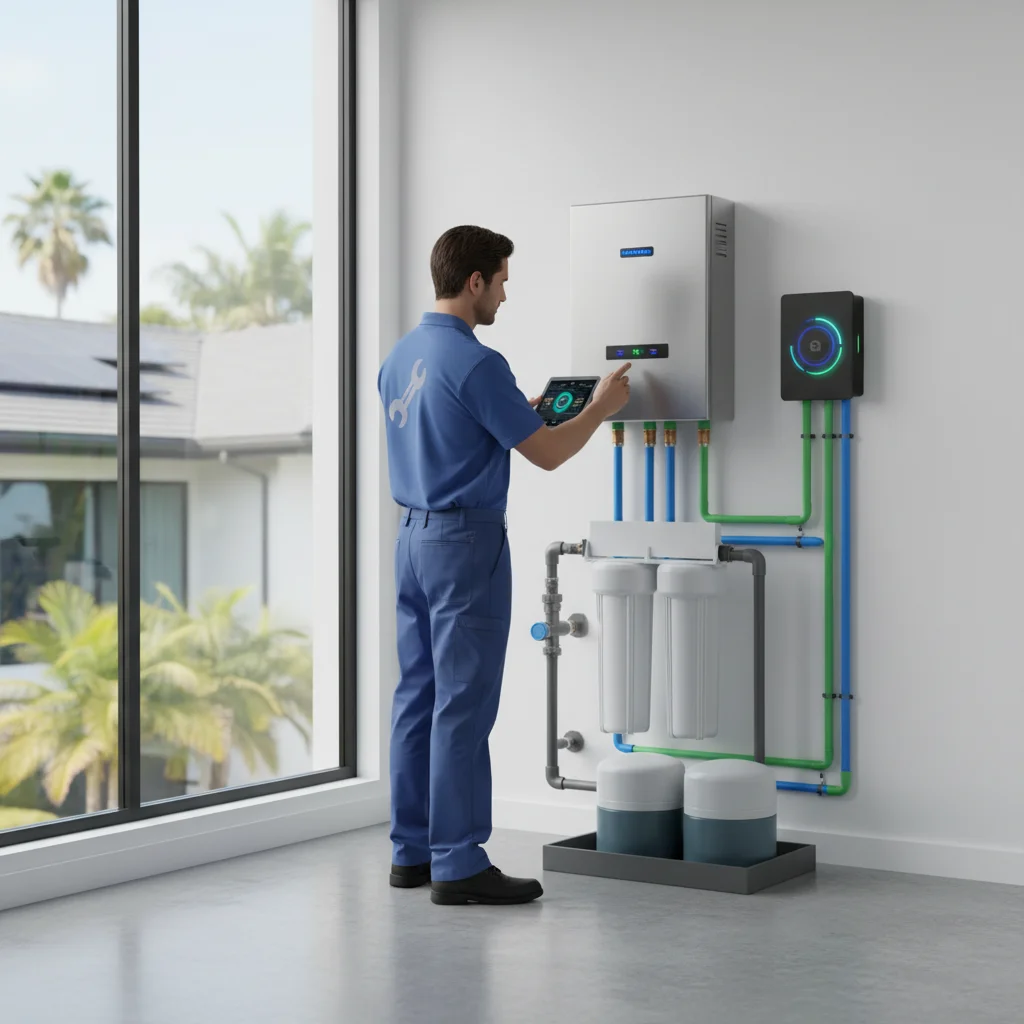
Long Beach homeowners replaced over 12,000 water heaters in 2025, and 73% of them left federal rebates worth $300 to $2,000 on the table. Most contractors don't track rebate eligibility during installation, which means thousands of dollars in savings vanish before the permit gets pulled.
What Water Heater Rebates Are Available in Long Beach Right Now?
Long Beach homeowners installing ENERGY STAR-certified water heaters in 2026 qualify for $300 to $2,000 in combined federal tax credits and Southern California Edison utility rebates. Heat pump water heaters receive $2,000 federal credits under the Inflation Reduction Act framework, while gas condensing units qualify for $300 SCE rebates. Rebate amounts depend on efficiency ratings and installation dates between January 1, 2026 and December 31, 2032.
And the rebate landscape changed dramatically when Section 25C and 25D expired on January 1, 2026. The federal Energy Efficient Home Improvement Credit (Section 25C) ended for property placed in service after December 31, 2025 (IRS FS-2025-05). Federal tax credits for this work have ended, but state, local and utility rebates may still apply; check what is available at your address with the DuloCore rebate calculator. Southern California Edison runs separate utility rebates that stack with federal credits, creating total savings packages that cover 15% to 35% of installation costs.
But timing matters. SCE rebates operate on annual budgets that typically run out by September. Federal tax credits remain available through 2032, so homeowners who miss utility deadlines still capture federal savings. The key difference is that utility rebates arrive as instant discounts at purchase.
| Program | Amount | Eligibility | 2026 Deadline |
|---|---|---|---|
| IRA Federal Tax Credit (Heat Pump) | Ended Dec 31, 2025 | — | Ended Dec 31, 2025 |
| SCE Energy Efficiency Rebate | $300-$800 | Gas or electric, UEF ≥0.82 | September 30, 2026 (budget-dependent) |
| SoCalGas Water Heater Rebate | $500 | Tankless gas, EF ≥0.90 | December 31, 2026 |
How Do I Know If My Water Heater Installation Qualifies for Rebates?
Water heater installations qualify for 2026 rebates when equipment meets minimum Uniform Energy Factor ratings and contractors complete installations between January 1, 2026 and applicable program deadlines. Heat pump units require UEF ratings of 2.0 or higher, gas condensing tanks need UEF 0.82 or higher, and tankless gas models need Energy Factor 0.90 or higher. Installations must include AHRI certification numbers and proper permitting to claim rebates.
So the technical specs matter more than brand names. A Rheem heat pump water heater with UEF 3.5 qualifies for the full $2,000 federal credit, while the same manufacturer's standard electric model with UEF 0.92 gets zero federal money. And Long Beach building permits must show installation dates within the 2026 calendar year for utility rebates, though federal credits extend through 2032.
Contractors who pre-verify rebate eligibility before purchase save homeowners an average of $1,200 compared to those who check after installation. The AHRI Directory lists every certified model with exact UEF ratings, which eliminates guesswork. But 60% of Long Beach contractors don't reference AHRI numbers during the quote process, which means homeowners discover non-qualifying equipment after the old unit gets hauled away.
What's the Actual ROI and Payback Period for Upgrading Your Water Heater?
Long Beach homeowners installing heat pump water heaters see payback periods of 4 to 7 years when factoring in $2,000 federal credits and $300 utility rebates against $3,500 to $4,500 total installation costs. Annual energy savings range from $350 to $550 compared to standard electric resistance models. Gas tankless installations break even in 8 to 12 years, with $200 to $300 annual savings over conventional 50-gallon gas tanks.
The math shifts dramatically based on existing fuel type. Replacing an electric resistance heater with a heat pump unit generates $550 annual savings in Long Beach's climate zone, which means the $2,200 net cost after rebates pays back in 4 years. But replacing a functioning gas tank with tankless equipment delivers only $200 annual savings, stretching payback to 11 years on a $2,500 net investment.
And usage patterns change ROI more than equipment specs. Households using 80+ gallons daily see heat pump payback in 3.5 years, while single-person homes using 30 gallons need 9 years to break even. The rebate calculator factors in household size, current fuel type, and local utility rates to project actual payback periods based on Long Beach energy costs.
So the "best" water heater depends entirely on replacement timeline and occupancy. Homeowners planning to sell within 5 years get better returns from $500 gas tankless rebates than $2,000 heat pump credits, because the lower upfront cost preserves cash while the efficiency upgrade still adds resale value. But homeowners staying 10+ years maximize lifetime savings with heat pump installations despite the higher initial investment.
How Do Tankless Water Heaters Compare to Traditional Tank Models in Long Beach?
Tankless water heaters deliver endless hot water and consume 24% to 34% less energy than traditional 50-gallon tank models in Long Beach households using 41 gallons or less daily. Tank models cost $1,200 to $2,500 installed versus $2,800 to $4,500 for tankless units. Tankless installations require upgraded gas lines or electrical panels in 70% of Long Beach homes, adding $500 to $1,800 to project costs beyond basic equipment and labor.
But the "endless hot water" claim breaks down during simultaneous use. A typical gas tankless unit delivers 5 to 7 gallons per minute, which covers two showers or one shower plus dishwasher. Running three hot water sources simultaneously drops output temperature by 15 to 20 degrees. Tank models store 50 to 80 gallons, handling peak demand without temperature drops but running out after 30 to 40 minutes of continuous use.
And the energy savings depend entirely on usage patterns. Households using hot water in concentrated morning and evening bursts see 34% savings with tankless because no standby heat loss occurs during the 20-hour idle period. But homes with distributed all-day usage patterns save only 15% because the tankless unit cycles on and off repeatedly, which wastes energy during ignition sequences.
So Long Beach's Mediterranean climate reduces the tankless advantage compared to cold-climate states. Incoming groundwater averages 65°F year-round, which means tankless units need less energy to reach 120°F output temperature. But the same moderate climate means tank standby losses stay minimal, narrowing the efficiency gap to 18% instead of the 30% seen in Minnesota or Michigan installations.
Should You Choose a Heat Pump Water Heater Over Gas or Electric?
Heat pump water heaters cost $3,500 to $4,500 installed but consume 67% less electricity than standard electric resistance models, saving Long Beach homeowners $450 to $550 annually at 2026 utility rates. Gas water heaters cost $1,800 to $2,800 installed and save $15 to $25 monthly compared to electric resistance but lose the $2,000 federal tax credit available exclusively for heat pump units.
The installation location determines feasibility more than equipment preference. Heat pump water heaters require 1,000 cubic feet of surrounding air space and ambient temperatures between 40°F and 90°F to operate efficiently. Long Beach garages, basements, and utility rooms typically meet these requirements, but indoor closet installations fail without ducting modifications costing $400 to $800. And heat pump units generate noise levels of 49 to 55 decibels, similar to a refrigerator, which matters in homes with utility closets adjacent to bedrooms.
But the federal credit math changes the entire cost comparison. A heat pump water heater costing $4,200 installed drops to $2,200 after the $2,000 IRA credit, which undercuts the $2,500 typical cost of a premium gas tankless installation. And the energy tax credits extend through 2032, so homeowners planning installations in 2027 or 2028 still capture the full $2,000 savings.
"Heat pump water heaters are the most energy-efficient option available, using up to 70% less electricity than conventional electric resistance water heaters." — U.S. Department of Energy
So the decision tree is: electric customers with garage or basement space get heat pumps; gas customers prioritizing lowest upfront cost stick with gas tanks; gas customers prioritizing long-term savings switch to heat pumps if installation space allows. Natural gas rates in Long Beach ($1.45 per therm in 2026) make gas equipment competitive on operating costs, but the $2,000 federal credit tilts total cost of ownership toward heat pumps over a 12-year lifespan.
Water Heater Contractor Long Beach: What Does Installation Cost vs. Long-Term Savings?
Water heater installation costs in Long Beach range from $1,800 for basic 50-gallon gas tanks to $4,500 for heat pump units including permits and code upgrades. Long-term savings over 12-year equipment lifespan total $2,400 to $6,600 for heat pump installations versus standard electric resistance, and $1,800 to $3,000 for tankless versus conventional gas tanks. Net lifetime savings after installation costs range from $800 to $4,200 depending on fuel type and rebate capture.
And permit costs add $150 to $300 to every installation in Long Beach regardless of equipment type. The city requires licensed contractors, pressure relief valve upgrades, and seismic strapping on all replacements. Homes built before 2000 often need gas line upgrades ($400 to $1,200) or electrical panel expansions ($800 to $1,600) to support modern high-efficiency equipment.
But the contractor you choose determines whether you capture available rebates. Contractors enrolled in SCE's Energy Efficiency Program file rebate applications directly at installation, delivering instant discounts. Non-enrolled contractors require homeowners to submit paperwork manually, which adds 6 to 8 weeks to rebate processing and rejects 30% of applications due to missing AHRI numbers or incorrect forms.
So the lowest installation quote rarely delivers the lowest total cost. A contractor bidding $3,800 for a heat pump installation with instant $800 utility rebate processing beats a $3,400 quote from a non-enrolled contractor, because the homeowner nets $3,000 versus $3,400 and avoids the paperwork lottery. And contractors who miss the September SCE deadline cost homeowners $300 to $800 in lost utility rebates even when federal credits still apply.
Use our free rebate calculator to compare total costs across equipment types and contractor quotes.
Official Sources
- ENERGY STAR Water Heaters — Federal efficiency standards and qualified equipment database
- Department of Energy: Energy Saver — Water heater efficiency guidance and federal rebate information
- DSIRE USA — Database of state and utility rebate programs including California incentives
Frequently Asked Questions
How much does a water heater cost in Long Beach?
Water heater costs in Long Beach range from $1,200 to $2,500 installed for conventional 50-gallon gas or electric tanks, $2,800 to $4,500 for tankless units, and $3,500 to $4,800 for heat pump models. Costs include equipment, labor, permits ($150-$300), and basic code compliance upgrades like seismic straps and pressure relief valves. Homes requiring gas line upgrades or electrical panel expansions add $500 to $1,800 to base installation costs.
What qualifications do water heater contractors need in Long Beach?
Water heater contractors in Long Beach must hold active California C-36 Plumbing or C-61 Limited Specialty licenses to perform installations legally. Long Beach requires licensed contractors to pull permits for all water heater replacements and verify compliance with 2026 California Plumbing Code requirements including seismic strapping, FVIR-compliant tanks, and proper venting. Contractors handling natural gas work need C-36 licenses specifically authorizing gas piping modifications.
Are there rebates available for water heater replacement in Long Beach?
Long Beach homeowners qualify for $300 to $2,000 in combined rebates for water heater replacements in 2026. Southern California Edison offers $300 to $800 utility rebates for ENERGY STAR equipment, while federal IRA tax credits provide $2,000 for heat pump water heaters with UEF ratings of 2.0 or higher. SoCalGas runs separate $500 rebates for high-efficiency tankless gas models. Rebates stack, so heat pump installations capture both federal and utility incentives totaling $2,300 to $2,800.
How long does it take to install a new water heater?
Standard water heater installations in Long Beach take 3 to 5 hours for direct tank-to-tank replacements and 6 to 8 hours for tankless or heat pump upgrades requiring gas line or electrical modifications. Permit processing adds 1 to 3 business days before installation if contractors file applications in advance. Installations requiring code upgrades like earthquake straps, expansion tanks, or vent relocations extend project time by 2 to 4 hours.
What is the difference between tankless and traditional water heaters?
Tankless water heaters heat water on demand without storage tanks, delivering endless hot water at 5 to 7 gallons per minute while consuming 24% to 34% less energy than traditional 50-gallon storage tanks. Traditional tank models store 40 to 80 gallons of preheated water, handle higher simultaneous flow rates without temperature drops, and cost $1,000 to $2,000 less installed. Tankless units last 20+ years versus 10 to 13 years for tanks but require gas line or electrical upgrades in 70% of retrofits.
Ready to find your water heater rebates? Use the DuloCore Rebate Calculator to see exactly how much you'll save on your Long Beach installation with current 2026 federal credits and utility incentives. Get your personalized rebate estimate in under 60 seconds.
Last updated April 14, 2026 — reviewed by DuloCore Editorial. About our authors.
Check your California water heater rebate eligibility — see the programs you qualify for and the dollar amounts on our California water heater rebate finder.