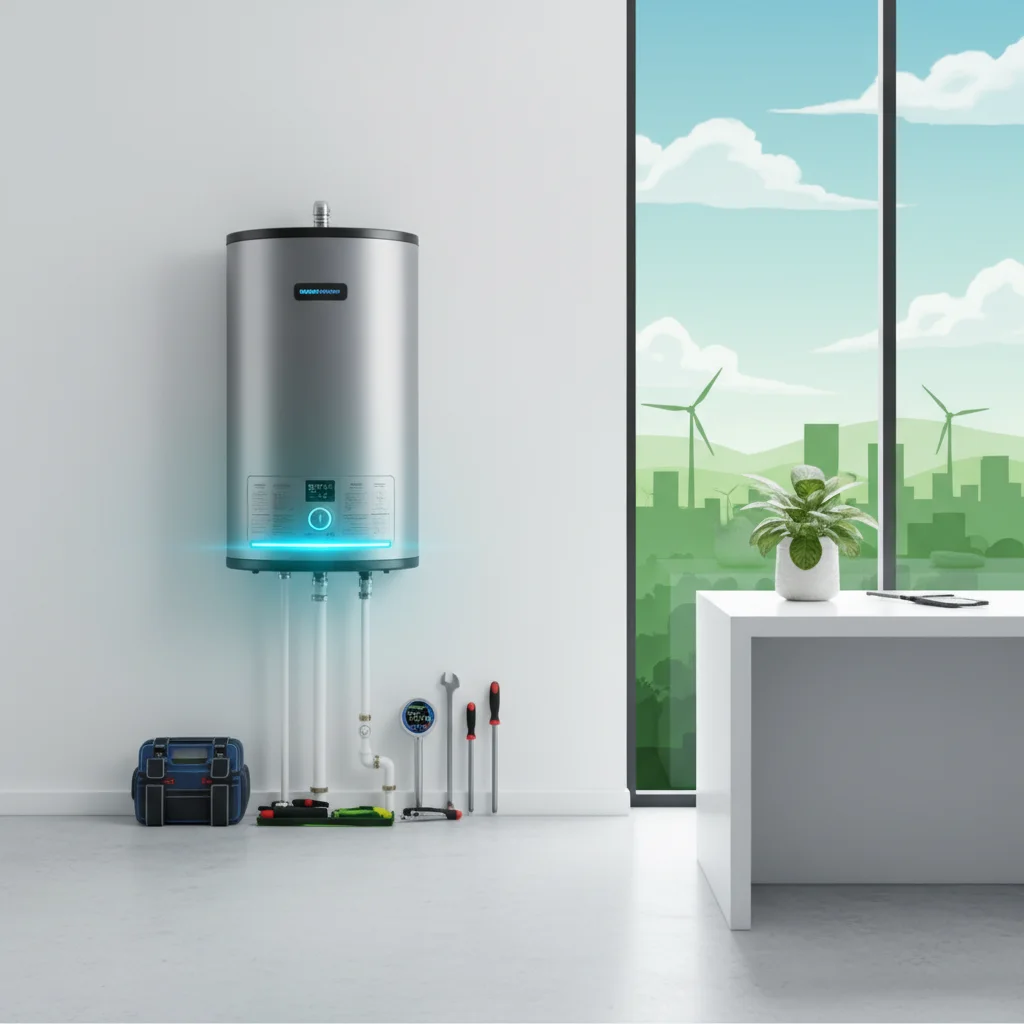
San Jose homeowners replaced over 14,000 water heaters in 2025, with installation costs ranging from $1,200 to $6,500 depending on the unit type and complexity. Those choosing heat pump water heaters spent an average of $3,800 but qualified for federal tax credits worth $2,000, cutting effective costs nearly in half.
How Much Does Water Heater Installation Cost in San Jose?
Water heater installation in San Jose costs $1,200 to $6,500 in 2026, with standard tank units averaging $1,800, tankless systems ranging $2,500 to $4,500, and heat pump water heaters costing $3,000 to $6,500 before rebates. Labor runs $500 to $1,500 depending on permit requirements and existing infrastructure modifications.
Standard 40-50 gallon tank water heaters represent the most common replacement in San Jose, with total installed costs between $1,200 and $2,200. And the price includes the unit itself ($600-$1,200), labor ($500-$800), permits ($150-$200), and disposal of the old unit. But homes requiring gas line modifications or electrical upgrades face additional charges of $300 to $800.
Tankless water heaters cost more upfront at $2,500 to $4,500 installed, reflecting higher equipment prices ($1,200-$2,800) and more complex installation requirements. So San Jose's strict building codes often mandate ventilation upgrades ($400-$900) and gas line upsizing ($300-$600) for tankless conversions. The city issued 2,847 tankless water heater permits in 2025, up 18% from the previous year.
Heat pump water heaters represent the premium option at $3,000 to $6,500 installed, but federal tax credits worth $2,000 under the IRA framework bring effective costs down to $1,000 to $4,500. According to the Department of Energy, these units use 50-60% less electricity than standard electric resistance water heaters. Check our rebate calculator to estimate total savings including utility incentives.
What's the ROI and Payback Period for Installing a New Water Heater?
Heat pump water heaters in San Jose deliver ROI of 140-280% over their 12-15 year lifespan, with payback periods of 4-6 years after federal tax credits. Standard tankless gas units show payback of 8-12 years, while basic tank replacements rarely generate positive ROI beyond reliability improvements and avoided emergency replacement costs.
The numbers favor heat pump installations for most San Jose households. A typical heat pump water heater costs $3,800 installed, receives a $2,000 federal tax credit, and saves $480 annually on electricity compared to a standard electric tank. So net cost after credits equals $1,800, delivering full payback in 3.75 years. And the remaining 8-11 years of the unit's life generate $3,840 to $5,280 in pure savings.
Tankless gas water heaters show slower returns despite higher efficiency. Installation costs average $3,200, with annual gas savings of $200-$300 compared to tank units. But the payback stretches to 10-16 years, and California's Building Future with Clean Energy program offers minimal incentives for gas appliances starting in 2026.
The federal Energy Efficient Home Improvement Credit (Section 25C) ended for property placed in service after December 31, 2025 (IRS FS-2025-05).
Standard tank-to-tank replacements rarely justify ROI analysis. The $1,800 average cost delivers minimal efficiency gains over existing units, but avoids emergency replacement premiums of $2,500-$3,500 when old units fail without warning.
Tank vs. Tankless vs. Heat Pump: How Do Water Heater Alternatives Compare in Cost and Efficiency?
Tank water heaters cost $1,200-$2,200 installed with 0.58-0.70 energy factor ratings, tankless units run $2,500-$4,500 with 0.82-0.96 efficiency, and heat pump models range $3,000-$6,500 delivering 2.0-3.5 coefficient of performance before $2,000 federal credits reduce effective costs to $1,000-$4,500.
Tank units dominate San Jose installations at 63% of permits issued, offering the lowest upfront investment and straightforward replacement of existing infrastructure. Standard 40-50 gallon gas tank heaters provide energy factors of 0.58-0.67, while newer high-efficiency models reach 0.70-0.78. But these units lose standby heat continuously, wasting 10-20% of total energy consumption just keeping water hot.
Tankless systems eliminate standby losses entirely, heating water on-demand with energy factors of 0.82-0.96. A family of four using 64 gallons daily saves $180-$280 annually compared to standard tank units. Or San Jose's dense housing stock creates challenges—many homes lack adequate gas supply lines (requiring $600-$1,200 upgrades) or proper ventilation clearances. Learn more about water heater rebates available for efficiency upgrades.
Heat pump water heaters extract heat from surrounding air, delivering 2.0-3.5 units of heating per unit of electricity consumed. Annual operating costs run $150-$220 versus $400-$550 for standard electric tanks, saving $250-$400 yearly. And federal energy tax credits worth $2,000 apply exclusively to heat pump models in 2026, making them cost-competitive with standard tanks after incentives.
| Water Heater Type | Installed Cost | Annual Operating Cost | Efficiency Rating | Federal Tax Credit |
|---|---|---|---|---|
| Standard Tank (Gas) | $1,200-$2,200 | $280-$380 | 0.58-0.70 EF | $0 |
| High-Efficiency Tank | $1,600-$2,600 | $240-$320 | 0.70-0.78 EF | $0 |
| Tankless (Gas) | $2,500-$4,500 | $200-$280 | 0.82-0.96 EF | $0 |
| Heat Pump Electric | $3,000-$6,500 | $150-$220 | 2.0-3.5 COP | $2,000 |
How Long Do Water Heaters Last and What Factors Affect Lifespan?
Standard tank water heaters last 8-12 years in San Jose, tankless units deliver 15-20 years, and heat pump models provide 12-15 years, with actual lifespan determined by water hardness (San Jose averages 8-12 grains per gallon), maintenance frequency, and installation quality including proper anode rod replacement every 3-5 years.
San Jose's moderately hard water accelerates tank corrosion, pushing standard units toward the lower end of expected lifespan. Homes with water hardness above 10 grains per gallon see tank failure at 7-9 years without water softening systems. And the city's high silica content (22-38 mg/L) creates additional scaling on heating elements, reducing efficiency 5-8% annually in electric models.
Tankless units avoid tank corrosion entirely but remain vulnerable to mineral buildup in heat exchangers. Annual descaling maintenance costs $150-$200 in San Jose but extends lifespan to 18-20 years. Or skipping maintenance cuts life expectancy to 10-12 years and voids most manufacturer warranties after year five.
Heat pump water heaters combine tank storage with mechanical components, creating dual failure modes. Tanks typically last 12-15 years, while compressors face higher failure rates at 8-10 years in dusty garages or cramped installation spaces restricting airflow. So proper installation with 700+ cubic feet of air space and clean air filters extends compressor life to match tank longevity.
Installation quality affects all types. Water heaters installed without seismic strapping (required by San Jose code since 1974) or proper temperature-pressure relief valve clearances fail earlier and create safety hazards. The city's building department flagged 340 installations for code violations in 2025, with 80% involving improper drainage or clearance issues.
What Maintenance Does Your San Jose Water Heater Need to Stay Efficient?
San Jose water heaters require annual sediment flushing ($0-$120 DIY or professional), anode rod inspection every 3-5 years ($180-$280 replacement), and tankless descaling every 12-18 months ($150-$220), with heat pump models adding air filter cleaning every 3 months and coil inspection annually to maintain efficiency ratings and prevent premature failure.
Sediment buildup from San Jose's mineral-heavy water reduces heating efficiency 3-5% per year without flushing. Tank owners drain 2-3 gallons quarterly through the bottom valve, removing calcium and magnesium deposits before they harden. And professional flushing services cost $120-$180 but include inspection of the anode rod and temperature-pressure relief valve.
Anode rods sacrifice themselves to corrosion, protecting tank walls from deterioration. These magnesium or aluminum rods degrade completely in 3-5 years in San Jose water conditions. Replacement costs $180-$280 but extends tank life 4-6 years. But 70% of San Jose homeowners never replace anode rods, leading to premature tank failure at 8-10 years instead of 12-15 years.
"Regular maintenance including annual flushing and anode rod replacement every 3-5 years can extend water heater lifespan by 40-60%." — ENERGY STAR Water Heater Guide
Tankless units demand descaling to remove mineral deposits from heat exchangers. San Jose's water requires descaling every 12-18 months, costing $150-$220 for professional service using citric acid or vinegar solutions. Or DIY descaling kits run $45-$65 but require 90 minutes and proper chemical handling.
Heat pump water heaters add mechanical maintenance to standard tank requirements. Air filters need cleaning every 3 months to maintain airflow and efficiency. And annual coil inspection prevents dust accumulation that reduces heat transfer efficiency 8-12%. Expect $200-$280 for annual professional heat pump maintenance including filter replacement, coil cleaning, and refrigerant level verification.
Are There Rebates or Tax Credits Available for Water Heater Installation in California?
California water heater rebates in 2026 include $2,000 federal tax credits for heat pump models under the IRA framework, $0-$800 from PG&E or San Jose Clean Energy depending on income qualification, and $0-$4,000 from the California TECH Clean California program for moderate-income households, with combined incentives reaching $6,800 for qualifying installations.
The federal Energy Efficient Home Improvement Credit (Section 25C) ended for property placed in service after December 31, 2025 (IRS FS-2025-05). Federal tax credits for this work have ended, but state, local and utility rebates may still apply; check what is available at your address with the DuloCore rebate calculator. Form 5695 only covers qualifying work completed by December 31, 2025 and claimed on a 2025 return; the federal 25C and 25D credits ended after that date (IRS FS-2025-05). And the same household claims multiple credits across different efficiency upgrades in a single tax year.
PG&E delivers $500-$800 rebates for heat pump water heater installations, with higher amounts reserved for customers in disadvantaged communities or California Alternate Rates for Energy (CARE) program participants. San Jose Clean Energy offers similar rebates ranging $300-$600 depending on unit efficiency and installation location. But these utility rebates require pre-approval and certified contractor installation.
California's TECH Clean California program targets moderate-income households earning 80-120% of area median income ($98,000-$147,000 for a family of four in San Jose). Qualifying homeowners receive $2,000-$4,000 toward heat pump water heater installations, covering 50-80% of total costs after federal credits. Applications require income verification and participating contractor enrollment.
| Program | Rebate Amount | Income Limit | Application Deadline |
|---|---|---|---|
| Federal IRA Tax Credit | Ended Dec 31, 2025 | — | Ended Dec 31, 2025 |
| PG&E Heat Pump Rebate | $500-$800 | CARE/FERA for max | Rolling (budget-limited) |
| San Jose Clean Energy | $300-$600 | None | Rolling (budget-limited) |
| TECH Clean California | $2,000-$4,000 | 80-120% AMI | Rolling (2026 budget) |
The Database of State Incentives for Renewables & Efficiency (DSIRE) maintains current program details at dsireusa.org. But funding depletes throughout the year, and applications received after budget exhaustion face waitlisting until the following program year. So early application in Q1-Q2 2026 maximizes approval odds.
Combining incentives requires coordination. Federal tax credits apply first to full installation costs, then state and utility rebates reduce out-of-pocket expenses further. A $4,200 heat pump installation receives $2,000 federal credit, $800 PG&E rebate, and potential $3,000 TECH grant, delivering net cost of negative $1,600 for qualifying moderate-income households.
Similar incentives apply to other efficiency upgrades—explore available heat pump rebates for HVAC system replacements that stack with water heater programs.
Official Sources
- Department of Energy - Energy Saver — Federal energy efficiency guidance and rebate information for water heaters and heat pumps
- IRS Energy Incentives — Official tax credit amounts, eligibility requirements, and filing instructions for residential energy improvements (note: the federal 25C and 25D credits ended for projects completed after December 31, 2025)
- DSIRE USA — Comprehensive database of state and utility rebate programs with current California water heater incentives
Frequently Asked Questions
How much does a water heater installation cost in San Jose?
Water heater installation in San Jose costs $1,200 to $6,500 in 2026 depending on unit type. Standard tank units average $1,800, tankless systems run $2,500 to $4,500, and heat pump water heaters cost $3,000 to $6,500 before federal tax credits of $2,000 reduce effective costs to $1,000-$4,500.
What rebates are available for water heater replacement in San Jose?
San Jose homeowners qualify for $2,000 federal IRA tax credits on heat pump water heaters through 2032, plus $300-$800 from PG&E or San Jose Clean Energy depending on income and program participation. The TECH Clean California program offers an additional $2,000-$4,000 for moderate-income households earning 80-120% of area median income.
Are water heater rebates in San Jose based on income or eligibility requirements?
Federal tax credits of $2,000 for heat pump water heaters carry no income limits. But PG&E offers higher rebates ($800 versus $500) for CARE program participants, and TECH Clean California restricts $2,000-$4,000 grants to households earning 80-120% AMI ($98,000-$147,000 for a San Jose family of four in 2026).
How long does it take to get a water heater rebate after installation in San Jose?
Federal tax credits apply when filing annual tax returns, delivering refunds within 21 days of e-filing or 6-8 weeks for paper returns. PG&E and San Jose Clean Energy process rebates within 6-8 weeks after receiving completed applications and proof of installation. TECH Clean California rebates arrive 4-6 weeks post-installation verification.
What is the difference between tankless and traditional water heater costs in San Jose?
Traditional tank water heaters cost $1,200-$2,200 installed in San Jose with annual operating costs of $280-$380 for gas units. Tankless systems cost $2,500-$4,500 installed but reduce operating costs to $200-$280 annually, delivering payback in 8-12 years. Tankless units last 15-20 years versus 8-12 years for tanks.
Ready to maximize your water heater rebates? Use our free rebate calculator to instantly calculate your eligible incentives from federal, state, and utility programs. Get your personalized savings estimate in under 60 seconds.
Last updated April 14, 2026 — reviewed by DuloCore Editorial. About our authors.
Check your California water heater rebate eligibility — see the programs you qualify for and the dollar amounts on our California water heater rebate finder.