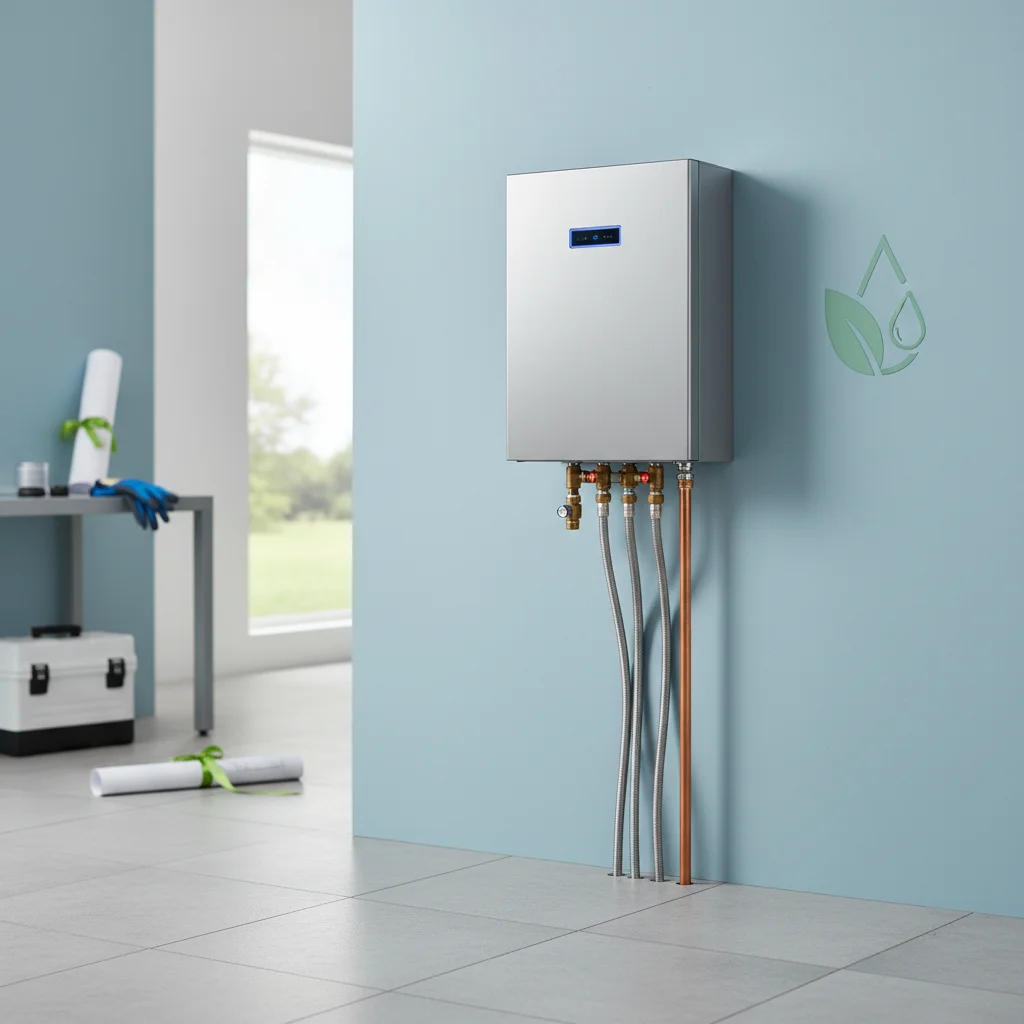
A conventional 50-gallon tank water heater loses $200–$400 per year to standby heat loss—energy spent keeping water hot even when you're not using it. And in 2026, federal tax credits now cover 30% of the cost to replace that inefficient tank with a heat pump water heater that uses 60% less energy and qualifies for rebates up to $1,750 under the Inflation Reduction Act.
What Water Heater Brands Qualify for Federal Tax Credits and Rebates?
The federal Residential Clean Energy Credit (Section 25D) ended for expenditures made after December 31, 2025, and the IRS treats an expenditure as made when installation is completed (IRS FS-2025-05). Federal tax credits for this work have ended, but state, local and utility rebates may still apply; check what is available at your address with the DuloCore rebate calculator. State-level rebates in California add $500–$1,750 through the Tech Clean California program for income-qualified homeowners.
But not all qualifying models offer the same performance. Rheem's ProTerra series delivers a UEF of 3.75—87% higher than the minimum—while A.O. Smith's Signature Premier models average 3.42. So homeowners installing the highest-efficiency qualifying models reduce annual water heating costs by $550 compared to conventional electric tanks, according to the U.S. Department of Energy.
"Heat pump water heaters use electricity to move heat from the surrounding air to the water in the tank, making them two to three times more energy efficient than conventional electric resistance water heaters." — ENERGY STAR
The stakes matter because water heating accounts for 18% of residential energy use nationwide. And the average American household spends $400–$600 annually on water heating alone. Installing a qualifying heat pump water heater cuts that expense by 60–75%, delivering $240–$450 in annual savings before factoring in federal credits or state rebates.
Check your local rebate calculator to see which brands qualify for combined federal and state incentives in your ZIP code.
How Long Does It Take to Recoup Your Water Heater Installation Investment?
Heat pump water heater installations cost $3,500–$5,500 after the 30% federal tax credit, and homeowners recoup the net expense in 4.2–6.8 years through reduced electricity bills, based on 2026 average residential electricity rates of $0.16 per kilowatt-hour. California homeowners who stack the federal credit with state rebates of $1,750 recover costs in 2.9–4.5 years.
And the payback period shortens in regions with higher electricity costs. Homeowners in Hawaii ($0.37/kWh) or Alaska ($0.23/kWh) recoup the investment in 2.1–3.4 years, while those in Louisiana ($0.12/kWh) see payback in 6.5–8.2 years.
| Location | Electricity Rate | Annual Savings | Payback Period (After Credits) |
|---|---|---|---|
| California | $0.24/kWh | $580 | 2.9–4.5 years |
| Hawaii | $0.37/kWh | $890 | 2.1–3.4 years |
| Louisiana | $0.12/kWh | $360 | 6.5–8.2 years |
So homeowners replacing a 12-year-old electric tank with a heat pump model save $7,200–$11,700 over the 15-year lifespan of the new unit, even after accounting for the higher upfront cost.
Solar water heaters deliver longer payback periods of 8–12 years due to higher installation costs of $8,000–$12,000, but they eliminate 70–90% of water heating costs in sunny climates. Explore energy tax credits to compare solar options.
Which Water Heater Type Works Best in Your Climate Zone?
Heat pump water heaters operate efficiently in climate zones with average basement or utility room temperatures of 40–90°F year-round, making them ideal for California's coastal regions, the Southeast, and the Mid-Atlantic. But performance drops 30–40% when ambient air temperatures fall below 40°F, limiting effectiveness in unheated basements in Minnesota, North Dakota, or Montana.
And tankless gas water heaters deliver consistent performance across all climate zones because they don't rely on ambient air temperature. Condensing tankless models achieve 95% thermal efficiency in climates ranging from Arizona's 110°F summers to Maine's subzero winters.
Solar water heaters excel in climate zones 1–3 (hot and warm regions) where annual solar insolation exceeds 5.0 kWh/m²/day. Homeowners in Phoenix, Las Vegas, and Southern California offset 80–95% of water heating costs with properly sized solar thermal systems. But in Seattle or Portland (3.0–3.5 kWh/m²/day), solar systems cover just 40–60% of demand, extending payback periods to 14–18 years.
California's varied climate zones create different optimal choices: heat pump models work well in coastal zones 3–6, tankless gas in mountain zones 14–16, and solar thermal in desert zones 10–15. Use the rebate calculator to compare climate-specific savings.
How Does a New Water Heater Compare to Tankless, Heat Pump, and Solar Alternatives?
Conventional 50-gallon electric tank water heaters cost $800–$1,200 installed and deliver a UEF of 0.90–0.95, consuming 4,500–5,200 kWh annually for a typical four-person household. Heat pump water heaters cost $3,500–$5,500 but reduce consumption to 1,800–2,100 kWh per year—a 60% improvement that saves $430–$545 annually at $0.16/kWh.
Tankless gas water heaters cost $2,500–$4,000 installed and achieve UEF ratings of 0.82–0.96, eliminating standby losses entirely. And they provide unlimited hot water for households with high simultaneous demand (multiple showers, dishwasher, and laundry running concurrently). But tankless electric models require 120–150 amp electrical service upgrades costing $1,500–$3,000 in older homes.
Solar water heaters cost $8,000–$12,000 installed and offset 50–90% of water heating energy depending on climate zone, but they require a backup electric or gas system for cloudy periods. And they deliver the longest payback periods of 8–15 years despite covering 30% of costs through federal credits.
| Type | Installed Cost | UEF | Annual Energy | Annual Cost | Lifespan |
|---|---|---|---|---|---|
| Conventional Electric | $800–$1,200 | 0.92 | 4,850 kWh | $776 | 10–12 years |
| Heat Pump | $3,500–$5,500 | 3.42 | 1,950 kWh | $312 | 13–15 years |
| Tankless Gas | $2,500–$4,000 | 0.91 | 210 therms | $294 | 18–20 years |
| Solar Thermal | $8,000–$12,000 | N/A | 400–1,200 kWh | $64–$192 | 20–25 years |
So homeowners prioritizing lowest operating cost choose heat pump or solar models, while those needing unlimited hot water on demand choose tankless gas. Review water heater rebates for cost breakdowns.
How Long Will Your Water Heater Last and What's the Expected Lifespan by Type?
Conventional tank water heaters last 10–12 years on average before the tank corrodes or the heating element fails, according to the National Association of Home Builders. Heat pump water heaters extend that to 13–15 years due to lower operating temperatures and reduced thermal stress on tank components.
And tankless water heaters deliver 18–20 years of service because they eliminate tank corrosion entirely—the primary failure mode in conventional models. Solar thermal collectors last 20–25 years, though pumps and controllers require replacement every 10–12 years.
But actual lifespan varies by water hardness, installation quality, and maintenance frequency. Homes with water hardness above 180 mg/L (grains per gallon > 10.5) experience 25–40% shorter tank life due to accelerated sediment buildup and anode rod depletion.
"Water heater life expectancy varies based on design, water quality, and maintenance. Tank water heaters typically last 10 to 15 years, while tankless water heaters can last 20 years or more." — U.S. Department of Energy
So homeowners in Phoenix (hardness 240 mg/L) replace conventional tanks every 8–9 years, while those in Seattle (hardness 40 mg/L) average 12–14 years. Installing a whole-house water softener adds $800–$1,500 upfront but extends tank life by 30–50%.
Compare lifespan costs across technologies using the rebate calculator to factor in replacement cycles over 20–30 years.
What Regular Maintenance Does Your Water Heater Need to Maximize Its Lifespan?
Tank water heaters require quarterly sediment flushing by draining 2–3 gallons from the tank bottom through the drain valve until water runs clear, preventing sediment buildup that reduces heating efficiency by 15–25% and accelerates tank corrosion. Annual anode rod inspection catches magnesium or aluminum rod depletion before tank corrosion begins—replacement costs $20–$50 but prevents $1,200–$1,800 tank replacement.
Heat pump water heaters add annual air filter cleaning or replacement ($0–$15) and biannual evaporator coil inspection to prevent dust buildup that reduces efficiency by 10–20%. And drain pan inspection every six months catches condensate leaks before water damage occurs.
Tankless water heaters need annual descaling with white vinegar or citric acid solution in regions with water hardness above 120 mg/L to prevent mineral buildup in heat exchanger tubes. Descaling costs $15–$25 for DIY or $150–$200 for professional service.
Solar water heaters require annual inspection of collector glazing for cracks, pump operation verification, and glycol concentration testing in closed-loop systems to prevent freeze damage. Professional maintenance costs $150–$250 annually but prevents $2,000–$4,000 collector or pump replacement.
Homeowners who skip maintenance see 20–35% shorter equipment life and 12–18% higher operating costs. Set quarterly and annual reminders to maintain eligibility for manufacturer warranties that require documented maintenance for coverage beyond the first year.
Official Sources
- ENERGY STAR Water Heaters — Federal certification standards and qualified product listings for tax credit eligibility (note: the federal 25C and 25D credits ended for projects completed after December 31, 2025)
- U.S. Department of Energy: Water Heating — Comprehensive guidance on water heater types, efficiency ratings, and energy savings calculations
- Database of State Incentives for Renewables & Efficiency (DSIRE) — Complete database of state, local, and utility rebate programs updated for 2026
Related Reading: Learn more about Property Manager Energy Audit Guide and Renewable Energy Home Integration Guide.
Related Reading: Learn more about Water Heater Expansion Tank Guide.
Frequently Asked Questions
What qualifies as a water heater installation for rebate eligibility?
The federal Energy Efficient Home Improvement Credit (Section 25C) ended for property placed in service after December 31, 2025 (IRS FS-2025-05). State rebates require income verification and approved contractor installation in most programs. And the unit replaces an existing electric or gas water heater in an existing home—new construction installations don't qualify for most state programs.
How much can you save with a water heater installation rebate?
Federal tax credits cover 30% of equipment and installation costs with no dollar cap on the credit amount, though heat pump water heaters typically cost $3,500–$5,500, yielding $1,050–$1,650 in federal credits. California's Tech Clean California program adds $500–$1,750 in point-of-sale rebates for income-qualified households. And utility rebates from PG&E, SCE, and SDG&E add $100–$500 depending on service territory and equipment efficiency tier.
What is the process for claiming a water heater installation rebate?
Form 5695 only covers qualifying work completed by December 31, 2025 and claimed on a 2025 return; the federal 25C and 25D credits ended after that date (IRS FS-2025-05). State rebates require pre-approval or reservation through program portals before installation begins. And contractors submit final paperwork and inspection photos within 30–90 days of installation to trigger rebate payment, which arrives 6–12 weeks later via check or direct deposit.
Are there any deadlines for submitting water heater installation rebate applications?
The federal Energy Efficient Home Improvement Credit (Section 25C) ended for property placed in service after December 31, 2025 (IRS FS-2025-05). California state rebates operate on annual budget cycles that exhaust funds by mid-year in high-demand regions—2026 allocations depleted in March in Los Angeles County. And utility rebates accept applications year-round until annual budgets exhaust, typically in August–October.
What is the difference between tank and tankless water heater rebates?
Tank-style heat pump water heaters qualify for the 30% federal credit (this federal credit ended for property placed in service after December 31, 2025) and most state rebates because they carry ENERGY STAR certification and exceed UEF thresholds of 2.0–3.75. Tankless gas water heaters qualify for federal credits if they achieve UEF ratings of 0.95 or higher, but most state programs exclude them because they don't reduce electricity demand during peak hours. And tankless electric models qualify for credits but require costly electrical service upgrades that aren't covered by rebates.
Ready to find your water heater rebates? Use our free rebate calculator to discover federal credits, state rebates, and utility incentives available in your ZIP code. Calculate your savings and payback period in under 60 seconds.
Updated on April 14, 2026. Fact-checked by DuloCore Editors. About our research team.
Check your California water heater rebate eligibility — see the programs you qualify for and the dollar amounts on our California water heater rebate finder.