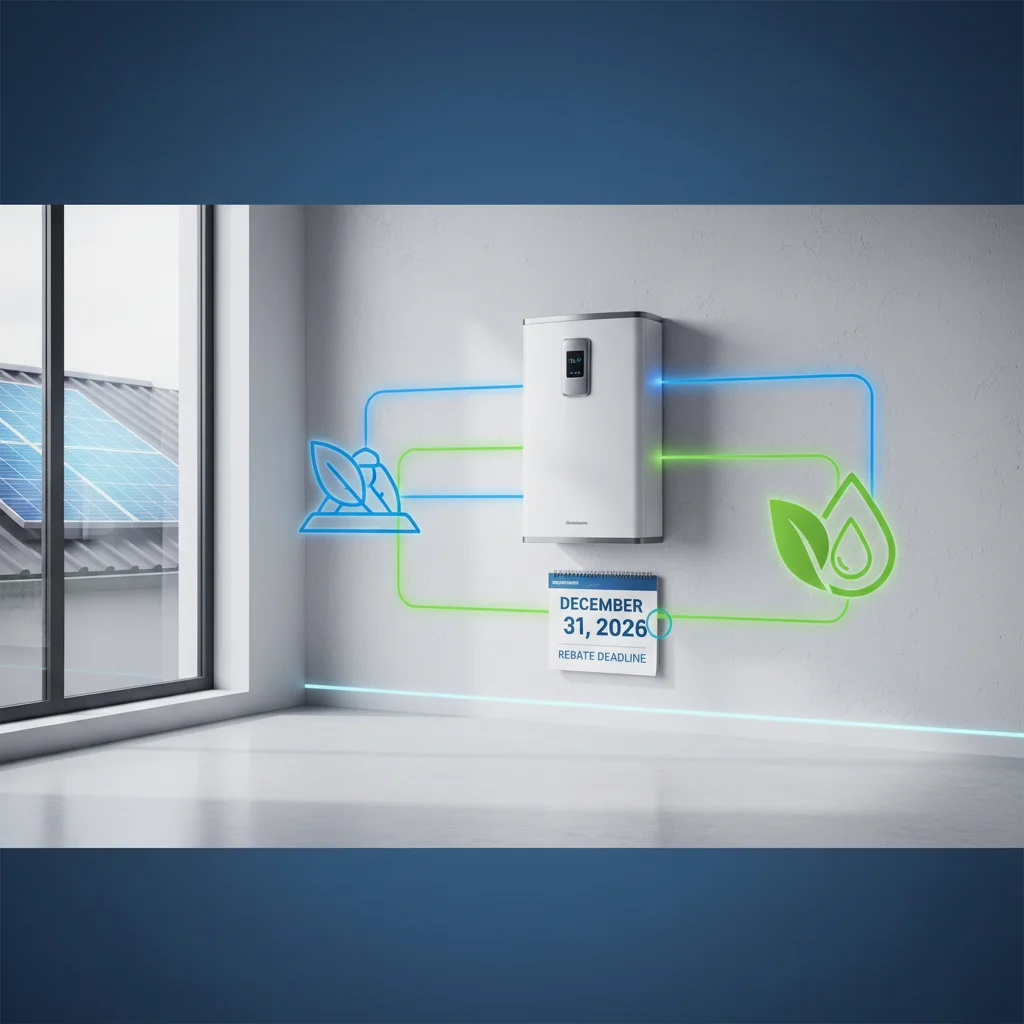
Over $4.3 billion in federal water heater rebates will expire unspent by December 31, 2026 if homeowners don't act fast. And that's just the federal programs—state and utility deadlines arrive even sooner, with California's TECH Clean program ending September 30, 2026 for applications submitted without pre-approval.
Can You Stack Water Heater Rebates in 2026?
Answer Capsule: Federal IRA tax credits, state energy efficiency rebates, and local utility incentives can be stacked together in 2026, allowing homeowners to combine up to three separate programs for heat pump water heaters. Total combined rebates reach $6,000-$8,500 in high-incentive states through December 2026.
Homeowners in 2026 combine federal Energy Efficient Home Improvement Credits with state programs like California's TECH Clean rebates and utility company efficiency incentives. But stacking works only when programs originate from different funding sources—federal, state, and local utility budgets. The IRS allows taxpayers to claim the 30% federal credit on top of state rebates without reduction, unlike earlier tax credit structures that required rebate deductions.
And the mechanics matter. Utility rebates process first as instant point-of-sale discounts, reducing the purchase price from $2,500 to $1,500. State rebates follow within 6-8 weeks after installation verification. Federal tax credits arrive 12-18 months later during tax filing season. So a $3,200 heat pump water heater triggers three separate payments across 18 months.
What Are the Stacking Rules for Federal and State Rebates?
Answer Capsule: Federal IRA credits apply to equipment costs after manufacturer rebates but before state or utility incentives, while state programs calculate rebate amounts using pre-tax retail prices. Stacking follows a specific processing sequence: utility point-of-sale discounts, state rebates within 60 days, then federal credits at tax time in 2027.
The sequencing determines total savings. Utility companies deduct rebates at checkout, lowering the actual price paid. State programs like California's TECH Clean don't reduce federal credit eligibility—the IRS calculates the 30% credit using the original equipment cost, not the discounted price. So a $3,200 water heater with an $800 utility rebate still qualifies for a $960 federal credit (30% of $3,200), not $720 (30% of $2,400).
But manufacturer rebates work differently. The IRS requires taxpayers to subtract manufacturer cash-back offers before calculating the federal credit percentage. A $500 manufacturer rebate on that same $3,200 unit drops the eligible cost to $2,700, reducing the federal credit to $810. Manufacturer financing promotions don't count as rebates—zero-interest payment plans don't affect credit calculations.
Or homeowners skip state programs entirely and stack only federal credits with utility rebates. This approach works in states with weak rebate programs or restrictive income limits. The federal Energy Efficient Home Improvement Credit (Section 25C) ended for property placed in service after December 31, 2025 (IRS FS-2025-05). Programs like California's TECH Clean reserve higher rebates for households under 80% area median income.
How Much Can You Save by Combining Multiple Rebate Programs?
Answer Capsule: Combined federal, state, and utility incentives reduce heat pump water heater costs by $4,200-$8,500 in 2026 depending on household income and location. Low-income households in California save $8,500 through stacked programs, while middle-income homeowners nationwide average $4,200-$5,800 in total rebates.
California homeowners earning under 80% area median income stack three programs for maximum savings. A $3,500 Rheem heat pump water heater triggers a $4,000 TECH Clean rebate, a $500 utility incentive from PG&E, and a $1,050 federal tax credit—total value $5,550, exceeding the equipment cost by $2,050. And contractors apply the rebates to cover installation labor, reducing out-of-pocket costs to zero.
But middle-income households face lower rebate caps. The same installation in Nevada yields a $1,050 federal credit and a $300 utility rebate from NV Energy, totaling $1,350 against a $4,200 installed cost. Stacking rules don't change, but program availability shrinks outside high-incentive states.
So geography drives total savings more than stacking strategy. Homeowners in the Northeast save $3,800-$5,200 through programs like Massachusetts Clean Energy Center rebates ($1,500) plus federal credits ($1,050) plus utility incentives ($500-$1,200). Southern states without robust state programs deliver $1,050-$2,000 total, relying almost entirely on federal credits and modest utility rebates.
Use our free rebate calculator to model stacking scenarios for your ZIP code and income level.
Which Water Heater Rebates Can Be Stacked Together?
Answer Capsule: Homeowners stack federal IRA tax credits with state energy office rebates and local utility efficiency programs simultaneously in 2026. Prohibited stacking includes combining multiple federal programs or claiming two state rebates for one installation.
The 30% Energy Efficient Home Improvement Credit combines with California TECH Clean, Oregon Heat Pump Water Heater rebates, or New York Clean Heat programs without conflicts. The federal home energy tax credits (Sections 25C and 25D) ended for projects completed after December 31, 2025 (IRS FS-2025-05). Federal tax credits for this work have ended, but state, local and utility rebates may still apply; check what is available at your address with the DuloCore rebate calculator.
State programs prohibit overlap within the same funding source. California bars combining TECH Clean with SGIP rebates for water heaters, though both programs fund different equipment types. And utility programs from the same company don't stack—PG&E customers can't claim both the Energy Upgrade California rebate and the PG&E Direct Install incentive for one water heater.
Or low-income households access specialized stacking. The High-Efficiency Electric Home Rebate Act (HEEHRA) programs launching in 2026 provide point-of-sale discounts up to $1,750 for heat pump water heaters. These stack with utility rebates but replace federal tax credits for households under 150% federal poverty level—tax credits offer no value to families with zero tax liability.
Check DSIRE to verify which programs stack in your state. And confirm stacking rules with program administrators before purchase—policies change mid-year as funding depletes.
What's the Deadline to Apply for Water Heater Rebates in 2026?
Answer Capsule: Federal IRA tax credits accept claims through December 31, 2032, but state and utility rebate deadlines range from June 30, 2026 to December 31, 2026. California's TECH Clean program ends September 30, 2026 for standard applications, while utility programs operate on first-come funding exhaustion.
California homeowners face the tightest deadline. TECH Clean requires applications by September 30, 2026 for installations completed between January 1, 2026 and November 30, 2026. Pre-reserved applications extend through November 30, 2026, but reservation slots fill by July 2026 based on current claim rates. And late applications forfeit $500-$1,000 in rebate value compared to early submissions.
Federal deadlines offer more flexibility. The IRS accepts 2026 installations on tax returns filed through April 15, 2027, with extensions to October 15, 2027. The federal Energy Efficient Home Improvement Credit (Section 25C) ended for property placed in service after December 31, 2025 (IRS FS-2025-05). So 2026 installations claim credits on 2026 tax returns filed in early 2027.
Utility programs run until funds exhaust. PG&E's 2026 water heater rebate budget depletes by August 2026 based on 2025 claim velocity. Southern California Edison extends through November 2026 with a waitlist system. Or homeowners in rural electric cooperative territories face no deadline—co-op programs refresh annually with consistent funding through 2030.
"State energy office rebate programs typically exhaust annual funding allocations 4-6 months before the calendar year ends during high-demand periods." — U.S. Department of Energy State Programs
How Do Stacking Rules Affect Your Total Rebate Amount?
Answer Capsule: Stacking rules reduce total rebate amounts by 15-25% when state programs cap combined incentives or require federal credit deductions. California caps total rebates at equipment cost, while Oregon reduces state rebates by 50% of federal credit value for high-income households.
California's TECH Clean program enforces a total incentive cap equal to equipment purchase price plus installation costs. A $3,200 water heater with $1,200 installation can't receive more than $4,400 in combined rebates. So homeowners qualifying for a $4,000 TECH rebate, $1,050 federal credit, and $500 utility incentive face a $1,150 reduction in the federal credit to stay under the cap. The IRS pro-rates the credit to fit within state limits.
But most states don't cap total incentives. Nevada, Arizona, and Texas allow full stacking without reductions. A $5,500 installed cost generates $1,050 federal + $800 state + $400 utility = $2,250 total, saving 41% without penalties. And these states process rebates independently—federal credits arrive at full value regardless of state rebate size.
Oregon implements a sliding reduction. Households earning over 100% area median income lose 50% of their state rebate value when claiming federal credits. A $1,500 Oregon rebate drops to $750 if the homeowner also claims the $1,050 federal credit. Low-income households under 80% AMI stack both programs at full value with no reduction.
So stacking strategy depends on state policy. Homeowners in cap states maximize utility rebates first (non-reducible), then state programs (sometimes reducible), then federal credits (always apply last). Homeowners in no-cap states claim all three programs simultaneously without optimization.
Link to energy tax credits for broader IRA credit stacking rules across heat pumps, insulation, and electrical upgrades.
Official Sources
- IRS Energy Incentives for Individuals — Federal tax credit eligibility and calculation rules for energy-efficient home improvements (note: the federal 25C and 25D credits ended for projects completed after December 31, 2025)
- DSIRE Database — Comprehensive state, local, and utility rebate program database with current incentive amounts and deadlines
- U.S. Department of Energy Save — Federal guidance on energy efficiency rebates, tax credits, and home upgrade programs (note: the federal 25C and 25D credits ended for projects completed after December 31, 2025)
Related Reading: Learn more about Tankless Water Heater Rebate and Water Heater Rebate Program.
Frequently Asked Questions
What is the water heater rebate deadline for 2026?
Federal IRA tax credits accept 2026 installations through tax filing deadlines in April 2027, while state programs like California TECH Clean end September 30, 2026. Utility rebates expire when annual funding depletes, typically 4-8 months before year-end. Oregon and Washington programs extend through December 31, 2026 with waitlist systems after September. And pre-approval applications must submit 30-45 days before installation to meet processing deadlines.
Are water heater rebates still available in 2026?
The federal Energy Efficient Home Improvement Credit (Section 25C) ended for property placed in service after December 31, 2025 (IRS FS-2025-05). State programs remain active in 23 states with funding through late 2026, though California and Oregon programs close to new applications by September 30, 2026. Utility rebates operate in 41 states with funding lasting 6-10 months into 2026. Check DSIRE for current program status in your state.
How much can you get back from a water heater rebate?
Combined federal, state, and utility rebates return $1,050-$8,500 depending on household income and location in 2026. Low-income California households receive up to $4,000 from TECH Clean plus $1,050 federal credit plus $500-$1,000 utility incentives. Middle-income homeowners nationwide average $1,350-$2,800 from federal credits ($1,050) and utility programs ($300-$1,750). And HEEHRA point-of-sale rebates launching mid-2026 add $1,750 for qualifying low-income households, replacing federal credits.
Do I qualify for the water heater tax credit in 2026?
Homeowners installing ENERGY STAR certified heat pump water heaters with Uniform Energy Factor ≥2.0 qualify for the federal 30% tax credit (this federal credit ended for property placed in service after December 31, 2025) in 2026, capped at $2,000 per household. The credit requires sufficient tax liability—homeowners owing less than $2,000 in federal taxes receive partial credits up to their tax bill. No income limits apply to federal credits, unlike state rebates which restrict higher rebates to households under 80-150% area median income. And rental properties don't qualify—credits apply only to primary residences.
What's the difference between a water heater rebate and tax credit?
Rebates provide upfront discounts or post-installation checks within 30-90 days, reducing out-of-pocket costs immediately, while tax credits lower federal income tax owed 12-18 months later when filing returns. State and utility programs issue rebates as direct payments or point-of-sale reductions, requiring no tax liability. Federal tax credits require homeowners to owe taxes—families with zero tax bills receive no credit value. And rebates often carry income restrictions (California caps at 80% AMI for maximum rebates). The federal Energy Efficient Home Improvement Credit (Section 25C) ended for property placed in service after December 31, 2025 (IRS FS-2025-05).
Ready to maximize your water heater rebate savings? Use our rebate calculator to find every federal, state, and utility incentive you qualify for in 2026. Enter your ZIP code and income to see exact rebate amounts and application deadlines for your area—calculate your total savings in under 60 seconds.
Updated: April 14, 2026 — fact-checked by DuloCore Research. About our editorial process.
Check your California water heater rebate eligibility — see the programs you qualify for and the dollar amounts on our California water heater rebate finder.