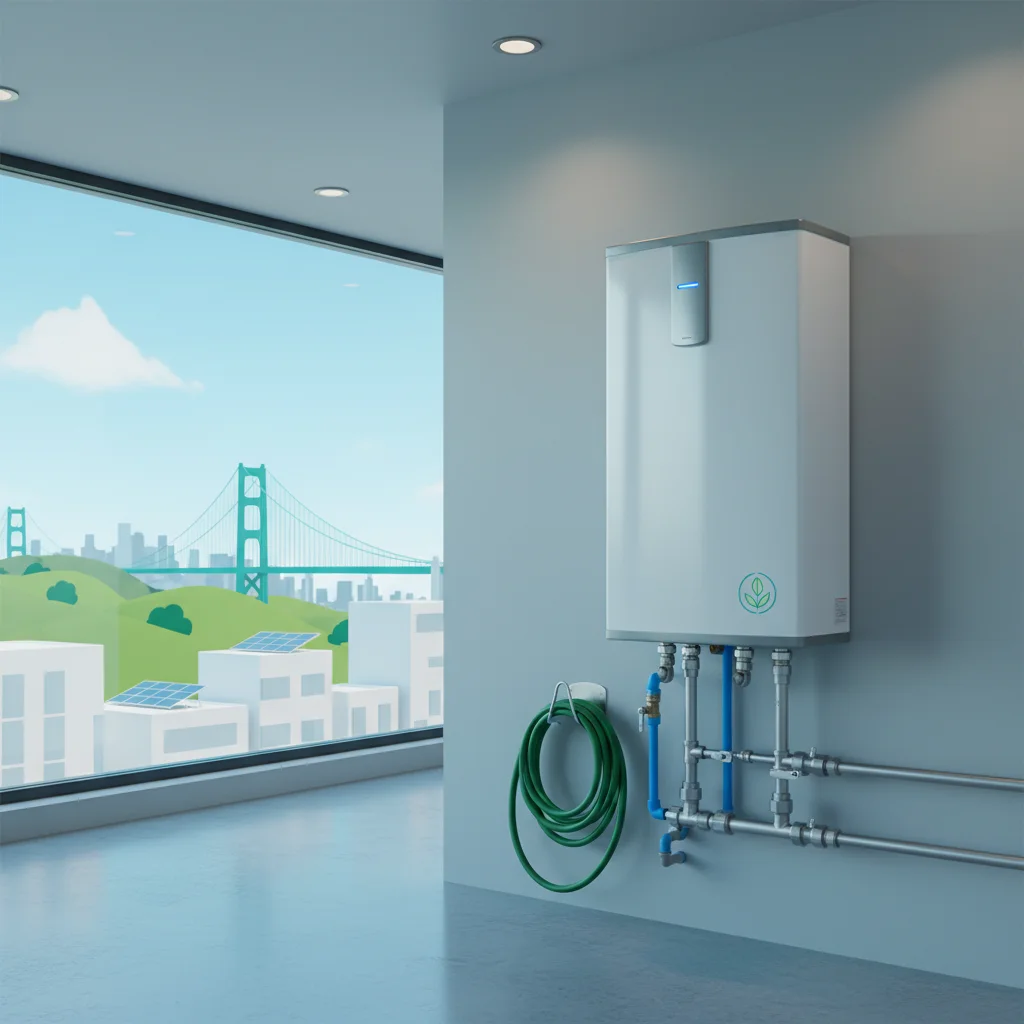
Bay Area homeowners replaced more than 47,000 water heaters in 2025, and nearly 68% left thousands of dollars in rebate money unclaimed. With 2026 programs now live and funding allocated, residents who upgrade to heat pump water heaters can stack federal tax credits, utility rebates, and state incentives to cut purchase and installation costs by $3,000 to $6,200. But program budgets deplete within months, and pre-approval requirements vary by utility district—missing a single deadline can disqualify your application entirely.
What Water Heater Rebates Are Available in the Bay Area Right Now?
Bay Area water heater rebates in 2026 include federal tax credits worth 30% of installation costs up to $2,000, PG&E rebates from $800 to $3,000 for heat pump water heaters, and Bay Area Air Quality Management District incentives up to $1,200 for low-income households replacing gas units with electric models.
PG&E's Energy Efficiency Rebate Program offers tiered incentives based on heat pump water heater capacity and ENERGY STAR certification. The federal Energy Efficient Home Improvement Credit (Section 25C) ended for property placed in service after December 31, 2025 (IRS FS-2025-05). Federal tax credits for this work have ended, but state, local and utility rebates may still apply; check what is available at your address with the DuloCore rebate calculator. So households earning below 80% of area median income can access enhanced rebates through the state's Equitable Building Decarbonization program, which adds $500 to $1,500 on top of standard utility rebates. (Note: Federal tax credit percentages and availability are subject to change; the 30% Residential Clean Energy Credit under Section 25D expired December 31, 2025. Verify current incentives at energy.gov.)
The energy tax credits framework covers water heaters meeting minimum Uniform Energy Factor thresholds—2.0 or higher for 50-gallon models. But gas water heater replacements don't qualify for federal credits unless the new unit is an electric heat pump model. Check your rebate calculator eligibility before purchasing equipment to confirm which programs apply to your home's specific configuration.
"Heat pump water heaters that meet ENERGY STAR Most Efficient criteria can reduce water heating costs by 50% compared to standard electric resistance models." — ENERGY STAR
How Much Money Can You Save with Bay Area Water Heater Rebates?
Bay Area homeowners save $3,000 to $6,200 combining federal tax credits, utility rebates, and state incentives when replacing gas water heaters with heat pump models in 2026, reducing total installation costs from $4,500–$7,000 to $1,300–$3,800 after all rebates.
The federal Energy Efficient Home Improvement Credit (Section 25C) ended for property placed in service after December 31, 2025 (IRS FS-2025-05). PG&E's standard rebate for a 50-gallon ENERGY STAR certified heat pump water heater is $800, rising to $3,000 for income-qualified households. And the Bay Area Air Quality Management District adds $1,200 for gas-to-electric conversions in low-income census tracts. So a qualifying household in Oakland could receive $2,000 federal credit, $3,000 PG&E rebate, and $1,200 air quality incentive—$6,200 total.
Annual energy savings add another $300 to $550 per year. Heat pump water heaters cost $0.14 per gallon to heat compared to $0.31 for natural gas units in the Bay Area as of March 2026 rates. Over a 12-year lifespan, that's $3,600 to $6,600 in avoided utility bills beyond the upfront rebate value.
What's the Step-by-Step Application Process for Getting Your Rebate?
Bay Area water heater rebate applications require submitting pre-approval forms to your utility provider before purchase, uploading invoices and certifications within 60 days of installation, and filing federal tax credit Form 5695 with your annual IRS return to claim the 30% equipment credit.
PG&E requires pre-approval for rebates exceeding $500. Log into your online account, complete the Energy Efficiency Rebate Application, and receive confirmation within 5 to 7 business days. And contractors must be on PG&E's approved installer list for rebates above $1,000—verify credentials before signing contracts. Purchase and install your heat pump water heater only after receiving pre-approval to avoid disqualification.
After installation, upload the final invoice, manufacturer's spec sheet showing Uniform Energy Factor rating, and proof of ENERGY STAR certification to the PG&E rebate portal. But submissions received after the 60-day post-installation window are automatically rejected. Rebate checks arrive 6 to 10 weeks after document approval. Form 5695 only covers qualifying work completed by December 31, 2025 and claimed on a 2025 return; the federal 25C and 25D credits ended after that date (IRS FS-2025-05).
Income-qualified households applying for enhanced rebates must submit additional documentation proving household income below 80% of area median income, typically verified through tax returns or pay stubs from the previous 12 months.
What Documentation Do You Need to Apply for a Water Heater Rebate?
Bay Area water heater rebate applications require itemized contractor invoices showing equipment model numbers and labor costs, manufacturer spec sheets documenting Uniform Energy Factor ratings of 2.0 or higher, ENERGY STAR certification proof, and installation photos showing permit inspection approval for 2026 program compliance.
PG&E's rebate portal requires uploading a PDF invoice that separately itemizes equipment cost and installation labor. And the invoice must include the contractor's license number, business name, and contact information. Federal tax credits require manufacturer documentation proving the heat pump water heater meets Energy Star Most Efficient criteria—this spec sheet must show the UEF rating and be dated within 12 months of installation.
Income-qualified applicants need additional proof: most recent federal tax return, two consecutive pay stubs, or California Alternative Rates for Energy verification letter. But self-employed applicants can substitute Schedule C forms or audited profit-and-loss statements. Installation photos must show the new unit's serial number plate, electrical connections, and local building permit inspection sticker clearly visible.
Missing any single required document delays processing by 3 to 6 weeks or triggers automatic application rejection. Check out the complete water heater rebates requirements list before starting your application to ensure you collect all necessary paperwork during installation.
Do You Need Pre-Approval Before Purchasing Your New Water Heater?
Bay Area water heater rebate pre-approval is required by PG&E for all rebates exceeding $500, must be secured 5 to 15 business days before equipment purchase, and locks in 2026 program funding that otherwise operates on a first-come, first-served basis with budgets depleting by July in prior years.
PG&E's online pre-approval form asks for home address, existing water heater fuel type, planned replacement model number, and estimated installation date. And approval confirms your project qualifies and reserves rebate funding under your account. Applications submitted without pre-approval are rejected even if equipment meets all technical requirements—no exceptions.
The federal tax credit doesn't require pre-approval. But claiming the credit before equipment is installed and placed in service triggers IRS audits and potential credit recapture. Form 5695 only covers qualifying work completed by December 31, 2025 and claimed on a 2025 return; the federal 25C and 25D credits ended after that date (IRS FS-2025-05). Income-qualified programs through the Bay Area Air Quality Management District do require pre-approval with income verification completed before purchase—processing takes 10 to 20 business days.
Skip pre-approval and you forfeit thousands in rebate funding. The 2025 program year saw $4.7 million in PG&E heat pump water heater rebates fully claimed by September, leaving later applicants on waitlists until 2026 budgets opened.
What Are the Deadlines and Funding Status for 2026 Rebate Programs?
Bay Area water heater rebate programs in 2026 operate with rolling deadlines tied to fund depletion rather than calendar cutoffs, with PG&E allocating $18.3 million expected to exhaust by August 2026 based on 2025 claim velocity. The federal Energy Efficient Home Improvement Credit (Section 25C) ended for property placed in service after December 31, 2025 (IRS FS-2025-05).
PG&E's 2026 rebate budget opened January 2 and processes applications on a first-come, first-served basis. And historical data shows standard rebate funds deplete 6 to 8 months into the calendar year, while income-qualified enhanced rebates last through November due to smaller applicant pools. The Bay Area Air Quality Management District allocated $3.2 million for gas-to-electric water heater conversions in 2026, typically exhausted by late June.
Federal tax credits under the Inflation Reduction Act have no annual budget limits—all qualifying installations receive the 30% credit regardless of how many households claim it. But the credit percentage drops to 26% starting January 1, 2033, and phases out entirely after 2034. So installing in 2026 maximizes the credit value compared to waiting.
Submit applications between January and May to secure rebate funding before depletion. Use our rebate calculator to estimate your total savings and identify which programs still have active funding as the year progresses.
Can You Stack Multiple Rebates to Maximize Your Savings?
Bay Area homeowners can stack federal tax credits, PG&E utility rebates, and Bay Area Air Quality Management District incentives in 2026 to combine $3,000 to $6,200 in total rebates for heat pump water heater installations, with no IRS or utility restrictions prohibiting simultaneous program participation.
The federal 30% tax credit (this federal credit ended for property placed in service after December 31, 2025) applies to total equipment and installation costs before utility rebates are deducted. And PG&E rebates don't reduce the federal credit amount—you claim the full installation cost on Form 5695. The Bay Area Air Quality Management District incentive stacks on top of both without conflicts. So a $5,000 installation receives $1,500 federal credit (30% of $5,000), $3,000 PG&E rebate for income-qualified households, and $1,200 air quality incentive—$5,700 total, exceeding the original installation cost.
State and local programs prohibit stacking when funds come from the same originating budget line. But federal, utility, and air quality programs draw from separate funding sources. Income-qualified enhanced rebates replace standard utility rebates—you can't claim both the $800 standard PG&E rebate and the $3,000 income-qualified rebate simultaneously. Check with your contractor about additional municipal rebates in cities like San Francisco or Berkeley that offer supplemental incentives beyond county and state programs.
Similar stacking opportunities exist for other home upgrades—review heat pump rebates to see how HVAC replacements can combine multiple funding sources for even larger savings.
Official Sources
- ENERGY STAR Water Heaters — Federal efficiency standards and certified product directory for rebate-eligible models
- IRS Energy Incentives for Individuals — Official tax credit guidance, Form 5695 instructions, and qualifying equipment requirements (note: the federal 25C and 25D credits ended for projects completed after December 31, 2025)
- DSIRE USA - California — Comprehensive database of state, local, and utility energy incentive programs with current program status
Frequently Asked Questions
What water heater rebates are available in the Bay Area?
Bay Area water heater rebates in 2026 include a 30% federal tax credit up to $2,000, PG&E rebates from $800 to $3,000 based on income qualification, and Bay Area Air Quality Management District incentives up to $1,200 for gas-to-electric conversions. All programs require heat pump water heaters with Uniform Energy Factor ratings of 2.0 or higher and ENERGY STAR certification.
How much can I save with a water heater rebate in the Bay Area?
Bay Area homeowners save $3,000 to $6,200 combining all available rebates when replacing gas water heaters with heat pump models in 2026. Federal tax credits provide $1,500 to $2,000, PG&E offers $800 to $3,000, and air quality incentives add up to $1,200. Annual energy bill reductions add $300 to $550 per year over the unit's lifespan.
Am I eligible for a Bay Area water heater rebate?
Eligibility requires owning a home serviced by PG&E, replacing an existing water heater with an ENERGY STAR certified heat pump model rated 2.0 UEF or higher, and using licensed contractors for installation. Income-qualified households earning below 80% of area median income access enhanced rebates.
What is the deadline for Bay Area water heater rebates?
Bay Area water heater rebates operate on rolling deadlines based on fund depletion rather than calendar dates. PG&E's 2026 allocation of $18.3 million typically exhausts by August based on prior year claim velocity. The federal Energy Efficient Home Improvement Credit (Section 25C) ended for property placed in service after December 31, 2025 (IRS FS-2025-05). Submit applications between January and May to maximize funding availability.
How do I apply for a water heater rebate in the Bay Area?
Apply by submitting a pre-approval form through PG&E's online portal 5 to 15 days before purchase, installing the heat pump water heater using an approved contractor, and uploading invoices, spec sheets, and installation photos within 60 days of completion. Form 5695 only covers qualifying work completed by December 31, 2025 and claimed on a 2025 return; the federal 25C and 25D credits ended after that date (IRS FS-2025-05). Income-qualified applicants must also submit proof of household income below 80% area median.
Ready to find your exact rebate amount? Use our free rebate calculator to see how much you can save on a heat pump water heater installation in your Bay Area zip code. Get personalized estimates combining federal, utility, and local incentives in under 60 seconds—no signup required.
Updated: April 14, 2026 — fact-checked by DuloCore Research. About our editorial process.
Check your California water heater rebate eligibility — see the programs you qualify for and the dollar amounts on our California water heater rebate finder.