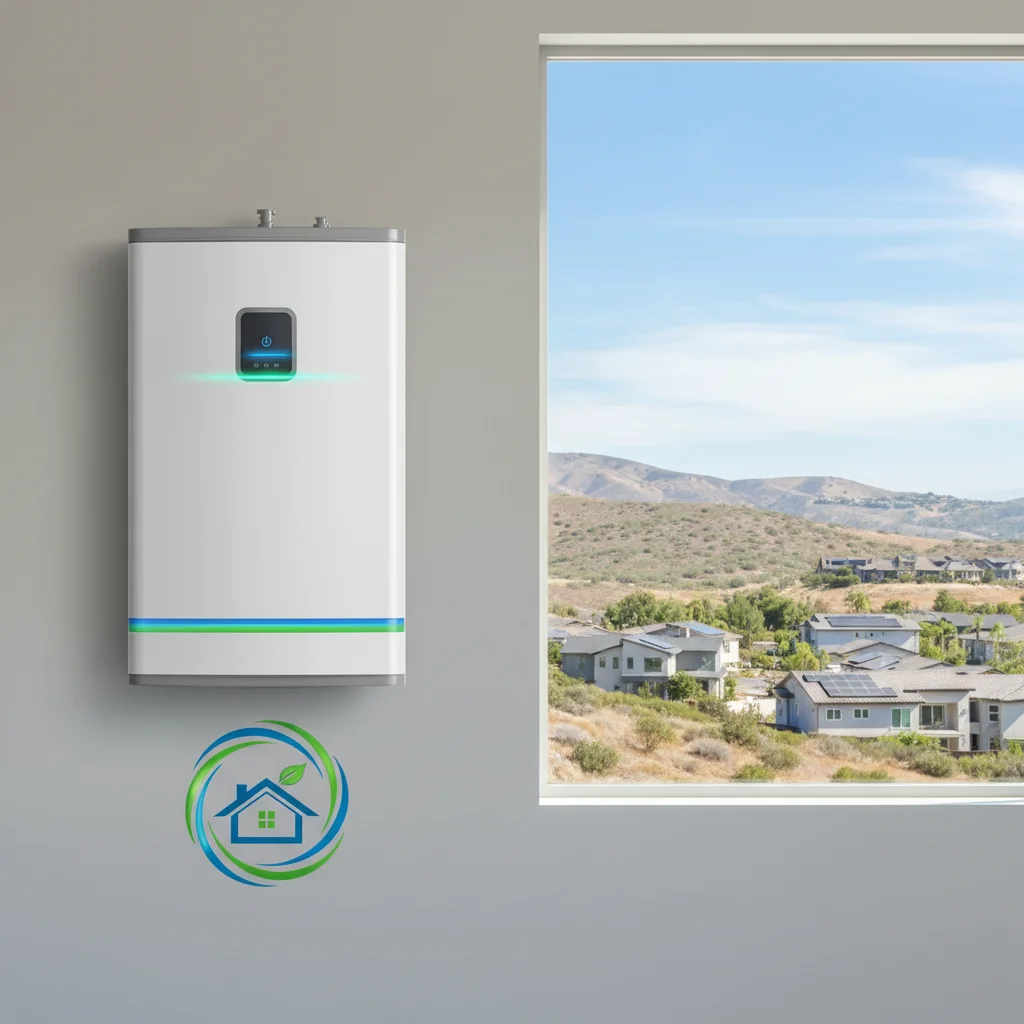
Homeowners replacing a standard water heater with a heat pump model in the Inland Empire can stack up to $10,000 in rebates from federal, state, and utility programs in 2026. And that's before factoring in the 30% federal tax credit that brings the total savings to $15,000 or more on a qualifying installation. But most residents don't know these programs exist—or that the application windows close as early as June 30, 2026 for some utility incentives.
What Water Heater Rebates Are Available in the Inland Empire Right Now?
Inland Empire residents in 2026 access three rebate tiers: the federal Home Electrification and Appliance Rebates (HEAR) program providing up to $1,750 for heat pump water heaters, Southern California Edison's $3,000 Energy Upgrade California incentive, and the federal 30% tax credit covering installation costs through 2032 under the Inflation Reduction Act.
Southern California Edison serves most of the Inland Empire and offers the highest utility rebate in California at $3,000 for qualifying heat pump water heater installations. The HEAR program launched in January 2026 and provides $1,750 for households earning up to 150% of area median income—roughly $150,000 for a family of four in Riverside County. So a moderate-income household replacing a gas water heater with an 80-gallon heat pump model can claim $4,750 in direct rebates before claiming the 30% federal tax credit on remaining costs.
And the Inland Empire benefits from additional rebates through municipal water districts. The Metropolitan Water District of Southern California offers up to $400 for high-efficiency models that reduce hot water consumption. But these water conservation rebates can't be stacked with energy-focused incentives from Edison—homeowners choose the higher value program.
"Heat pump water heaters can save a household more than $550 per year on electric bills compared to standard electric resistance water heaters." — U.S. Department of Energy
How Much Money Can You Save with Water Heater Rebates in 2026?
Total savings from Inland Empire water heater rebates reach $15,200 for a qualifying installation: $3,000 from Southern California Edison, $1,750 from HEAR, and $3,450 in federal tax credits on a $11,500 installation (30% of cost after rebates). Operating cost reductions add $550 annually compared to electric resistance models and $300 versus gas heaters.
The math works like this for a household earning $120,000 annually in Riverside: a Rheem 80-gallon heat pump water heater costs $3,200 for the unit plus $8,300 for installation, totaling $11,500. Edison's $3,000 rebate and the $1,750 HEAR rebate drop the upfront cost to $6,750. The federal Energy Efficient Home Improvement Credit (Section 25C) ended for property placed in service after December 31, 2025 (IRS FS-2025-05). Federal tax credits for this work have ended, but state, local and utility rebates may still apply; check what is available at your address with the DuloCore rebate calculator. Net cost after all incentives: $3,300 for a system that saves $550 per year on electricity.
And payback happens in six years—but the system lasts 15 years. So lifetime savings total $8,250 in energy costs plus the $8,200 in rebates and credits, for a total $16,450 benefit on a $3,300 net investment. But households earning under 80% of area median income ($80,000 for a family of four) can access higher HEAR rebates—up to $4,000 instead of $1,750—pushing total incentives past $10,000.
Use our free rebate calculator to find your exact savings based on your income and current water heater type.
What Are the Eligibility Requirements for Inland Empire Water Heater Rebates?
Southern California Edison's $3,000 rebate requires installation of an ENERGY STAR-certified heat pump water heater with a Uniform Energy Factor (UEF) of 3.3 or higher by a licensed contractor in Edison's service territory. HEAR rebates require household income verification at or below 150% area median income and installation of ENERGY STAR Most Efficient models.
Edison verifies eligibility through three checkpoints: the water heater must appear on the ENERGY STAR certified product list, installation requires a California C-36 plumbing contractor license, and the home must be in Edison's coverage area (which includes Riverside, San Bernardino, and portions of San Diego County). And the program requires pre-approval—homeowners submit a reservation form before purchasing equipment.
HEAR rebates add income documentation requirements. Households submit tax returns or paystubs proving income falls below the threshold: $150,000 for a four-person household in Riverside County, $140,000 in San Bernardino County. So a household earning $145,000 qualifies in Riverside but not in San Bernardino—and the program uses 2024 tax returns to verify 2026 eligibility.
But the federal 30% tax credit (this federal credit ended for property placed in service after December 31, 2025) has no income limits. Form 5695 only covers qualifying work completed by December 31, 2025 and claimed on a 2025 return; the federal 25C and 25D credits ended after that date (IRS FS-2025-05). Or renters installing qualified equipment in a home they own as a second property also qualify—the credit follows the taxpayer, not the residence type.
The federal Residential Clean Energy Credit (Section 25D) ended for expenditures made after December 31, 2025, and the IRS treats an expenditure as made when installation is completed (IRS FS-2025-05).
What's the Deadline to Apply for Water Heater Rebates in Your Area?
Southern California Edison's 2026 rebate program operates on a first-come, first-served basis with funding expected to exhaust by June 30, 2026 based on current application rates. HEAR rebates run through December 31, 2031 but California's allocation serves approximately 180,000 households statewide—Inland Empire allocation projects depletion by early 2027.
Edison launched the 2026 cycle on January 15, 2026 with $47 million in funding. At current application rates of 450 rebates per week, the program reaches capacity in 23 weeks—around June 30, 2026. So homeowners planning a water heater replacement should submit pre-approval forms by April 30, 2026 to secure a reservation before funds run out. And once a reservation is approved, installation must occur within 180 days or the reservation expires.
HEAR operates differently—California received $194 million in federal funding to distribute through 2031, but demand models project depletion by March 2027. The state allocates funds by county based on population and income demographics, with Riverside County receiving $12.3 million and San Bernardino County receiving $10.8 million. But these allocations serve 28,000 Riverside households and 22,000 San Bernardino households—meaning the program closes when county-specific funding depletes, not when the statewide pot runs dry.
The federal Energy Efficient Home Improvement Credit (Section 25C) ended for property placed in service after December 31, 2025 (IRS FS-2025-05). But the credit percentage drops to 26% in 2033 and 22% in 2034 before expiring, so installations before 2033 maximize savings.
How Do You Apply for Rebates Step-by-Step?
Southern California Edison requires pre-approval through the online Energy Upgrade California portal before purchase, followed by contractor installation documentation and final inspection within 180 days. HEAR rebates require income verification through the California TECH Clean California platform, equipment purchase receipts, and contractor certification forms submitted within 90 days of installation.
Start with Edison's pre-approval: log into the Energy Upgrade California portal, select "Heat Pump Water Heater," enter home address to verify service territory, and submit property details including current water heater type and age. Edison reviews the application within 5-7 business days and issues a reservation number valid for 180 days.
Next, select a contractor. Edison requires a California C-36 licensed plumber—verify the license at CSLB.ca.gov. The contractor purchases an ENERGY STAR certified heat pump water heater with UEF ≥ 3.3, installs the system, and submits installation documentation including photos, electrical permit, and final inspection certificate to Edison within 30 days of completion.
For HEAR rebates, visit TechCleanCalifornia.org and create an account. Upload proof of income (2024 tax return or three recent paystubs), property ownership documents, and contractor invoices showing equipment model numbers and installation costs. But the contractor must also register with the TECH Clean California platform and certify the installation meets program requirements—so confirm contractor participation before hiring.
The federal tax credit requires no pre-approval. Form 5695 only covers qualifying work completed by December 31, 2025 and claimed on a 2025 return; the federal 25C and 25D credits ended after that date (IRS FS-2025-05). Check out our guide on energy tax credits for complete filing instructions.
How Do Inland Empire Rebates Compare to California State and Federal Programs?
Inland Empire residents access higher total incentives than most California regions: Southern California Edison's $3,000 rebate exceeds PG&E's $2,000 and SMUD's $1,500 programs, while HEAR income limits at 150% AMI ($150,000) cover more households than the 80% AMI threshold in competing state programs. The federal Energy Efficient Home Improvement Credit (Section 25C) ended for property placed in service after December 31, 2025 (IRS FS-2025-05).
Edison's advantage comes from higher funding allocation per customer. The utility serves 5 million customers but allocated $47 million to water heater rebates in 2026—$9.40 per customer. PG&E serves 16 million customers with $65 million in funding—$4.06 per customer. So Edison offers 2.3 times more money per household, translating to higher individual rebate amounts.
And HEAR's 150% AMI threshold in the Inland Empire captures middle-income households that would miss incentives in the Bay Area. The 150% AMI cutoff in Riverside County is $150,000 for a family of four—but the same threshold in San Francisco is $198,000. So a household earning $145,000 qualifies in Riverside but only accesses the lower $1,750 rebate tier in San Francisco (versus the $4,000 tier for households under 80% AMI).
But federal programs level the field. The 30% tax credit (this federal credit ended for property placed in service after December 31, 2025) provides identical benefits in Riverside, San Francisco, and Des Moines. And heat pump water heaters qualify for the same $1,750-$4,000 HEAR rebates nationwide—the only variation is the income threshold, which adjusts for local cost of living.
Combined, Inland Empire homeowners access $8,200 in rebates and credits compared to $7,200 for PG&E customers and $6,750 for SMUD customers. Or put differently: Inland Empire residents save 13% more on the same installation. For more on stacking multiple incentive programs, see our article on heat pump rebates.
Official Sources
- U.S. Department of Energy - Energy Saver — Federal energy efficiency guidance and heat pump water heater rebate information
- DSIRE USA — Database of State Incentives for Renewables & Efficiency with California-specific rebate program details
- Internal Revenue Service - Form 5695 — Residential Energy Credits form for claiming federal tax credits on qualifying equipment (note: the federal 25C and 25D credits ended for projects completed after December 31, 2025)
Frequently Asked Questions
Are water heater rebates available in the Inland Empire?
Southern California Edison offers a $3,000 rebate for heat pump water heater installations in the Inland Empire through June 30, 2026, and the federal HEAR program provides $1,750-$4,000 based on household income through 2031. The federal Energy Efficient Home Improvement Credit (Section 25C) ended for property placed in service after December 31, 2025 (IRS FS-2025-05). Total incentives reach $10,750 for moderate-income households when stacking all three programs.
What is the maximum rebate amount for water heater replacement?
Maximum rebates total $10,000 for Inland Empire households earning under 80% area median income: $3,000 from Southern California Edison, $4,000 from HEAR, and $3,000 from the federal tax credit on a typical $10,000 installation. Households earning 80%-150% AMI receive $7,750 total ($3,000 Edison + $1,750 HEAR + $3,000 tax credit). And high-income households ineligible for HEAR still claim $6,000 ($3,000 rebate + $3,000 tax credit).
How long does it take to receive a water heater rebate?
Southern California Edison processes rebate payments within 6-8 weeks after contractor submits final installation documentation and inspection photos. HEAR rebates take 8-12 weeks from application submission for income verification and equipment compliance review. The federal Energy Efficient Home Improvement Credit (Section 25C) ended for property placed in service after December 31, 2025 (IRS FS-2025-05).
Do I need to use a contractor for water heater rebate eligibility?
Southern California Edison and HEAR both require installation by a licensed contractor with a California C-36 plumbing license and platform registration. DIY installations don't qualify for utility rebates or HEAR incentives. But the federal 30% tax credit (this federal credit ended for property placed in service after December 31, 2025) allows DIY installations if the homeowner obtains required electrical permits and the equipment meets ENERGY STAR certification standards—though most jurisdictions require professional installation for permit approval.
Which water heater types qualify for Inland Empire rebates?
Heat pump water heaters with a Uniform Energy Factor (UEF) of 3.3 or higher and ENERGY STAR certification qualify for all three programs. Hybrid heat pump models from Rheem, A.O. Smith, and Bradford White meet the requirements. But traditional gas or electric resistance water heaters don't qualify—even high-efficiency condensing gas models—because the programs specifically incentivize electrification and heat pump technology.
Ready to calculate your exact rebate amount? Use our free rebate calculator to see how much you'll save on a new water heater based on your income, home location, and current equipment. Get personalized estimates from vetted contractors in under 2 minutes.
Last updated: April 14, 2026. Reviewed by the DuloCore Editorial Team. About our authors.
Check your California water heater rebate eligibility — see the programs you qualify for and the dollar amounts on our California water heater rebate finder.