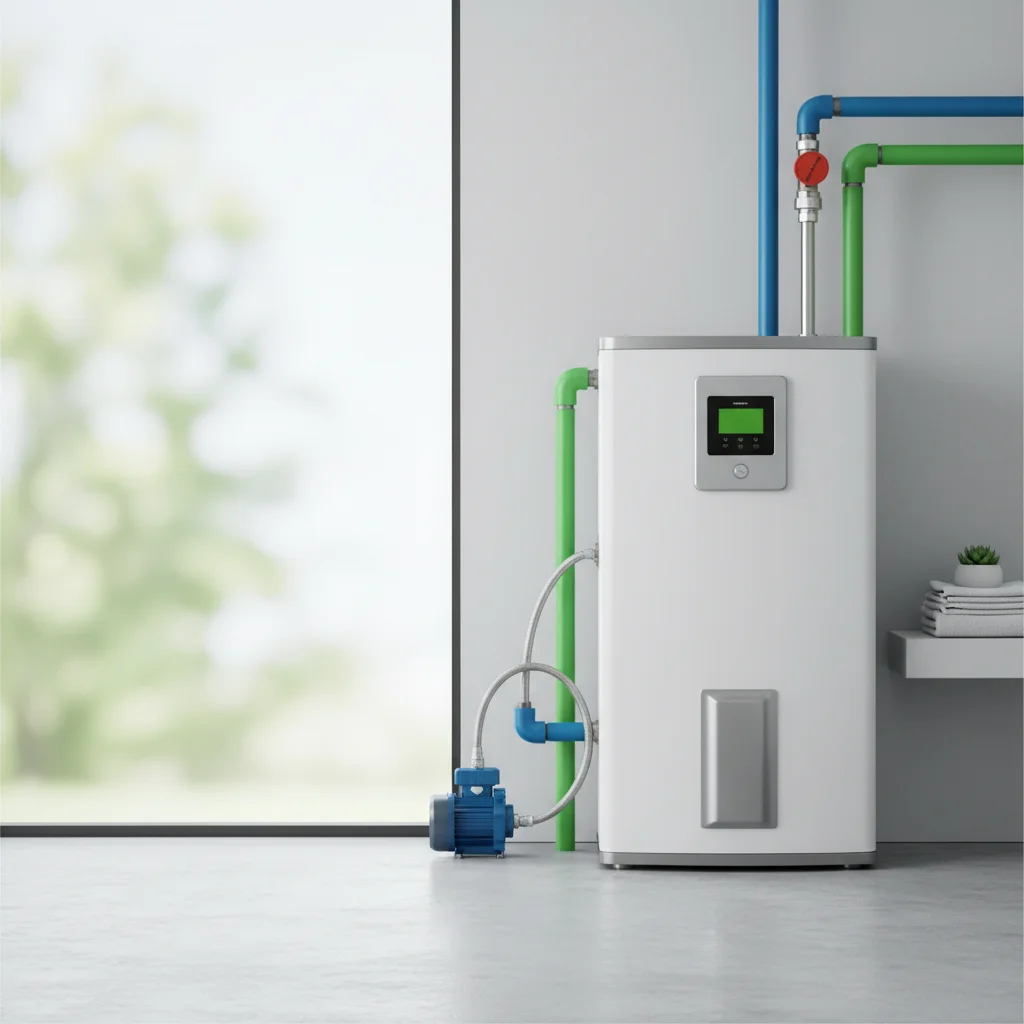
The average American household wastes 12,000 gallons of water annually just waiting for hot water to reach the tap. And in California, where water scarcity drives utility rates to $80-120 per month for a family of four, that's $200-300 in wasted water every year. Recirculation pumps cut that waste to near zero—but installation costs range from $400 to $2,800 depending on system complexity and plumbing configuration.
How Much Does a Water Heater Recirculation Pump Cost to Install?
Water heater recirculation pump installation costs $400-$2,800 in 2026 California markets, with $800-$1,200 representing typical spending for standard residential systems. Basic retrofit pumps cost $150-$400 for equipment, while comfort valve systems add $200-$500. Professional installation runs $250-$800 depending on plumbing complexity, electrical requirements, and permit fees.
Basic timer-controlled pumps represent the lowest-cost entry point at $400-$800 total installed. These systems circulate hot water on preset schedules—typically morning and evening hours—reducing wait times from 45-90 seconds to 5-10 seconds. But timer systems waste energy heating water during unused periods.
Demand-controlled systems cost $800-$1,400 installed and activate only when occupants press a button or sensor detects motion near fixtures. These save 30-50% more energy than timer systems by eliminating unnecessary circulation. And demand pumps qualify for utility rebates in 18 California service territories.
Dedicated return line installations—required for new construction or major remodeling—cost $1,500-$2,800 because plumbers must run additional piping from fixtures back to the water heater. Retrofit comfort valve systems cost $800-$1,400 and use existing cold water lines as return paths, eliminating the need for new plumbing.
So installation costs vary by $2,400 between basic and premium systems. California homeowners save $180-$420 annually on combined water and energy bills, creating payback periods of 2-10 years depending on system choice and household size.
| System Type | Equipment Cost | Installation Cost | Total Cost | Annual Savings | Payback Period |
|---|---|---|---|---|---|
| Basic Timer Pump | $150-$300 | $250-$500 | $400-$800 | $180-$240 | 2-4 years |
| Demand-Controlled Pump | $350-$600 | $450-$800 | $800-$1,400 | $280-$420 | 2-5 years |
| Dedicated Return Line | $800-$1,500 | $700-$1,300 | $1,500-$2,800 | $320-$420 | 4-8 years |
What Rebates and Tax Credits Can You Get for a Recirculation Pump?
California utility rebates provide $50-$300 for ENERGY STAR-certified recirculation pumps installed in 2026, with 18 investor-owned and municipal utility districts offering programs. Pacific Gas & Electric provides $100 for timer-controlled pumps and $150 for demand-activated systems. Southern California Edison offers $75-$125 depending on pump efficiency rating and installation verification.
Federal tax credits don't directly cover recirculation pumps as standalone equipment. But the IRA (Inflation Reduction Act) Energy Efficient Home Improvement Credit allows $150-$250 for water heating system upgrades when installed alongside qualifying equipment like heat pump water heaters. And combining a recirculation pump with a heat pump water heater creates eligibility for both federal credits and state rebates totaling $600-$2,000.
"ENERGY STAR certified recirculation pumps use 10-15% less electricity than standard models and qualify for utility rebates in most service territories." — ENERGY STAR Water Heaters
Municipal water districts in drought-prone regions offer water conservation rebates of $50-$200 for recirculation pump installations that reduce household water consumption by documented amounts. East Bay Municipal Utility District provides $100 for demand-controlled pumps paired with low-flow fixtures. And Marin Municipal Water District offers tiered rebates of $75-$150 based on home size and prior water usage.
State-level rebates don't exist for recirculation pumps specifically. But California's TECH Clean California program provides point-of-sale discounts of $500-$800 for heat pump water heaters, which pair effectively with recirculation systems. Homeowners installing both technologies access combined incentives of $650-$1,100 from utility and state programs.
So total available rebates range from $50 to $300 for pumps alone, or $650-$2,300 when bundled with qualifying water heater upgrades.
How Long Does It Take a Recirculation Pump to Pay for Itself?
Recirculation pump payback periods span 2-10 years in California homes, with $180-$420 in annual combined water and energy savings offsetting initial installation costs of $400-$2,800. Demand-controlled systems deliver the fastest returns at 2-5 years, while dedicated return line installations require 4-10 years to break even depending on household size and water costs.
Water savings alone justify pump installations in high-cost utility districts. California households waste 30-50 gallons daily waiting for hot water—12,000-18,000 gallons annually at $0.015-$0.025 per gallon. That's $180-$450 in water costs eliminated by recirculation pumps that deliver hot water in 5-10 seconds instead of 45-90 seconds.
Energy costs determine whether payback periods hit 2 years or 10 years. Timer-controlled pumps running 8 hours daily consume 300-500 kWh annually at California's average residential rate of $0.32/kWh—$96-$160 in electricity. But demand-controlled pumps use 60-150 kWh annually, costing just $19-$48 and creating net savings of $210-$402 when water conservation benefits are included.
"Hot water recirculation systems reduce water waste by 10,000-15,000 gallons per year in typical households, with demand-controlled pumps using 70% less energy than timer-based systems." — U.S. Department of Energy
Climate zone impacts payback calculations through energy costs. Southern California homes with minimal heating seasons see slower payback—4-7 years—because recirculation pumps provide comfort benefits but don't reduce space heating loads. Northern California homes in climate zones 3-5 achieve 2-5 year payback when pumps reduce heat loss from long pipe runs and improve overall system efficiency.
And utility rebates accelerate payback by 12-24 months. A $1,200 demand pump system with $150 in utility incentives drops to $1,050 net cost, achieving payback in 3.5 years instead of 4.2 years at $300 annual savings.
Is a Recirculation Pump Right for Your Climate Zone?
California climate zones 1-16 all benefit from recirculation pumps, but zones 3-5 (northern coastal and mountain regions) achieve 25-40% faster payback periods than zones 8-15 (southern inland valleys and deserts). Homes with water heaters located 50+ feet from primary bathrooms see the largest water savings—15,000-20,000 gallons annually—regardless of climate zone.
Cold climate zones justify recirculation pumps through reduced heat loss. Homes in zones 3-5 lose 12-18°F from water sitting in pipes during winter months, forcing water heaters to consume 200-350 kWh annually reheating cold water. Recirculation pumps maintain 110-120°F water temperature in pipes, cutting reheating energy by 60-80% and saving $64-$112 annually at $0.32/kWh.
Hot climate zones prioritize water conservation over energy savings. Zones 10-15 experience 90-110°F summer temperatures, reducing heat loss from pipes but intensifying drought-driven water costs. Desert communities pay $0.020-$0.030 per gallon during peak summer months, making 12,000-gallon annual savings worth $240-$360—enough to justify $800-$1,400 pump installations in 2-4 years.
Coastal climate zones 1, 5-7 face moderate conditions where comfort drives adoption more than economics. Mild year-round temperatures of 55-75°F minimize both heat loss and water scarcity concerns. But homes with master bathrooms 75+ feet from water heaters still waste 60-90 seconds and 3-5 gallons per shower waiting for hot water, creating $120-$200 in annual waste.
So climate zone matters less than plumbing layout. Homes with long pipe runs (50+ feet) in any California climate zone achieve 3-6 year payback periods. And homes with short runs (under 30 feet) in temperate zones require 7-10 years to break even, making recirculation pumps optional rather than economically compelling.
Recirculation Pump vs. Tankless Water Heaters vs. On-Demand Systems: Which Saves More Money?
Demand-controlled recirculation pumps deliver the highest return on investment at $180-$420 annual savings for $800-$1,400 installed, achieving 2-5 year payback periods. Tankless water heaters cost $2,500-$4,500 installed and save $100-$180 annually, requiring 14-25 years to break even. On-demand recirculation valves cost $40-$80 but save only $80-$120 annually because they lack automated circulation.
Tankless water heaters eliminate standby heat loss—the 150-300 kWh annually wasted maintaining 120°F water in storage tanks—but don't solve wait time issues. Homes with tankless heaters still experience 30-60 second delays for hot water to travel from heater to fixtures. And installing recirculation pumps with tankless systems adds $800-$1,400 to the $2,500-$4,500 tankless installation cost, creating total investments of $3,300-$5,900.
On-demand valves installed at individual fixtures cost $40-$80 per location and activate pumps only when users press buttons. These save water but require manual activation before every shower or dishwashing session—a behavioral friction that reduces actual usage and limits savings to $80-$120 annually. And multi-bathroom homes need 3-5 valves at $120-$400 total cost.
Heat pump water heaters paired with recirculation pumps create the optimal efficiency combination. Heat pump models cost $1,800-$3,500 installed but qualify for $500-$2,000 in combined utility and federal incentives, dropping net cost to $1,300-$2,500. These save 250-400 kWh annually compared to electric resistance heaters—$80-$128 at $0.32/kWh—plus the $180-$420 from recirculation systems, totaling $260-$548 in annual savings and 3-7 year payback.
| Technology | Installed Cost | Annual Savings | Payback Period | Best For |
|---|---|---|---|---|
| Demand Recirculation Pump | $800-$1,400 | $280-$420 | 2-5 years | Existing homes, long pipe runs |
| Tankless Water Heater | $2,500-$4,500 | $100-$180 | 14-25 years | New construction, tight spaces |
| Heat Pump Water Heater + Pump | $2,600-$4,900 | $260-$548 | 5-10 years | Maximum efficiency, rebate stacking |
| On-Demand Valves | $120-$400 | $80-$120 | 2-4 years | Budget-conscious, single bathroom |
So recirculation pumps outperform tankless heaters on economics alone. And combining pumps with heat pump water heaters maximizes both efficiency and comfort while qualifying for the largest rebate packages.
How Long Will Your Recirculation Pump Last and When Should You Replace It?
Recirculation pumps last 8-15 years depending on water quality, usage patterns, and maintenance frequency. Timer-controlled models average 10-12 year lifespans, while demand-activated systems last 12-15 years because they run 60-80% fewer hours annually. And hard water areas reduce pump life by 20-30% through calcium buildup in impellers and check valves.
Pumps failing before 8 years indicate installation problems or water quality issues. Manufacturers warranty most residential recirculation pumps for 3-5 years, but professional installation with proper check valves, thermal expansion tanks, and pressure regulation extends service life to 10+ years. And homes with water hardness above 10 grains per gallon need water softeners to prevent premature pump failure.
Replacement timing depends on failure symptoms rather than fixed schedules. Pumps requiring replacement show these warning signs: grinding or squealing noises indicating bearing wear, visible water leaks from seal failures, circulation time exceeding 20-30 seconds when previously under 10 seconds, or electricity consumption increasing by 30%+ compared to baseline usage.
So proactive replacement at 10-12 years prevents emergency failures and water damage. A 12-year-old pump that saved $280 annually delivered $3,360 in cumulative savings against initial costs of $800-$1,400—a 140-240% return on investment. And replacing with newer ENERGY STAR models offering 15-25% better efficiency continues savings for another decade.
Annual maintenance extends pump lifespan by 2-4 years. Homeowners flush sediment from pump housings, inspect check valves for proper seating, verify timer or sensor operation, and test circulation time once yearly. These 15-minute tasks cost nothing but prevent 40% of premature pump failures caused by sediment buildup and valve debris.
Use our free rebate calculator to compare pump replacement costs with available utility incentives and projected lifetime savings.
Official Sources
- U.S. Department of Energy - Water Heating — Federal guidance on water heater efficiency, recirculation systems, and energy-saving technologies
- ENERGY STAR Water Heaters — Certification database for efficient recirculation pumps and water heating equipment
- DSIRE USA — Comprehensive database of California utility rebates and incentive programs for water efficiency upgrades
Frequently Asked Questions
How much does a water heater recirculation pump cost?
Water heater recirculation pump installation costs $400-$2,800 in 2026, with most California homeowners spending $800-$1,400 for demand-controlled systems. Basic timer pumps cost $400-$800 installed, while dedicated return line systems requiring new plumbing run $1,500-$2,800. Equipment alone ranges from $150 for basic models to $600 for premium ENERGY STAR-certified pumps. Professional installation adds $250-$800 depending on electrical work, plumbing complexity, and local permit fees.
What is a recirculation pump and why do I need one?
Recirculation pumps maintain hot water circulation between water heaters and fixtures, eliminating 30-90 second wait times and preventing 10,000-15,000 gallons of annual water waste. These pumps activate via timers, buttons, or motion sensors to push hot water through pipes continuously or on-demand. Homes with water heaters located 50+ feet from primary bathrooms waste 3-5 gallons per shower waiting for hot water. And California households waste $180-$450 annually in water costs from this delay.
Are water heater recirculation pumps eligible for tax credits or rebates?
California utility companies provide $50-$300 rebates for ENERGY STAR-certified recirculation pumps in 2026, with 18 service territories offering programs. Pacific Gas & Electric gives $100-$150, while Southern California Edison provides $75-$125 depending on pump type. Federal tax credits don't cover pumps as standalone equipment, but IRA credits allow $150-$250 when installed with qualifying heat pump water heaters. Municipal water districts add $50-$200 conservation rebates, creating total potential incentives of $100-$550 for pump installations.
How long does it take to install a water heater recirculation pump?
Professional installation takes 2-5 hours for retrofit systems using existing plumbing and 6-12 hours for dedicated return line installations requiring new pipes. Basic comfort valve pumps install in 2-3 hours because plumbers use cold water lines as return paths. Demand-controlled systems need 3-4 hours for pump mounting, electrical connections, sensor installation, and testing. And dedicated return line systems require cutting drywall, running copper or PEX tubing, and patching walls—6-12 hours of labor at $80-$125 per hour.
What are the energy savings from installing a recirculation pump?
Demand-controlled recirculation pumps save $180-$420 annually through combined water conservation and energy efficiency. Water savings alone total $180-$360 by eliminating 10,000-15,000 gallons of waste at California rates of $0.015-$0.025 per gallon. Energy costs range from net increases of $48-$96 for timer systems running continuously to net savings of $40-$80 for demand pumps that activate only when needed. And northern California climate zones see additional $60-$110 savings from reduced pipe heat loss during winter months.
Ready to calculate your exact savings? Our rebate calculator shows available utility incentives, projected water and energy savings, and payback periods for recirculation pumps in your specific California service territory. Get your personalized estimate in under 2 minutes.
Updated: April 14, 2026 — fact-checked by DuloCore Research. About our editorial process.
Check your California water heater rebate eligibility — see the programs you qualify for and the dollar amounts on our California water heater rebate finder.