Update (2026): The federal Energy Efficient Home Improvement Credit (Section 25C) expired December 31, 2025, following the passage of the OBBBA. Check state and local programs for current incentives.
An inefficient air conditioner consumes up to 50% more electricity than a modern, high-efficiency unit, directly inflating monthly utility bills. As summer temperatures climb, millions of homeowners are unknowingly paying hundreds of extra dollars each year to run outdated cooling systems. So this waste isn't just about comfort; it's a direct financial drain that efficiency testing identifies and helps to eliminate.
Why is Air Conditioner Efficiency Testing Crucial for Unlocking Financial Savings?
Air conditioner efficiency testing provides the certified performance data required by rebate programs to validate energy savings. This third-party verification, conducted by HVAC technicians, documents a unit's SEER2 and EER2 ratings, which directly determines eligibility for 2026 state, utility, and federal incentives that return up to $8,000 to homeowners.
So why does this formal testing matter? Without a certified test result, a homeowner's claim for a high-efficiency upgrade is just an assertion. But rebate programs managed by utilities and state energy offices require empirical proof that new equipment meets stringent performance standards. A formal test provides this non-negotiable data point. For example, a utility may offer a $500 rebate for a unit with a SEER2 rating of 16, but a $1,000 rebate for a unit with a SEER2 of 18 or higher. The efficiency test is the mechanism that proves which tier the equipment qualifies for, directly unlocking the maximum available financial incentive. This process transforms an equipment specification sheet into a validated claim for cash back, turning an expensive home improvement project into a subsidized, cost-effective investment. A comprehensive home energy audit often includes this type of system evaluation.
How Do AC Efficiency Test Results Determine My Eligibility for Rebates and Incentives?
AC efficiency test results directly determine rebate eligibility by measuring a unit's performance against specific program thresholds. Rebate programs in 2026 require minimum SEER2 (Seasonal Energy Efficiency Ratio 2) and EER2 (Energy Efficiency Ratio 2) ratings, with higher ratings unlocking larger incentive amounts, often tiered up to $2,000.
Test results serve as the official documentation for rebate applications. Utility and state programs set clear performance benchmarks; for instance, a baseline rebate of $300 may require a 15 SEER2 rating, while a premium rebate of $750 requires an 18 SEER2 rating or higher. So the certified report from an HVAC technician acts as proof of purchase and installation of qualifying equipment. Without this validated data, an application is incomplete and will be rejected. The U.S. Department of Energy emphasizes the importance of these metrics for consumer savings.
"Choosing an air conditioner with a higher SEER can result in 20% to 40% energy savings." — U.S. Department of Energy
And this verification ensures that public and utility funds are allocated only to installations that deliver guaranteed energy reductions, protecting the integrity of the incentive programs.
What Specific Rebate Amounts and Eligible Equipment are Available from My State and Utility?
Specific 2026 rebate amounts and eligible equipment vary by location, with state and utility programs offering point-of-sale rebates from $250 to over $2,000. Eligible equipment is defined by ENERGY STAR certification and minimum SEER2 ratings, typically starting at 15 or 16 SEER2 for central air conditioners.
For example, California's TECH Clean California program offers homeowners up to $3,000 for installing high-efficiency equipment. In Texas, Austin Energy provides rebates up to $1,100 for central air conditioners with a SEER2 rating of 16 or higher. But these programs are geographically restricted. Eligible equipment always includes high-performance central air conditioners and ductless mini-splits that exceed federal minimum standards. The key is that higher efficiency ratings consistently unlock larger rebate amounts. Many homeowners also find that these upgrades pair well with other incentives, including federal energy tax credits. Use our free rebate calculator to discover the exact incentives available in your ZIP code for 2026.
Are There Income Limits or Specific Contractor Requirements for AC Efficiency Rebate Programs?
Many 2026 AC efficiency rebate programs include income limits and mandate the use of certified contractors to ensure quality installations. Low-to-moderate income (LMI) households often qualify for enhanced rebates that cover up to 100% of project costs, with income thresholds typically set at 80% of the Area Median Income (AMI).
Most state and utility rebate programs require that installation be performed by a licensed and insured HVAC contractor, and some require technicians to hold specific certifications, like NATE (North American Technician Excellence). This requirement protects the homeowner and ensures the system is installed to manufacturer specifications, which is critical for achieving the tested efficiency rating. For instance, the Home Energy Rebate Programs, funded by the Inflation Reduction Act, offer up to $8,000 for LMI households for heat pump installations, which provide both cooling and heating. So verifying a contractor's credentials before work begins is a non-negotiable step in the rebate application process. These high-efficiency systems are often covered under heat pump rebates.
What is the Application Process, Deadlines, and Current Funding Status for AC Efficiency Incentives?
The 2026 application process for AC efficiency incentives typically involves pre-approval, installation by a certified contractor, and submission of a final application with invoices and test results. Most programs have a firm application deadline of December 31, 2026, and funding is often allocated on a first-come, first-served basis.
The process begins with the homeowner or contractor confirming equipment eligibility and reserving funds through the program's online portal. After the high-efficiency air conditioner is installed and tested, the final application is submitted. This packet must include the dated sales invoice, the AHRI certificate for the equipment, and the contractor's license number. So prompt submission is critical, as popular programs often exhaust their annual funding months before the final deadline. For example, many state energy office programs for 2026 opened their application windows in January and expect to close them by October. Checking the program's website for real-time funding status is essential before committing to a project. A great resource for tracking program availability is the DSIRE database.
Can I Stack Multiple Rebates? Understanding Program Stacking Rules for AC Efficiency Upgrades.
Homeowners can stack multiple rebates for AC efficiency upgrades, combining federal tax credits with state and local utility incentives to reduce total project costs by over 50%. Program stacking rules for 2026 permit layering a federal credit, like the 30% IRA credit, on top of a state or utility rebate.
For instance, a homeowner installing a $7,000 high-efficiency air conditioner can receive a $1,500 rebate from their local utility. And they can also claim a federal tax credit of 30% on the remaining $5,500 project cost, which equals an additional $1,650 in savings. So the total out-of-pocket cost is reduced from $7,000 to just $3,850. But it's crucial to review the terms for each program, as some state incentives are designated as the "payer of last resort" and may be reduced by the amount of other rebates received. The Database of State Incentives for Renewables & Efficiency (DSIRE) provides detailed information on stacking rules.
"Many programs can be combined with other state and federal incentives, including tax credits." — DSIRE
This strategy maximizes financial return on the investment in energy efficiency.
AC Efficiency Rebate Program Comparison (2026)
| Program Type | Typical Rebate Amount | Key Eligibility Requirement | 2026 Deadline |
|---|---|---|---|
| Federal IRA Tax Credit | Ended Dec 31, 2025 | — | Dec 31, 2025 |
| State Energy Office | $500 - $3,000 | SEER2 ≥ 16, state residency | Varies (often Q4 2026) |
| Local Utility | $250 - $1,500 | SEER2 ≥ 15, utility customer | Dec. 31, 2026 |
Official Sources
- ENERGY STAR — A U.S. Environmental Protection Agency (EPA) program providing credible, objective information on the energy efficiency of products.
- IRS.gov Energy Credits Page — Official guidance from the Internal Revenue Service on federal tax credits for home energy improvements. (note: the federal 25C and 25D credits ended for projects completed after December 31, 2025)
- Database of State Incentives for Renewables & Efficiency (DSIRE) — The most comprehensive source of information on incentives and policies that support renewable energy and energy efficiency in the United States.
Related Reading: Learn more about Duct Leakage Testing Home.
Frequently Asked Questions About AC Efficiency Testing and Rebates
Is an air conditioner efficiency test mandatory to qualify for home improvement rebates?
Yes, for most 2026 utility and state rebate programs, an efficiency test or an AHRI (Air-Conditioning, Heating, and Refrigeration Institute) certificate is mandatory. This documentation serves as official proof that the installed equipment meets the specific SEER2 and EER2 performance standards required for the incentive. So without this certified data, an application is considered incomplete and will be denied.
What is the typical procedure for an AC efficiency test required for rebate applications?
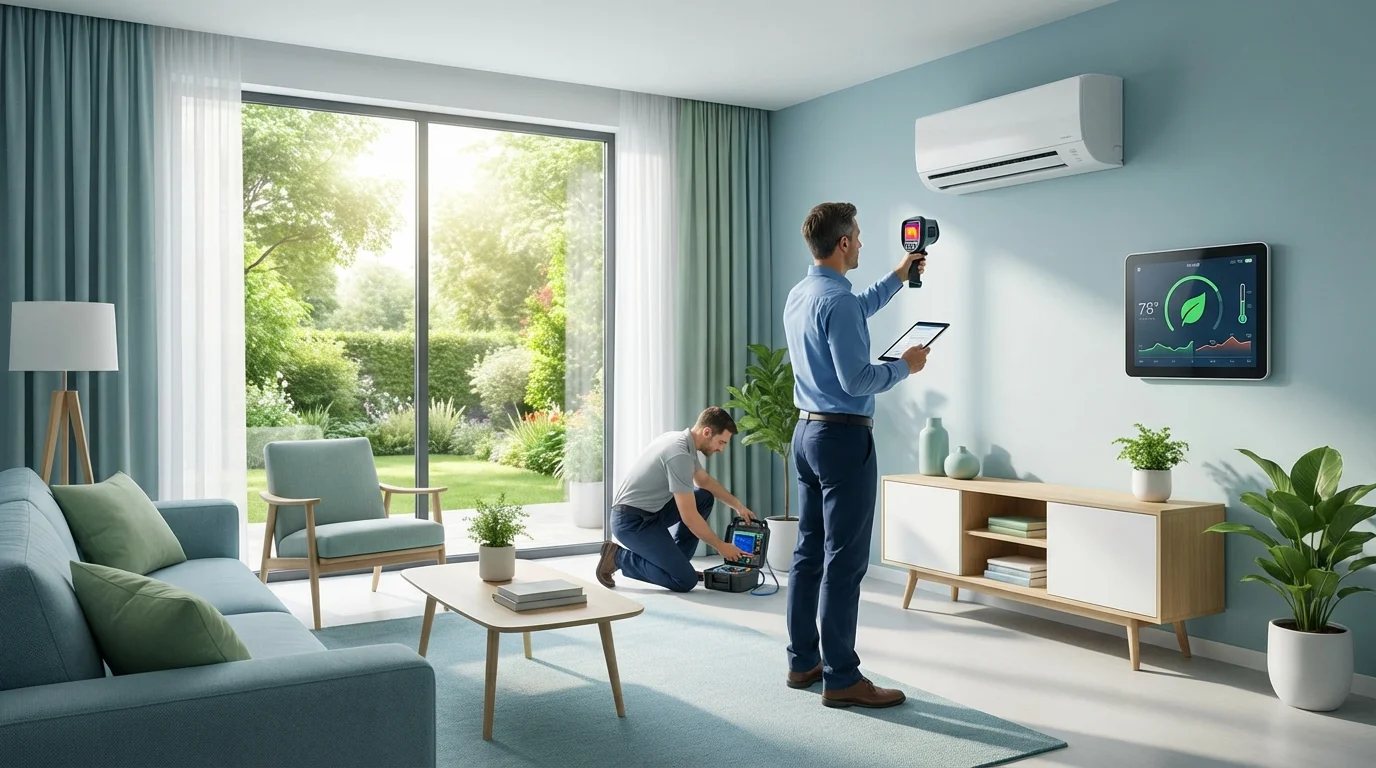
The typical procedure involves a certified HVAC technician using diagnostic tools to measure system performance after installation. The technician verifies the unit's SEER2 and EER2 ratings against the manufacturer's specifications listed on the AHRI certificate. And this certificate, along with the paid invoice, is then submitted with the rebate application. The entire process confirms the equipment installed is the exact model that qualifies.
How do AC efficiency test results impact the potential rebate amount I can receive?
AC efficiency test results directly impact the rebate amount. Many 2026 programs use a tiered structure; for example, a unit testing at 16 SEER2 may qualify for a $400 rebate, while a unit testing at 18 SEER2 qualifies for a $750 rebate. So a higher certified efficiency rating unlocks a larger financial incentive. The test provides the validation needed to place the installation into the correct rebate tier.
When should I schedule an air conditioner efficiency test to meet rebate submission deadlines?
An air conditioner efficiency test should be scheduled immediately upon completion of the new system installation. This ensures you have the required documentation well before the program's application deadline, which is often December 31, 2026. Because many programs are funded on a first-come, first-served basis, waiting until the end of the year risks finding that program funds have already been exhausted.
Who is certified to perform an AC efficiency test that is accepted for rebate programs?
Only a licensed and insured HVAC contractor is certified to perform an AC efficiency test for rebate programs. Many programs also require the technician to hold a NATE (North American Technician Excellence) certification. Using a non-certified individual will result in the test results being rejected by the rebate administrator. So always verify a contractor's credentials with the program before beginning work.
Unlock Your AC Rebates in 2026
Don't leave money on the table. An efficient air conditioner not only lowers your bills but also qualifies you for thousands in rebates. Use our free, up-to-date tool to see every incentive you qualify for in just two minutes.
Calculate Your Savings NowLast updated April 14, 2026 — reviewed by DuloCore Editorial. About our authors.