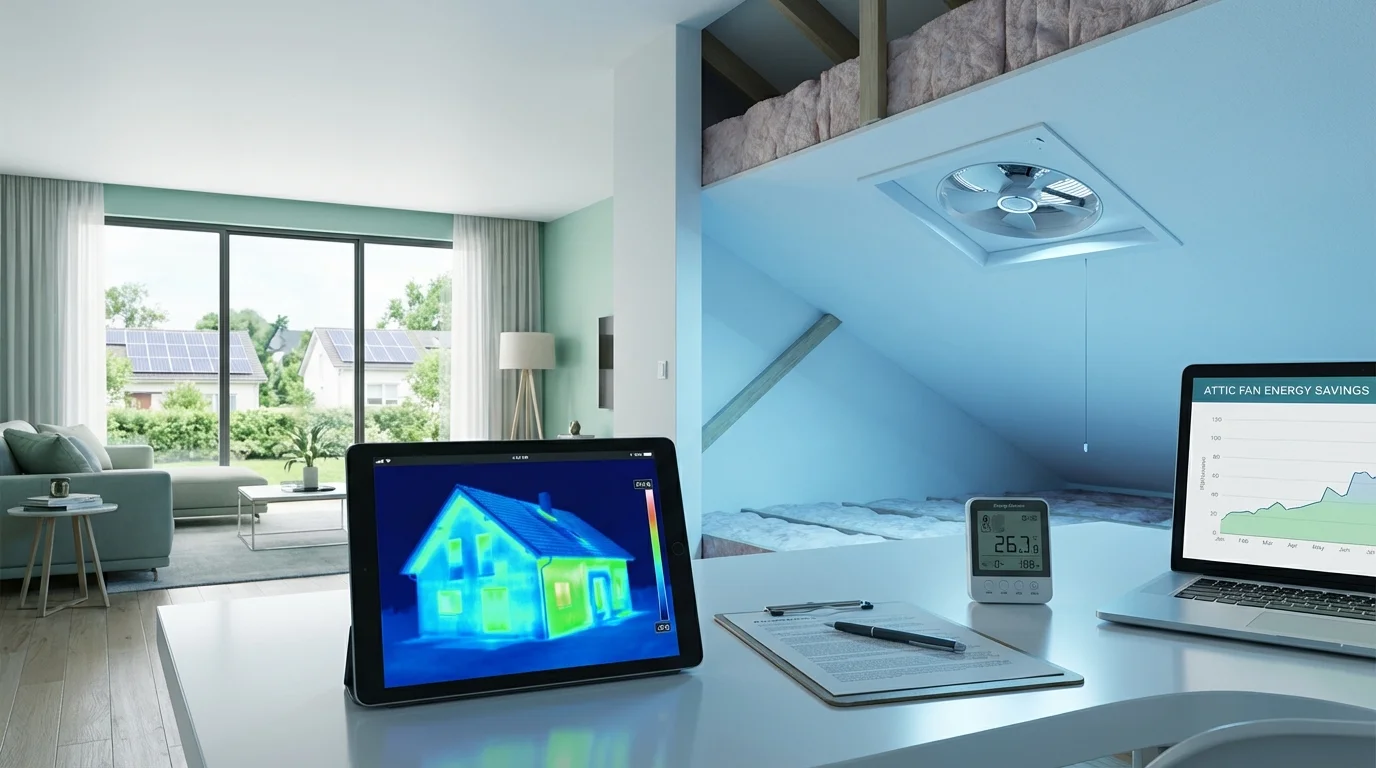
An unventilated attic can reach 150°F on a summer day, forcing your air conditioner to work overtime and driving up cooling costs by as much as 30%. This intense heat radiates down into your living spaces, creating uncomfortable hotspots and straining your home's entire cooling system. So conducting an energy savings audit for an attic fan isn't just about comfort; it's a direct countermeasure against escalating utility bills during peak temperature seasons.
What Specific Attic Fan Rebates and Energy Savings Are Available in My State and From My Utility?
An attic fan energy savings audit identifies state and utility rebates for attic ventilation systems, typically valued between $75 and $300 for 2026 programs. These incentives target ENERGY STAR® certified solar or electric-powered attic fans, which must meet specific airflow (CFM) ratings to qualify for the full rebate amount.
State energy offices and local utility providers offer distinct rebate programs for attic fans, with amounts varying by location and equipment efficiency. For example, a state-level program may offer a flat $150 rebate for any qualifying solar attic fan, while a utility provider adds a $75 bill credit for customers within its service area. But these programs often have specific efficiency requirements, such as a minimum solar panel wattage or a thermostat-and-humidistat control feature. An audit's primary function is to match your home's needs with these specific 2026 rebate criteria. And a comprehensive audit will catalog all available incentives, including any potential energy tax credits that apply to home envelope improvements. So verifying eligibility through an official audit is the first step before purchase and installation to guarantee access to these savings, which can reduce the initial project cost by 20-40%.
The core tension for homeowners is the upfront cost of an attic fan versus the long-term, often invisible, energy savings. So why does this matter now? Because without proper ventilation, that 150°F attic heat directly increases the load on your HVAC system. The U.S. Department of Energy states that effective attic ventilation can reduce a home's cooling costs by up to 30%. For an average household spending $500 on summer cooling, that's a direct saving of $150 per year, demonstrating a clear and rapid return on investment.
Do I Qualify? Understanding Income Limits and Eligibility for Attic Fan Rebate Programs.
Attic fan rebate program qualification hinges on homeownership, equipment standards, and, in some cases, household income, with enhanced rebates in 2026 often reserved for households at or below 80% of the Area Median Income (AMI). Standard eligibility typically requires the property to be a primary residence receiving service from the sponsoring utility.
Eligibility for attic fan rebates is multi-faceted. First, the homeowner must reside in the property; rental properties often don't qualify for standard residential programs. Second, the purchased equipment must be on the program's approved product list, which usually includes ENERGY STAR® certified models with specific performance metrics. And for income-qualified programs, applicants must provide documentation verifying their household income falls below a certain threshold, typically 80% or 120% of the AMI. So these enhanced rebates can increase the standard incentive by 50-100%. But failing to meet any single criterion, from residency status to the fan's CFM rating, results in disqualification. A detailed audit confirms every eligibility point before you invest, preventing the loss of hundreds of dollars in potential savings. You can use our free rebate calculator to see initial estimates.
What's the Application Process and Deadline for Attic Fan Energy Rebates?
The application process for 2026 attic fan rebates involves submitting a completed form, a dated sales receipt, and equipment specification sheets, typically online through a utility portal, with a final submission deadline of December 31, 2026. Most programs require post-installation submission within 90 days of purchase.
Applying for an attic fan rebate follows a strict, sequential process. First, homeowners must purchase and install qualifying equipment. After installation, the applicant gathers the required documents: the application form (downloaded from the utility's website), the itemized invoice showing model numbers and cost, and proof of ENERGY STAR® certification. And these documents are then uploaded to the program's online portal or mailed in. So the most common point of failure is an incomplete application—missing a signature or a receipt. The deadline is absolute; applications for 2026 installations are typically due by year-end or within a specific window, like 90 days post-purchase. Missing this window means forfeiting the rebate, which is often between $100 and $250. An audit helps organize this paperwork, ensuring every box is checked for a successful submission.
Can I Stack Attic Fan Rebates, and What Are the Contractor Requirements?
Stacking attic fan rebates from a state and a utility is often permitted, potentially combining for up to $300 in savings, but contractor requirements are strict, frequently mandating the use of a licensed professional from a pre-approved network. These rules ensure installations meet local building codes and program standards.
Stacking incentives is a key strategy for maximizing savings. For instance, a homeowner can apply for a $150 state-level rebate and a separate $75 rebate from their electric utility for the same attic fan installation. But this is only allowed if both programs explicitly permit it. And many programs impose strict contractor requirements to ensure safety and performance. So homeowners can't perform a DIY installation and claim the rebate. They must hire a contractor who is licensed, insured, and often listed on the utility’s or state’s "Certified Installer" list. Using an uncertified contractor is a common reason for rebate denial. An energy audit not only identifies stacking opportunities but also provides a list of vetted local contractors who meet these stringent 2026 program requirements, streamlining the entire process from purchase to payout. This step is critical for projects like heat pump rebates as well.
Rebate Program Comparison
| Program Name (2026) | Rebate Amount | Key Eligibility | Application Deadline |
|---|---|---|---|
| State Energy Office Grant | $150 flat rate | ENERGY STAR® certified solar fan | Dec 31, 2026 |
| Local Utility Credit | Up to $100 | Must be a utility customer; pro install | 90 days post-install |
| Low-Income Weatherization | Up to 100% of cost | Income at/below 80% AMI | Rolling; funds limited |
How Do I Check the Funding Status of Attic Fan Rebate Programs?
The funding status for 2026 attic fan rebate programs is monitored on the official program website, typically managed by the state energy office or local utility, which provides real-time updates on remaining funds. Many programs operate on a first-come, first-served basis and can be depleted before the year-end deadline.
Rebate programs are allocated a finite budget each year. So it's critical to check the funding status before making a purchase. Most utility and state energy program websites feature a dedicated page or dashboard showing the percentage of funds already disbursed. For example, a program may show "85% of funds claimed as of October 2026." And this information signals urgency, as the program will likely close to new applicants soon. Waiting until the end of the year to apply is a risk, as funds for popular programs like attic fan incentives often run out by the third or fourth quarter. A proper home energy audit includes verifying this funding availability as a key step in the planning process.
"Many states and utilities offer rebates or other incentives for energy-saving products. The Database of State Incentives for Renewables & Efficiency® (DSIRE) is the most comprehensive source of information on these programs." — U.S. Department of Energy
Official Sources
- Database of State Incentives for Renewables & Efficiency (DSIRE) — A comprehensive national database of state, local, utility, and federal incentives for energy efficiency and renewables.
- ENERGY STAR Rebate Finder — A federal tool from the EPA to find rebates on ENERGY STAR certified products in your zip code.
- DOE Energy Saver — Federal guidance on energy-saving measures, including technical specifications for ventilation and insulation.
Related Reading: Learn more about Liheap Energy Audit Program and Mini Split Energy Audit Assessment.
Related Reading: Learn more about Attic Insulation Energy Savings.
Related Reading: Learn more about Whole House Fan Energy Savings.
Frequently Asked Questions
What are the eligibility requirements for an attic fan energy savings audit?
Eligibility typically requires being the homeowner of the property being audited. And the property must be located within the service territory of the sponsoring utility or state program. Some programs may have additional requirements, such as the age of the home (e.g., built before 2010) or not having received a similar audit within the last 3-5 years.
What does an attic fan energy savings audit typically involve?
An audit involves a certified technician inspecting your attic's current ventilation, insulation levels (R-value), and air leakage points. They measure the attic's square footage to calculate the required fan capacity (CFM). The final report provides recommendations for fan type (solar vs. electric), placement, and a detailed list of all applicable 2026 rebates and incentives you qualify for.
How much energy can I expect to save after an attic fan energy audit?
Implementing the recommendations from an attic fan audit, primarily by installing a properly sized fan, reduces home cooling costs by 10% to 30%. For a typical home, this translates to $100 to $250 in savings during the summer cooling season alone. The exact savings depend on your climate zone, electricity rates, and existing insulation levels.
Are there rebates or incentives available for completing an attic fan energy audit?
Yes, many utilities offer rebates that cover a portion or the full cost of the audit itself, often between $50 and $150. So the audit is frequently low-cost or free for the homeowner. These incentives are designed to encourage proactive energy efficiency assessments. You must check with your local utility provider for specific 2026 program details.
How does an attic fan energy audit compare to a full home energy assessment?
An attic fan audit is a specialized assessment focused solely on attic ventilation and its impact on cooling loads. A full home energy assessment is more comprehensive, including a blower door test for air leaks, ductwork inspection, and analysis of all appliances, windows, and insulation throughout the entire building envelope. A full assessment costs more, typically $400-$700.
Find Every Attic Fan Rebate in Your Area
Don't leave money on the table. Our tool scans thousands of state and utility programs to find every incentive you qualify for in under 2 minutes.
Calculate Your Savings NowUpdated on April 14, 2026. Fact-checked by DuloCore Editors. About our research team.