Air leakage in a typical American home is equivalent to leaving a window wide open 24 hours a day, 365 days a year. This invisible drain on your finances inflates heating and cooling bills by up to 40%, silently siphoning money from your bank account every single month. So stopping these leaks is one of the fastest ways to cut energy costs.
What is a Blower Door Test, and How Does it Improve Your Home's Energy Efficiency?
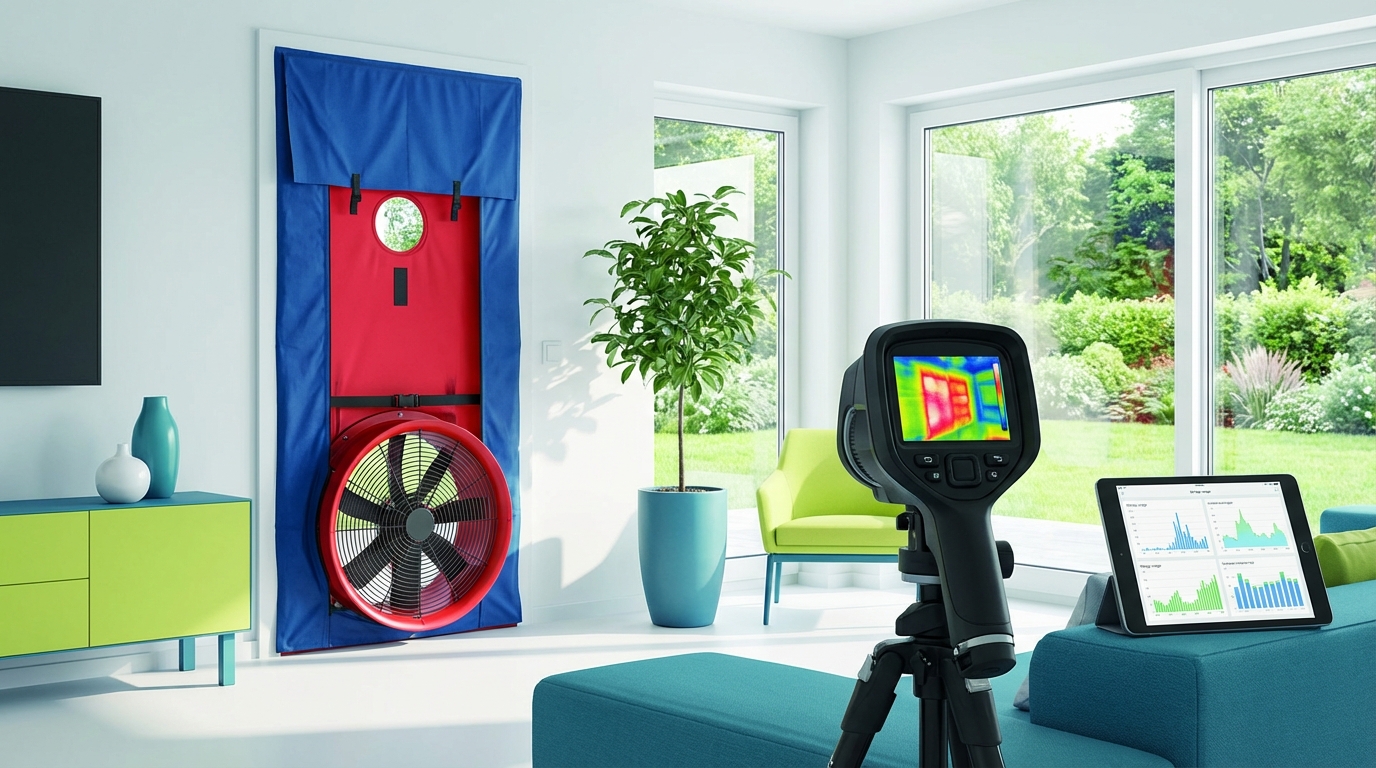
A blower door test is a diagnostic tool that measures a home's airtightness by depressurizing the interior and quantifying air leakage in cubic feet per minute (CFM). For 2026, this test is often a prerequisite for accessing up to $1,600 in air sealing and insulation rebates.
So why does this test matter? The core issue is that hidden air leaks in your home's envelope—around windows, electrical outlets, and attic hatches—force your HVAC system to work overtime. And this wasted energy translates directly into higher utility bills. The Department of Energy estimates that air sealing improvements identified by a blower door test can reduce annual energy costs by 15% or more. But without the diagnostic data from the test, you're just guessing where to seal. So the test provides a precise roadmap, showing exactly where your home is losing the most energy and allowing for targeted, cost-effective repairs instead of wasteful guesswork. A comprehensive home energy audit almost always includes this crucial step.
What Rebates and Financial Incentives are Available for Blower Door Tests and Related Energy Upgrades?
Rebates and financial incentives for blower door tests in 2026 include direct utility rebates of $100-$300 for the test itself; federal tax credits no longer apply (IRS FS-2025-05). These programs make diagnostic testing and energy efficiency improvements more financially accessible for homeowners.
Homeowners have access to a layered system of incentives. At the federal level, the Energy Efficient Home Improvement Credit (Section 25C) ended for property placed in service after December 31, 2025 (IRS FS-2025-05). But state and local utilities offer the most direct rebates, often covering a portion or the full cost of the test, which typically ranges from $250 to $450. So these programs are designed to encourage homeowners to take the first step in identifying energy loss. And many programs require a "test-in, test-out" model, where a second test verifies that the completed work reduced air leakage by a required minimum, such as 15%, before the full rebate is paid.
How Do State and Utility Programs Impact Blower Door Test Rebates in My Area?
State and utility programs directly fund blower door test rebates, with amounts in 2026 ranging from $150 in Texas with Austin Energy to over $400 in California through PG&E's programs. These regional differences are based on local energy goals, climate zones, and regulatory mandates.
The availability and value of rebates are highly localized. And programs in colder states like Massachusetts or Minnesota often offer more generous incentives for air sealing because the savings potential from reduced heating costs is greater. But warmer states focus on reducing cooling loads. So it's essential to check with your specific electric or gas utility provider, as their programs are separate from state-level initiatives. The Database of State Incentives for Renewables & Efficiency (DSIRE) is an excellent resource for navigating these local options.
"Many states offer additional tax incentives for energy efficiency improvements. In addition, some utilities offer customers financial incentives for energy efficiency upgrades." — U.S. Department of Energy
Are There Income Limits, Application Deadlines, or Specific Contractor Requirements for Blower Door Test Rebates?
Yes, most 2026 state and utility rebate programs for blower door tests have specific requirements, including income limits for enhanced rebates, application deadlines often set for December 31, and mandatory use of certified contractors (e.g., BPI or RESNET professionals) to ensure quality and accuracy.
Eligibility isn't automatic. And many programs have two tiers: a standard rebate available to all customers and an enhanced rebate, sometimes offering up to 100% of the cost, for households earning below 80% of the Area Median Income (AMI). So you must verify your income eligibility. But contractor choice is also restricted; you can't just hire any handyman. And utilities require the test to be performed by a Building Performance Institute (BPI) or RESNET certified technician to guarantee standardized, accurate results. Finally, all programs operate with strict deadlines, typically at the end of the calendar year, and require applications to be submitted within 30-90 days of the service date.
Can I Stack Blower Door Test Rebates with Other Home Energy Programs, and How Do They Compare?
Yes, homeowners can stack a blower door test rebate with incentives for the resulting upgrades, such as a $150 test rebate combined with a $1,200 air sealing rebate. This "stacking" maximizes savings and is a key strategy for reducing project costs in 2026.
Stacking is the most effective way to finance energy upgrades. And a typical project starts with a utility rebate of $150 for the blower door test itself. So based on the test results, you proceed with air sealing, which qualifies for a separate utility rebate up to $1,200. The federal home energy tax credits (Sections 25C and 25D) ended for projects completed after December 31, 2025 (IRS FS-2025-05). Federal tax credits for this work have ended, but state, local and utility rebates may still apply; check what is available at your address with the DuloCore rebate calculator. But this approach is more comprehensive than single-item rebates, like those for windows or appliances. So while standalone heat pump rebates are valuable, they don't address the foundational issue of a leaky home envelope, which a blower door test directly tackles.
What is the Current Funding Status for Blower Door Test Rebates, and What's the Application Process?
For 2026, funding for most state and utility blower door test rebates is available on a first-come, first-served basis and typically gets depleted by Q4. The application process involves finding a certified contractor, scheduling the test, and submitting an invoice and test report to the utility portal.
Program funds are finite. And while budgets are set at the beginning of the year, they often run out before December 31. So it's critical to act early. The application process is standardized across most utilities. First, you must find a program-approved contractor through the utility's online list. And that contractor performs the test and provides you with a detailed invoice and a report showing the air leakage rate (CFM50). So you then upload these documents, along with a completed rebate application form, to the utility's online portal. Reimbursement is typically issued as a check or bill credit within 6-8 weeks. Use our free rebate calculator to see what you qualify for now.
"A home energy assessment (or audit) can help you understand the whole picture of your home's energy use... A professional can do a more thorough assessment than you can do yourself." — ENERGY STAR
Blower Door Test Rebate Program Comparison (2026 Examples)
| Program / Utility | Rebate Amount (Test) | Key Eligibility Requirement | Application Deadline |
|---|---|---|---|
| Mass Save (MA) | Up to $350 | Must be part of a full home energy assessment | December 31, 2026 |
| Austin Energy (TX) | $150 | Home must be at least 10 years old | December 15, 2026 |
| PG&E (CA) | Up to $400 | Must achieve 15% leakage reduction post-work | November 30, 2026 |
Official Sources
- ENERGY STAR — A U.S. Environmental Protection Agency (EPA) program providing credible, objective information on energy-efficient products and practices.
- DSIRE — The most comprehensive source of information on incentives and policies that support renewables and energy efficiency in the United States.
Frequently Asked Questions
Is a blower door test mandatory for home energy rebate eligibility?
For many high-value 2026 rebates, yes. While smaller rebates for single items like thermostats don't require it, most comprehensive "whole-home" or air sealing rebates worth $1,000 or more mandate a pre- and post-improvement blower door test. So this verifies that the contractor's work achieved a minimum 15-20% reduction in air leakage, which is required to release the funds.
What is the average cost of a blower door test for homeowners?
The average standalone cost for a professional blower door test in 2026 ranges from $250 to $450. And the price depends on your location, the size of your home, and whether the test is part of a more comprehensive home energy audit, which can cost between $400 and $700. But many utility rebates are designed to cover $150-$300 of this cost directly.
What happens during a blower door test appointment?
During a 60- to 90-minute appointment, a certified technician will first close all exterior windows and doors. And they will then mount a powerful, calibrated fan into the frame of an exterior door. So the fan pulls air out of the house, lowering the interior pressure. And this pressure difference causes outside air to rush in through all unsealed cracks and openings, which the technician can identify using tools like smoke pencils or infrared cameras.
Are there deadlines to complete a blower door test for energy rebate applications?
Yes, all 2026 rebate programs have strict deadlines. And typically, the work must be completed and the application submitted by December 31, 2026. However, some utilities have earlier deadlines, such as November 30, to allow for processing time. So always check the specific program guidelines, as applications submitted after the deadline are automatically rejected, regardless of when the test was performed.
How does a blower door test help identify specific areas for home energy improvements?
The test quantifies total air leakage, but its real value is in diagnostics. And while the fan is running, the technician walks through the home with a smoke pencil or thermal imaging camera. So the depressurization makes air leaks visible; smoke will be sucked out through gaps around window trim, electrical outlets, and attic hatches. And this provides a visual map of exactly where to apply caulk, spray foam, or weatherstripping for maximum impact.
Updated: April 14, 2026 — fact-checked by DuloCore Research. About our editorial process.