Update (2026): The federal Energy Efficient Home Improvement Credit (Section 25C) expired December 31, 2025, following the passage of the OBBBA. Check state and local programs for current incentives.
Up to 30% of the energy used to heat and cool the average American home is simply wasted due to air leaks and poor insulation. This isn't just an efficiency problem; it's a direct drain on your bank account month after month, with that wasted energy adding up to over $600 in unnecessary costs annually for the typical household. So a professional diagnosis is the first step to stopping the financial leak.
Why Should I Get a Building Science Energy Audit?
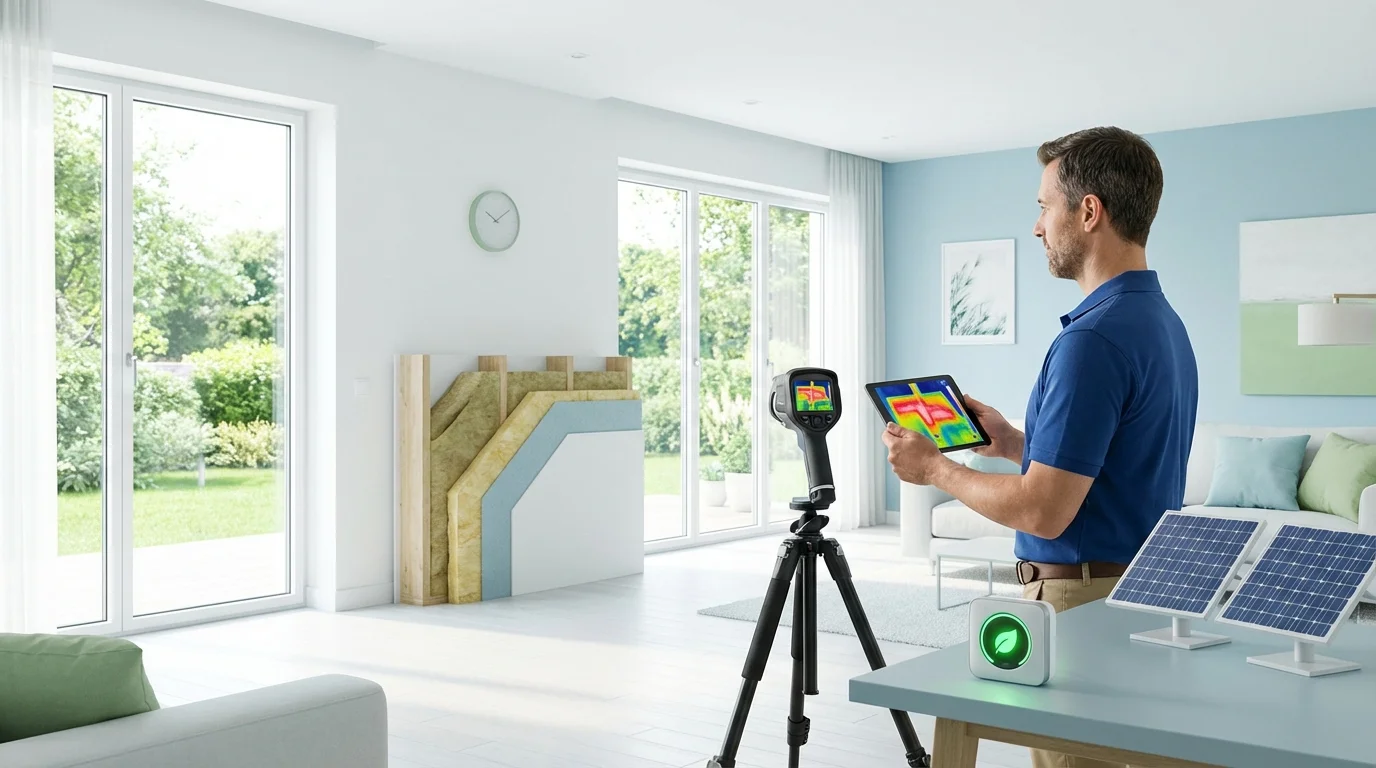
A building science energy audit is a comprehensive home performance assessment that uses diagnostic tools like blower doors and infrared cameras to pinpoint specific energy waste sources. So it provides a prioritized roadmap for 2026 upgrades, unlocking access to federal and state rebates requiring this professional evaluation.
A building science energy audit moves beyond a simple visual inspection. It's a diagnostic process that quantifies your home's energy performance, identifying the precise locations of air leakage, insulation gaps, and inefficient appliance operation. And this data-driven report is often a mandatory prerequisite for accessing thousands of dollars in home improvement rebates. For instance, the Home Electrification and Appliance Rebate (HEAR) program requires an audit to validate the need for upgrades like heat pumps or electrical panel improvements. But without this certified assessment, homeowners are ineligible for up to $14,000 in point-of-sale discounts. So the audit acts as a key, unlocking a direct path to funding for projects that permanently lower your utility bills by 20-40%. A home energy audit is the foundational step toward a more efficient and less costly home.
What Specific Rebate Amounts and Eligible Equipment Qualify After My Energy Audit?
Post-audit, homeowners access specific 2026 rebate amounts up to $14,000 per household for qualifying high-efficiency electric equipment. So this includes up to $8,000 for a heat pump, $1,750 for a heat pump water heater, and $840 for an electric stove.
The results of your building science energy audit directly determine your eligibility for a suite of high-value rebates. And these programs are designed to fund the specific upgrades your audit identifies as most impactful. Qualifying equipment under the 2026 HEAR program includes up to $8,000 for space heating and cooling with heat pump rebates, $4,000 for an electrical panel upgrade, and $2,500 for electrical wiring improvements. So the audit report serves as the official justification for these investments.
"Homeowners can use the HEAR Rebates to save money on the upfront cost of purchasing new, efficient electric appliances, and will also save money on their energy bills in the long run." — U.S. Department of Energy
But the funding isn't limited to HVAC. It also covers up to $1,600 for insulation, air sealing, and ventilation projects, directly addressing the air leakage and thermal deficiencies found during the audit.
How Do My Income, State, and Utility Company Affect My Eligibility for Energy Audit Rebates?
Eligibility for 2026 energy audit rebates is primarily determined by household income relative to the Area Median Income (AMI), with state and utility programs adding further layers. So low-income households (<80% AMI) qualify for 100% of costs covered, while moderate-income households (80-150% AMI) qualify for 50%.
Your geographic location and income level are critical factors. And the federal HEAR program sets the foundation: households earning less than 80% of the Area Median Income get 100% of their project costs covered, up to the $14,000 cap. But households earning between 80% and 150% of AMI are eligible for a 50% rebate on the same upgrades. Many states and utility companies offer their own supplementary programs. For example, a utility in California may offer an additional $500 rebate for an energy audit that a utility in Florida does not. So it's essential to check local programs. Use our free rebate calculator to discover the specific incentives available in your zip code based on your income. These local programs often have separate funding pools and application processes.
What is the Application Process, Key Deadlines, and Current Funding Status for These Programs?
The 2026 application process requires homeowners to first schedule an audit with a certified professional. So after receiving the report, they submit it alongside rebate applications for specific upgrades. Key deadlines are often set by states for Q4 2026, with funding allocated on a first-come, first-served basis.
Navigating the application process requires a specific sequence of actions. First, a homeowner must engage a BPI (Building Performance Institute) certified auditor. And after the audit is complete, the auditor provides a detailed report. This report becomes the core document for rebate applications, which are typically submitted through a state energy office's online portal.
"Many state and local governments and utilities offer energy efficiency incentives. Common programs include weatherization assistance, loans, grants, and rebates." — DSIRE
Funding for these 2026 programs is finite. So once a state's allocation from the federal government is depleted, the program closes to new applicants until the next funding cycle. And with many state programs launching in early 2026, it's critical to act promptly. Checking your state's energy office website provides the most current information on funding status and application deadlines, which often fall around September 30th. Don't forget to check on available energy tax credits as well.
Can I Stack Multiple Rebates, and What Are the Contractor Requirements?
Homeowners can stack federal tax credits with state and utility rebates in 2026, but not two federal rebates for the same upgrade. So contractor requirements are strict, mandating installers be licensed, insured, and often hold certifications like BPI or from the equipment manufacturer.
Combining incentives is a powerful strategy to reduce project costs. And a homeowner can combine a federal IRA tax credit, like the 30% credit for geothermal systems, with a state-level HEAR rebate. But a homeowner cannot claim a HEAR rebate and a federal tax credit for the same heat pump installation. So careful planning is required to maximize savings. Contractor choice is not optional; it's a requirement for eligibility. Most rebate programs mandate that all work, from the initial audit to the final installation, be performed by professionals holding specific credentials. This ensures the work meets quality and safety standards, guaranteeing the projected energy savings. Always verify a contractor's credentials on the state licensing board's website before signing a contract. A list of approved contractors is often available on your state's energy office rebate portal. This protects both your investment and your eligibility for geothermal tax credit incentives.
| Program Feature | Federal HEAR Rebates | Typical State Program (e.g., NYSERDA) | Typical Utility Program |
|---|---|---|---|
| Max Incentive | $14,000 per household | $5,000 - $10,000 | $500 - $2,000 |
| Income Eligibility | <150% Area Median Income | Varies; often tiered | Often available to all customers |
| Eligible Upgrades | Heat pumps, insulation, electrical | Comprehensive retrofits, audits | Specific appliances (e.g., smart thermostats) |
| 2026 Deadline | Varies by state | Typically Q3 or Q4 | Often ongoing until funds are depleted |
Official Sources
- ENERGY STAR — A U.S. Environmental Protection Agency program providing credible, objective information on energy-efficient products and practices.
- Database of State Incentives for Renewables & Efficiency (DSIRE) — The most comprehensive source of information on incentives and policies that support renewables and energy efficiency in the United States.
- IRS.gov Clean Energy Credits — Official guidance from the Internal Revenue Service on federal tax credits for energy-efficient home improvements. (note: the federal 25C and 25D credits ended for projects completed after December 31, 2025)
Related Reading: Learn more about Energy Audit Condo Apartment and Energy Audit Log Cabin.
Frequently Asked Questions
Who qualifies for a building science energy audit rebate?
Eligibility primarily depends on household income and location. For the federal HEAR program in 2026, households earning less than 150% of the Area Median Income (AMI) qualify. Those under 80% of AMI receive up to 100% of the cost covered, while those between 80-150% of AMI receive up to 50%. Many state and utility programs offer rebates to all homeowners regardless of income, so check local listings.
What is the typical cost of a building science energy audit, and can it be rebated?
A comprehensive building science energy audit typically costs between $400 and $900, depending on the home's size and the tests performed. And yes, the cost of the audit itself is often eligible for a rebate. Some state and utility programs offer a specific rebate for the audit, often covering $150 to $500 of the fee, or they roll the cost into the larger project rebate if you proceed with the recommended upgrades.
What can I expect during a building science energy audit of my home?
An audit takes 2-4 hours and involves a certified technician performing several diagnostic tests. This includes a blower door test to measure air leakage, infrared thermal imaging to find insulation gaps, and a combustion safety test for gas appliances. The auditor will also inspect your HVAC system, water heater, and insulation levels in the attic and walls, providing a detailed report with prioritized recommendations.
Are there specific deadlines to complete an energy audit for rebate eligibility?
Yes, deadlines are critical. While federal IRA funding extends through December 31, 2025, state-administered programs like HEAR operate on annual funding cycles. For 2026, many states will have application deadlines in the third or fourth quarter (e.g., September 30, 2026) to process claims before their fiscal year ends. Since funding is often first-come, first-served, completing your audit early in the year is advantageous.
How does a building science energy audit differ from a basic home energy assessment?
A basic assessment is often a free, visual walk-through offered by a utility, providing general tips. A building science energy audit is a paid, diagnostic service using specialized equipment like blower doors and infrared cameras. It provides quantifiable data on air leakage rates (CFM50), insulation effectiveness (R-value), and appliance efficiency. This detailed report is required for most high-value 2026 rebates.
Unlock Your Home's Rebate Potential
Stop guessing how much you can save. A building science audit is your first step. Use the DuloCore Rebate Calculator to find every state, federal, and utility incentive you qualify for in under 2 minutes.
Calculate Your Savings NowUpdated: April 14, 2026 — fact-checked by DuloCore Research. About our editorial process.