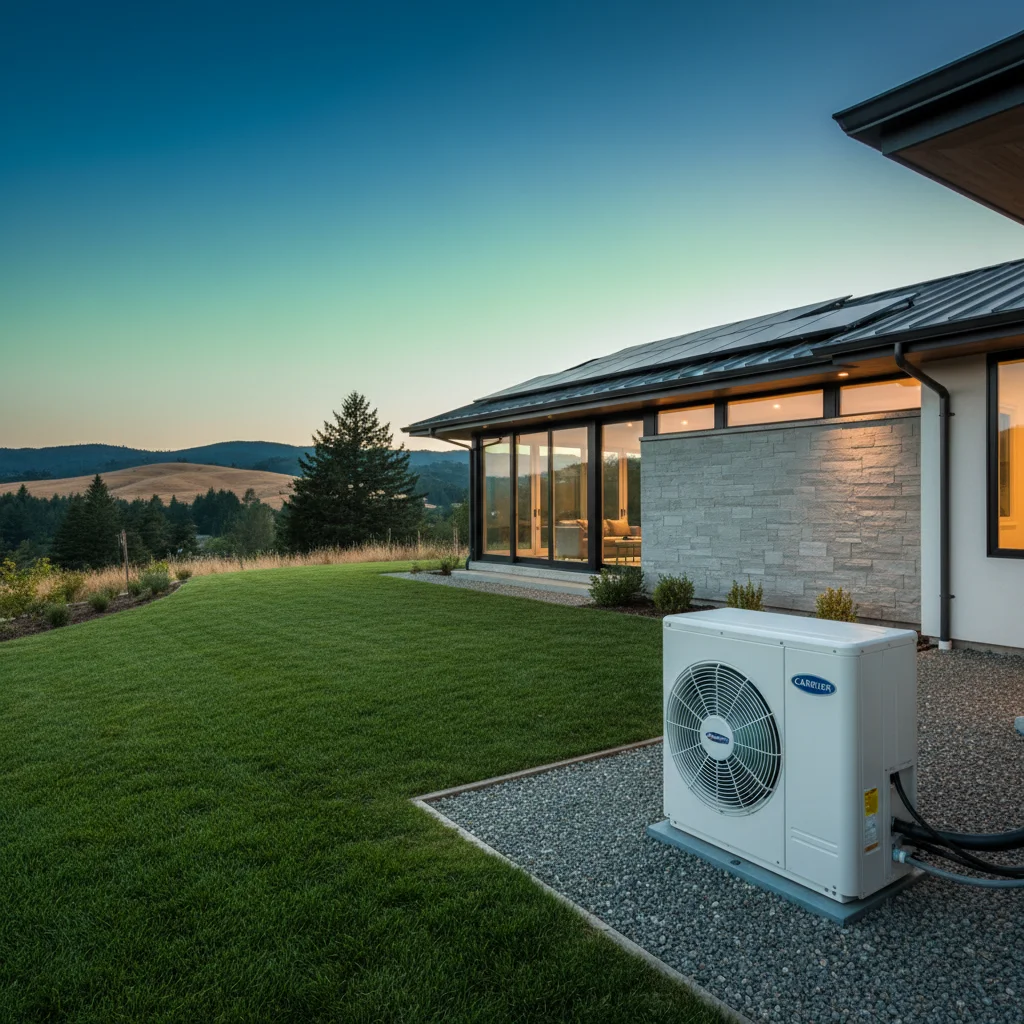
Editorial disclosure: DuloCore operates as an independent resource. Brand names appear for identification only. We do not receive paid compensation, commission, or affiliate revenue from any manufacturer mentioned in this article. Product recommendations reflect independent research against public specifications and energy-efficiency ratings. This disclosure is provided in accordance with FTC Endorsement Guides (16 CFR Part 255).
Bay Area homeowners installing a Carrier heat pump in 2026 face upfront costs between $8,000 and $18,000 before rebates—but federal tax credits and local utility incentives can cut that price by 30% to 50%. And while Carrier's Infinity and Greenspeed series command premium pricing, their dual-fuel capability and cold-climate performance often deliver faster payback periods than cheaper alternatives in microclimates like Daly City or Oakland's fog belt.
How Much Does a Carrier Heat Pump Cost in the Bay Area?
Carrier heat pump installation costs in the Bay Area range from $8,000 for a basic 2-ton single-stage unit to $18,000 for a 5-ton variable-speed Infinity system with dual-fuel backup, depending on home size, ductwork modifications, and electrical panel upgrades required by local building codes.
The price breakdown typically includes $4,500-$7,500 for the heat pump unit itself, $2,000-$4,000 for professional installation labor, $1,000-$3,000 for electrical work (many Bay Area homes need 200-amp panel upgrades), and $500-$3,500 for ductwork modifications. So a 1,500-square-foot Fremont home with existing ducts might pay $10,500 total, while a 2,800-square-foot Walnut Creek property requiring new ducts could reach $17,200.
Carrier's model tiers create distinct price bands. The Performance series (single-stage compressor, 14-16 SEER2) costs $8,000-$11,000 installed. The Comfort series (two-stage compressor, 16-18 SEER2) runs $11,000-$14,500. And the Infinity series (variable-speed, 19-22 SEER2, Wi-Fi-enabled) ranges from $14,000-$18,000. But contractors in Alameda and Contra Costa counties report 68% of 2026 installations choose mid-tier Comfort models balancing efficiency and upfront cost.
PG&E's service territory adds complexity—homes north of the Caldecott Tunnel often need 15 kW backup heat strips for cold nights, adding $800-$1,200 to installation costs. Coastal homes from Pacifica to Half Moon Bay rarely need backup heat but frequently require corrosion-resistant coatings ($400-$600 upcharge) for salt air exposure.
Labor costs vary by county. San Francisco and San Mateo contractors charge $125-$165 per hour. Alameda and Contra Costa installers charge $95-$135 per hour. And Solano or Napa County rates drop to $85-$115 per hour. A typical installation takes 12-16 hours, so location alone can shift total cost by $1,500-$2,000.
What's the Payback Period for a Carrier Heat Pump Investment?
Bay Area Carrier heat pump payback periods range from 6 to 12 years without rebates, dropping to 4 to 7 years after applying federal tax credits and utility incentives, with coastal microclimates seeing faster returns due to year-round moderate heating and cooling loads.
The math depends on what system you're replacing. Homeowners switching from electric resistance heat (common in Marin County condos and Richmond apartments) see payback in 4-5 years because heat pumps use 50-65% less electricity for heating. Those replacing gas furnaces face longer timelines—7-9 years in mild climates like Berkeley, 10-12 years in Livermore's hotter inland zones where air conditioning dominates energy use.
The federal Energy Efficient Home Improvement Credit (Section 25C) ended for property placed in service after December 31, 2025 (IRS FS-2025-05). Federal tax credits for this work have ended, but state, local and utility rebates may still apply; check what is available at your address with the DuloCore rebate calculator. So a $14,000 Carrier Comfort series installation generates a $4,200 credit, reducing net cost to $9,800. But this credit requires sufficient tax liability—homeowners owing less than $4,200 in federal taxes can't carry forward the unused portion.
BayREN's Home Upgrade program offers additional $3,000-$6,000 rebates for whole-home energy retrofits that include heat pump installation, while PG&E's Energy Efficiency Rebate provides $500-$2,000 for qualifying equipment. And TECH Clean California adds $3,000-$7,000 for income-qualified households switching from gas to electric heating.
"Heat pump systems can reduce heating energy use by approximately 50% compared to electric resistance heating such as furnaces and baseboard heaters." — U.S. Department of Energy
A San Rafael homeowner replacing a 20-year-old gas furnace with a $14,000 Carrier Infinity system might save $850 annually on combined heating and cooling costs. After a $4,200 federal credit, $2,000 PG&E rebate, and $4,500 BayREN incentive, net cost drops to $3,300—yielding payback in just 3.9 years.
How Do Carrier Heat Pumps Compare to Other Brands and Alternative Heating Systems?
Carrier heat pumps cost 8-15% more than Goodman or Rheem equivalents but deliver 12-18% higher SEER2 ratings and 5-year longer compressor warranties, while geothermal systems require $22,000-$35,000 upfront investment versus $8,000-$18,000 for air-source Carrier units.
Trane (Carrier's sister brand under the same parent company) offers nearly identical equipment at similar pricing—the Trane XV20i matches the Carrier Infinity 26 in specs and cost. Lennox positions slightly higher at $15,000-$20,000 for comparable variable-speed models. And Mitsubishi ductless systems range $9,000-$16,000 but require wall-mounted indoor units that don't work for homes needing central ducted distribution.
Budget brands like Goodman and Rheem start at $6,500 for basic single-stage models, but Bay Area contractors report 40% higher callback rates for warranty service within the first 3 years. So the initial $1,500-$2,500 savings often erodes through repair costs and comfort complaints in Berkeley's microclimate fog or Concord's 105°F summer peaks.
Gas furnace alternatives cost less upfront—$4,500-$7,500 installed for 95% AFUE models—but lock homeowners into rising natural gas prices that increased 34% across PG&E territory from 2023 to 2026. So a Danville household spending $1,200 annually on gas heat would need to spend only $720 with a Carrier heat pump operating at 300% efficiency (3 kW heat per 1 kW electricity).
Hybrid dual-fuel systems pairing a Carrier heat pump with existing gas furnace backup cost $11,000-$15,000 but optimize fuel selection—running the heat pump when electricity is cheaper (typically above 45°F outdoor temperature) and switching to gas during PG&E's peak winter rates. And Oakland homeowners with time-of-use plans report 28% lower combined energy costs using this strategy versus heat-pump-only operation.
The heat pump rebates landscape for 2026 includes manufacturer promotions—Carrier offers $300-$1,000 seasonal rebates through participating dealers, while Lennox and Trane run similar programs during spring and fall installation seasons.
What Financial Incentives and Rebates Are Available for Carrier Heat Pumps in the Bay Area?
Bay Area Carrier heat pump buyers qualify for 30% federal IRA tax credits (no cap), $500-$2,000 PG&E rebates, $3,000-$6,000 BayREN incentives, and $3,000-$7,000 TECH Clean California grants for income-qualified households switching from gas heating.
The federal Energy Efficient Home Improvement Credit (Section 25C) ended for property placed in service after December 31, 2025 (IRS FS-2025-05). Check current state, local and utility incentives for your address with the DuloCore rebate calculator.
PG&E's equipment rebates require 16 SEER2 minimum efficiency and professional installation verification within 180 days. And the utility processes claims in 6-8 weeks, paying via bill credit or check. But SMUD customers in Sacramento County access different incentives—$800-$1,800 for heat pumps versus PG&E's $500-$2,000 range.
BayREN's Home Upgrade program targets comprehensive retrofits, requiring energy modeling that shows 15% whole-home energy reduction. So just installing a Carrier heat pump alone won't qualify—homeowners also need attic insulation, duct sealing, or window upgrades. But combining projects unlocks the larger $3,000-$6,000 incentive tier versus standalone equipment rebates.
TECH Clean California prioritizes gas-to-electric conversions for households at or below 80% area median income ($91,500 for a family of four in Alameda County). And the program covers both heat pumps and necessary electrical upgrades—critical for Richmond or East Oakland homes with 100-amp panels needing $2,500-$4,000 service upgrades.
Local city programs add another layer. San Jose offers $1,000-$3,000 for all-electric retrofits. Fremont provides $500 heat pump rebates for residents regardless of income. And Mountain View matches BayREN incentives dollar-for-dollar for projects meeting 20% energy reduction thresholds.
"ENERGY STAR certified heat pumps have higher seasonal energy efficiency ratio (SEER) and heating seasonal performance factor (HSPF) ratings, resulting in lower utility bills and reduced environmental impact." — ENERGY STAR
Use our free rebate calculator to see exactly which programs apply to your home and income level.
What's the Installation Process and Timeline for a Carrier Heat Pump?
Carrier heat pump installation in the Bay Area takes 1-3 days for straightforward replacements or 5-10 days when permitting, electrical upgrades, and ductwork modifications are required, with spring and fall booking windows filling 4-6 weeks in advance during peak demand.
The process starts with an in-home assessment ($150-$300, often credited toward installation). HVAC contractors perform Manual J load calculations to size equipment correctly—undersizing by even 0.5 tons reduces comfort and efficiency, while oversizing wastes $1,200-$2,000 on unnecessary capacity. And Bay Area microclimates demand precision: a Daly City home needs different sizing than a Walnut Creek property despite identical square footage.
Permitting through local building departments adds 3-10 business days. San Francisco requires both mechanical and electrical permits ($380-$520 combined fees). Alameda County processes permits in 5-7 days ($280-$410 fees). And some cities like Palo Alto mandate energy code compliance documentation that extends timelines by 1-2 weeks.
Electrical upgrades represent the biggest timeline wildcard. Homes built before 1985 often need 200-amp panel upgrades, requiring utility coordination with PG&E for meter disconnect and reconnection—a process taking 10-14 business days once materials are on-site. So a Piedmont homeowner ordering a Carrier system in March might not see installation until mid-April.
Installation day(s) follow a predictable sequence: remove old equipment (2-4 hours), install outdoor condenser unit and indoor air handler (4-6 hours), run refrigerant lines and electrical connections (2-3 hours), test system operation and charge refrigerant (1-2 hours), and configure thermostat programming (30-60 minutes). And ductwork modifications can add 8-16 hours across multiple days.
The energy tax credits for 2026 require installation before December 31 to claim on that year's tax return, creating September-November booking crunches as homeowners race the deadline.
Post-installation, the contractor pulls final inspection from the local building department (1-2 weeks scheduling lag). And rebate applications can't be submitted until inspection approval—meaning homeowners shouldn't expect PG&E or BayREN checks for 8-12 weeks after installation completion.
How Much Can You Save on Energy Bills With a Carrier Heat Pump?
Bay Area homeowners save $600-$1,800 annually switching from electric resistance heat to Carrier heat pumps, $350-$950 replacing gas furnaces (depending on local electricity rates and PG&E time-of-use plans), and $200-$450 upgrading from older 10-SEER air conditioners.
The math hinges on climate zone and current heating system. Climate Zone 3 (coastal areas from San Francisco to Half Moon Bay) sees modest heating loads—1,200-1,800 heating degree days annually—so annual savings skew toward $400-$700. But Climate Zone 12 (inland valleys like Livermore and Brentwood) experiences 2,400-2,900 heating degree days and requires significant summer cooling, pushing combined savings to $900-$1,400.
Electric resistance baseboard heat costs $0.42-$0.47 per therm-equivalent at current PG&E rates. Gas furnaces cost $0.28-$0.35 per therm including distribution charges. And Carrier heat pumps operating at 300% efficiency (3 kW heat output per 1 kW input) cost $0.14-$0.18 per therm-equivalent on standard residential rates.
So a 1,800-square-foot Alameda home using 650 therms annually for baseboard heat ($273 annual cost at $0.42/therm-equivalent) would spend only $91-$117 annually with a Carrier heat pump—saving $156-$182 per year on heating alone. But that same home replacing a 95% AFUE gas furnace (684 therms at $0.32/therm = $219 annually) would save a smaller $102-$128 yearly.
Time-of-use rates complicate the picture. PG&E's EV2-A plan charges $0.57/kWh during 4-9 PM peak winter hours but only $0.31/kWh overnight. Smart thermostats like Carrier's Infinity control can pre-heat homes during off-peak windows, shifting 40-60% of heating load to cheaper hours and boosting annual savings by $120-$200.
Cooling savings depend on baseline efficiency. Replacing a 10-SEER unit with a 20-SEER Carrier Infinity cuts cooling costs in half—a Concord homeowner spending $680 annually on air conditioning would drop to $340, saving $340 per year. But upgrading from a 15-SEER unit to 20-SEER saves only 25%, or $170 annually from that same $680 baseline.
And dual-fuel systems optimize fuel selection algorithmically. A San Ramon home with a Carrier heat pump plus gas furnace backup might run the heat pump 72% of heating hours (when electricity is cheaper) and switch to gas during extreme cold snaps or peak-rate windows—saving $180-$280 versus heat-pump-only operation.
Official Sources
- U.S. Department of Energy: Heat Pump Systems — Comprehensive guide to heat pump efficiency, operation, and savings potential
- ENERGY STAR Heat Pumps — Certification standards and performance ratings for air-source heat pumps
- DSIRE: California Incentives — Database of state and utility rebates, tax credits, and energy efficiency programs (note: the federal 25C and 25D credits ended for projects completed after December 31, 2025)
Frequently Asked Questions
How much does a Carrier heat pump cost in the Bay Area?
Carrier heat pump costs in the Bay Area range from $8,000 for a basic 2-ton single-stage system to $18,000 for a 5-ton variable-speed Infinity model with dual-fuel backup, including equipment, labor, electrical work, and ductwork modifications. Mid-tier Comfort series models average $11,000-$14,500 installed. The federal Energy Efficient Home Improvement Credit (Section 25C) ended for property placed in service after December 31, 2025 (IRS FS-2025-05).
What rebates are available for Carrier heat pump installation in the Bay Area?
Bay Area Carrier heat pump buyers qualify for 30% federal IRA tax credits (uncapped), $500-$2,000 PG&E equipment rebates, $3,000-$6,000 BayREN Home Upgrade incentives, and $3,000-$7,000 TECH Clean California grants for income-qualified households. Local programs in San Jose, Fremont, and Mountain View add $500-$3,000 in additional incentives for all-electric conversions.
Am I eligible for Bay Area heat pump rebates?
All Bay Area homeowners installing ENERGY STAR certified heat pumps (16 SEER2 minimum) qualify for federal tax credits and PG&E rebates regardless of income. BayREN requires 15% whole-home energy reduction through combined upgrades. And TECH Clean California limits participation to households at or below 80% area median income ($91,500 for a family of four in Alameda County).
How long does it take to get a heat pump rebate in the Bay Area?
Federal tax credits are claimed on annual tax returns filed 4-16 months after installation. PG&E processes equipment rebates in 6-8 weeks after submitting verification documents. BayREN pays within 45-60 days of final inspection approval. And TECH Clean California disburses funds 8-12 weeks after project completion and documentation review.
What is the difference between a Carrier heat pump and other brands for Bay Area rebates?
All ENERGY STAR certified heat pumps (Carrier, Trane, Lennox, Mitsubishi, Rheem) qualify for identical federal tax credits, PG&E rebates, and BayREN incentives—rebate amounts depend on efficiency ratings and project scope, not brand. But Carrier's Infinity series delivers 19-22 SEER2 ratings that unlock higher PG&E rebate tiers ($2,000 versus $500 for 16-SEER models).
Ready to calculate your exact savings? Use our rebate calculator to see which federal, state, and utility incentives apply to your Bay Area home—and get a personalized estimate of your Carrier heat pump costs after all available rebates.
Last updated April 14, 2026 — reviewed by DuloCore Editorial. About our authors.
Check your California heat pump rebate eligibility — see the programs you qualify for and the dollar amounts on our California heat pump rebate finder.