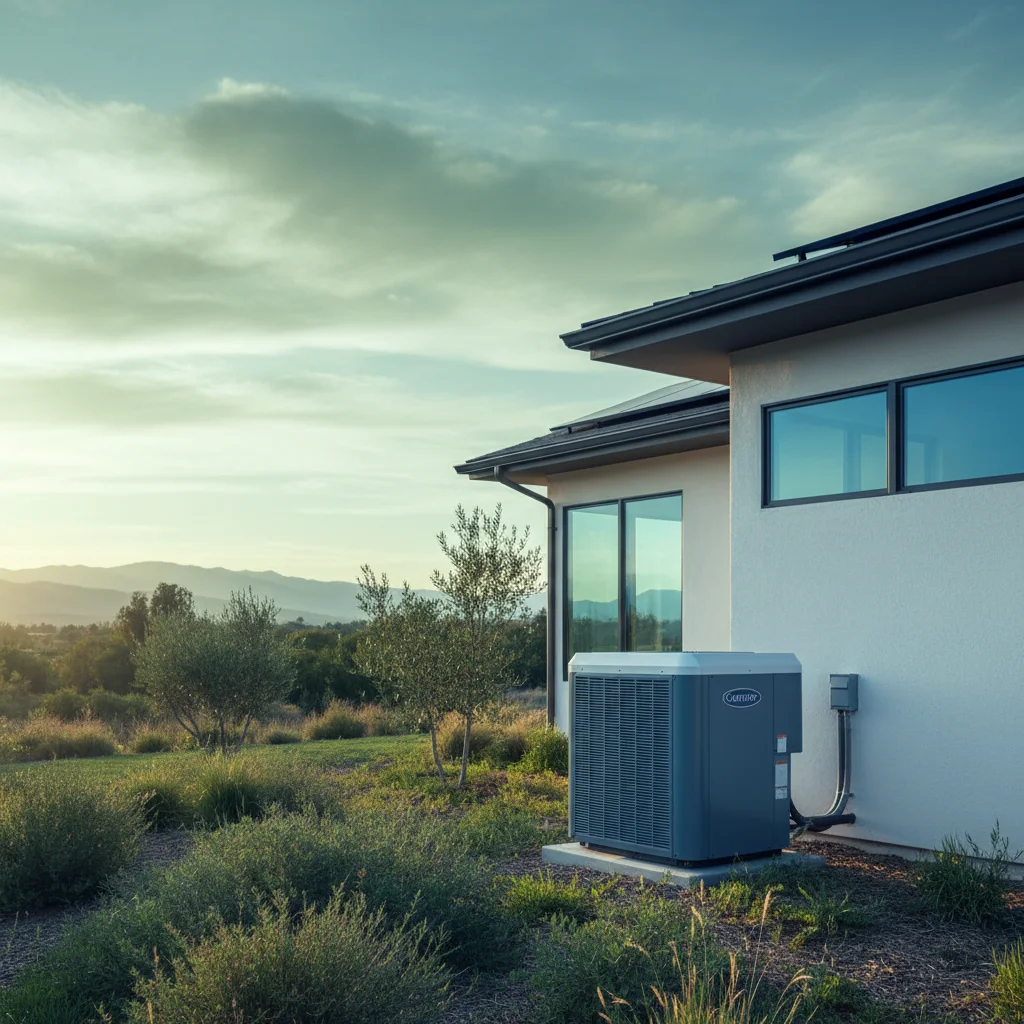
Central Valley homeowners paid between $8,000 and $18,000 for Carrier heat pump installations in 2025, but federal tax credits and California utility rebates now cut that upfront cost by $2,000 to $6,000 in 2026. And the gap between premium Carrier Infinity models and budget Comfort series units hit $7,000 last year—a spread that changes the payback math entirely when electricity rates in Fresno and Bakersfield climbed to $0.28 per kilowatt-hour during summer peak hours.
So homeowners replacing aging air conditioners with Carrier heat pumps face a choice: pay $12,000 for a 16-SEER unit that barely qualifies for rebates, or spend $16,500 for a 20-SEER Infinity system that unlocks maximum incentives and cuts cooling costs by 42% compared to standard AC. But the real cost isn't the sticker price—it's the total spend over 15 years when Central Valley homes run cooling 6 months annually and mild winters let heat pumps replace gas furnaces without backup resistance heat.
How Much Does a Carrier Heat Pump Cost in the Central Valley?
Carrier heat pump installations in the Central Valley range from $8,000 for a 2-ton Comfort 16 model to $18,000 for a 5-ton Infinity 20 with variable-speed compressor and smart thermostat. Equipment accounts for $4,500 to $11,000, while labor, permits, and ductwork modifications add $3,500 to $7,000 depending on home size and existing HVAC infrastructure.
And contractor quotes in Fresno, Modesto, and Bakersfield average $375 per ton for basic installations, but jump to $550 per ton when homes need electrical panel upgrades or duct sealing to meet Title 24 efficiency standards. A 3-ton Carrier Infinity 18VS with Wi-Fi thermostat costs $13,200 installed in a 1,800-square-foot ranch, while the same home needing a 200-amp panel upgrade pays $15,400 total.
But Carrier's mid-tier Performance series delivers 18-SEER efficiency for $10,500 to $14,000 installed—a sweet spot that qualifies for federal tax credits and SMUD rebates without the $3,000 premium Infinity models command. So most Central Valley contractors stock Performance 17 and 18 models because they hit rebate thresholds at price points 28% below Infinity units.
Tonnage requirements drive costs more than brand. Central Valley homes need 400-600 square feet of cooling per ton, so a 2,000-square-foot house requires a 3.5- to 4-ton unit costing $11,000 to $15,000 installed. And poorly insulated older homes in Stockton and Visalia often need 5-ton systems costing $16,000 to $18,000 because attic temperatures hit 140°F in July.
What's the Payback Period for a Carrier Heat Pump Investment?
Carrier heat pumps in Central Valley homes achieve payback in 8 to 12 years when replacing electric resistance heat or window air conditioners, but extend to 14 to 18 years when replacing efficient natural gas furnaces. Annual savings range from $420 for mild-climate Modesto homes to $890 for Bakersfield properties running cooling April through October.
And PG&E customers see faster payback than SMUD territory because tiered electricity rates penalize heavy summer use—a 3-ton Carrier heat pump saves $680 annually in Fresno versus $520 in Sacramento for identical 2,200-square-foot homes. So geography matters as much as equipment efficiency when calculating return on investment.
But federal tax credits and utility rebates shorten payback by 2.5 to 4 years. A homeowner spending $14,000 on a Carrier Infinity 18 receives a $2,100 federal credit plus $2,500 SMUD rebate, dropping net cost to $9,400 and payback period from 16 years to 11 years at $850 annual savings. Use our free rebate calculator to model your specific savings based on zip code and current heating system.
"Heat pumps in California's Central Valley climate zone 13 deliver average seasonal performance factors of 3.2, meaning homeowners get $3.20 of heating or cooling for every $1 of electricity consumed" — ENERGY STAR Heat Pump Guide
Electricity rate trends accelerate payback. PG&E rates increased 62% from 2019 to 2025, and California Public Utilities Commission projections show 4-6% annual increases through 2030. So a heat pump saving $600 annually in 2026 will save $820 annually by 2030 as natural gas furnace costs stay flat but electricity-powered heat pumps lock in efficiency gains.
How Does a Carrier Heat Pump Compare to Other Heating and Cooling Alternatives?
Carrier heat pumps cost $8,000 to $18,000 installed versus $5,500 to $9,000 for standard air conditioner plus gas furnace combinations in Central Valley homes. But heat pumps eliminate natural gas service charges averaging $22 monthly, saving $264 annually before counting energy efficiency gains.
And Carrier's Greenspeed variable-capacity compressors modulate output from 40% to 100%, reducing energy use 35% compared to single-stage AC units that run full-blast or shut off completely. So a Carrier Infinity 20 uses 2,100 kilowatt-hours annually to cool a 2,000-square-foot Fresno home versus 3,200 kWh for a 14-SEER air conditioner—a $308 annual savings at $0.28 per kWh.
But geothermal heat pumps outperform air-source Carrier models with 400% efficiency versus 320% for the best air-source units. Geothermal installations cost $18,000 to $35,000 in the Central Valley due to drilling or trenching for ground loops, pushing payback to 18-25 years despite 40% lower operating costs. So air-source Carrier heat pumps dominate residential installations because upfront costs stay manageable.
Ductless mini-split heat pumps from Mitsubishi and Daikin cost $3,500 to $8,000 per zone but require outdoor units for each indoor head. A whole-home ductless system serving 4 zones costs $14,000 to $22,000—similar to ducted Carrier systems but with zone-by-zone temperature control that cuts cooling costs 18% in homes where families occupy 2-3 rooms most hours. Learn more about heat pump rebates for different system types.
How Long Will Your Carrier Heat Pump Last?
Carrier heat pumps last 15 to 20 years in Central Valley climates when maintained with annual filter changes and biennial refrigerant checks. Heat pump lifespan matches traditional air conditioners but exceeds gas furnaces, which last 18 to 25 years but require heat exchanger inspections every 5 years to prevent carbon monoxide leaks.
And variable-speed Carrier Infinity models extend lifespan to 18-22 years because soft-start compressors reduce mechanical stress compared to single-stage units that slam on at full power. So the $3,000 premium for Infinity systems amortizes over 20 years instead of 15, lowering annual ownership cost from $933 to $825 for a $16,500 installation.
But Central Valley dust and agricultural particulates shorten outdoor coil life 2-3 years unless homeowners install MERV 13 filters and rinse condenser fins quarterly. Bakersfield and Fresno HVAC contractors report compressor failures at year 12-14 for neglected units versus year 18-20 for maintained systems—a $4,500 replacement cost that wipes out 3 years of energy savings.
Carrier's 10-year parts warranty covers compressor and heat exchanger but excludes labor, which averages $450 for refrigerant recharge or $1,200 for reversing valve replacement. Extended warranties cost $350 to $800 depending on coverage tier, but most contractors recommend self-insuring because repair frequency stays low until year 12.
What Financial Incentives and Rebates Are Available for Central Valley Homeowners?
Central Valley homeowners installing Carrier heat pumps in 2026 qualify for federal tax credits up to 30% of installation costs capped at $2,000, plus California utility rebates ranging from $2,000 to $3,000 for ENERGY STAR certified systems. Combined incentives reduce net cost by $4,000 to $5,000 for qualifying installations.
And SMUD offers $2,500 rebates for heat pumps rated 18-SEER or higher, while PG&E provides $3,000 for all-electric home conversions that eliminate natural gas service. So Sacramento homeowners installing a $14,000 Carrier Performance 18 receive $2,500 from SMUD plus $2,000 federal credit, dropping net cost to $9,500.
But income-qualified homeowners in San Joaquin, Stanislaus, and Fresno counties unlock additional incentives through California's TECH Clean California program, which provides $3,000 to $5,000 supplemental rebates for households earning below 80% area median income. And low-income programs waive the requirement to bundle heat pumps with insulation or air sealing, reducing total project costs by $2,500 to $4,000.
The federal Energy Efficient Home Improvement Credit (Section 25C) ended for property placed in service after December 31, 2025 (IRS FS-2025-05).
Form 5695 only covers qualifying work completed by December 31, 2025 and claimed on a 2025 return; the federal 25C and 25D credits ended after that date (IRS FS-2025-05). Federal tax credits for this work have ended, but state, local and utility rebates may still apply; check what is available at your address with the DuloCore rebate calculator. And homeowners must own the property where equipment installs, excluding rental properties unless owner-occupied. Check energy tax credits for complete eligibility details.
What's the Installation Process and Timeline for a Carrier Heat Pump?
Carrier heat pump installations take 1 to 3 days for straightforward replacements but extend to 5 to 7 days when homes need electrical upgrades, ductwork modifications, or Title 24 compliance testing. Contractors schedule site assessments 1-2 weeks before installation to calculate Manual J load requirements and identify permit needs.
And Central Valley jurisdictions require HVAC permits costing $150 to $400 plus Title 24 energy compliance forms submitted before final inspection. Fresno and Bakersfield building departments process permits in 3-5 business days, while Modesto and Stockton take 7-10 days during summer peak season when installation demand spikes.
But equipment lead times vary by model—Carrier Comfort and Performance series ship within 5-7 days, while custom Infinity configurations take 2-3 weeks for factory builds. So homeowners ordering heat pumps in March or April for summer installation avoid 4-6 week delays that hit June and July when Central Valley temperatures reach 105°F and contractors run 3-week backlogs.
Installation day one covers outdoor condenser placement, refrigerant lines, and electrical connections. Day two handles indoor air handler installation, thermostat wiring, and ductwork integration. And day three completes system commissioning, Title 24 testing, and homeowner training on thermostat operation. Most contractors charge 50% upfront and 50% upon final inspection approval.
Official Sources
- ENERGY STAR Heat Pumps — Federal efficiency standards and qualified product lists
- U.S. Department of Energy - SAVE — Tax credit details and energy efficiency guidance (note: the federal 25C and 25D credits ended for projects completed after December 31, 2025)
- DSIRE USA — State and utility rebate database for California programs
Frequently Asked Questions
Do Carrier heat pumps qualify for the 25C tax credit in 2026?
No, Section 25C expired December 31, 2025. The federal Energy Efficient Home Improvement Credit (Section 25C) ended for property placed in service after December 31, 2025 (IRS FS-2025-05). And systems must meet ENERGY STAR Most Efficient criteria or 16-SEER minimum ratings to qualify.
How much does a Carrier heat pump cost in the Central Valley?
Carrier heat pump installations cost $8,000 to $18,000 in Central Valley markets depending on tonnage, efficiency rating, and home modifications. A 3-ton Carrier Performance 17 costs $10,500 to $12,000 installed in standard applications, while 5-ton Infinity 20 models reach $16,000 to $18,000 with smart controls and electrical upgrades. Equipment accounts for 55-60% of total cost, labor and permits add 40-45%.
What rebates are available for Carrier heat pump installation?
SMUD customers receive $2,500 rebates for 18-SEER or higher systems, PG&E offers $3,000 for all-electric conversions, and federal tax credits cover 30% of costs up to $2,000. Income-qualified households access additional $3,000 to $5,000 through TECH Clean California programs. Combined incentives reduce net installation cost by $4,000 to $7,000 depending on utility territory and household income.
How long does it take to install a Carrier heat pump?
Standard Carrier heat pump installations take 1 to 3 days including permitting, equipment setup, and final inspection. Homes needing electrical panel upgrades or significant ductwork modifications require 5 to 7 days. And permit processing adds 3 to 10 days depending on jurisdiction, while equipment lead times range from 5 days for stock models to 3 weeks for custom Infinity configurations during peak season.
What is the difference between Carrier and other heat pump brands for rebates?
Carrier, Trane, Lennox, and other major brands qualify for identical rebates when meeting ENERGY STAR efficiency thresholds—rebate programs don't favor specific manufacturers. But Carrier's Infinity and Performance series exceed minimum requirements by wider margins, giving homeowners buffer against future rebate threshold increases. And some California utility programs require third-party verification that favors established brands with extensive contractor networks like Carrier.
Ready to calculate your savings? Use our rebate calculator to see exactly how much you'll save on a Carrier heat pump installation in your Central Valley zip code, including all federal, state, and utility incentives you qualify for.
Updated: April 14, 2026 — fact-checked by DuloCore Research. About our editorial process.
Check your California heat pump rebate eligibility — see the programs you qualify for and the dollar amounts on our California heat pump rebate finder.