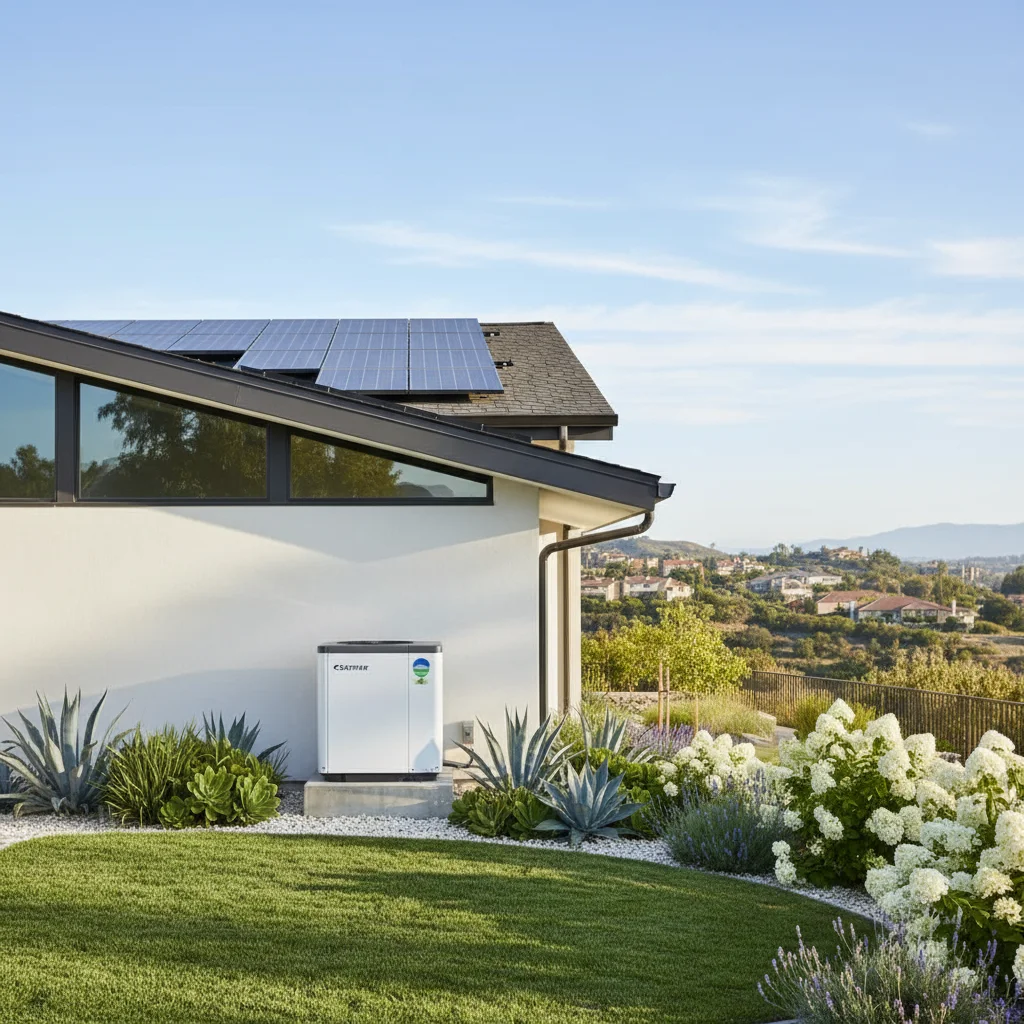
Editorial disclosure: DuloCore operates as an independent resource. Brand names appear for identification only. We do not receive paid compensation, commission, or affiliate revenue from any manufacturer mentioned in this article. Product recommendations reflect independent research against public specifications and energy-efficiency ratings. This disclosure is provided in accordance with FTC Endorsement Guides (16 CFR Part 255).
Orange County homeowners paid between $8,000 and $18,000 for Carrier heat pump installations in 2025, but new federal and state rebate programs launched in 2026 now cut that cost by up to $10,000. The gap between quoted prices and actual out-of-pocket costs has never been wider.
How Much Does a Carrier Heat Pump Cost in Orange County?
Carrier heat pump installations in Orange County range from $8,000 to $18,000 in 2026, with 3-ton systems averaging $12,500 installed and 5-ton systems reaching $16,800. System cost depends on SEER2 rating, ductwork modifications, and home square footage.
And the price breakdown reveals where money goes. Equipment accounts for 40% of total cost at $3,200 to $7,200. Labor runs $2,400 to $4,800. Ductwork modifications add $1,200 to $3,600 for homes with existing HVAC. Electrical panel upgrades cost $800 to $2,000 when current systems can't handle the heat pump's 240-volt requirements.
So three factors drive final pricing. SEER2 ratings separate basic from premium models—a 15 SEER2 Carrier Comfort model costs $8,000 installed while a 20 SEER2 Infinity system hits $16,000. Home size determines tonnage requirements, with most Orange County homes needing 3 to 5 tons of capacity. Installation complexity varies by property, with older homes requiring more electrical and ductwork updates than new construction.
But contractors quote vastly different prices for identical systems. Three quotes for the same Carrier Performance 16 SEER2 unit ranged from $11,200 to $14,800 in a 2025 Orange County consumer survey. And the lowest bid wasn't always the best value—warranty coverage, installation quality, and included services varied significantly.
"Heat pump costs have increased 12% since 2023 due to refrigerant transition requirements and supply chain factors." — U.S. Department of Energy
What Is the ROI and Payback Period for a Carrier Heat Pump Investment?
Carrier heat pump installations in Orange County deliver 8- to 12-year payback periods based on 2026 energy costs, with annual savings of $840 to $1,680 for homes replacing natural gas furnaces and central air conditioning systems.
Payback calculations require comparing total installation costs against annual operating savings. A $12,500 Carrier system replacing gas heat and AC saves $1,200 annually in a 2,000-square-foot home, creating a 10.4-year payback. And that assumes stable energy rates—Southern California Edison's 2026 rate increases shortened payback periods by 14 months compared to 2024 projections.
So ROI varies by replaced system type. Homes ditching electric resistance heat see 5- to 7-year paybacks with $2,100 annual savings. Natural gas replacement yields 10- to 12-year paybacks at $1,000 annual savings. New construction installations without baseline comparison show negative ROI unless utility rebates exceed $3,000.
Operating costs tell the real story. Carrier's Infinity 20 system with 20 SEER2 rating costs $68 monthly to heat and cool a 2,000-square-foot Orange County home year-round. Gas furnace plus 14 SEER AC costs $138 monthly for identical comfort. But the $70 monthly difference takes 149 months to recover a $10,500 net installation cost after rebates.
Or consider maintenance savings. Heat pumps eliminate furnace filter changes, pilot light monitoring, and combustion safety inspections. Annual HVAC maintenance drops from $380 for dual systems to $220 for heat pump-only service. That $160 annual difference adds up over the system's 15-year lifespan, contributing $2,400 to total ROI.
Use our free rebate calculator to calculate exact payback periods based on your current energy bills and eligible incentive amounts.
How Long Do Carrier Heat Pumps Last and What's the Lifespan Comparison?
Carrier heat pump systems installed in Orange County last 15 to 20 years with proper maintenance, matching or exceeding the 15-year average lifespan of traditional furnace and air conditioner combinations while requiring 30% fewer service calls.
And lifespan data from HVAC contractors shows Carrier systems outperforming budget brands. Carrier's Infinity series averages 18.2 years in coastal Orange County climates with mild winters. Goodman and Rheem systems average 14.8 years. But brutal desert installations in places like Palm Springs cut all brands' lifespans by 20% due to year-round cooling demands.
Component durability determines overall system longevity. Carrier's scroll compressors carry 10-year warranties and routinely operate 12 to 15 years before failure. Outdoor coils last 12 to 18 years in coastal areas but corrode faster in beach-adjacent properties. Indoor air handlers operate 18 to 25 years with minimal maintenance.
So maintenance frequency directly impacts lifespan. Annual professional service adds 3 to 5 years of operational life. Neglected systems fail at 11 to 13 years. And the maintenance cost difference is stark—$220 annually for preventive service versus $2,800 average compressor replacement cost.
Or compare heat pumps against traditional split systems. Gas furnaces last 15 to 20 years but require $180 annual maintenance. Central AC units last 12 to 15 years. Installing both costs $8,500 and creates two potential failure points. One heat pump system costs $12,500 but eliminates the dual-system complexity and reduces service needs by 30%.
Orange County's mild climate extends heat pump lifespan compared to extreme temperature zones. Systems here avoid the stress of heating through Minnesota winters or cooling through Arizona summers. But beach proximity introduces salt air corrosion risks that can cut lifespan by 15% without protective coatings.
"Proper maintenance extends heat pump lifespan by an average of 40% compared to neglected systems." — ENERGY STAR
What Rebates and Tax Credits Are Available for Carrier Heat Pumps in Orange County?
Orange County homeowners qualify for up to $10,000 in combined federal, state, and utility incentives for Carrier heat pump installations in 2026, including a 30% federal tax credit capped at $2,000 and California's Energy Savings Assistance Program rebates reaching $8,000 for income-qualified households.
The federal Energy Efficient Home Improvement Credit (Section 25C) ended for property placed in service after December 31, 2025 (IRS FS-2025-05). Federal tax credits for this work have ended, but state, local and utility rebates may still apply; check what is available at your address with the DuloCore rebate calculator. And that's per-tax-year, not per-lifetime—homeowners can claim credits for multiple properties or future replacements. But the system must meet ENERGY STAR Most Efficient criteria, requiring minimum 18 SEER2 and 8.1 HSPF2 ratings.
California's Tech Clean California program offers point-of-sale rebates ranging from $1,000 to $8,000 based on household income and system efficiency. Households under 80% area median income ($94,600 for a family of four in Orange County) qualify for maximum rebates. And the rebates apply at purchase, reducing upfront costs rather than requiring tax-time reimbursement.
| Program | Amount | Income Limit | Application Deadline |
|---|---|---|---|
| Federal IRA Tax Credit | Ended Dec 31, 2025 | — | Ended Dec 31, 2025 |
| Tech Clean California | $1,000–$8,000 | <80% AMI for maximum | June 30, 2026 (subject to fund availability) |
| Southern California Edison | $500–$2,500 | No limit | Ongoing (while funds last) |
So stacking incentives maximizes savings. A qualifying household earning $75,000 annually can claim $2,000 federal credit plus $5,000 state rebate plus $1,200 utility incentive, reducing a $12,500 system to $4,300 net cost. But timing matters—Tech Clean California operates on first-come funding, and Southern California Edison's rebate budget depletes by September in high-demand years.
Or consider income-qualified programs. California's Energy Savings Assistance Program provides zero-cost heat pump installations for households under 250% of federal poverty level ($73,000 for family of four). And that's full installation at no charge, not a rebate requiring upfront payment.
Learn more about all available energy tax credits and how to combine multiple incentive programs for maximum savings.
Carrier Heat Pump Cost vs. Other Brands: Is It Worth the Investment?
Carrier heat pumps cost 15% to 25% more than Goodman or Rheem equivalents in Orange County, with comparable 16 SEER2 systems priced at $12,500 for Carrier versus $9,800 for Goodman, but Carrier's 10-year compressor warranty and 18.2-year average lifespan justify the premium for homeowners prioritizing longevity.
Price comparisons reveal the brand hierarchy. Budget brands like Goodman range $8,000 to $11,000 installed. Mid-tier Rheem and Trane systems cost $10,000 to $14,000. Premium Carrier and Lennox installations reach $12,000 to $18,000. And the gap widens at higher efficiency levels—a 20 SEER2 Carrier Infinity costs $16,800 while a 20 SEER2 Goodman GSZC runs $13,200.
So what separates premium from budget? Carrier's Infinity series offers 20 SEER2 efficiency versus Goodman's 18 SEER2 maximum. Carrier includes communicating thermostats that optimize performance across indoor and outdoor units. And Carrier's Greenspeed intelligence adjusts capacity from 40% to 100% in 1% increments, while budget brands cycle between fixed-speed stages.
But warranty coverage matters more than features. Carrier provides 10-year parts warranty on compressors and heat exchangers. Goodman offers 10-year parts but requires annual professional maintenance documentation. Rheem matches Carrier's coverage. And all warranties require registered equipment within 90 days of installation—contractors often skip this step, voiding coverage.
Or examine contractor support and availability. Carrier trains 2,400 California contractors compared to Goodman's 1,100. More trained technicians means faster service, easier part sourcing, and competitive pricing on repairs. And that matters at year 8 when the compressor needs refrigerant or the control board fails.
Operating costs don't vary dramatically between brands at equivalent SEER2 ratings. A 16 SEER2 Carrier costs $84 monthly to operate in typical Orange County use. A 16 SEER2 Goodman costs $87 monthly. That $3 difference equals $36 annually—irrelevant compared to the $2,700 upfront price gap.
Resale value considerations enter the equation for homeowners selling within 10 years. Buyer surveys show 47% of California homebuyers recognize Carrier as a premium brand versus 18% for Goodman. And homes with Carrier systems command $1,200 higher prices on average in comparable sales data from Orange County MLS records.
Check out our comparison of heat pump rebates across different brands to see which qualifies for the highest incentive amounts.
What's the Installation Process and Timeline for a Carrier Heat Pump?
Carrier heat pump installations in Orange County require 1 to 3 days from equipment delivery to system commissioning, with typical single-family home installations completing in 8 to 12 hours for straightforward replacements and 16 to 24 hours for installations requiring electrical panel upgrades or ductwork modifications.
Day one starts with site assessment and preparation. Contractors verify electrical capacity, inspect existing ductwork, and position outdoor unit location. And permitting requirements vary by city—Irvine requires mechanical and electrical permits taking 3 to 5 business days, while Anaheim issues same-day permits for standard replacements.
So timeline extends before installation day. Equipment ordering takes 5 to 14 days depending on model availability—Carrier's Infinity series averages 12-day lead times while Performance models ship in 6 days. Permit approval adds 1 to 10 days. Contractor scheduling ranges 7 to 21 days in peak season (May through September) versus 2 to 7 days in winter months.
Installation sequence follows standard protocols. Outdoor unit placement and pad installation takes 2 hours. Indoor air handler installation requires 3 to 4 hours including ductwork connections. Refrigerant line set installation runs 1 to 2 hours. Electrical connections and panel work adds 2 to 3 hours. System charging and commissioning takes 1 hour. Final testing and customer training requires 30 minutes.
But complications extend timelines. Electrical panel upgrades add 4 to 6 hours and require separate permits. Ductwork replacement or modification adds 8 to 12 hours across multiple days. Asbestos abatement in pre-1980 homes adds 3 to 5 days and $1,200 to $3,000 in costs. And crane access for difficult outdoor unit placement adds $800 and 2 hours.
Or consider multi-day scenarios. A typical installation occurs over two days—day one for outdoor unit and electrical, day two for indoor components and commissioning. This approach allows concrete pads to cure and permits inspection between phases. And some contractors prefer this method to maintain quality over speed.
Post-installation requirements include utility company inspection for rebate qualification. Southern California Edison schedules inspections 5 to 10 business days after installation. Passing inspection triggers rebate processing within 6 to 8 weeks. And contractors handle inspection scheduling as part of turnkey installation packages.
Official Sources
- U.S. Department of Energy - Save Energy, Save Money — Federal guidance on heat pump efficiency, rebates, and energy savings calculations
- ENERGY STAR Heat Pumps — Certification requirements, product listings, and performance data for qualified heat pump systems
- DSIRE - Database of State Incentives for Renewables & Efficiency — Comprehensive database of California and federal rebates, tax credits, and incentive programs (note: the federal 25C and 25D credits ended for projects completed after December 31, 2025)
Related Reading: Learn more about Daikin Heat Pump Cost Orange County and Heat Pump Installation Cost Orange County.
Frequently Asked Questions
What is the cost of a Carrier heat pump in Orange County?
Carrier heat pump systems cost $8,000 to $18,000 installed in Orange County during 2026, with 3-ton 16 SEER2 systems averaging $12,500. Price depends on system size, efficiency rating, ductwork requirements, and electrical upgrades. Budget an additional $800 to $2,000 for panel upgrades and $1,200 to $3,600 for duct modifications if needed.
How much can I save with heat pump rebates in Orange County?
Orange County homeowners save $3,700 to $10,000 combining federal, state, and utility rebates in 2026. Federal tax credits provide up to $2,000, Tech Clean California offers $1,000 to $8,000 based on income, and Southern California Edison contributes $500 to $2,500. Income-qualified households under 80% area median income receive maximum state rebates.
Am I eligible for Carrier heat pump rebates in Orange County?
The federal Energy Efficient Home Improvement Credit (Section 25C) ended for property placed in service after December 31, 2025 (IRS FS-2025-05). Tech Clean California restricts maximum rebates to households earning under 80% area median income ($94,600 for family of four). Southern California Edison rebates have no income restrictions but require 16 SEER2 minimum rating.
What is the application process for heat pump rebates in Orange County?
Form 5695 only covers qualifying work completed by December 31, 2025 and claimed on a 2025 return; the federal 25C and 25D credits ended after that date (IRS FS-2025-05). Tech Clean California applications submit online through participating contractors at point of sale, with income verification required for amounts over $2,500. Southern California Edison rebates apply through contractor-submitted applications within 60 days of installation completion.
When is the deadline to apply for heat pump rebates in Orange County?
The federal Energy Efficient Home Improvement Credit (Section 25C) ended for property placed in service after December 31, 2025 (IRS FS-2025-05). Tech Clean California accepts applications until June 30, 2026, or until program funds deplete. Southern California Edison processes rebates year-round while funds last, typically exhausting budgets by October in high-demand years. Submit applications within 60 days of installation for fastest processing.
Ready to see how much you'll save? Use our free rebate calculator to get personalized estimates for your home. Input your address, current system details, and income level to discover all available federal, state, and utility incentives. Most Orange County homeowners qualify for $3,700 to $10,000 in combined rebates—find your exact amount in under 2 minutes.
Last updated April 14, 2026 — reviewed by DuloCore Editorial. About our authors.
Check your California heat pump rebate eligibility — see the programs you qualify for and the dollar amounts on our California heat pump rebate finder.