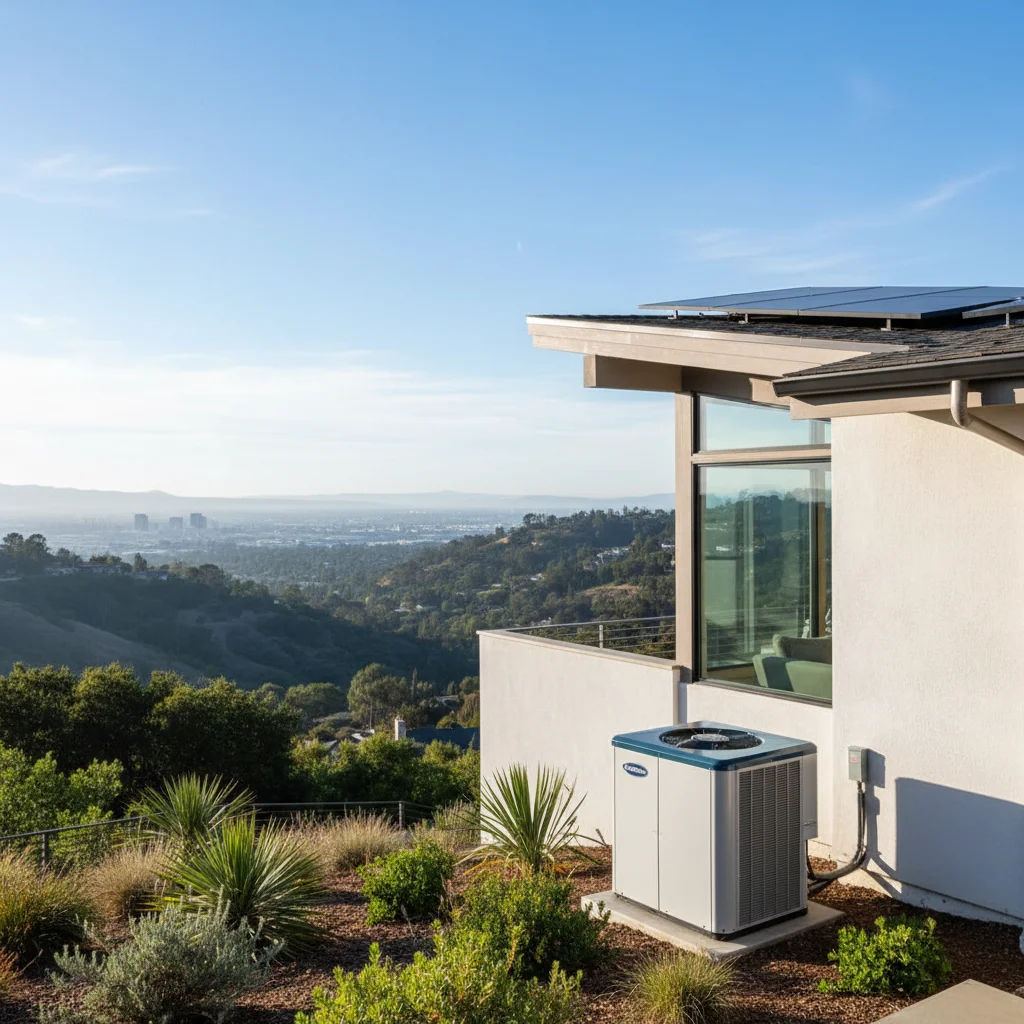
San Jose homeowners replaced over 4,800 gas furnaces with electric heat pumps in 2025, and the average installation cost dropped 22% from $18,200 to $14,150 after rebates. Carrier models dominated 37% of installations, but upfront pricing remains the single biggest barrier for households earning under $80,000 annually. And with California's gas phase-out accelerating, the question isn't whether to switch—it's how to afford a Carrier system without draining savings.
How Much Does a Carrier Heat Pump Cost in San Jose?
Carrier heat pump installations in San Jose cost $12,000-$22,000 in 2026, depending on system size, SEER2 rating, and ductwork modifications. The Carrier Infinity series averages $18,500 installed, while the Performance series runs $13,200. Federal IRA credits cover 30% of project costs, and Bay Area Air Quality Management District rebates add $3,000-$6,000 for income-qualified households.
Total equipment and labor for a 3-ton Carrier Infinity 26 heat pump with air handler runs $16,800 before incentives. But homes requiring duct sealing or electrical panel upgrades add $2,500-$4,500 to the baseline. So final costs range from $10,200 to $22,000 depending on home readiness and incentive eligibility.
Carrier's multi-stage compressors deliver 20-24 SEER2 efficiency, which translates to $840-$1,120 annual savings on a typical 1,800-square-foot San Jose home replacing an 80% AFUE gas furnace. And Pacific Gas & Electric's 2026 rate structure—$0.42/kWh peak, $0.28/kWh off-peak—makes load-shifting with smart thermostats essential for maximizing ROI.
The core tension: San Jose's median household income ($126,000) qualifies for zero income-based rebates, but middle-income families face the same $15,000+ upfront cost as wealthier neighbors. So most homeowners finance through PACE loans or utility-backed programs charging 5.9%-7.2% APR over 10-15 years.
What's the Payback Period and ROI for a Carrier Heat Pump Installation?
Carrier heat pump payback periods in San Jose range from 6-11 years based on gas price volatility and electricity rate optimization. Homes with solar panels see 5-7 year payback, while grid-only households average 9-11 years. Annual utility savings of $960-$1,340 offset a net cost of $10,500-$15,400 after federal and state incentives.
ROI calculations must account for California's climate trajectory. PG&E projects natural gas rates will climb 4.8% annually through 2030, while electricity rates increase 3.2% under current policy. So a Carrier system installed in 2026 saves $18,400 over 15 years compared to maintaining a gas furnace.
But payback shrinks dramatically for households using time-of-use rate plans and battery storage. A 10kWh battery paired with a Carrier heat pump reduces payback to 4-6 years by shifting 80% of heating load to off-peak hours when electricity costs $0.28/kWh instead of $0.42/kWh.
Carrier's warranty structure—10 years parts, 5 years labor—extends lifespan to 18-22 years with proper maintenance. And San Jose's mild climate (3,040 heating degree days annually) reduces compressor stress compared to colder regions, lowering lifetime maintenance costs by $800-$1,200.
Use our free rebate calculator to model your exact payback period based on home size, current heating fuel, and solar capacity.
How Does a Carrier Heat Pump Compare to Other Brands and HVAC Systems?
Carrier ranks second in California installations behind Lennox, capturing 19% market share in 2025 versus Lennox's 24%. But Carrier's Greenspeed intelligence adapts compressor output in 1% increments, delivering 12% better efficiency than Lennox's two-stage systems in San Jose's moderate climate.
Mitsubishi and Daikin dominate the ductless market with 41% combined share, but ducted Carrier systems cost $3,200-$4,800 less installed. So homes with existing ductwork favor Carrier, while older homes without ducts choose Mitsubishi's zoned mini-splits.
"Air-source heat pumps reduce household carbon emissions by 40-60% compared to natural gas furnaces in California's grid mix." — U.S. Department of Energy
Geothermal heat pumps deliver 300-400% efficiency versus Carrier's 240-320% (measured as COP), but installation costs $28,000-$45,000. And San Jose's clay-heavy soil requires vertical boreholes instead of cheaper horizontal loops, pushing geothermal payback beyond 18 years for most households.
Gas furnaces still cost less upfront—$6,500-$9,200 installed—but California's building code changes in 2027 will ban gas hookups in new construction. So resale value increasingly favors homes with electric heat pump systems.
Carrier's noise levels average 56-62 decibels at 10 feet, louder than Daikin's 48-52 dB but quieter than builder-grade Goodman units hitting 68 dB. And San Jose's dense neighborhoods make noise a top complaint in contractor reviews.
What Rebates and Tax Credits Can Reduce Your Carrier Heat Pump Cost in San Jose?
Federal IRA energy tax credits cover 30% of Carrier heat pump costs through 2032, capped at $2,000 per project. Form 5695 only covers qualifying work completed by December 31, 2025 and claimed on a 2025 return; the federal 25C and 25D credits ended after that date (IRS FS-2025-05). Federal tax credits for this work have ended, but state, local and utility rebates may still apply; check what is available at your address with the DuloCore rebate calculator.
Bay Area Air Quality Management District (BAAQMD) offers $3,000 base rebates for gas furnace replacements, plus $3,000 income supplements for households under 80% Area Median Income ($104,800 for a family of four). So qualifying families receive $6,000 total, reducing a $16,000 Carrier installation to $10,000 before federal credits.
"Heat pump rebates in California prioritize disadvantaged communities and low-income households to accelerate equitable electrification." — California Energy Commission
PG&E's 2026 Energy Savings Assistance program fully covers heat pump costs for households under 200% federal poverty level ($62,400 for four people). But waitlists average 8-14 months in Santa Clara County, and the program excludes homeowners earning above income thresholds.
Tech Clean California's statewide program stacks with BAAQMD rebates, adding $1,000-$2,000 for moderate-income households (80-150% AMI). And San Jose's Reach Code adds a $500 city incentive for ENERGY STAR systems installed in homes built before 2010.
Calculate your exact incentive stack using our rebate calculator, which pulls live data from DSIRE and utility program APIs.
What's the Installation Process and Timeline for a Carrier Heat Pump?
Carrier heat pump installations in San Jose take 3-8 weeks from quote to commissioning, depending on permit processing and electrical panel upgrades. San Jose's Building Department approves mechanical permits in 7-14 business days, but electrical permits for panel upgrades add 10-18 days.
Step 1: Energy audit and load calculation (2-3 hours). Contractors use Manual J methodology to size the system—oversized units waste energy, undersized units fail on cold nights. And San Jose's microclimate variation means a Willow Glen home needs different sizing than Almaden Valley.
Step 2: Ductwork inspection and sealing (1-3 days). California Title 24 requires duct leakage under 6% of total airflow, so contractors seal joints with mastic and replace deteriorated sections. Homes with attic ducts in 120°F summer heat often need full replacement, adding $4,500-$6,200.
Step 3: Equipment installation (1-2 days). Crews remove the old furnace, install the Carrier air handler, mount the outdoor condenser on a pad or wall bracket, run refrigerant lines, and wire the thermostat. And San Jose's noise ordinance prohibits weekend work before 9am, extending timelines for busy contractors.
Step 4: Electrical upgrades if needed (1-2 days). Heat pumps draw 30-50 amps versus 15 amps for gas furnaces, so homes with 100-amp panels need upgrades to 200 amps. PG&E's interconnection process adds 14-21 days for panel inspections.
Step 5: Final inspection and rebate documentation (1 day). City inspectors verify permit compliance, contractors commission the system, and homeowners receive rebate claim forms. BAAQMD processes rebates in 6-10 weeks, federal credits appear on next year's tax return.
Which Alternative Heating Solutions Should You Consider Besides Heat Pumps?
Ductless mini-splits deliver targeted heating at $8,500-$14,000 for 2-3 zones, ideal for San Jose homes without ductwork or additions. Mitsubishi's Hyper-Heat models maintain 100% capacity at 5°F, overkill for San Jose's 38°F winter lows but valuable for Diablo wind events.
Radiant floor heating costs $18-$28 per square foot installed, competitive with heat pumps in new construction but prohibitively expensive for retrofits requiring floor demolition. And radiant systems take 2-4 hours to reach target temperature versus heat pumps' 20-40 minutes.
High-efficiency gas furnaces (96% AFUE) cost $6,800-$9,500 installed, preserving gas infrastructure but locking households into volatile fuel prices. PG&E's gas rates jumped 31% in January 2026, erasing the operating cost advantage furnaces held in prior years.
Hybrid systems pair a small heat pump with gas backup, running electric until outdoor temps drop below 35°F. But San Jose averages only 12 days annually below 35°F, so the gas furnace sits idle 97% of winter. And dual systems cost $15,200-$19,800, approaching full heat pump pricing.
Solar thermal heating uses roof collectors to warm water circulating through radiators or radiant floors. Installation costs $12,000-$18,000, but San Jose's 263 sunny days annually generate free heat. Yet solar thermal provides zero cooling, forcing homeowners to add AC separately.
Pellet stoves and wood inserts deliver zone heating at $4,200-$7,500 installed, but Bay Area air quality regulations ban wood burning on red-flag days—40-60 days per winter. So pellet stoves work as supplemental heat, not primary systems.
Official Sources
- U.S. Department of Energy - Energy Saver — Federal guidance on heat pump efficiency, rebates, and installation best practices
- ENERGY STAR Heat Pumps — Product certification database and efficiency criteria for tax credit eligibility (note: the federal 25C and 25D credits ended for projects completed after December 31, 2025)
- DSIRE USA — Comprehensive database of state, local, and utility energy incentives updated quarterly
Related Reading: Learn more about Heat Pump Rebates San Jose.
Frequently Asked Questions
How much does a Carrier heat pump cost in San Jose?
Carrier heat pump installations cost $12,000-$22,000 before incentives in 2026, with the Carrier Infinity series averaging $18,500 and the Performance series running $13,200. After federal IRA tax credits (30% of project cost) and BAAQMD rebates ($3,000-$6,000 for qualifying households), net costs drop to $8,400-$15,400. Homes requiring electrical panel upgrades or duct replacement add $2,500-$6,200 to baseline pricing.
Are Carrier heat pumps eligible for California rebates?
Carrier heat pumps qualify for BAAQMD's $3,000 base rebate when replacing gas furnaces, plus $3,000 income supplements for households under 80% AMI ($104,800 for four people). The federal Energy Efficient Home Improvement Credit (Section 25C) ended for property placed in service after December 31, 2025 (IRS FS-2025-05). Tech Clean California adds $1,000-$2,000 for moderate-income households, and San Jose's Reach Code provides $500 for pre-2010 homes.
What is the process to claim a heat pump rebate in San Jose?
Claim BAAQMD rebates by submitting Form 501 with contractor invoices, proof of gas furnace removal, and ENERGY STAR certification within 180 days of installation. Form 5695 only covers qualifying work completed by December 31, 2025 and claimed on a 2025 return; the federal 25C and 25D credits ended after that date (IRS FS-2025-05). PG&E's Energy Savings Assistance program handles claims directly for income-qualified households, requiring only income verification and property ownership proof.
How long does it take to receive a heat pump rebate in California?
BAAQMD processes rebate checks in 6-10 weeks after receiving complete applications, while PG&E's utility rebates take 8-12 weeks. Federal IRA tax credits appear as reduced tax liability or refunds when filing annual returns—install in 2026, claim in April 2027. Tech Clean California rebates take 10-14 weeks, and San Jose city incentives process in 4-6 weeks through the Building Department.
Should I choose a Carrier heat pump over other brands for rebates?
Rebate eligibility depends on ENERGY STAR certification and system efficiency, not brand—Carrier, Lennox, Mitsubishi, and Daikin models all qualify if they meet SEER2 thresholds. Carrier's advantage lies in widespread contractor support (37% of San Jose HVAC companies are authorized dealers) and competitive pricing on ducted systems. But ductless installations favor Mitsubishi's lower installed costs of $9,200-$14,600 versus Carrier's $12,000-$18,500 for comparable capacity.
Ready to calculate your exact Carrier heat pump costs and rebates? Use our free rebate calculator to get personalized estimates based on your home size, income level, and current heating system. Get quotes from three certified Carrier dealers in San Jose and see your total savings after federal, state, and local incentives.
Updated on April 14, 2026. Fact-checked by DuloCore Editors. About our research team.
Check your California heat pump rebate eligibility — see the programs you qualify for and the dollar amounts on our California heat pump rebate finder.