Update (2026): The federal Energy Efficient Home Improvement Credit (Section 25C) expired December 31, 2025, following the passage of the OBBBA. Check state and local programs for current incentives.
Up to 30% of a home's heating and cooling energy escapes through air leaks around windows, doors, and ductwork. This wasted energy translates directly into hundreds of dollars lost each year. So finding a certified energy auditor isn't just about identifying problems; it's the first step to unlocking thousands in government rebates and tax credits designed to pay for the solutions.
What Rebates and Financial Incentives Are Available for Energy Audits and Upgrades in My State and Through My Utility?
State and utility energy programs offer direct financial incentives for home energy audits and subsequent efficiency upgrades in 2026. These programs provide rebates ranging from $150 to $500 for the initial audit and up to $8,000 for qualifying upgrades like insulation or air sealing. For example, the New York State Energy Research and Development Authority (NYSERDA) offers cost-sharing for audits. And many local utilities, such as PG&E in California, provide rebates of $0.50 per square foot for attic insulation installed after a certified audit. But funding for these programs is often limited and distributed on a first-come, first-served basis each calendar year. So homeowners must verify the current funding status and deadlines directly with their state energy office or local utility provider before scheduling an audit or beginning any work. A complete home energy audit is the required first step for most of these programs.
So what? Why does this matter? A certified home energy audit is the key that unlocks access to an average of $5,300 in available home energy rebates and energy tax credits. Without this professional assessment, homeowners are ineligible for the majority of state and federal programs, leaving 20-40% of potential energy savings on the table.
Do I Qualify? Understanding Income Limits and Eligible Equipment for Energy Efficiency Programs.
A homeowner's eligibility for 2026 energy efficiency programs depends on household income and the specific equipment installed. Many state-level rebates are income-qualified, offering 100% of project costs up to $14,000 for households earning less than 80% of the Area Median Income (AMI). So families with higher incomes often qualify for smaller, tiered rebates. And all programs require that installed equipment meets specific efficiency standards, such as ENERGY STAR 7.0 for windows or a SEER2 rating of 16+ for heat pumps. Equipment that doesn't meet these minimum specifications won't qualify for any rebate or tax credit, regardless of the homeowner's income level. Verifying both income and equipment requirements on the program's official website before purchase is a mandatory step in the process.
"Saving money on energy bills is easier than you think. There are a number of simple, low- or no-cost steps you can take to reduce your energy consumption." — U.S. Department of Energy
What is the Application Process for Energy Rebates, and What Deadlines or Funding Status Should I Be Aware Of?
The application process for 2026 energy rebates typically involves four distinct steps: pre-approval, the audit, installation, and final submission. First, homeowners submit an initial application to their utility or state program to reserve funds. And once pre-approved, a certified auditor performs the assessment and provides a report. So based on that report, a qualified contractor installs the recommended upgrades, like new insulation or heat pump rebates. Finally, the homeowner submits final invoices and the audit report to receive the rebate, a process that takes 6-8 weeks. But homeowners must pay close attention to deadlines. Most state programs have a December 31, 2026, application cutoff, and funding often runs out before then. So checking the program's funding status online weekly is a critical action.
How Can I Maximize My Savings: Understanding Stacking Rules and Certified Contractor Requirements?
Homeowners maximize savings by stacking multiple incentives and ensuring all work is performed by certified professionals. Stacking involves combining a federal tax credit, a state rebate, and a local utility incentive for a single project. For instance, a homeowner can claim the 30% federal IRA tax credit (up to $2,000) for insulation while also receiving a $1,500 state rebate for the same project. And most programs mandate that all work must be completed by a contractor holding specific certifications, such as from the Building Performance Institute (BPI). So using an uncertified contractor will void eligibility for nearly all 2026 rebate programs. Use our free rebate calculator to find every incentive you qualify for.
"DSIRE is the most comprehensive source of information on incentives and policies that support renewables and energy efficiency in the United States." — DSIRE
2026 Energy Rebate Program Comparison
| Program / Incentive | Maximum Amount | Key Eligibility Requirement | 2026 Deadline |
|---|---|---|---|
| Federal IRA Tax Credit (25C) | Ended Dec 31, 2025 | — | December 31, 2025 |
| State Weatherization Program | $8,000 | Income-qualified (typically <80% Area Median Income) | Varies by state |
| Local Utility Rebate | $500 - $2,000 | Must be a customer; often requires pre-approval | Often Dec 31, 2026 |
Official Sources
- ENERGY STAR Rebate Finder — A tool from the U.S. EPA to find local rebates and special offers for ENERGY STAR certified products.
- Database of State Incentives for Renewables & Efficiency (DSIRE) — The most comprehensive U.S. database for state-level energy efficiency policies and incentives.
Related Reading: Learn more about Insulation Contractors Near Me.
Related Reading: Learn more about Energy Star Appliance Rebates Near Me.
Frequently Asked Questions About Certified Energy Auditors and Energy Rebate Programs
How do I find a qualified certified energy auditor in my area?
Homeowners find qualified auditors through national certification bodies or state-sponsored program websites. The two primary national certifications are from the Building Performance Institute (BPI) and the Residential Energy Services Network (RESNET). Many state energy offices and utility companies also maintain a public list of pre-approved, certified auditors who are eligible to perform work for their specific 2026 rebate programs.
What is the typical cost of a certified home energy audit?
A comprehensive, certified home energy audit typically costs between $300 and $700 in 2026. The final price depends on the size of the home, its location, and the specific tests included, such as a blower door test or infrared thermography. But many utility and state programs offer rebates that cover $150 to $500 of this cost, effectively reducing the out-of-pocket expense for the homeowner.
What should I expect during a professional energy audit?
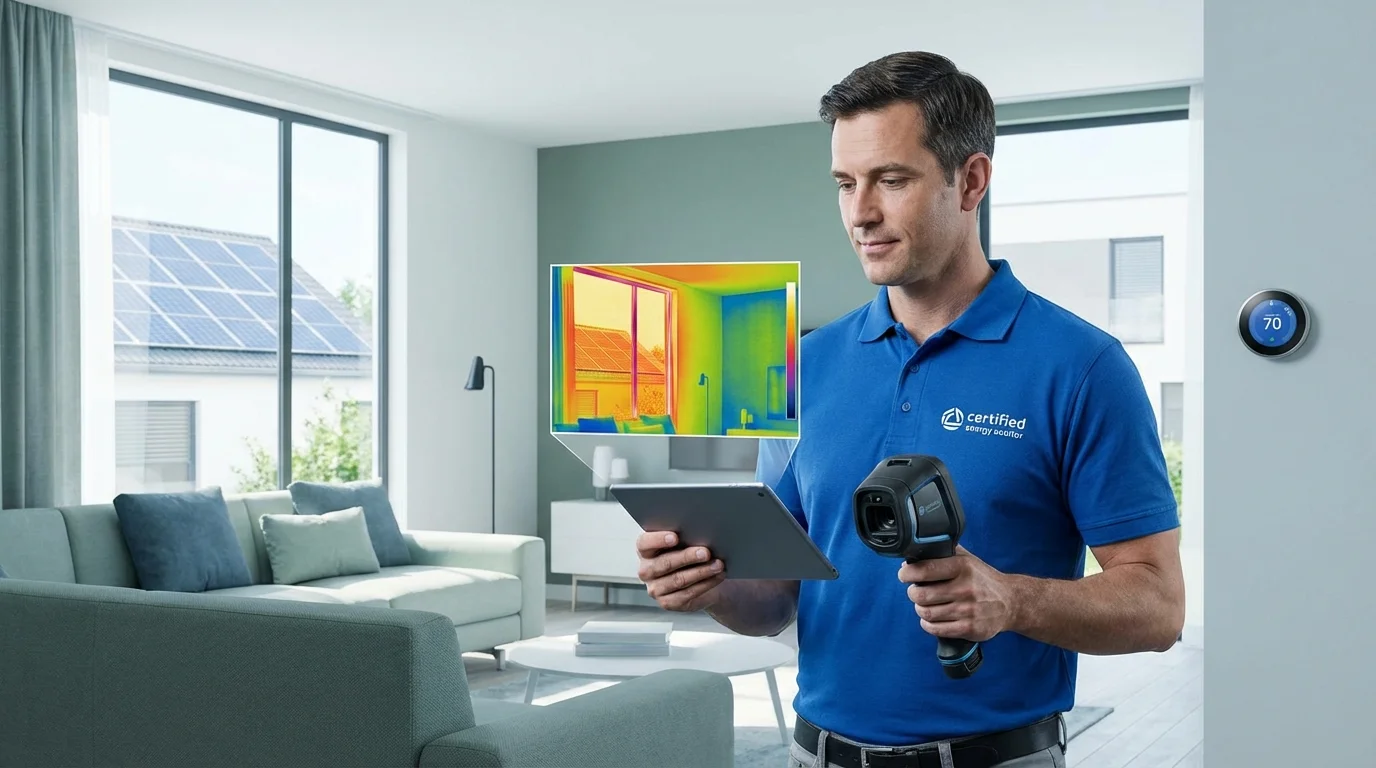
A professional energy audit is a 2-4 hour process involving a room-by-room inspection and diagnostic testing. The auditor will perform a blower door test to measure air leakage, use an infrared camera to spot insulation gaps, and inspect HVAC systems, appliances, and lighting. So afterward, you receive a detailed report prioritizing cost-effective upgrades with estimated energy savings, typically ranging from 15% to 30%.
Are certified energy audits required for specific home improvement rebates?
Yes, a certified energy audit is a mandatory prerequisite for most 2026 state and utility whole-home performance rebates. These programs, which offer thousands of dollars for insulation, air sealing, and HVAC upgrades, require the audit as a baseline assessment. The audit report serves as the official documentation to justify the upgrades and is a required part of the final rebate application paperwork.
Unlock Your Home's Savings Potential
A certified energy audit is your first step. The next is finding out exactly how much you can get back. Our tool instantly calculates your eligibility for every federal, state, and utility rebate available in your area.
Calculate Your Savings NowLast updated April 14, 2026 — reviewed by DuloCore Editorial. About our authors.