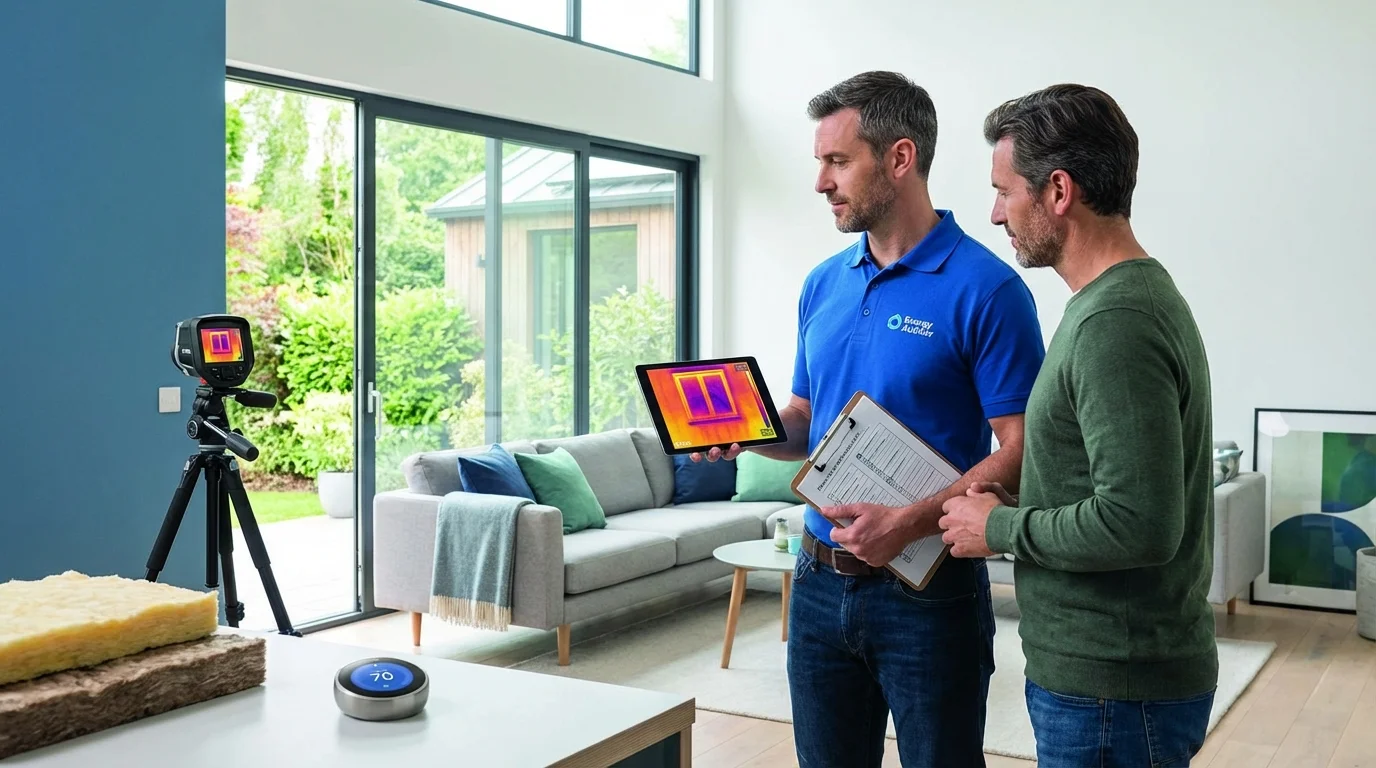
Up to 30% of a home's cooling energy escapes through air leaks in windows, doors, and ductwork. With electricity rates climbing, that wasted energy translates directly into hundreds of dollars lost each summer. So an energy audit isn't just about comfort; it's a direct countermeasure against needlessly high utility bills before the peak cooling season begins.
What Cooling Season Energy Audit Rebates Are Available and How Much Can I Save?
Cooling season energy audit rebates are financial incentives from utilities, states, and the federal government that reduce the cost of a professional home energy assessment. These 2026 programs include direct rebates of $50-$300 for the audit itself and federal tax credits covering 30% of subsequent efficiency upgrades.
Homeowners access a tiered system of savings through a cooling season energy audit. So the initial audit often qualifies for a direct utility rebate, frequently covering 50-100% of the cost, up to a $300 cap. And this audit unlocks eligibility for further incentives. For instance, the Inflation Reduction Act provides annual energy tax credits of up to $1,200 for weatherization improvements like insulation and air sealing identified in the audit. But these credits are non-refundable, meaning they only reduce tax liability. State programs add another layer, sometimes offering thousands for upgrades like new windows or duct sealing. For example, a homeowner in Massachusetts gets a no-cost audit through Mass Save, then accesses rebates up to $10,000 for insulation improvements. So the total savings from an audit and the resulting upgrades often exceed $2,500 in the first year alone.
The core tension is that homeowners are paying for 100% of their energy but only using 70% of it effectively. That 30% waste, primarily from air leaks and poor insulation, costs the average U.S. family over $600 annually just for cooling and heating. A cooling season energy audit provides a specific, prioritized roadmap to reclaim that lost money, turning energy liabilities into tangible savings.
Am I Eligible for Cooling Season Energy Efficiency Rebates, Including Income-Based Programs?
Eligibility for 2026 cooling season energy rebates is determined by homeownership, location, utility provider, and, for some programs, household income. Federal tax credits are broadly available to homeowners, while state and utility rebates require residency and an active account, with income-based programs offering enhanced benefits up to $14,000.
General eligibility for most 2026 utility rebates requires the applicant to be the homeowner and a customer of the sponsoring utility. But income-based programs have specific thresholds. The federal Home Energy Rebates program, administered by states, defines "low-income" as below 80% of the Area Median Income (AMI). So households at this level qualify for rebates covering up to 100% of project costs, capped at $14,000. For example, a family of four in Denver with an income under $88,000 qualifies for these amplified savings. And moderate-income households (80-150% of AMI) are eligible for rebates covering 50% of the cost. These programs are designed to make critical efficiency upgrades accessible, ensuring energy savings aren't limited to high-income households. Verifying local AMI thresholds is the first step for applicants seeking maximum financial assistance.
"All states, the District of Columbia, and U.S. territories have received funding to stand up Home Energy Rebate programs and are in various stages of program design and implementation." — U.S. Department of Energy
How Do I Apply for Cooling Season Energy Rebates, What Are the Deadlines, and Is Funding Still Available?
The application process for 2026 cooling season energy rebates typically involves a multi-step verification path, starting with a pre-approval from a utility or state program administrator. Deadlines are often December 31, 2026, or when funds are exhausted, as most programs operate on a first-come, first-served basis.
Applying for an energy audit rebate starts with confirming eligibility through your utility's online portal or a state energy office website. And the next step is scheduling an audit with a certified professional, often from a pre-approved list. So after the audit, the homeowner receives a report detailing recommended upgrades. To claim further rebates for things like heat pump rebates, homeowners submit contractor invoices and the audit report through the same portal. Most 2026 programs have a rolling application window but finite funding. But popular programs, like those in the Northeast, often deplete their annual budgets by Q3. Therefore, initiating the process early in the year is critical. Use our free rebate calculator to find available funding and deadlines in your area.
Can I Combine Energy Rebates to Maximize Savings, and What Contractor Requirements Should I Know?
Combining, or "stacking," energy rebates is a common strategy where homeowners apply federal tax credits on top of state and utility incentives to reduce out-of-pocket costs by over 50%. However, most programs mandate that the audit and subsequent work be performed by certified contractors, such as BPI-certified professionals.
Stacking rebates requires careful planning. For instance, a homeowner can receive a $200 instant rebate from their utility for an energy audit. And based on that audit, they can install $4,000 worth of insulation, qualifying for a $1,500 state rebate. So the remaining $2,500 out-of-pocket cost is then eligible for the 30% federal tax credit, saving an additional $750. But this is only possible if the work meets program standards. Most rebate programs require that the energy auditor holds a certification from the Building Performance Institute (BPI). And contractors performing the upgrades, like insulation or HVAC installation, must often be licensed, insured, and listed on the utility’s approved network. Using a non-certified contractor will automatically disqualify an otherwise eligible project from receiving any financial incentives.
"DSIRE is the most comprehensive source of information on incentives and policies that support renewable energy and energy efficiency in the United States." — DSIRE
How Do Cooling Season Energy Audit Programs Vary by State and Utility Provider?
Cooling season energy audit programs exhibit dramatic variance by state and utility, with incentives in some regions offering a free audit and up to $10,000 in upgrade support. In contrast, other areas provide only a modest $50 rebate for the audit itself, reflecting differing state-level energy policies.
The differences are stark. For example, California's statewide programs, supplemented by utility-specific offerings from PG&E or SoCal Edison, create a rich ecosystem of rebates for audits, air sealing, and high-efficiency AC units. But a state with less aggressive clean energy goals may only offer the minimum federal incentives. Utility providers further segment the landscape. A large municipal utility often has a bigger budget for residential rebates than a small rural co-op. So a homeowner served by Austin Energy in Texas has access to different, and often more generous, audit rebates than a homeowner 50 miles away served by a smaller provider. This underscores the necessity of checking for incentives at the federal, state, and local utility levels to create a complete picture of available savings before starting a home energy audit.
2026 Cooling Season Rebate Program Comparison
| Program / Incentive | Rebate Amount / Credit Value | Key Eligibility Requirement | 2026 Deadline |
|---|---|---|---|
| Federal IRA Tax Credit | Ended Dec 31, 2025 | — | Ended Dec 31, 2025 |
| State Weatherization Program | $1,500 - $8,000 | Income-based (typically <80% AMI) | Varies by state; often rolling |
| Utility Energy Audit Rebate | $50 - $300 (or free) | Must be a customer of the utility | Often Dec. 31 or when funds run out |
Official Sources
- ENERGY STAR Rebate Finder — A tool from the U.S. EPA to find local rebates and special offers for ENERGY STAR certified products.
- Database of State Incentives for Renewables & Efficiency (DSIRE) — The most comprehensive national database of energy efficiency and renewable energy incentives administered by state and local governments.
- U.S. Department of Energy (DOE) Energy Saver — Federal guidance on home energy audits, weatherization, and accessing federal programs and tax credits. (note: the federal 25C and 25D credits ended for projects completed after December 31, 2025)
Related Reading: Learn more about Moisture Problems Energy Audit and Phantom Load Energy Audit.
Frequently Asked Questions
Who is qualified to perform a cooling season energy audit?
A qualified energy auditor typically holds a certification from an organization like the Building Performance Institute (BPI) or the Residential Energy Services Network (RESNET). Most state and utility rebate programs require using a certified professional from their pre-approved list to be eligible for financial incentives. These auditors use specialized equipment like blower doors and infrared cameras to accurately diagnose energy loss, ensuring the audit meets program standards for a rebate claim.
How much does a cooling season energy audit typically cost?
A professional home energy audit typically costs between $300 and $700 for a comprehensive assessment. However, many utility companies offer rebates that cover $100-$300 of this cost, and some state programs, like Mass Save in Massachusetts, provide the audit at no cost to the homeowner. The final price depends on the size of the home and the level of detail, but incentives frequently reduce the out-of-pocket expense to under $200.
What specific areas does a cooling season energy audit checklist cover?
A cooling season audit checklist focuses on heat gain and air conditioning efficiency. An auditor inspects insulation levels (especially in the attic), air leakage points using a blower door test, the condition and sealing of ductwork, window and door seals, and the performance of the air conditioning system. The final report prioritizes fixes, such as adding R-30 insulation or sealing duct leaks, that offer the fastest payback in summer energy savings.
Find Your Cooling Season Rebates Now
Don't overpay for cooling this summer. A home energy audit is the first step to unlocking thousands in savings. Use the DuloCore Rebate Calculator to instantly find every federal, state, and utility rebate you qualify for in 2026.
Last reviewed: April 14, 2026. Reviewed by DuloCore Energy Specialists. About the team.