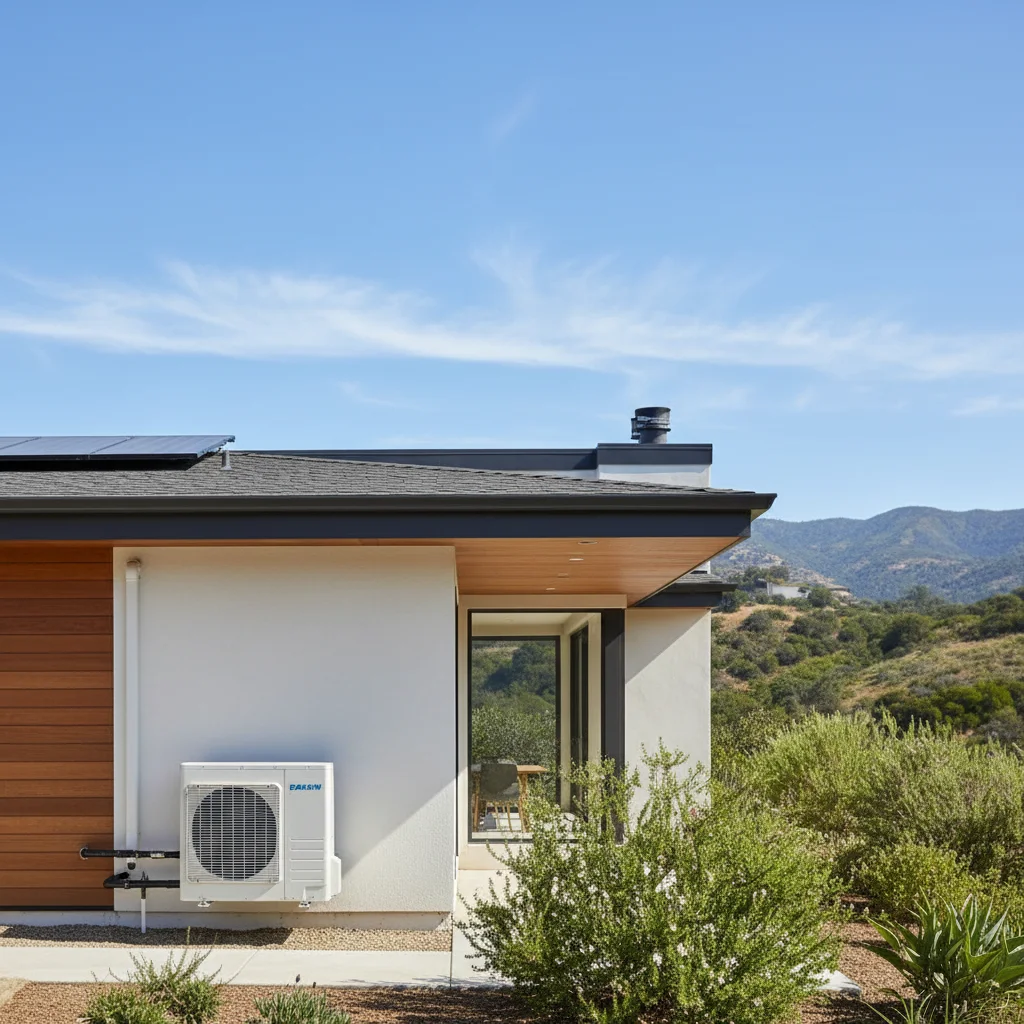
California homeowners installing a Daikin heat pump in 2026 pay between $8,000 and $18,000 before rebates—but state incentives can reduce that figure. With the state's push to electrify 6 million homes by 2030, rebate programs now stack state rebates with local utility incentives for qualifying households.
What Is the Total Cost of Installing a Daikin Heat Pump in California?
Daikin heat pump systems in California range from $8,000 to $18,000 installed in 2026, with ducted central units averaging $12,000 to $18,000 and ductless mini-splits costing $8,000 to $14,000. Equipment accounts for 40-50% of total cost, labor 30-40%, and electrical upgrades or panel modifications add $500 to $3,000 depending on home infrastructure.
And the final price depends on system size measured in tons. A 2-ton Daikin DZ18TC costs around $9,500 installed, while a 5-ton DZ20VC runs $16,000 to $18,000 in urban markets like Los Angeles and San Francisco. But rural areas with limited HVAC contractors see 10-15% higher labor rates. So homeowners in Central Valley counties often pay $1,200 to $2,400 more than Bay Area residents for identical systems.
Installation complexity drives variance. Homes without existing ductwork require new duct runs at $3,500 to $7,000, while properties with 100-amp electrical panels need upgrades to 200-amp service at $2,000 to $3,000. Or homeowners choosing ductless systems avoid these costs entirely, explaining why mini-splits dominate retrofit installations in older California housing stock built before 1980.
Which Daikin Heat Pump Models Qualify for California Rebates?
Daikin heat pumps must meet ENERGY STAR standards with SEER2 ratings of 16 or higher and HSPF2 ratings of 7.8 or higher; federal tax credits for them no longer apply (IRS FS-2025-05). California's Tech Clean program adds NEEP Cold Climate tier requirements: HSPF2 of 8.5 minimum and heating capacity retention of 70% at 5°F ambient temperature.
The Daikin DZ20VC variable-speed ducted system qualifies with SEER2 18.9 and HSPF2 9.5. And the DZ18TC single-stage unit meets baseline thresholds at SEER2 16.2 and HSPF2 8.6. But ductless models like the Aurora series hit SEER2 21 and HSPF2 10, making them eligible for California's $3,000 heat pump rebate for low-to-moderate income households.
Or consider the Fit series: the FTK09NMVJU single-zone mini-split delivers SEER2 20.3 and HSPF2 9.8, qualifying for every available 2026 incentive program. So homeowners replacing gas furnaces with this model can claim utility rebates reaching $7,000 in PG&E territory.
"Heat pumps must meet ENERGY STAR Most Efficient criteria to qualify for enhanced rebates under California's Technology and Equipment for Clean Heating (TECH) Initiative." — California Energy Commission
Use our free rebate calculator to find your exact savings based on your zip code and income level.
How Long Does It Take to Recoup Your Daikin Heat Pump Investment in California?
California homeowners recover Daikin heat pump costs in 4 to 8 years depending on energy prices, climate zone, and system efficiency. San Francisco residents replacing natural gas furnaces see 4- to 5-year paybacks with combined annual savings of $1,200 to $1,800, while Sacramento homeowners achieve 6- to 7-year returns with $900 to $1,300 yearly savings.
And the math shifts dramatically in high-electricity-cost zones. PG&E territory residents paying $0.38 per kWh save $1,500 annually by replacing resistance heat, but Southern California Edison customers at $0.29 per kWh save $1,100 for identical usage. So payback periods vary by 24 months across utility territories for the same equipment.
But low-income households claiming the full rebate stack—$3,000 state rebate plus $2,000 utility incentive—reduce net cost on a $12,000 system to $7,000. Or that drops payback to under 6 years with $1,200 annual savings. And these households often see immediate positive cash flow when monthly heating cost reductions exceed financing payments.
Climate zone 16 (San Francisco, coastal moderate) achieves fastest ROI at 4.2 years average. Zone 13 (Fresno, hot dry summer) extends to 7.1 years due to lower heating loads. So coastal California delivers the strongest financial case for heat pump rebates and replacements.
What's the Expected Lifespan of a Daikin Heat Pump and How Does It Compare to Other Brands?
Daikin heat pumps last 15 to 20 years with proper maintenance, matching Mitsubishi Electric and Carrier but exceeding American Standard (12-15 years) and Goodman (10-14 years). Variable-speed compressors in premium Daikin models like the DZ20VC reach 20-year lifespans because soft-start technology reduces mechanical stress during startup cycles—the leading cause of compressor failure.
And warranty coverage reflects durability expectations. Daikin provides 12-year parts warranties on registered systems versus 10 years from Lennox and 5 years from budget brands. But extended warranties cost $400 to $800, adding 1-2% to total ownership cost over the system's life.
Maintenance frequency drives actual lifespan variance. California's mild climate requires annual professional service at $150 to $250, while homeowners performing quarterly filter changes and coil cleaning extend equipment life by 3 to 5 years. Or neglecting maintenance cuts lifespan to 10 to 12 years and increases energy consumption by 15-25%, negating efficiency savings.
"Regular maintenance can extend heat pump life by up to 5 years and maintain efficiency ratings within 5% of new equipment performance." — U.S. Department of Energy
So total cost of ownership over 18 years for a $14,000 Daikin system with biannual maintenance ($4,500) and two refrigerant recharges ($800) reaches $19,300—or $1,072 annually. And that beats gas furnace total ownership cost of $1,350 per year in California's $0.35/kWh electricity markets.
How Do Daikin Heat Pump Costs Compare to Alternative Heating Systems in California?
Daikin heat pumps cost $8,000 to $18,000 installed versus $4,500 to $9,000 for gas furnaces, $3,000 to $6,000 for resistance heat, and $20,000 to $35,000 for geothermal systems. But operating costs reverse the equation: heat pumps deliver 300-400% efficiency (COP 3-4) while gas furnaces achieve 95% AFUE and resistance heat stays at 100%.
And annual heating costs in California climate zone 12 (Sacramento) show the spread. A 1,800-square-foot home pays $850 yearly with a Daikin heat pump at $0.32/kWh, $1,200 with a 95% AFUE gas furnace at $1.80/therm, or $2,100 with electric resistance heat. So gas furnaces cost 41% more annually to operate, and resistance heat runs 147% higher.
But upfront costs determine adoption. Gas furnaces require $4,500 less initial investment, extending heat pump payback to 6 years without rebates. Or geothermal systems cost $14,000 to $22,000 more than air-source heat pumps despite 10-15% better efficiency, pushing payback beyond 20 years in mild California climates.
So ductless mini-splits occupy the value position. A $9,000 Daikin Aurora system costs double a basic gas furnace but qualifies for $5,000 to $8,000 in 2026 rebates, dropping net cost to $1,000 to $4,000—cheaper than furnace replacement when incentives apply. And installation takes 1 day versus 2-3 days for ducted systems, saving $600 to $1,200 in labor.
For homeowners weighing broader energy tax credits, note that the federal heat pump credit was not extended: the Energy Efficient Home Improvement Credit (Section 25C) ended for property placed in service after December 31, 2025 (IRS FS-2025-05). Check current state, local and utility incentives for your address with the DuloCore rebate calculator.
What Rebate Programs and Financial Incentives Are Available for Daikin Heat Pumps in California?
California homeowners installing Daikin heat pumps in 2026 access state Tech Clean rebates up to $3,000 and utility programs paying $2,000 to $7,000 depending on income and location; federal tax credits no longer apply (IRS FS-2025-05).
Form 5695 only covers qualifying work completed by December 31, 2025 and claimed on a 2025 return; the federal 25C and 25D credits ended after that date (IRS FS-2025-05). Federal tax credits for this work have ended, but state, local and utility rebates may still apply; check what is available at your address with the DuloCore rebate calculator.
But California's stacked incentives create deeper savings. The Tech Clean California program offers $3,000 rebates for households under 80% area median income ($104,400 for a family of four in Los Angeles County). Or utility programs layer additional incentives: PG&E pays $2,000 for gas furnace replacements, SCE offers $3,000 for manufactured home installations, and SDG&E provides $7,000 for low-income all-electric retrofits.
The federal Residential Clean Energy Credit (Section 25D) ended for expenditures made after December 31, 2025, and the IRS treats an expenditure as made when installation is completed (IRS FS-2025-05).
And point-of-sale rebates eliminate upfront cost barriers. Participating contractors apply Tech Clean rebates at installation, reducing customer payments by $3,000 immediately. So homeowners pay only net cost after all incentives.
Official Sources
- U.S. Department of Energy - Save Energy, Save Money — Federal guidance on residential energy efficiency upgrades and available tax credits (note: the federal 25C and 25D credits ended for projects completed after December 31, 2025)
- ENERGY STAR Heat Pumps — Official efficiency requirements and qualified product listings
- DSIRE - California Incentives — Database of state, local, and utility energy efficiency rebate programs
Frequently Asked Questions
How much does a Daikin heat pump cost in California?
Daikin heat pumps cost $8,000 to $18,000 installed in California in 2026, with ductless mini-splits ranging $8,000 to $14,000 and ducted central systems running $12,000 to $18,000. System size, efficiency rating, and installation complexity drive price variance. A 3-ton Daikin DZ18TC averages $11,500 installed in urban markets, while 5-ton variable-speed models reach $17,000. Electrical panel upgrades add $2,000 to $3,000, and new ductwork costs $3,500 to $7,000 for homes without existing HVAC infrastructure.
What rebates are available for Daikin heat pump installation in California?
California homeowners claim $3,000 state Tech Clean rebates for households under 80% area median income and utility incentives of $2,000 to $7,000 depending on location and income; federal tax credits no longer apply (IRS FS-2025-05). PG&E offers $2,000 for gas furnace replacements, SCE pays $3,000 for manufactured home installations, and SDG&E provides up to $7,000 for low-income all-electric conversions.
Am I eligible for California heat pump rebates?
State Tech Clean rebates limit eligibility to households earning under 80% area median income ($104,400 for a Los Angeles County family of four in 2026). Utility rebates vary by territory: PG&E requires gas furnace replacement, SCE targets manufactured homes, and SDG&E prioritizes all-electric retrofits. The federal Energy Efficient Home Improvement Credit (Section 25C) ended for property placed in service after December 31, 2025 (IRS FS-2025-05).
What is the process for claiming a Daikin heat pump rebate in California?
Form 5695 only covers qualifying work completed by December 31, 2025 and claimed on a 2025 return; the federal 25C and 25D credits ended after that date (IRS FS-2025-05). California Tech Clean rebates process at point-of-sale through participating contractors who apply the $3,000 reduction directly to your invoice. Utility rebates require online applications within 90 days of installation completion, with program-specific forms available at PG&E.com, SCE.com, and SDGE.com. Processing takes 6 to 10 weeks for utility rebates.
When do California heat pump rebates expire?
The federal Energy Efficient Home Improvement Credit (Section 25C) ended for property placed in service after December 31, 2025 (IRS FS-2025-05), so there is no federal credit deadline left to plan around. California Tech Clean funding extends through 2027 under current budget allocations but requires annual legislative renewal. Utility rebate programs operate on annual budgets that typically exhaust by October, with PG&E's 2025 program closing in September due to high demand. So homeowners maximize savings by installing systems in Q1 or Q2 of each year before utility funds deplete.
Ready to see your exact savings? Our rebate calculator shows your specific state and utility incentives based on your income, zip code, and equipment choice. Get your personalized estimate in under 60 seconds.
Last updated April 14, 2026 — reviewed by DuloCore Editorial. About our authors.
Check your California heat pump rebate eligibility — see the programs you qualify for and the dollar amounts on our California heat pump rebate finder.