Editorial disclosure: DuloCore operates as an independent resource. Brand names appear for identification only. We do not receive paid compensation, commission, or affiliate revenue from any manufacturer mentioned in this article. Product recommendations reflect independent research against public specifications and energy-efficiency ratings. This disclosure is provided in accordance with FTC Endorsement Guides (16 CFR Part 255).
Central Valley homeowners replacing gas furnaces with Daikin heat pumps cut cooling costs by 40-60% while reducing winter heating bills by $800-$1,200 annually. And in a region where summer temperatures regularly exceed 105°F and winter lows drop to 32°F, the dual-fuel efficiency of Daikin's inverter-driven systems delivers year-round savings that gas and electric resistance systems can't match.
How Much Does a Daikin Heat Pump Cost in the Central Valley?
Daikin heat pump installations in California's Central Valley range from $8,500 to $18,000 in 2026, with system size, efficiency rating, and ductwork modifications driving final costs. A 2-ton Daikin Fit system averages $9,200 installed, while a 4-ton Daikin Quaternity ultra-high-efficiency model costs $16,500-$18,000 before rebates reduce net expense by $1,000-$4,000.
So what drives this wide price range? Central Valley installation costs vary based on home size (1,200-3,000 square feet is typical), existing ductwork condition, and whether the system replaces aging equipment or requires new infrastructure. A Fresno homeowner upgrading from a 20-year-old gas furnace and air conditioner pays $12,000-$15,000 for a complete Daikin variable-speed system with new thermostat and air handler. But a Modesto home needing duct sealing and insulation upgrades adds $2,500-$4,000 to the baseline equipment and labor cost of $10,000.
Daikin's tiered product lineup lets Central Valley homeowners match system cost to climate needs. The Daikin Fit (18 SEER2, 8.5 HSPF2) starts at $8,500 installed for 2-ton systems serving 1,200-1,500 square feet. The Daikin One+ (19-20 SEER2, 10 HSPF2) costs $11,000-$14,000 for 3-ton installations covering 1,800-2,200 square feet. And the Daikin Quaternity (up to 23 SEER2, 11 HSPF2) reaches $16,500-$18,000 for 4-ton systems in 2,500-3,000 square foot homes where premium efficiency justifies the upfront investment.
Labor accounts for 35-45% of total installation cost in the Central Valley. HVAC contractors charge $85-$125 per hour, with typical installations requiring 16-24 hours for equipment removal, refrigerant line installation, electrical upgrades, thermostat wiring, and startup testing. A straightforward replacement takes 12-16 hours and costs $1,500-$2,000 in labor. But homes requiring 200-amp electrical panel upgrades or significant duct modifications add 8-12 hours and $1,000-$1,500 to labor expense.
Central Valley climate conditions favor higher-efficiency Daikin models despite elevated upfront costs. Summer cooling loads dominate annual HVAC usage, with air conditioning running 1,200-1,800 hours per year versus 800-1,200 hours for heating. A 20 SEER2 system costs $2,500-$3,500 more than an 18 SEER2 model but saves $180-$240 annually on electricity at PG&E's current $0.32-$0.38 per kWh rates. Or the payback period stretches 12-16 years on efficiency premiums alone, though utility rebates can shorten it.
What Are the Best Alternatives to Daikin Heat Pumps in the Central Valley?
Carrier Infinity and Lennox Signature series heat pumps offer comparable performance to Daikin systems at $10,000-$17,000 installed, while Rheem and Trane mid-tier models cost $7,500-$12,000 and deliver similar lifecycle savings for Central Valley homeowners prioritizing value over premium features.
Carrier's Infinity 26 achieves 26 SEER2 and 11 HSPF2—the highest efficiency available in California residential markets—at $15,500-$17,500 installed for 3-4 ton systems. And the Infinity platform's variable-speed compressor and advanced dehumidification match Daikin's Quaternity performance in extreme Central Valley summer humidity of 60-80% during monsoon season. But Carrier systems require proprietary Infinity thermostats that cost $400-$600, adding $200-$300 over standard programmable controls.
Lennox Signature series heat pumps range from $12,000-$16,000 installed and include SunSource solar-compatible models that integrate with rooftop PV arrays. A Stockton homeowner with existing solar panels offsets 70-90% of heat pump electricity costs by pairing a Lennox SL28XCV (20 SEER2) with a 7.2 kW solar system. (Note: The federal Residential Clean Energy Credit (Section 25D) ended for expenditures made after December 31, 2025, and the IRS treats an expenditure as made when installation is completed (IRS FS-2025-05).)
Rheem Prestige and Performance Platinum models deliver 18-20 SEER2 at $9,000-$13,000 installed—matching Daikin Fit and One+ efficiency at 15-20% lower cost. Modesto and Merced contractors report Rheem heat pumps as the best value proposition for Central Valley homes under 2,000 square feet where premium features like smart home integration and ultra-quiet operation aren't priorities. And Rheem's 10-year parts and labor warranty matches Daikin's coverage without requiring extended warranty purchases.
Trane XV20i variable-speed systems cost $13,500-$16,000 and carry the industry's longest compressor warranty at 12 years. Central Valley installers favor Trane for homes with aggressive cooling demands—2,000+ cooling hours annually—where compressor longevity justifies the $1,500-$2,500 premium over comparable Daikin models. But Trane systems weigh 30-40 pounds more than Daikin equivalents, complicating rooftop installations on homes with weight-restricted roof structures.
Mitsubishi ductless mini-splits offer targeted cooling and heating for $4,500-$8,000 per zone, making them cost-effective alternatives for Central Valley homes with inefficient or absent ductwork. A Fresno homeowner installing three Mitsubishi MXZ-series heads (living room, master bedroom, kitchen) pays $13,500-$16,000 total versus $15,000-$18,000 for whole-home ducted systems. Or the ductless approach eliminates 20-30% energy loss from leaky Central Valley duct systems that lose conditioned air to attics and crawlspaces.
How Long Do Daikin Heat Pumps Last and What's the Warranty?
Daikin heat pumps last 15-20 years in Central Valley climate conditions, with compressors rated for 20-25 years and air handlers requiring replacement at 12-18 years based on regional HVAC contractor maintenance records and manufacturer specifications.
Compressor lifespan drives overall system longevity. Daikin scroll compressors carry 12-year parts warranties and typically operate 20-25 years with biannual professional maintenance and annual filter changes. But Central Valley's extreme temperature swings—70°F daily variation in spring and fall—stress compressor components, reducing lifespan to 18-22 years for systems running 2,000+ hours annually. And coastal Central Valley homes (Tracy, Livermore) with moderate 80-95°F summer peaks extend compressor life to 23-27 years versus inland Fresno and Bakersfield installations that endure 105-112°F extremes.
Air handlers and indoor components fail before compressors in Central Valley installations. Blower motors last 12-15 years, evaporator coils corrode after 15-18 years, and control boards fail at 10-14 years. A Stockton homeowner replacing a 16-year-old Daikin system typically retains the outdoor compressor unit while upgrading the indoor air handler, reducing replacement cost from $12,000 to $4,500-$6,000.
Daikin's standard warranty covers parts for 12 years on compressors and 5 years on other components when homeowners register systems within 60 days of installation. But labor isn't included, adding $500-$1,200 to repair costs for compressor replacements and $200-$400 for blower motor or control board failures. Extended warranties cost $800-$1,500 and cover labor for 10 years, paying for themselves if a single compressor replacement occurs within the warranty period.
Central Valley maintenance schedules extend Daikin heat pump lifespan by 3-5 years. Biannual professional service costs $180-$240 annually and includes refrigerant level checks, electrical connection tightening, condensate drain clearing, and coil cleaning. And homeowners changing filters monthly during cooling season (May-October) reduce blower motor strain that causes 30-40% of premature air handler failures in the region.
Daikin heat pumps retain 70-80% of original efficiency after 15 years with proper maintenance. A 2011 Daikin system rated at 16 SEER (old rating scale) operates at 11-13 SEER equivalent after 15 years, still exceeding federal minimum efficiency of 14 SEER2 for new equipment. But rising electricity costs and improved rebate programs make replacement economically advantageous at 14-16 years when systems drop below 12 SEER equivalent and annual operating costs exceed $1,800-$2,200.
What Rebates Can Help Pay for a Daikin Heat Pump?
The federal Energy Efficient Home Improvement Credit (Section 25C) ended for property placed in service after December 31, 2025 (IRS FS-2025-05). California utility companies offer $1,000-$3,000 rebates for qualifying high-efficiency installations meeting Energy Star Most Efficient criteria.
The federal Energy Efficient Home Improvement Credit (Section 25C) ended for property placed in service after December 31, 2025 (IRS FS-2025-05). Federal tax credits for this work have ended, but state, local and utility rebates may still apply; check what is available at your address with the DuloCore rebate calculator.
PG&E's Energy Efficiency Rebate program offers $500-$2,000 for Central Valley homeowners replacing gas furnaces or electric resistance heating with qualifying heat pumps. The base rebate of $500 applies to 16 SEER2 systems, while $1,000 rewards 18 SEER2 installations and $2,000 incentivizes 20+ SEER2 models. But PG&E requires pre-installation applications and contractor verification, adding 2-3 weeks to project timelines.
SMUD (Sacramento Municipal Utility District) provides $3,000 rebates for Daikin heat pump installations in Sacramento County portions of the Central Valley. The SMUD Heat Pump Upgrade Incentive covers systems 16 SEER2 and higher with no efficiency tiers—all qualifying models receive the full $3,000. And SMUD processes rebates within 6-8 weeks versus PG&E's 10-14 week payment timeline, improving contractor cash flow and reducing homeowner financing needs.
Low-income Central Valley households access enhanced rebates through California's TECH Clean California program. Eligible homeowners earning below 80% area median income ($68,000 for a family of four in Fresno County) receive $3,000-$8,000 for heat pump installations, with higher amounts for households below 60% AMI. And TECH coordinates with utility rebates, allowing homeowners to stack $5,000-$10,000 in total incentives that cover 50-70% of system costs.
Combining state and utility incentives reduces net Daikin heat pump costs to $8,000-$12,000 for Central Valley homeowners. A Fresno household installing a $13,500 Daikin system receives a $1,500 PG&E rebate and qualifies for $4,000 TECH incentive (if income-eligible), cutting out-of-pocket expense to $8,000. Or annual savings of $1,000-$1,400 on combined heating and cooling costs generate 6-8 year payback periods on net investment. Calculate exact savings and rebate eligibility with our free rebate calculator.
How Does Daikin Compare to Other Heat Pump Brands on Cost and Performance?
Daikin heat pumps cost 5-15% more than Rheem and Trane equivalents but deliver comparable efficiency, quieter operation at 56-62 decibels versus 64-70 dB for competing brands, and superior build quality that extends Central Valley lifespan by 2-4 years according to regional HVAC contractor maintenance data.
Equipment cost comparisons reveal modest Daikin premiums. A 3-ton Daikin One+ (19 SEER2) costs $11,500-$13,000 installed versus $10,000-$11,500 for equivalent Rheem Performance Platinum or Trane XR17 models. But Daikin's variable-speed compressor operates in 0.5-ton increments compared to 1-ton steps on competing two-stage systems, reducing temperature swings from 3-5°F to 1-2°F and improving comfort in Central Valley's moderate spring and fall months.
Noise performance favors Daikin in dense Central Valley neighborhoods. The Daikin Fit operates at 56-58 decibels at full capacity—quieter than normal conversation at 60 dB—while Carrier Infinity runs at 59-62 dB and budget Goodman models reach 68-72 dB. And Stockton and Modesto municipal codes restrict outdoor HVAC equipment to 65 dB at property lines, making Daikin systems code-compliant without sound blankets that add $300-$500 to competing installations.
Warranty coverage separates premium and value brands. Daikin's 12-year compressor warranty matches Carrier and exceeds Rheem's 10-year coverage but trails Trane's 12-year full parts and labor warranty. Central Valley homeowners value labor coverage that saves $800-$1,500 on compressor replacements, making Trane's comprehensive warranty worth the $1,000-$1,500 equipment premium for risk-averse buyers.
Refrigerant technology positions Daikin for long-term regulatory compliance. All current Daikin systems use R-410A refrigerant scheduled for phase-down starting 2028, but the company commits to backward-compatible R-32 conversions that allow field refrigerant changes at $400-$600 cost. Competing brands require complete system replacement when R-410A availability declines post-2030, creating $8,000-$12,000 forced upgrade expenses for Central Valley homeowners with 10-15 year old equipment.
Smart home integration varies by brand and price tier. Daikin One+ thermostats include WiFi, voice control, and geofencing at no additional cost, while Carrier Infinity charges $200-$400 for Cor smart thermostat upgrades and Rheem EcoNet adds $150-$250. But Lennox iComfort and Trane ComfortLink systems match Daikin's included features, eliminating the $200-$400 premium. For more context on available programs, see our guide to heat pump rebates.
What's the Installation Process and Timeline for a Daikin Heat Pump?
Daikin heat pump installation takes 1-3 days in Central Valley homes, with straightforward replacements completing in 8-12 hours and complex projects requiring ductwork modifications, electrical panel upgrades, or structural reinforcement extending to 20-30 hours over multiple days.
Day one focuses on existing system removal and site preparation. Contractors disconnect and remove old furnaces and air conditioners in 2-3 hours, then inspect ductwork for leaks, assess electrical capacity, and verify refrigerant line routing. A Fresno home with accessible attic ducts and adequate 150-amp service completes preparation by midday. But Modesto homes with crawlspace ductwork or undersized 100-amp panels require 4-6 additional hours for access modifications and electrical upgrades.
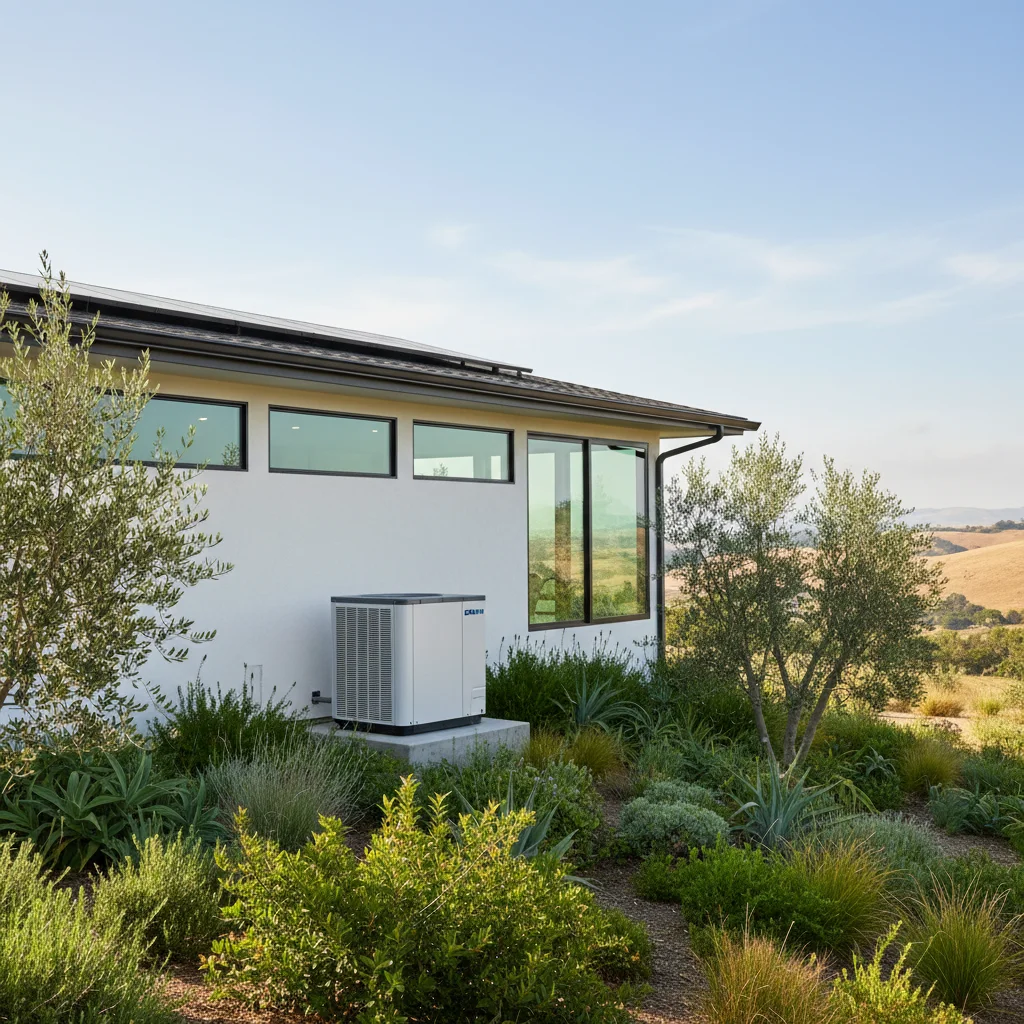
Outdoor unit installation follows preparation. Contractors pour 3×3 foot concrete pads or install composite equipment stands in 1-2 hours, then position Daikin compressor units and connect refrigerant lines. Central Valley building codes require 12-18 inch equipment clearance from walls and 48-60 inch clearance for service access, complicating installations on small urban lots in Stockton and Sacramento where side yards measure 4-6 feet wide.
Indoor air handler replacement takes 4-6 hours for attic installations and 6-9 hours for closet or garage locations. Contractors remove existing furnaces, install new air handlers, connect ductwork, run refrigerant lines through walls or attics, and wire thermostats and controls. And Central Valley homes with 30+ year old ductwork add 2-4 hours for sealing and insulation upgrades that reduce 20-30% efficiency losses from leaky connections.
Electrical work consumes 2-4 hours on standard installations and 6-10 hours for panel upgrades. Daikin heat pumps require dedicated 240V/30-40 amp circuits that older Central Valley homes with 100-125 amp panels can't support without removing other circuits. A Fresno homeowner upgrading from 100-amp to 200-amp service pays $1,800-$2,500 and extends installation by one full day for utility disconnect, panel replacement, and city inspection.
System testing and commissioning require 2-3 hours. Contractors charge refrigerant to manufacturer specifications, test cooling and heating modes, verify airflow reaches 350-450 cubic feet per minute per ton, calibrate thermostats, and demonstrate smart controls. And Central Valley installers perform combustion safety tests when heat pumps replace gas furnaces, ensuring proper ventilation and carbon monoxide clearance in sealed attics where gas lines remain for water heaters.
Post-installation timelines vary by complexity. Simple replacements finish in one 8-10 hour day, allowing homeowners to restore heating and cooling the same evening. But projects requiring electrical upgrades, significant duct modifications, or structural work span 2-3 days with overnight interruptions to HVAC service. Central Valley contractors recommend scheduling installations during mild spring (March-April) or fall (October-November) months when outdoor temperatures of 60-75°F minimize discomfort during multi-day projects.
Official Sources
- DOE Energy Saver — Federal guidance on heat pump technology, efficiency ratings, and energy savings calculations
- Energy Star Heat Pump Guide — Certification requirements, qualified product lists, and regional efficiency recommendations
- IRS Energy Credits — Federal tax credit eligibility, documentation requirements, and annual limits for heat pump installations (note: the federal 25C and 25D credits ended for projects completed after December 31, 2025)
Related Reading: Learn more about Trane Heat Pump Cost Central Valley.
Frequently Asked Questions
What is the cost of a Daikin heat pump in the Central Valley?
Daikin heat pump systems cost $8,500-$18,000 installed in Central Valley homes in 2026, with entry-level Daikin Fit models starting at $8,500 for 2-ton systems and premium Quaternity models reaching $18,000 for 4-ton high-efficiency installations. Average costs settle at $12,000-$14,000 for 3-ton systems serving 1,800-2,200 square foot homes. And utility rebates cut net costs by $1,000-$3,000.
How much rebate can I get for installing a Daikin heat pump in the Central Valley?
Central Valley homeowners receive $1,000-$5,000 in combined rebates for qualifying Daikin heat pump installations in 2026. PG&E offers $500-$2,000 based on efficiency tier, and SMUD provides $3,000 flat rebate for Sacramento County residents; federal tax credits no longer apply (IRS FS-2025-05). Low-income households access $3,000-$8,000 additional incentives through TECH Clean California, potentially covering 50-70% of total system costs.
Are Daikin heat pumps eligible for California rebates in the Central Valley?
All current Daikin residential heat pumps qualify for California utility rebates in the Central Valley because they exceed minimum 16 SEER2 and 9 HSPF2 efficiency thresholds required by PG&E and SMUD programs. Daikin Fit models (18 SEER2) receive $1,000 PG&E rebates, while Daikin One+ (19-20 SEER2) and Quaternity (20-23 SEER2) systems qualify for $1,500-$2,000 tier payments. SMUD offers $3,000 flat rebates regardless of efficiency level for all qualifying systems.
How long does it take to receive a Daikin heat pump rebate in the Central Valley?
PG&E processes Central Valley heat pump rebates in 10-14 weeks after contractors submit required documentation including proof of installation, equipment serial numbers, and efficiency certifications. SMUD completes rebate payments in 6-8 weeks for Sacramento County installations. The federal Energy Efficient Home Improvement Credit (Section 25C) ended for property placed in service after December 31, 2025 (IRS FS-2025-05). And TECH Clean California rebates require 8-12 weeks for income verification and 12-16 weeks for payment.
What is the difference between Daikin and other heat pump brands for Central Valley rebates?
Daikin heat pumps qualify for identical rebate amounts as competing brands when systems meet the same efficiency tiers—rebates reward performance specifications, not brand names. A 20 SEER2 Daikin One+ receives the same $2,000 PG&E rebate as equivalent Carrier, Lennox, or Trane models. But Daikin's product lineup includes more models exceeding 18 SEER2 thresholds for top-tier rebates compared to budget brands like Goodman or Rheem whose entry models qualify only for $500-$1,000 base incentives.
Ready to find out how much you can save? Use our free rebate calculator to calculate your exact rebate eligibility and 10-year energy savings for Daikin heat pumps in the Central Valley. Get personalized results in under 60 seconds based on your home size, current system, and utility provider.
Last updated April 14, 2026 — reviewed by DuloCore Editorial. About our authors.
Check your California heat pump rebate eligibility — see the programs you qualify for and the dollar amounts on our California heat pump rebate finder.