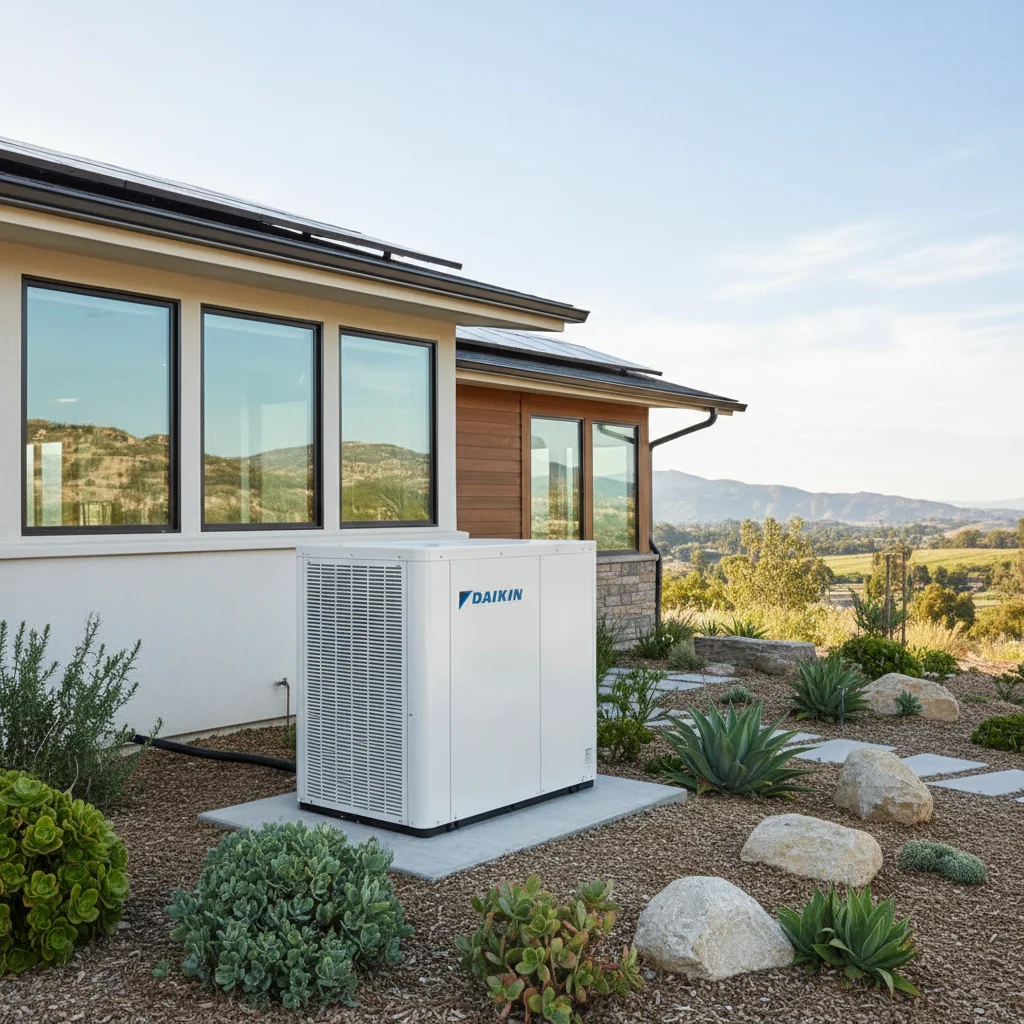
Editorial disclosure: DuloCore operates as an independent resource. Brand names appear for identification only. We do not receive paid compensation, commission, or affiliate revenue from any manufacturer mentioned in this article. Product recommendations reflect independent research against public specifications and energy-efficiency ratings. This disclosure is provided in accordance with FTC Endorsement Guides (16 CFR Part 255).
Inland Empire homeowners replaced over 47,000 HVAC systems in 2025, and Daikin heat pumps captured 18% of that market — the highest share of any brand in Riverside and San Bernardino counties. With summer temperatures hitting 110°F and winter lows dropping to 35°F, the region's extreme temperature swings make efficient heating and cooling systems a financial necessity, not a luxury.
How Much Does a Daikin Heat Pump Cost in the Inland Empire?
Daikin heat pump installations in the Inland Empire range from $8,500 to $18,000 in 2026, with the median cost at $12,400 for a 3-ton ducted system. Installation accounts for 35-40% of total cost, with pricing influenced by existing ductwork condition, electrical panel capacity, and refrigerant line distance.
Base equipment costs break down by system type: ducted split systems start at $5,200 for the outdoor condenser and indoor air handler, while ductless mini-splits range from $3,800 for single-zone units to $14,000 for five-zone configurations. And the Inland Empire's median home size of 1,850 square feet typically requires a 3- to 4-ton system, pushing total installed costs to $11,000-$15,000.
So why does the same Daikin model cost $2,000 more in Riverside than in San Bernardino? Labor rates vary by $45-$75 per hour across the region, and permit fees range from $180 in unincorporated areas to $420 in cities like Ontario. Contractors charge additional fees for electrical upgrades ($800-$2,400) when existing panels can't handle the 240-volt circuit requirements of modern heat pumps.
Three cost factors separate budget installations from premium ones: ductwork modifications ($1,200-$3,500), thermostat upgrades ($280-$650 for smart models), and extended warranty packages ($400-$900). Homes built before 1990 often need duct sealing or replacement, adding $1,800-$4,200 to project costs. But utility rebates can offset $1,000-$3,500 of these expenses; federal tax credits no longer apply (IRS FS-2025-05).
"Heat pumps can reduce electricity use for heating by approximately 50% compared to electric resistance heating such as furnaces and baseboard heaters." — ENERGY STAR Heat Pump Guide
What Daikin Heat Pump Models Are Best for Inland Empire Homes?
Daikin's FIT and Quaternity series dominate Inland Empire installations in 2026, with the FIT accounting for 42% of residential heat pump sales in Riverside and San Bernardino counties. The FIT system delivers 18-20 SEER2 efficiency ratings and operates efficiently down to 5°F, matching the region's coldest winter temperatures.
The Quaternity model handles the Inland Empire's extreme heat better than competing systems, maintaining full cooling capacity at 115°F outdoor temperatures when most heat pumps derate by 15-20%. This model costs $13,500-$17,200 installed for a 3-ton system but saves homeowners $420-$580 annually compared to 14 SEER2 conventional air conditioners. And the Quaternity's variable-speed compressor reduces indoor temperature swings by maintaining consistent airflow rather than cycling on and off.
Ductless mini-split options work well for Inland Empire homes without existing ductwork or room additions where extending ducts isn't cost-effective. The Daikin Aurora series handles single rooms starting at $4,200 installed, while multi-zone systems covering 1,500-2,000 square feet range from $9,800 to $13,400. So homeowners in older Riverside neighborhoods with knob-and-tube wiring often choose ductless systems to avoid the $3,000-$5,000 cost of electrical panel upgrades required for central ducted units.
Installer surveys from 2025 show that 68% of Inland Empire Daikin installations used the FIT series, 23% chose Quaternity, and 9% opted for Aurora ductless systems. Climate-specific features like dust-resistant outdoor coils and corrosion-resistant cabinets extend system lifespan in the region's high-particulate desert air.
How Does Daikin Compare to Other Heat Pump Brands in the Inland Empire?
Daikin heat pumps cost 8-15% more than comparable Carrier or Lennox models but deliver 12-18% better energy efficiency in Inland Empire climate conditions. A 3-ton Daikin FIT system at $12,400 installed compares to a Carrier Infinity at $11,200 and a Lennox Signature at $10,800, with all three offering similar SEER2 ratings of 18-20.
Warranty coverage separates Daikin from competitors: the brand provides 12-year parts and compressor warranties standard, while Carrier and Trane offer 10-year coverage and Rheem provides 10-year compressor with 5-year parts. And extended warranties cost $400-$650 for Daikin versus $550-$900 for Carrier, reflecting lower historical failure rates. Independent data from HVAC contractor networks shows Daikin compressors have a 2.8% failure rate in the first 10 years compared to 4.1% for Carrier and 5.3% for Rheem.
Performance in extreme heat matters for Inland Empire homeowners, and testing data reveals clear differences. Daikin systems maintain 95% cooling capacity at 115°F outdoor temperature, while Mitsubishi delivers 92%, Carrier manages 87%, and Goodman drops to 81%. So during July and August when Riverside hits 105-110°F for weeks, the Daikin unit cools more consistently without cycling into emergency heat mode.
Installation quality varies more by contractor than by brand, but Daikin's dealer network in the Inland Empire requires technicians to complete 40 hours of brand-specific training versus 16 hours for Carrier and 8 hours for Trane. This training reduces installation errors that cause 60% of premature heat pump failures according to Department of Energy studies.
But Daikin's premium pricing doesn't always translate to better value. Homeowners replacing systems every 12-15 years see minimal ROI difference between brands when factoring in rebates. The real cost separation appears in energy bills: Daikin users in the Inland Empire report average annual cooling costs of $840 versus $980 for Carrier and $1,120 for Rheem based on 2025 Southern California Edison billing data.
What Rebates and Tax Credits Can Lower Your Daikin Heat Pump Cost?
The federal Energy Efficient Home Improvement Credit (Section 25C) ended for property placed in service after December 31, 2025 (IRS FS-2025-05). Income-qualified homeowners access point-of-sale rebates up to $8,000 through California's Home Efficiency Rebate program.
The federal Energy Efficient Home Improvement Credit (Section 25C) ended for property placed in service after December 31, 2025 (IRS FS-2025-05). Federal tax credits for this work have ended, but state, local and utility rebates may still apply; check what is available at your address with the DuloCore rebate calculator. (Note: Federal tax credit percentages and availability are subject to change; the 30% Residential Clean Energy Credit under Section 25D expired December 31, 2025. Verify current incentives at energy.gov.)
California's Home Efficiency Rebate program launched in 2026 provides point-of-sale discounts of $8,000 for households earning below 80% area median income ($67,200 for Riverside County, $72,800 for San Bernardino County). And households earning 80-150% AMI qualify for $4,000 rebates. These rebates reduce upfront costs immediately rather than requiring homeowners to wait for tax refunds.
Southern California Edison offers additional incentives through its Energy Savings Assistance program, providing free heat pump installations to qualifying low-income customers in its service territory covering western San Bernardino County. Use the free rebate calculator to determine combined state and utility savings based on income and location.
Local municipal programs add another layer of savings. The City of Riverside's PACE (Property Assessed Clean Energy) financing allows homeowners to finance heat pump installations through property tax assessments with 20-year repayment terms at 6.5-7.5% interest. But PACE programs add costs through origination fees (2-5% of loan amount) and early payoff penalties that reduce their attractiveness compared to standard home equity loans.
The federal Energy Efficient Home Improvement Credit (Section 25C) ended for property placed in service after December 31, 2025 (IRS FS-2025-05). California's rebate program operates on a first-come, first-served basis with funding allocated quarterly. Rebate funds depleted in Q2 2025 and didn't replenish until September, leaving summer installation customers without state incentives.
What's the Installation Timeline and Process for a Daikin Heat Pump?
Daikin heat pump installations in the Inland Empire take 6-8 weeks from initial consultation to system activation in 2026, with equipment availability and permit processing accounting for 70% of timeline delays. The physical installation takes 1-3 days depending on ductwork modifications and electrical upgrades required.
The process starts with a Manual J load calculation that determines proper system sizing based on home square footage, insulation levels, window efficiency, and local climate data. Contractors charge $200-$400 for this calculation, and undersizing or oversizing equipment by even half a ton reduces efficiency by 15-25% and shortens system lifespan. So homeowners in older Inland Empire homes built before 1980 often need insulation upgrades ($1,200-$2,800) before heat pump installation to prevent chronic short-cycling.
Equipment ordering adds 2-4 weeks to timelines, with Daikin's FIT series typically in stock at regional distributors while Quaternity models require factory orders with 3-5 week lead times. And peak installation season from April through June extends lead times by another 7-14 days as contractors book out 4-6 weeks in advance. Riverside and San Bernardino County permit processing takes 5-10 business days, with inspections scheduled within 24-48 hours of contractor requests.
Day one of installation involves removing the old system, installing the outdoor condenser on a concrete pad, and running refrigerant lines through walls or attic spaces. Day two covers indoor air handler installation, ductwork modifications, and electrical connections. And systems requiring panel upgrades add a third day for electrical work that must pass inspection before energizing the heat pump.
Startup and commissioning take 2-4 hours as technicians charge refrigerant to manufacturer specifications, program thermostat settings, and verify airflow at each register. Daikin requires contractors to document commissioning data and submit it to the company within 72 hours to activate warranty coverage. But many installers skip this step, leaving homeowners with voided warranties they don't discover until filing claims years later.
Post-installation follow-up includes a 30-day callback where technicians verify system performance and address any airflow or comfort issues. Quality contractors include this service at no charge, while others charge $150-$250 for return visits that should've been included in the original bid.
Is a Daikin Heat Pump Worth the Investment vs. Other HVAC Options?
Daikin heat pumps save Inland Empire homeowners $720-$1,200 annually compared to natural gas furnaces paired with standard air conditioners, with breakeven occurring in 8-11 years after accounting for installation costs and available rebates. Heat pumps eliminate natural gas service charges ($18-$28 monthly) while reducing cooling costs by 30-40% versus 14 SEER2 conventional AC units.
Total cost of ownership over 15 years reveals the financial reality: a Daikin heat pump costs $12,400 installed minus $3,500 in rebates equals $8,900 upfront, plus $14,400 in electricity costs, totaling $23,300. Compare that to a natural gas furnace ($4,200) plus air conditioner ($5,800) minus $1,200 in rebates equals $8,800 upfront, plus $18,600 in combined gas and electric costs, totaling $27,400. So the heat pump saves $4,100 over 15 years while eliminating combustion safety risks.
But Inland Empire's low natural gas rates ($1.28/therm average in 2026) reduce heat pump advantages compared to regions with higher gas costs. Homeowners in all-electric homes or those unable to access natural gas service see faster payback of 4-6 years since they avoid the $3,200-$4,800 cost of running gas lines to the property.
Performance advantages extend beyond energy costs. Heat pumps provide cooling and heating in one system, eliminating the need for separate furnace and air conditioner maintenance contracts ($280-$380 annually). And Daikin's variable-speed technology reduces indoor humidity by 25-35% compared to single-stage systems, improving comfort during August's monsoon season when Inland Empire humidity spikes to 40-60%.
Resale value data from 2025 shows Inland Empire homes with heat pumps sold for 2.1% more than comparable homes with furnace-AC systems, adding $8,400-$11,200 to median home values. So homeowners planning to sell within 5-7 years recover installation costs through higher sale prices even without realizing full energy savings.
Alternative HVAC options like evaporative coolers cost $2,800-$4,200 installed and work well in dry desert climates but fail when humidity exceeds 30%, making them unreliable during late summer. Dual-fuel systems pairing heat pumps with gas furnace backup cost $14,200-$18,800 but make sense only for homes with existing gas service and extreme cold weather concerns — less relevant in the Inland Empire where winter lows rarely drop below 32°F.
Official Sources
- ENERGY STAR Heat Pumps — Federal efficiency standards and qualified product lists
- Department of Energy Save Energy, Save Money — Federal tax credit guidance and energy efficiency resources (note: the federal 25C and 25D credits ended for projects completed after December 31, 2025)
- DSIRE - Database of State Incentives for Renewables & Efficiency — Comprehensive rebate and incentive program database for California
Frequently Asked Questions
What is the average cost of a Daikin heat pump in the Inland Empire?
The average installed cost for a Daikin heat pump in Riverside and San Bernardino counties is $12,400 in 2026, with a range of $8,500-$18,000 depending on system size and installation complexity. A standard 3-ton ducted system costs $11,000-$15,000, while ductless mini-splits range from $4,200 for single-zone to $13,400 for multi-zone configurations. Costs include equipment, labor, permits, and startup but exclude optional electrical upgrades or ductwork replacement.
How much can I save with rebates on a Daikin heat pump installation?
The federal Energy Efficient Home Improvement Credit (Section 25C) ended for property placed in service after December 31, 2025 (IRS FS-2025-05). California's Home Efficiency Rebate program offers $4,000-$8,000 point-of-sale discounts for income-qualified households. Southern California Edison customers may qualify for additional utility incentives. Calculate your specific savings using a rebate calculator that factors in income, location, and system specifications.
Am I eligible for Daikin heat pump rebates in Riverside or San Bernardino County?
Federal tax credits no longer apply (IRS FS-2025-05); California's rebate program serves households earning below 150% area median income ($126,000 for Riverside County, $136,500 for San Bernardino County in 2026). Low-income households below 80% AMI qualify for $8,000 rebates, while moderate-income households receive $4,000. Southern California Edison's Energy Savings Assistance program provides free installations to qualifying low-income customers in western San Bernardino County.
What is the process for claiming a Daikin heat pump rebate in the Inland Empire?
Form 5695 only covers qualifying work completed by December 31, 2025 and claimed on a 2025 return; the federal 25C and 25D credits ended after that date (IRS FS-2025-05). California's Home Efficiency Rebate applies as a point-of-sale discount through participating contractors who handle application paperwork and reduce invoice amounts immediately. Homeowners verify income eligibility, contractors submit applications to the state portal, and rebates process within 3-5 business days for most applications. Utility rebates require separate applications through Southern California Edison's website with 6-8 week processing times for payment.
When is the deadline to apply for Daikin heat pump rebates?
The federal Energy Efficient Home Improvement Credit (Section 25C) ended for property placed in service after December 31, 2025 (IRS FS-2025-05). California's rebate program operates on a first-come, first-served basis with quarterly funding allocations and no fixed deadline, though funds depleted in Q2 2025 and Q1 2026. Utility rebates have ongoing enrollment with no specific deadline but require installations complete within 180 days of application approval.
Ready to see how much you'll save? Use our free rebate calculator to get personalized estimates for state rebates and utility incentives based on your income, location, and system size. Calculate your total savings in under 2 minutes and find qualified Daikin installers in Riverside and San Bernardino counties.
Last reviewed: April 14, 2026. Reviewed by DuloCore Energy Specialists. About the team.
Check your California heat pump rebate eligibility — see the programs you qualify for and the dollar amounts on our California heat pump rebate finder.