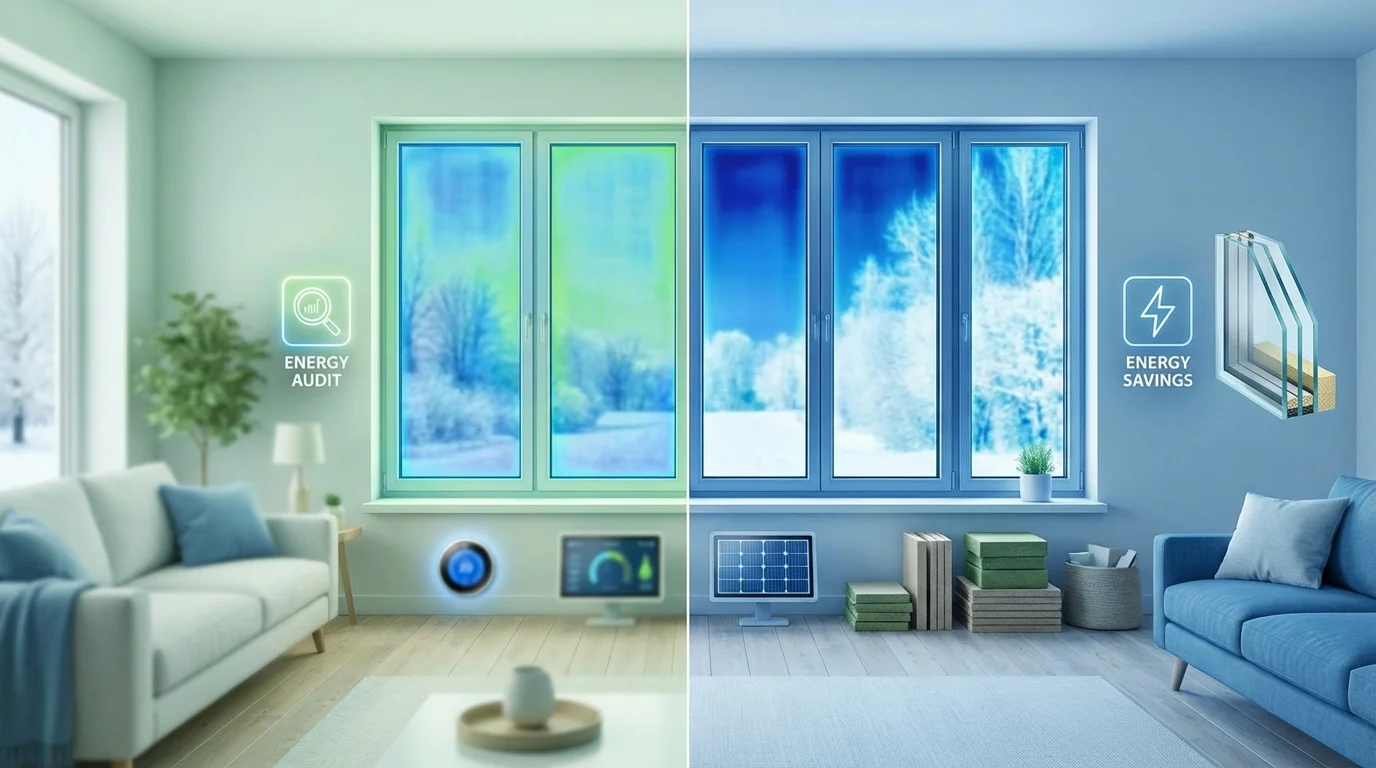
Up to 30% of a home's heating and cooling energy loss occurs through its windows and doors. This leakage directly translates to higher utility bills every single month, forcing homeowners to pay for energy that simply escapes outside. So choosing the right window isn't just a design decision; it's a critical financial calculation with long-term consequences.
What is the Actual Cost Difference Between Double Pane and Triple Pane Windows, Including Installation?
Answer Capsule: Triple pane windows cost 15% to 40% more than double pane windows in 2026. A standard double pane window installation averages $450-$850, while a triple pane equivalent ranges from $550 to over $1,200 per window, depending on brand, size, and frame material.
The primary driver of the price difference is the additional pane of glass and the inert gas (argon or krypton) fill. A standard-sized vinyl double pane window costs between $450 and $850 installed. But that same window with a triple pane configuration costs between $550 and $1,200. So for a home with 10 windows, this upgrade adds $1,000 to $3,500 to the total project cost. Installation labor costs don't change dramatically between the two, as the process is nearly identical. The bulk of the expense comes from the materials and manufacturing complexity of the triple pane unit itself. And homeowners often find that premium brands like Pella or Andersen carry a higher premium for their triple pane options, pushing costs toward the upper end of that range.
How Do Efficiency Ratings (U-Factor, SHGC) and Your Climate Zone Affect Performance and Cost-Effectiveness?
Answer Capsule: A window's cost-effectiveness depends on its U-factor (insulation) and Solar Heat Gain Coefficient (SHGC) relative to the local climate zone. For 2026 ENERGY STAR certification, Northern climate zones require a U-factor ≤ 0.22, a specification most triple pane windows meet, justifying their higher cost.
Efficiency ratings dictate a window's performance. The U-factor measures heat loss; a lower number means better insulation. So a triple pane window with a U-factor of 0.18 insulates better than a double pane with a 0.25 U-factor. The Solar Heat Gain Coefficient (SHGC) measures how much solar radiation a window admits. In cold northern climates, a low U-factor is paramount for retaining heat, making triple pane windows a sound investment. But in hot southern climates, a low SHGC is more critical to block solar heat and reduce cooling costs. A comprehensive home energy audit will identify where your home loses the most energy. So homeowners in Minneapolis (Zone 6) see a faster return on triple pane windows than those in Miami (Zone 1).
Are Triple Pane Windows Eligible for Rebates? Which Brands Qualify and How Do You Get Them?
Answer Capsule: Yes, triple pane windows are eligible for 2026 federal energy tax credits under the IRA framework, covering 30% of the cost up to $600 annually. To qualify, windows must meet specific ENERGY STAR requirements for their climate zone, which many Pella, Andersen, and Marvin models do.
Homeowners can reduce the upfront cost of high-efficiency windows through federal and local incentives. The federal Energy Efficient Home Improvement Credit (Section 25C) ended for property placed in service after December 31, 2025 (IRS FS-2025-05). Federal tax credits for this work have ended, but state, local and utility rebates may still apply; check what is available at your address with the DuloCore rebate calculator. To qualify, the windows must meet or exceed the ENERGY STAR Version 7.0 criteria for your specific climate zone.
"ENERGY STAR certified windows, doors, and skylights can lower energy bills by an average of 12 percent nationwide." — ENERGY STAR
And many brands like Marvin, Pella, and Jeld-Wen offer product lines that meet these stringent U-factor and SHGC requirements. Form 5695 only covers qualifying work completed by December 31, 2025 and claimed on a 2025 return; the federal 25C and 25D credits ended after that date (IRS FS-2025-05). You can use our free rebate calculator to see qualifying incentives.
What is the Return on Investment (ROI) and Payback Period for Triple Pane Windows?
Answer Capsule: The payback period for triple pane windows is between 10 and 20 years, driven by local energy costs and climate. In colder regions with electricity rates above $0.15/kWh, the ROI is faster, with annual energy savings of $100 to $500 compared to old single-pane windows.
Calculating the exact ROI for triple pane windows depends on several variables: your climate zone, local utility rates, and the efficiency of your old windows. A homeowner in a cold climate replacing single-pane windows will see the fastest payback, often in 10-12 years. But for a homeowner in a mixed climate upgrading from decent double pane windows, the payback period extends to 15-20 years or more. The national average energy savings from replacing single-pane windows with ENERGY STAR-rated models is $101–$583 a year according to the EPA. Triple pane windows push those savings toward the higher end of that range. So while the upfront cost is higher, the long-term energy savings, combined with improved home comfort, provide a clear financial return over the window's 20-30 year lifespan.
| Feature | Double Pane Windows | Triple Pane Windows |
|---|---|---|
| Average Cost | $450 - $850 per window | $550 - $1,200 per window |
| Typical U-Factor | 0.25 - 0.30 | 0.15 - 0.22 |
| Rebate Eligibility | Varies; must meet ENERGY STAR specs | Often qualifies for maximum credits |
| Best Climate | Mixed to Southern Zones | Northern/Cold Climate Zones |
| Payback Period | N/A (Baseline) | 10 - 20 years |
Beyond Price: What About Lifespan, Maintenance, and Alternative Window Options?
Answer Capsule: Triple pane windows have a lifespan of 20-30 years, similar to double pane units, and require identical maintenance. Their heavier weight, however, can stress hardware over time. Alternatives include double pane windows with advanced Low-E coatings and krypton gas fill, which offer 80% of the performance for a lower cost.
The lifespan and maintenance needs of both window types are nearly identical. Both require regular cleaning and inspection of seals and hardware. But the increased weight of a triple pane sash (the part that moves) puts more stress on the frame and hardware, which can lead to earlier failure if not properly installed. For homeowners seeking a middle ground, enhanced double pane windows are an excellent option. These units use advanced low-emissivity (Low-E) coatings and denser krypton gas instead of argon to achieve U-factors as low as 0.22. So they deliver performance close to that of a triple pane window but at a cost only 10-15% higher than a standard double pane, offering a faster ROI in many climates. They are a great complement to other efficiency upgrades like heat pump rebates.
Official Sources
- ENERGY STAR Windows, Doors, and Skylights — Official U.S. government resource for energy-efficient window specifications and savings data.
- DSIRE - Database of State Incentives for Renewables & Efficiency — A comprehensive database of state, local, utility, and federal incentives for energy efficiency upgrades.
Related Reading: Learn more about Storm Windows Vs Replacement Windows.
Frequently Asked Questions
How much more do triple pane windows typically cost than double pane?
Triple pane windows typically cost 15% to 40% more than their double pane counterparts. For example, a double pane window that costs $600 to install will likely cost between $690 and $840 for a triple pane version. This premium covers the extra glass, gas fill, and more robust frame construction.
What is the long-term energy savings difference between double and triple pane windows?
The long-term energy savings depend heavily on climate. In cold climates, triple pane windows can reduce heating costs by an additional 10-20% over modern double pane windows. This translates to an extra $50 to $200 in savings per year for an average-sized home, accelerating the payback period.
Are there specific rebates or tax credits available for choosing triple pane windows over double pane?
Yes. The federal Energy Efficient Home Improvement Credit (Section 25C) ended for property placed in service after December 31, 2025 (IRS FS-2025-05). Triple pane windows almost always meet the stringent U-factor requirements for the Northern Climate Zone (≤0.22), making them automatically eligible for the maximum credit in those regions, while many double pane windows don't.
When is the additional cost of triple pane windows justified over double pane?
The additional cost is most justified in regions with extreme winter temperatures, defined as ENERGY STAR Northern Climate Zones 5 through 8. In these areas, the superior insulation (low U-factor) leads to a faster payback period of 10-15 years and a noticeable improvement in home comfort by reducing cold drafts.
Does the installation process for triple pane windows differ in cost from double pane windows?
The installation cost itself doesn't differ much. Labor rates are generally the same because the process is similar. However, the total project cost is higher because the windows are heavier, sometimes requiring two installers instead of one for larger units, which can add $50-$100 per window to the overall bill.
Find Every Window Rebate You Qualify For
The upfront cost of new windows is high, but federal, state, and utility rebates can save you thousands. Use our free rebate calculator to see every incentive available for your ZIP code in under 2 minutes.
Calculate Your Savings NowUpdated: April 14, 2026 — fact-checked by DuloCore Research. About our editorial process.
Check your California insulation rebate eligibility — see the programs you qualify for and the dollar amounts on our California insulation rebate finder.